Effective proposal management is the backbone of federal contract wins. A disciplined, repeatable process reduces errors, improves team accountability, ensures compliance with FAR requirements, and allows your team to focus on crafting a compelling, differentiated response instead of scrambling to meet submission deadlines.
This guide walks through proven best practices across the entire proposal lifecycle—from capture handoff through final submission—with tactical guidance for GovCon teams looking to scale their proposal capacity without adding headcount.
Key Takeaways
- Build a four-phase process (initiation, planning, execution, closeout) to cut chaos and improve win consistency
- Assign one accountable owner per requirement with RACI matrices so nothing slips through the cracks
- Run structured kickoffs and color reviews to align teams on win strategy, compliance, and schedule gates
- Centralize work with shared platforms, version control, and real-time status tracking to stop duplicate effort
- Automate compliance checks, content reuse, and workflow routing to reclaim 30-40% of coordination time
Build a Scalable Proposal Process
A defined, documented proposal process is the foundation for repeatable success. Without one, every pursuit becomes a custom project where roles are unclear, deadlines slip, and compliance gaps appear at the worst possible moment. Your process should cover all phases from opportunity qualification through post-submission debrief, with enough flexibility to scale based on proposal size and complexity.
Define the Four Core Phases
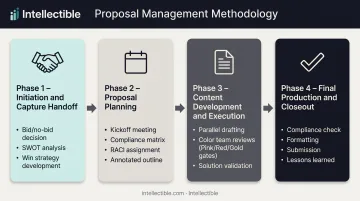
Phase 1: Initiation and Capture Handoff
The proposal effort begins before the RFP drops. During initiation, your team conducts a formal bid/no-bid decision based on win probability, strategic fit, resource availability, and competitive positioning. Complete a SWOT analysis to identify strengths you can leverage, weaknesses you must mitigate, opportunities in the evaluation criteria, and threats from competitors or incumbents.
Develop your initial win strategy: the 2-3 core themes that will differentiate your proposal from competitors. Then formalize the capture-to-proposal transition. In a structured handoff meeting, the capture manager should deliver competitive intelligence, customer insight, teaming agreements, and documented assumptions to the proposal team.
Phase 2: Proposal Planning
Planning starts with a comprehensive kickoff meeting where the entire proposal team aligns on opportunity background, win themes, compliance requirements, roles, responsibilities, schedule, and communication protocols. According to Lohfeld Consulting's guidance, distribute the RFP and available materials about 48 hours before kickoff or within 5% of the total proposal duration to give contributors time to prepare.
During planning, lock in these core artifacts:
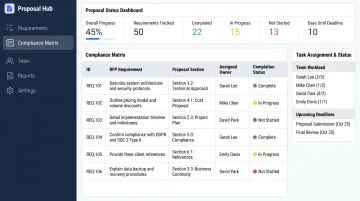
- Compliance matrix mapping every RFP requirement to a specific proposal section
- Responsibility assignment matrix (RAM or RACI) with an owner for each deliverable
- Annotated outline defining structure and messaging for each section
- Master schedule with color review gates (Pink, Red, Gold) and interim milestones
Phase 3: Content Development and Execution
During execution, the draft takes shape through parallel workstreams:
- Writers and SMEs produce initial drafts from the annotated outline
- Technical solutions are validated for feasibility and compliance
- Volume leads integrate sections into cohesive narratives
- The team runs iterative reviews at each color-team gate
Color-team gates protect quality before you advance:
- Pink Team verifies compliance and win-strategy execution
- Red Team simulates the evaluator's perspective and flags scoring risks
- Gold Team confirms required changes landed and the proposal is production-ready
Phase 4: Final Production and Closeout
Production is a controlled checklist, not a scramble:
- Final compliance check against your matrix for every requirement
- Formatting, graphics, and desktop publishing per RFP specifications
- Final quality review for consistency and readability
- Delivery packages (electronic files, hard copies if required, SF 1449 or other forms)
- Secure submission well ahead of the deadline
After submission, hold a lessons-learned debrief to capture what worked, what didn't, and how to improve the next effort. If you win, request a debrief from the agency. If you lose, use the agency debrief and internal retrospective to strengthen your process.
This four-phase process should be documented in a proposal management plan template, trained across your BD and proposal teams, and consistently applied to all opportunities. Tailor the level of rigor to proposal size—a $500K task order may not need a formal Pink Team, but a $50M IDIQ absolutely does.
Establish Clear Roles and Responsibilities
Unclear roles are one of the fastest ways to derail a proposal. When contributors don't know who owns a requirement, tasks get duplicated, critical sections go unwritten, and accountability evaporates. The APMP Business Development Lifecycle framework defines distinct boundaries between capture, proposal, and delivery roles to prevent these gaps.
Proposal Manager
The Proposal Manager is the single point of accountability for the entire proposal effort. This person owns the schedule, coordinates all contributors, manages reviews, ensures compliance, and makes trade-off decisions when scope, quality, or deadlines conflict.
Key responsibilities include:
- Creating the proposal management plan with schedule, milestones, roles, and review gates
- Running the kickoff meeting and ensuring alignment on win strategy and compliance obligations
- Tracking deliverables against deadlines and escalating blockers before they become critical
- Facilitating color team reviews and adjudicating conflicting feedback
- Maintaining the compliance matrix and ensuring every requirement is addressed
- Coordinating final production, quality checks, and submission
The Proposal Manager does not write technical content; SMEs and proposal writers own that work. The PM's job is to make sure contributors deliver on time and that the final document is compliant, compelling, and submitted correctly.
Capture Manager
The Capture Manager leads pre-RFP pursuit planning and hands off a complete win strategy to the proposal team. Their role typically covers:
- Developing customer relationships and competitive analysis
- Identifying teaming partners
- Shaping requirements when legally permissible
- Building the business case for the bid/no-bid decision
At the capture-to-proposal transition, the Capture Manager delivers:
- Win strategy and discriminators grounded in customer insight
- Competitive intelligence on incumbents and other bidders
- Teaming agreements, NDAs, and subcontractor commitments
- Assumptions about technical approach, pricing strategy, and risk posture
The Capture Manager typically steps back once the RFP is released, though they may remain available for customer clarifications or strategic questions. APMP is clear: the Capture Manager does not write, format, or submit the proposal. That responsibility belongs to the Proposal Manager.
Subject Matter Experts (SMEs)
SMEs provide the technical, operational, or functional expertise that makes your solution credible. Their responsibilities include:
- Providing technical content, approach details, and solution architecture
- Validating that proposed solutions are feasible, compliant, and aligned with customer requirements
- Supporting pricing development with labor estimates, resource requirements, and cost assumptions
- Participating in color team reviews to assess technical soundness
SMEs are typically stretched thin across multiple proposals, so effective tasking is critical:
- Give each SME a clear writing assignment with a due date, word-count target, and content expectations
- Provide an annotated outline section, relevant RFP excerpts, and reusable content from past proposals
- Schedule midpoint check-ins to catch issues early
Proposal Writers and Editors
Dedicated proposal writers turn SME input into customer-focused, compliant, persuasive narrative. They take raw technical content, sparse bullets, and rough email responses and shape them into scannable, benefit-driven sections evaluators can score.
Writer responsibilities include:
- Translating SME input into evaluator-ready narrative
- Weaving win themes and discriminators through each section
- Hitting compliance, page counts, and style standards
Editors protect consistency, compliance, and quality across volumes:
- Confirming every RFP requirement is addressed
- Reinforcing win themes and consistent tone
- Catching errors before final production
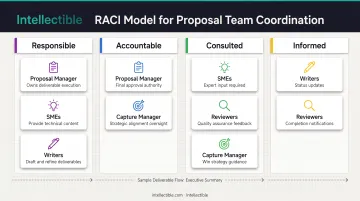
Create a RACI or Responsibility Assignment Matrix (RAM) that maps each proposal section and task to:
- Responsible: The person doing the work
- Accountable: The person ultimately answerable for completion (usually the Proposal Manager)
- Consulted: People who provide input or expertise
- Informed: People who need status updates but aren't directly involved
A clear RACI prevents duplicated effort, ensures every task has an owner, and provides a shared reference when contributors ask, "Who's handling this?"
Implement Effective Collaboration Practices
Proposal development is inherently collaborative. A typical federal proposal involves 10-20 contributors working across multiple locations, time zones, and organizations (prime, subs, teaming partners). Without structured communication and coordination, distributed teams quickly lose alignment, duplicate work, and miss critical handoffs.
Conduct a Comprehensive Kickoff Meeting
The kickoff meeting is your best opportunity to align the entire team before a single word is written. The agenda should cover:
- Opportunity overview: Customer background, mission, pain points, and program history
- Win themes and discriminators: The 2-3 core messages that will differentiate your proposal
- Compliance review: Walk through the evaluation criteria, page limits, submission requirements, and mandatory attachments
- Annotated outline: Review the proposed structure and messaging for each section
- Schedule and review gates: Confirm draft due dates, Pink/Red/Gold review timing, and final submission deadline
- Roles and responsibilities: Introduce the team and clarify who owns each section using the responsibility assignment matrix (RAM)
- Communication protocols: Define status-meeting frequency, escalation paths, and collaboration tools
- Q&A: Surface questions, concerns, and blockers early
Distribute the RFP and kickoff materials 48 hours in advance so contributors arrive prepared. After the kickoff, send meeting notes, action items with owners and due dates, and a running link to the shared collaboration workspace.
Establish Communication Protocols and Status Reporting
Effective status updates prevent surprises. During intensive writing periods, hold daily 15-minute stand-ups where each contributor reports:
- What they completed since the last check-in
- What they're working on next
- Any blockers or issues requiring escalation
- Decisions they need from leadership or the customer
During planning phases, weekly status meetings with a structured agenda are sufficient. Track completed tasks, upcoming deliverables, risks, and open action items in a shared log that everyone can access.
Use Centralized Collaboration Platforms
Store all proposal materials in a single, centralized repository (SharePoint, Google Drive, or dedicated proposal management software) where every contributor works from the same version. Scattered email attachments, local hard drives, and disconnected cloud folders are a recipe for lost work and version-control disasters.
Best practices include:
- Logical folder structure: Organize by volume, section, review stage, and supporting materials
- Naming conventions: Use consistent file names with version numbers and dates (e.g.,
Vol1_TechApproach_v3_2025-05-15.docx) - Version control: Enable document versioning and track who made changes, when, and why
- Access permissions: Grant access based on role—Contributors see their sections, Proposal Managers see everything, external reviewers see final drafts only
AI workflow platforms like Intellectible can go further. They extract requirements from RFPs, route sections to the right contributors, automate compliance checks, and maintain full audit trails. Teams scale proposal capacity without adding headcount.
Document Decisions and Action Items
Proposal teams make dozens of critical decisions each week: which technical approach to propose, how to interpret ambiguous requirements, whether to take exception to a contract term, which win theme to emphasize. If these decisions aren't documented, they get revisited, forgotten, or contradicted later in the process.
Maintain a running decision log that captures:
- The decision made
- The rationale and supporting analysis
- Who made the decision and when
- Any dissenting opinions or risks
Keep a parallel action-item log with owner, due date, status, and dependencies. Update both logs after every status meeting and review gate.
Facilitate Effective Color Team Reviews
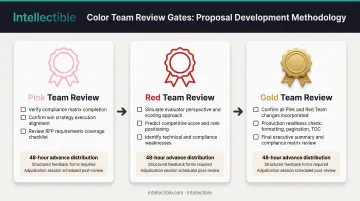
Staged color reviews are your quality gates. Each review has a distinct purpose:
- Pink Team: Verify compliance with all RFP requirements and execution of the win strategy
- Red Team: Simulate the evaluator's perspective and predict how the proposal will score
- Gold Team: Confirm that required changes were incorporated and that the proposal is ready for production
To run effective reviews:
- Distribute materials at least 48 hours in advance
- Provide reviewers with clear focus areas and review criteria (compliance checklist, win-theme scorecard, technical feasibility rubric)
- Set expectations for feedback format (written comments in the document, structured review forms, or both)
- Allow sufficient time for meaningful review—not a last-minute read-through the night before submission
- Consolidate feedback into a single adjudication session to resolve conflicting comments and prioritize changes
The best reviewers bring constructive independence. Choose people who:
- Were not involved in drafting (fresh eyes catch more issues)
- Represent customer, management, technical, and cost perspectives
- Will challenge assumptions rather than rubber-stamp the draft
Leverage Technology and Automation
Modern proposal teams improve efficiency by adopting purpose-built tools and automating repetitive tasks. Excel trackers and Word documents work for small proposals, but they don't scale to complex, multi-volume federal pursuits with dozens of contributors and hundreds of requirements.
Proposal management software centralizes content libraries, automates compliance checking, facilitates collaboration, tracks progress, and manages reviews in one integrated platform. Categories to consider include:
- Document collaboration platforms: Microsoft 365, Google Workspace for real-time co-authoring and version control
- Proposal-specific software: RFP360, Loopio, RFPIO for requirement tracking and content libraries
- Project management tools: Asana, Monday.com for task assignment, scheduling, and status visibility
- Compliance checking tools: Automated shred-and-thread engines that map RFP requirements to proposal sections
According to Deltek's 2026 Clarity GovCon study of 917 U.S. and Canadian contractors, 90% now use AI, though only 5% report fully developed maturity. GovCon teams see automation's value, but most are still early in how they apply it.
AI-powered workflow automation platforms like Intellectible orchestrate complex proposal workflows end to end. They connect data sources, automate compliance-matrix generation and pricing calculations, route documents for review, extract deadlines and submission rules from RFPs, and keep full audit trails.
That lets teams scale proposal capacity without adding headcount—and reclaim 30-40% of the time spent hunting for the right SOP, past-performance summary, or policy interpretation.
Select tools that integrate with your existing ecosystem (CRM, ERP, document repositories) and give you workflow visibility. Proposal Managers should see what's on track, what's stuck, and where to intervene before a deadline is missed.
Master Content Management and Reuse
Well-managed content libraries reduce writing time and improve consistency, but they require discipline and maintenance. The average proposal writer loses 30-40% of their time hunting for capability statements, past-performance summaries, resumes, or approach templates. A governed content library eliminates that waste.
Build an Effective Content Library
Organize reusable content into logical categories:
- Corporate capability statements: Company overview, certifications, facilities, quality systems
- Past performance summaries: Project descriptions, customer names, contract values, outcomes, and references
- Resumes: Key personnel CVs formatted for federal proposals with relevant clearances and certifications
- Technical approach boilerplate: Proven methodologies, tools, frameworks, and processes
- Management approach templates: Organizational charts, quality-assurance plans, risk-management frameworks
Make the library usable day to day:
- Tag content by topic, keyword, customer type, contract vehicle, and security classification
- Maintain version control with currency dates so teams know what is current versus obsolete
- Build modular chunks you can combine flexibly instead of monolithic documents used whole or not at all
Establish quality standards and approval processes for library content. Have a subject-matter expert review every piece, edit it for clarity and consistency, and get content-owner approval before it enters the library. Archive retired content rather than deleting it so you can reference it later without accidentally reusing it.
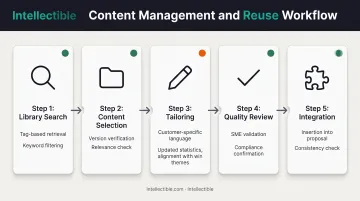
Tailor Reused Content to the Opportunity
Generic copy-paste is obvious to evaluators and damages your credibility. Even the best library content must be tailored to the specific opportunity, customer, and requirements. Before inserting reused content:
- Confirm it addresses the current RFP requirement
- Replace generic references with customer-specific language (for example, "the agency" becomes "the Department of Defense")
- Update statistics, dates, and examples to reflect current information
- Adjust tone and emphasis to align with the current win strategy
Tailored reuse combines efficiency with relevance. You start with proven content, then adapt it to show you understand this customer's mission and challenges.
Conduct Rigorous Reviews and Quality Checks
Structured, multi-layered reviews catch errors before submission, confirm compliance, sharpen win themes, and improve readability. According to FAR 15.305, agencies must assess proposals solely against the solicitation's stated factors and subfactors, documenting strengths, deficiencies, significant weaknesses, and risks. Your review process should anticipate this rigor.
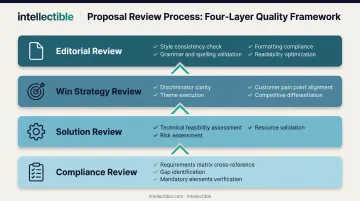
Four Review Types That Catch Different Problems
Compliance Review: Does the proposal respond to every requirement? Use your compliance matrix to cross-reference each RFP obligation against the corresponding proposal section. Mark each requirement as addressed, partially addressed, or missing, and escalate gaps immediately.
Solution Review: Is the technical approach sound and feasible? Have SMEs confirm the solution fits the proposed schedule, budget, and risk tolerance. Flag technical inconsistencies, unvalidated assumptions, and gaps between promises and delivery capacity.
Win Strategy Review: Are discriminators clear and compelling? Confirm your 2-3 core win themes run through the narrative and that you addressed known customer pain points. Evaluators should see clearly why your solution beats the alternatives.
Editorial Review: Is the writing clear, consistent, and error-free? Check for style-guide compliance, consistent terminology, proper formatting, and zero typos or grammar errors. Read section transitions aloud—awkward handoffs often hide here.
Conducting Effective Reviews
Give reviewers clear focus areas and review criteria: a one-page reviewer guide that explains what to look for and how to provide feedback. Allow sufficient time for meaningful review; a 200-page technical volume requires at least 4-6 hours of focused review time, not a 30-minute skim.
Use structured feedback forms or comment templates to standardize input. Create a consolidated feedback loop where the Proposal Manager adjudicates conflicting comments, prioritizes changes based on impact and feasibility, and communicates decisions back to the team.
Pre-Submission Quality Check
Before you hit "submit," conduct a final quality check:
- Compliance matrix cross-reference: Confirm every requirement is addressed and mapped to a specific page or section
- Readability review: Read the executive summary and key sections aloud to catch awkward phrasing or unclear logic
- Production checklist: Verify page limits, formatting, file names, portal instructions, required forms (SF 1449, reps and certs), and file integrity
According to FAR 52.215-1, the offeror bears responsibility for on-time receipt, and late proposals are not considered except under narrow regulatory exceptions. Submit at least 2-4 hours before the deadline to account for portal issues, file-upload delays, or last-minute corrections.
Frequently Asked Questions
What are the best practices for proposal management?
Run a defined four-phase process (initiation, planning, execution, closeout) with one Proposal Manager accountable and a RACI matrix for every deliverable. Use structured kickoffs, color team reviews, collaboration tools, and gate-level quality checks to catch compliance gaps and messaging weaknesses before submission.
What are the three C's of proposal writing?
The three C's are Compliant (meets every RFP requirement), Compelling (persuasive and differentiated), and Clear (easy for evaluators to score). Miss any one—compliance, persuasion, or clarity—and the proposal either gets rejected or fails to win.
How long should proposal development take?
Timelines vary by complexity, but OST Global notes major federal proposals typically allow 30-60 days after RFP release. Plan on 2-3 weeks for small task orders, 4-6 weeks for medium contracts, and 8-12+ weeks for large IDIQs—roughly 25% planning, 50% drafting and reviews, 25% production.
What tools do proposal managers use?
Teams typically combine proposal software (RFP360, Loopio, RFPIO), collaboration suites (Microsoft 365, Google Workspace), and project tools (Asana, Monday.com) with content libraries and compliance trackers. AI workflow platforms like Intellectible connect data sources, automate manual tasks, and keep audit trails across the full proposal lifecycle.
How do you improve proposal win rates?
Invest in capture before the RFP drops, build win themes from real customer insight, and enforce strict compliance—one missed requirement can disqualify a strong bid. Tell a clear story evaluators can score, and run external reviews with people who didn't draft the content to catch blind spots before submission.
What happens in a proposal kickoff meeting?
The kickoff aligns the team on opportunity background, win strategy, compliance rules, section ownership, schedule gates, and communication protocols. Contributors should leave knowing what they own, when drafts are due, and how progress will be tracked through color reviews to final submission.