Manual proposal work can't keep pace anymore. Deltek's 2026 Clarity study, covering more than 900 contractors, found a single RFP response can take up to 84 hours to prepare. That same study found 96% of contractors expect compliance costs to hold steady or rise, and bid/proposal costs have climbed from 14% to 19% of pursuit budgets.
AI-driven RFP automation is compressing that timeline. Go/No-Go decisions, compliance matrix generation, and first-draft narrative writing that used to take weeks now happen in hours. This guide ranks the best RFP automation platforms built for government contractors in 2026, from dedicated GovCon suites to horizontal AI build platforms that let teams customize the entire pursuit workflow.
TL;DR
- Five factors matter most: compliance automation, AI drafting accuracy, security certifications, integration depth, and pricing transparency
- Shortlist to watch: Intellectible, GovDash, AutogenAI Federal, Procurement Sciences (Awarded AI), and DeepRFP
- The right tool cuts proposal cycle time sharply, but only when compliance depth matches your data sensitivity
Overview of RFP Automation Software in Government Contracting
RFP automation software parses solicitations, extracts requirements, drafts compliant responses, and manages review workflows. It replaces the spreadsheet-and-email chaos most proposal teams still run on.
There's a real split in this market:
- Commercial RFP tools (Loopio, Responsive) built for vendor questionnaires and security reviews
- GovCon-specific platforms built around FAR requirements, Section L/M parsing, and FedRAMP-aligned security
That distinction matters because FAR 15.204-1 requires proposals to follow a uniform contract format, with offeror instructions in Section L and evaluation factors in Section M. A tool that doesn't understand that structure will miss requirements. Below are the platforms built for this environment in 2026.

Top RFP Automation Software for Government Contractors in 2026
Each platform below was evaluated on compliance depth, AI drafting accuracy, security posture, and its ability to scale bid volume without adding headcount.
Intellectible
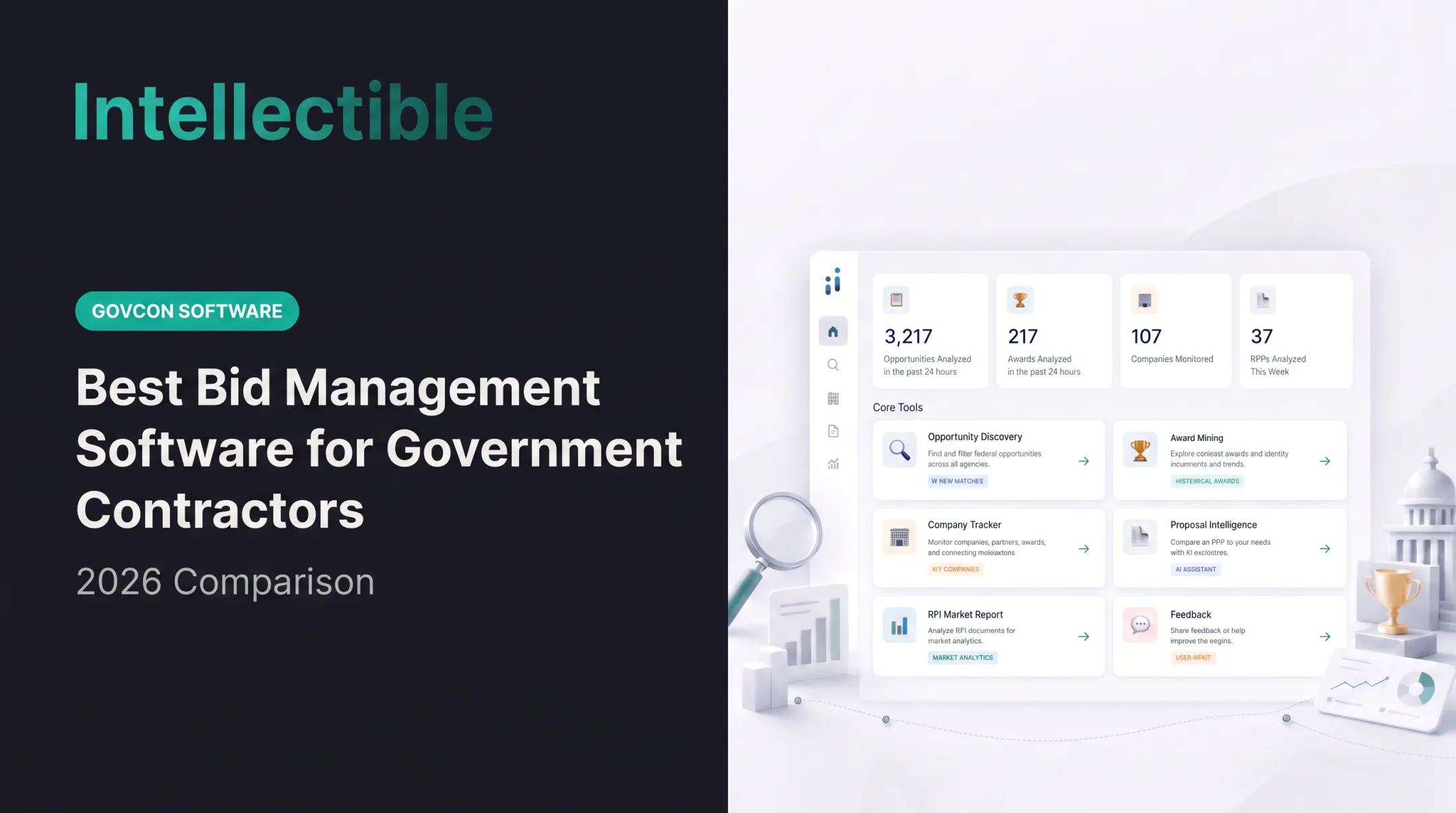
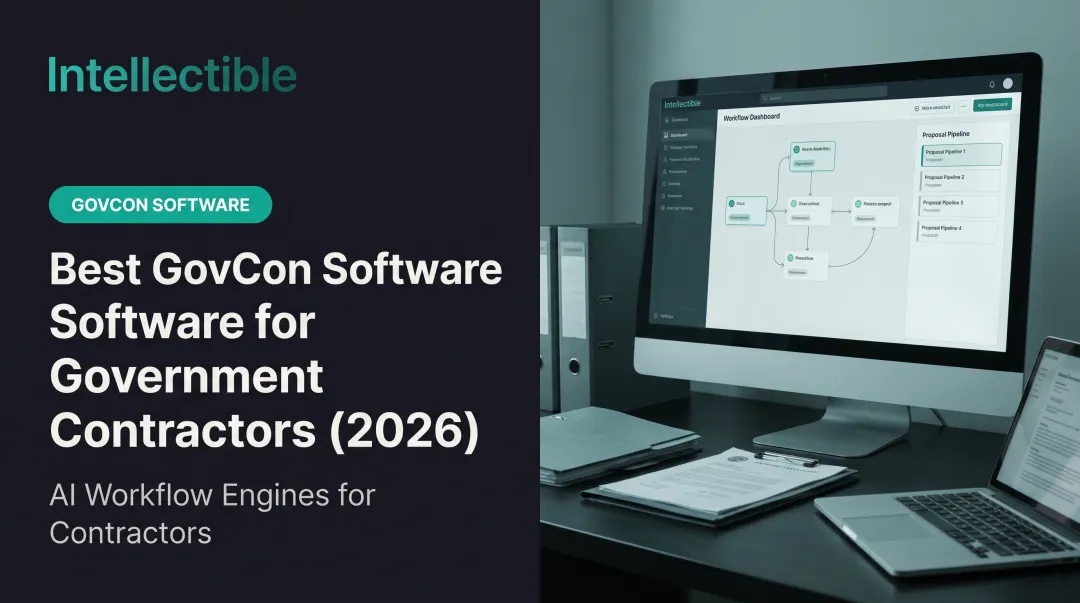
Intellectible is a horizontal AI build platform built for custom pursuit systems, not a fixed-template proposal app. It pairs production-ready engines (Revenue Discovery, GovCon, and Proposal & Pursuit) with a full developer suite: visual workflow builder, PostgreSQL databases, and React interfaces.
Contracting teams shape pursuit and pricing workflows around their own compliance requirements instead of bending to a vendor's preset process.
The GovCon Engine follows a Capture → Sort → Pursue → Act flow, generating go/no-go reports, requirement summaries, compliance matrices, and risk lists directly from solicitation documents. The Proposal & Pursuit Engine runs an Upload → Compliance → Variables → Draft sequence for drafting and review.
Clients including Oceus and HHS report 95%+ time saved on opportunity search and Go/No-Go decisions. Oceus specifically reviews more than double its previous volume of qualified opportunities, with seven to eight passing its threshold monthly.
| Factor | Details |
|---|---|
| Core Differentiator | Horizontal AI build platform combining ready-made engines with a full developer suite, avoiding per-workflow infrastructure rebuilds |
| Key Outcome | 95%+ time saved on opportunity/Go-No-Go decisions; 90% reduction in time to final pricing with audit trail |
| Best For | Contractors wanting a custom, scalable pursuit-to-pricing operating system without adding headcount |

GovDash
GovDash covers capture, proposal drafting, and contract administration in one platform. The company raised a $30M Series B in January 2026, backed by Mucker Capital and BCI, and reports customers won more than $5 billion in government contracts in 2025.
Its AI assistant, Dash, synthesizes organizational data and executes proposal workflows, including compliance tracking and citation automation, inside native Word and Salesforce integrations. GovDash's homepage claims proposals produced 60% faster. Test that figure against your own baseline rather than taking it at face value.
One caveat: GovDash's own security documentation describes hosting on Azure Commercial with a FedRAMP Moderate Equivalency audit, not Azure GovCloud. If your data sensitivity requires a formal FedRAMP authorization, confirm the current status directly rather than assuming it.
| Factor | Details |
|---|---|
| Core Differentiator | AI trained on federal procurement data with native Word/Salesforce workflows |
| Key Feature | Automated compliance matrix generation from full solicitation packages |
| Best For | Mid-market federal contractors scaling bid volume in Microsoft Word environments |
AutogenAI Federal
AutogenAI Federal builds a custom language model trained on each customer's own proposal history, prioritizing persuasive narrative quality over pure compliance-checking. The platform states FedRAMP High authorization and CMMC Level 2 alignment, with its February 2025 launch release citing accreditation by the U.S. Air Force.
An AutogenAI-hosted study claims users grew revenue 12.4% year-over-year while non-users saw a 7.1% decline. That figure is vendor-published with no disclosed methodology, so treat it as directional, not independently verified.
| Factor | Details |
|---|---|
| Core Differentiator | Custom AI language model per customer for persuasive, compliant narrative |
| Security | FedRAMP High (vendor-stated), CMMC Level 2 |
| Best For | Large proposal teams where writing quality is the primary differentiator |
Procurement Sciences (Awarded AI)
Procurement Sciences covers opportunity discovery through contract execution and announced a FedRAMP Moderate Authorization to Operate in March 2026, a government-issued authorization rather than self-attestation. A November 2025 release put its customer base at more than 300 organizations.
The platform offers predictive win probability (PWIN) scoring alongside flexible deployment options: Azure Commercial, Azure Government, or customer-managed Kubernetes for CUI and ITAR-sensitive environments.
| Factor | Details |
|---|---|
| Core Differentiator | PWIN scoring plus flexible deployment for regulated data environments |
| Security | FedRAMP Moderate, CMMC, NIST 800-171 |
| Best For | Defense/intelligence contractors needing strict data isolation |

DeepRFP
DeepRFP is a self-serve, AI-native platform built for lean teams since 2021, with no legacy workflow bolted on later. Pricing is transparent: $89 per user per month on the Pro plan, with a 7-day free trial and no credit card required.
Features include AI solicitation analysis, compliance matrix generation, and "virtual SMEs" trained on your uploaded knowledge base. It doesn't advertise FedRAMP authorization, which makes it a fit for lower-sensitivity civilian and SLED work rather than defense-grade CUI.
| Factor | Details |
|---|---|
| Core Differentiator | Transparent low-cost pricing with no enterprise implementation overhead |
| Pricing | $89/user/month, 7-day free trial |
| Best For | Small businesses and solo proposal consultants working SLED/civilian contracts |
How We Chose the Best RFP Automation Software
Government proposals live and die by Section L and M compliance. FAR 15.305 requires agencies to evaluate proposals solely against the factors stated in the solicitation — meaning a tool that misparses those sections doesn't just slow you down, it can disqualify you.
The most common mistake we see: contractors adopt a general-purpose commercial RFP tool built for vendor questionnaires, then find it can't parse FAR cost/pricing data requirements under FAR 15.408.
We scored each platform against four factors:
- Compliance matrix accuracy against real Section L/M requirements
- Integration depth with existing CRM, Word, and document systems
- Scalability to grow bid volume without adding proposal staff
- Total cost of ownership, including onboarding time and per-user pricing
Tools that missed on compliance were cut first, regardless of feature count or price.

Conclusion
There's no single "best" RFP automation platform for every government contractor. The right fit depends on matching compliance depth and security posture to your actual data sensitivity — a defense subcontractor handling CUI has very different needs than a civilian-agency vendor.
Before committing, run any shortlisted tool against a solicitation you've already submitted. Compare its extracted compliance matrix against what your team produced manually. That's the fastest way to see if the AI drafting and requirement extraction hold up under real conditions.
If you want a custom, scalable pursuit-to-pricing system without adding headcount or stitching together five separate tools, explore Intellectible's AI build platform.
Frequently Asked Questions
What is the best RFP software?
It depends on your workflow. GovCon-specific platforms suit FAR-heavy narrative proposals, while general tools suit high-volume questionnaires. Horizontal platforms like Intellectible let contractors build custom pursuit workflows around how their teams already work.
What should a buyer test during evaluation?
Run a live solicitation through each shortlisted platform, including Intellectible, and compare what each produces: does the compliance matrix hold through an amendment, does drafting cite a traceable source, and does review routing match your approval chain. Feature lists rarely separate GovCon-ready tools from generic drafting.
Is there AI software available for RFP responses?
Yes. Modern platforms parse solicitations, draft first-pass responses from your approved content library, and flag compliance gaps automatically. That cuts hours of manual cross-referencing.
Do government RFP tools need FedRAMP authorization?
Not universally, but it's strongly preferred for CUI, ITAR, or defense-sensitive data. FedRAMP status is use-case specific: the same tool can be in-scope for one contract and out-of-scope for another, so verify against your actual data-handling requirements.
How long does it take to implement government RFP response software?
Timelines vary by platform. AI-native tools generally onboard faster than enterprise suites that need dedicated implementation teams. Confirm timelines directly with each vendor.
Can small government contractors afford RFP automation software?
Pricing ranges widely, from per-user SMB tools like DeepRFP at $89/user/month to custom enterprise contracts. ROI often justifies the cost once teams pursue more bids without adding proposal headcount.