That approach breaks down fast. A single formula error in an overhead calculation can make a bid uncompetitive — or worse, create defective pricing exposure after award. Manual price-analysis turnaround runs anywhere from 1 to 60 days, according to a 2020 NCMA survey on cost analysis practices. When proposals are due in days, that's a problem.
This guide covers labor rate fundamentals, how GSA ceiling pricing actually works, why manual processes create risk, and how purpose-built pricing software — including platforms like Intellectible — changes the equation.
Key Takeaways
- Fully burdened rates fold in fringe, overhead, G&A, and profit; errors in any pool create compliance or bid risk
- GSA Schedule rates are ceilings, not fixed prices; task orders are often negotiated lower
- Spreadsheet-based pricing creates audit exposure and slows proposal turnaround
- Purpose-built software centralizes rate build-ups and auto-generates audit-ready trails
Understanding Labor Rates and GSA Pricing Fundamentals
A fully burdened labor rate starts with base salary, then layers on indirect cost pools. GSA's own Pricing Intelligence Suite explicitly labels its labor category outputs as "fully burdened Not-to-Exceed Ceiling Rates."
Here's what typically goes into the build-up:
- Base salary — the direct hourly or annual pay rate for the labor category
- Fringe — benefits, payroll taxes, paid leave
- Overhead — costs tied to the work itself (supervision, facilities, equipment)
- G&A — corporate-level costs not tied to a specific contract
- Profit — negotiated fee on top of total cost

No single FAR-mandated percentage governs these pools. FAR 31.203 requires contractors to group indirect costs logically and allocate them based on benefits received. The exact bases are contractor-specific, not universal.
What Are G&A Rates, Specifically?
G&A covers corporate-level costs such as executive compensation, legal, accounting, and finance that support the whole company rather than one contract. No verified FAR benchmark range exists for G&A; the applicable rate depends entirely on a contractor's disclosed cost accounting practices.
What Is a Forward Pricing Rate?
A forward pricing rate agreement (FPRA) projects labor and indirect rates that will apply to future work. Once negotiated, contracting officers use these rates as the basis for pricing contracts and modifications during the agreement period. Under FAR 15.407-3, any condition affecting the agreement's validity must be reported promptly. A stale rate can invalidate the agreement.
Where to Find GSA Rate Data
Three tools matter here:
- GSA eLibrary — search by contract number, contractor name, SIN, or NAICS to see current Schedule awards
- GSA Advantage — the procurement-facing search and browse tool buyers use to shop labor categories
- CALC / Pricing Intelligence Suite — aggregates awarded labor category ceiling rates and percentile breakdowns for market comparison
The critical distinction: published Schedule rates are ceilings. GSA states plainly that MAS hourly ceilings represent maximum vendor pricing, and discounts at the task-order level are common. Under FAR 8.405-4, ordering activities can request price reductions any time, and must seek one when an order exceeds the simplified acquisition threshold.
That means contractors need to track two numbers for every labor category: the published ceiling and the actual awarded rate. Losing track of the gap is how pricing teams underbid or overbid without realizing it.

Why Manual Labor Rate & GSA Pricing Processes Break Down
Spreadsheets work fine for one contract vehicle and a handful of labor categories. They fall apart at scale.
Complexity multiplies fast. Multiple SINs, dozens of labor categories, and several contract vehicles mean every rate update touches linked cells across multiple files. One broken formula reference often goes unnoticed until the proposal is already submitted.
Audits expose weak documentation. DCAA forward-pricing audits test whether proposed labor hours, base rates, and indirect rates are fair, reasonable, and CAS-compliant. DCAA reports a typical 45-60 day turnaround before negotiations even begin.
Incurred cost submissions add a six-month deadline under FAR Subpart 42.7, with pool, base, and rate documentation required by FAR 52.216-7. Spreadsheets rarely keep a clean, defensible version history across that timeline.
Speed becomes the bottleneck. Proposal teams often need final pricing in days. Manually rebuilding rate calculations and chasing updated overhead numbers takes weeks, and that gap costs winnable bids.
Fragmented files create version risk. Rates live in one file, GSA compliance notes in another, DCAA documentation in a third. Nobody is sure which version is current. That pattern feeds defective pricing findings: NCMA defines defective pricing as failing to disclose current, accurate, complete data.

Fixed-Price Contract Types and Their Pricing Implications
Those process failures matter more once pricing risk is locked to the contract type:
| Contract Type | Risk Profile |
|---|---|
| Firm-fixed-price (FFP) | No cost adjustment; contractor absorbs full cost risk |
| Fixed-price with EPA | Price adjusts up or down based on labor/material cost indexes |
| Fixed-price incentive (FPI) | Final profit and price adjust via formula tied to actual vs. target cost |
Under FFP, a bad labor rate build is baked in for the life of the contract. EPA and FPI structures allow adjustment, but only if cost tracking is accurate enough to trigger it correctly.
How Labor Rate & GSA Pricing Software Solves These Challenges
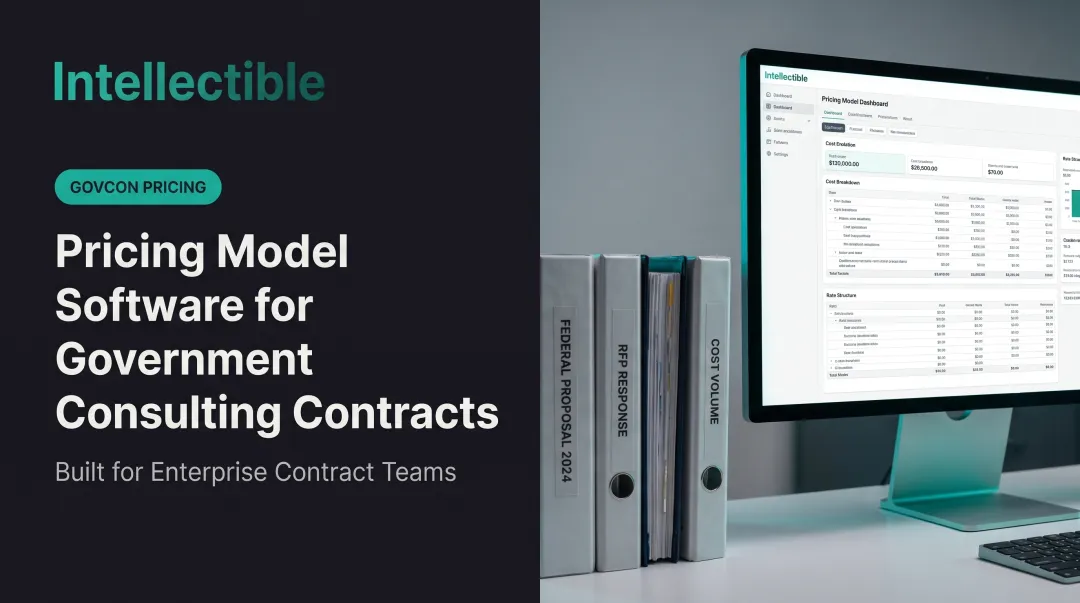
Purpose-built pricing software replaces scattered spreadsheets with a governed workflow.
- Automated rate build-ups: Connects base salary, fringe, overhead, G&A, and profit in one calculation engine. Update one input and every downstream number recalculates—no broken links.
- Centralized rate research: Surfaces historical task-order data and GSA ceiling benchmarks from sources like eLibrary and CALC inside the pricing workspace, instead of manual lookups.
- Audit-ready documentation: Logs every assumption, cost category, approval, and change as it happens, so teams are not reconstructing evidence after an auditor asks.
Intellectible's Approach
Intellectible's Pricing Engine runs a five-stage workflow:
Intake → Extract → Review Assumptions → Build Cost Model → Publish Pricing
During extraction, the platform normalizes inputs from RFPs, discovery calls, and CRM notes, and flags missing fields for human review instead of guessing. Build Cost Model then calculates categories automatically with configurable logic across labor, geography, utilization, and risk.
Every record keeps approval status, owners, exceptions, and full change history. That gives pricing and compliance teams a traceable evidence trail when a rate is questioned.

Intellectible reports a 90% reduction in time to final pricing with full audit-trail control. The figure is a platform-wide benchmark, not a GSA-only case study, yet the same configurable rate logic, source-level traceability, and structured approvals map directly to fully burdened labor rate work.
Publish Pricing hands off into CRM and proposal systems (including Salesforce and HubSpot), so rates stay tied to the opportunity pipeline. Teams shorten the quote-to-proposal cycle without adding pricing analysts.
Choosing the Right Pricing Software: Key Capabilities to Evaluate
Not all pricing tools are built for GovCon complexity. When you evaluate options, prioritize these capabilities:
- Configurable rate calculators — fringe, overhead, and G&A pools should be adjustable per contractor's disclosed cost structure, not hardcoded
- GSA/SIN-specific tracking — monitor ceiling rates, EPAs, and price-reduction clauses per Schedule and SIN
- Audit-trail and version control — documented pool/base/rate history that supports DCAA forward-pricing and incurred-cost documentation needs
- Integration flexibility — APIs and connectors so pricing data flows into existing CRM, proposal, and finance systems instead of becoming another disconnected tool
The right platform reduces manual work without becoming a black box. Pricing teams should still be able to see and defend every number behind a rate.
Frequently Asked Questions
Where can I find GSA price lists?
GSA eLibrary and GSA Advantage publish official Schedule price lists searchable by contractor, SIN, or NAICS code. The CALC tool, now part of GSA's Pricing Intelligence Suite, aggregates awarded labor category rates for market comparison.
How do you defend a forward pricing rate under DCAA review?
A forward pricing rate projects labor or indirect costs across future pricing actions, and DCAA reviews it for reasonableness before it is relied on. What survives review is the support behind it: the historical base, the projection method, and a record of who approved the assumptions and when.
How is a G&A rate built and justified?
G&A covers corporate costs — executive compensation, legal, finance — that are not tied to a single contract, and there is no universal FAR benchmark to point at. The rate follows your disclosed cost accounting structure, so defending it means showing consistency with that disclosure rather than comparison to an industry figure.
What are the different types of fixed-price contracts?
Firm-fixed-price locks in a price regardless of actual cost. Fixed-price with economic price adjustment allows movement based on labor/material indexes. Fixed-price incentive adjusts final profit and price using a target-cost formula.
How much time can pricing software actually save on a proposal?
Automating rate build-ups and compliance checks can cut time to final pricing dramatically. Intellectible cites a 90% reduction as a platform-wide benchmark for its Pricing Engine.
Does GSA pricing software replace the need for a pricing analyst?
No. Software accelerates calculations and reduces manual errors, but analysts still apply judgment on competitive positioning, negotiation strategy, and how aggressively to discount below ceiling rates.