Introduction
Most GovCon companies don't lose contracts because they lack the capabilities to perform the work. They lose because their proposal process fails them — late starts, rushed pricing, inconsistent win themes, or a compliance gap that disqualifies an otherwise strong submission.
The federal contracting environment has no tolerance for improvisation. Government evaluators score proposals against defined criteria using formal source selection methodologies. Non-compliance with RFP formatting rules — a wrong font, a missed page limit — can result in disqualification regardless of technical merit. In a 2025 GAO decision, an agency's exclusion of a proposal was upheld because the offeror used Arial Narrow instead of the required font — adding roughly three pages of text to a volume with a 50-page limit.
This article breaks down what the proposal development process actually requires — from opportunity identification through final submission — and where most teams give up winnable ground.
Key Takeaways
- The proposal development process runs five stages — from opportunity identification through Go/No-Go, planning, writing, pricing, and submission
- Winning proposals are built before the RFP drops — capture planning is a prerequisite, not optional prep
- The Go/No-Go decision is a formal gating mechanism, not an informal gut check
- Pricing deserves the same strategic rigor as the technical approach — not an afterthought
- Most GovCon losses trace to process failures, not capability gaps
What Is Proposal Development in Government Contracting?
Proposal development is the end-to-end process of identifying a government opportunity, deciding whether to pursue it, and creating a responsive, compliant document that persuades the agency your organization is the best-fit awardee.
The goal is a submission that scores highest against the government's stated evaluation factors. That means structuring every section to earn points in a formal source selection — not simply describing your company's services.
Three related concepts often get conflated:
- Proposal development — creating the actual response documents
- Proposal management — the project management and coordination layer governing the development effort
- Capture management — the pre-RFP phase of intelligence gathering and relationship building that feeds into proposal development
All three are essential. Capture management, however, is where win rates are actually shaped — teams that invest in it before the RFP drops arrive with agency insight, incumbent intelligence, and a solution narrative already built.
Why a Structured Process Is Non-Negotiable
The federal contracting environment places demands on the proposal process that most commercial sales processes simply don't. Proposals are scored against explicitly defined criteria. Submission channels and formats are dictated by each individual solicitation. Errors in either area carry real consequences.
The Win Rate Gap Is Real
Deltek's 2026 GovCon study of more than 900 contractors reports a 72% win rate for top performers versus a 48% industry average — a 24-point gap that reflects significant differences in business development discipline, pipeline management, and proposal quality.
Without a defined process, what typically goes wrong:
- Reactive writing that starts too late and produces generic, company-centric content
- Pricing assembled under deadline pressure, disconnected from the technical approach
- Inconsistent win themes across volumes written by different contributors
- Compliance gaps discovered mid-draft rather than at kickoff
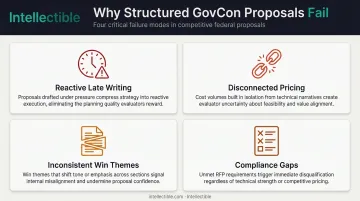
These failures don't occur in isolation. A team that rushes the Go/No-Go decision, skips early capture work, and assembles pricing last is operating at a structural disadvantage regardless of how capable its people are.
Process Discipline Is the Competitive Differentiator
High-performing GovCon companies don't win because they have better talent on every pursuit. They win because they apply a repeatable process that allocates resources to the right opportunities, builds strategy before writing begins, and routes work through defined review checkpoints.
The sections below break down exactly what that process looks like — from pipeline qualification through final submission.
How the GovCon Proposal Development Process Works
The process flows through five sequential but often overlapping stages. Where most proposals lose ground isn't in any single step — it's in the handoffs between them.
Step 1: Opportunity Identification and Go/No-Go Decision
GovCon companies identify opportunities through federal portals like SAM.gov, agency forecast tools, and pipeline intelligence platforms. Under FAR 5.101, contract actions expected to exceed $25,000 must generally be published through the Governmentwide Point of Entry — making SAM.gov the primary federal discovery channel, though each solicitation designates its own submission channel.
The Go/No-Go decision converts raw opportunity data into a binary pursuit commitment. This is a structured evaluation against defined dimensions, not an informal conversation:
- Capability fit — Does your organization have the past performance and technical ability to compete credibly?
- Resource availability — Can your proposal team absorb this pursuit without degrading other active bids?
- Teaming requirements — Do you need partners, and can you assemble them in time?
- Probability of win (pWin) — What does the competitive landscape realistically look like?
- Incumbent status — Is there an entrenched incumbent, and what's your displacement strategy?
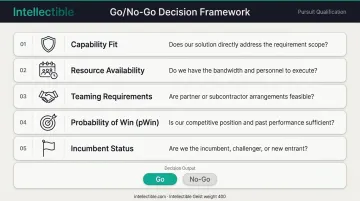
Teams that skip this rigor tend to chase too many opportunities, win too few, and burn out their proposal staff in the process.
Step 2: Proposal Planning and Team Assembly
When the RFP drops and the bid decision is made, the proposal manager is assigned and the compliance matrix is built. Every mandatory section, page limit, and formatting rule is mapped before any writing begins — mapping during the writing phase is one of the most common sources of late-stage rework.
A typical GovCon proposal team includes:
- Proposal manager — owns the schedule, process, and compliance
- Volume leads — technical, management, and pricing
- Subject matter experts (SMEs) — contribute section content within their domains
- Past performance owner — coordinates relevant contract references
- Editor and graphic designer — budget permitting
Step 3: Developing the Win Strategy
A win strategy defines why your company should win — capturing win themes, discriminators against known competitors, and direct alignment between your solution and the agency's mission priorities. As APMP defines it, a discriminator is not just different from competitors — it's different and important to the customer.
This strategy must be documented before writing begins. Experienced teams annotate the proposal outline with win themes and evaluation criteria callouts so every contributor reinforces the same central narrative.
When sections are written independently without a shared strategy, the proposal reads like a collection of capability statements rather than a coherent case for award.
Step 4: Writing, Pricing, and Assembling the Proposal
Two workstreams run in parallel during this phase:
- Technical and management volumes — writers and SMEs develop the technical approach, staffing plan, and management plan
- Cost/price volume — the pricing team builds the cost model simultaneously, running concurrently rather than waiting for the technical draft to close
The parallel structure matters. Pricing built after the technical approach is finalized often contradicts it — either proposing a staffing model that doesn't match the labor hours estimated or reflecting a last-minute number that evaluators can identify as disconnected from the narrative.
Under FAR 15.304, cost or price is evaluated in every source selection. In best-value tradeoff competitions (FAR 15.101-1), agencies can select other than the lowest-priced offeror — but the solicitation controls price's relative weight.
In LPTA competitions under FAR 15.101-2, the lowest evaluated price among technically acceptable offers wins outright. GAO estimated LPTA was used for approximately 25% of DoD competitive contracts valued at $5M or more in FY2018. The procurement type shapes how price-conscious your approach needs to be.
Step 5: Review, Finalize, and Submit
GovCon color team reviews are structured quality gates, each tied to a specific completeness threshold:
| Review | Stage | Purpose |
|---|---|---|
| Pink Team | Early draft / storyboard | Tests strategy execution and section structure before full drafting |
| Red Team | Near-final draft | Predicts evaluator scoring, identifies compliance gaps and weak arguments |
| Gold Team | Final version | Executive sign-off authorizing submission |
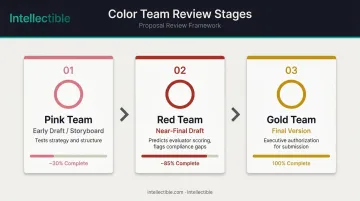
Each review involves different participants at a defined completeness threshold. A Red Team review of a 30% complete document wastes everyone's time and misses the compliance issues that matter at 85% completion.
Final submission steps:
- Run a compliance checklist against every RFP instruction
- Submit through the channel designated in the solicitation — FAR 15.208 places responsibility on the offeror to ensure the proposal reaches the correct office by the stated deadline
- Retain confirmation of receipt as part of the proposal record
In Guidehouse Inc., GAO upheld rejection of a quotation that reached an agency security gateway but not the designated inbox before the deadline. The channel specified in the solicitation is the only channel that counts.
Key Factors That Shape a Winning GovCon Proposal
Evaluation Criteria Alignment
Government proposals are scored against explicitly stated factors and subfactors — typically technical approach, management plan, past performance, and price. Proposals that write to these criteria outperform those that describe general capabilities, regardless of the company's actual qualifications.
Evaluators score against stated criteria, not their overall impression of the offeror. A proposal that describes a strong company but doesn't map its solution to each evaluation factor will score below a less-capable competitor whose submission does.
Capture Maturity
The quality and depth of intelligence gathered before the RFP releases is one of the strongest predictors of proposal quality. Teams with pre-RFP relationships, knowledge of the agency's priorities, and insight into competitor weaknesses write far more competitive proposals than those responding cold at solicitation release.
Deltek's 2025 Clarity report identified "finding opportunities too late" as the leading business development challenge among contractors — confirming that the problem isn't always capability, it's timing.
AI-Powered Workflow Automation
That timing problem points to a deeper constraint: bandwidth. The operational load of a competitive capture process stretches most teams thin:
- Continuous opportunity monitoring across federal databases
- Go/No-Go analysis on each qualifying opportunity
- Compliance matrix builds against solicitation requirements
- Pricing scenario modeling before submission
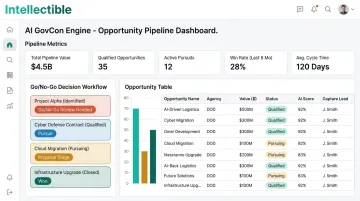
Intellectible's Proposal & Pursuit Engine tackles this directly — providing a governed proposal workflow that reads solicitations, attachments, and addenda to extract key dates, submission rules, required sections, and compliance obligations, then turns those requirements into a structured response plan with owners, deadlines, and status tracking. Defense contractor Oceus doubled the qualified opportunities it surfaces and reviews each month after deploying the platform.
As CEO Jeff Harman noted: "Now we're looking at more than double the qualified opportunities per week — about seven to eight opportunities a month making it through our threshold."
Intellectible reports platform-wide outcomes of 95%+ time savings on opportunity search and Go/No-Go decisions and a 150%+ increase in actionable pipeline opportunities — enabling teams to pursue more of the right opportunities without expanding headcount. The HHS Corporate Director of Business Development put it directly: "Intellectible is taking the tedious, monotonous hours of RFP efforts out of human hands. This allows us to do what we should be doing, analyzing and selling."
Common Mistakes in GovCon Proposal Development
The Proposal Effort Starts Before the RFP
By the time a solicitation is published, agencies have often already formed impressions of likely awardees through market research, RFIs, and industry days. Companies that begin their proposal effort at RFP release are starting months behind competitors who invested in capture. The proposal development process starts in the capture phase.
No Formal Go/No-Go Process
Pursuing every opportunity that appears on SAM.gov without formal qualification depletes proposal team capacity and produces reactive, low-quality submissions. A disciplined Go/No-Go process protects resources for pursuits with a realistic probability of win — and raises the average quality across the portfolio.
Treating Pricing as an Afterthought
Pricing built at the last minute and disconnected from the technical approach creates internal inconsistencies that evaluators flag. In best-value competitions, a price too high relative to the technical approach or too low to be credible can result in elimination regardless of technical score. Pricing is a parallel workstream, not a finishing step.
Writing to Capabilities Instead of Evaluation Criteria
A company-centric proposal describes what the organization does. A client-centric proposal maps deliverables, methodologies, and staffing directly to the government's evaluation factors and scoring criteria. Evaluators score against stated criteria — a proposal that doesn't speak their language leaves points on the table.
Ignoring the Post-Award Debrief
Unsuccessful offerors have the right to request a debrief — and agencies must comply. Under FAR 15.505, a preaward debrief request must be submitted within three days of exclusion notice. Under FAR 15.506, a postaward request must be received within three days of award notification. Win/loss feedback from debriefs is among the most actionable intelligence a GovCon company can collect — and most teams skip it entirely.
Each of these mistakes compounds the others. Fixing them starts with building a repeatable process — not reacting to each solicitation as if it's the first.
Conclusion
Proposal development in GovCon is a structured, phased discipline — not a writing project. It starts with pipeline intelligence, moves through deliberate planning and strategy, and ends with a scored submission that reflects how well the team understood and responded to the government's evaluation criteria.
Consistently winning proposals come from process discipline. Teams that execute these practices outperform reactive competitors — even when both carry similar qualifications:
- Making deliberate Go/No-Go decisions before committing resources
- Building win strategy before a single word is written
- Developing pricing in parallel with technical volumes
- Running structured reviews tied to evaluation criteria
The difference between winning and losing is rarely who has the best writers. It's who runs the better process.
Frequently Asked Questions
What is proposal development?
Proposal development is the end-to-end process of creating a responsive, compliant response to a government solicitation — covering opportunity qualification, writing, pricing, review, and submission — with the goal of winning a federal or state contract.
What are the four models of proposal development?
The four commonly referenced models are: Traditional (Waterfall) with sequential phases and color team reviews, Agile/Iterative with rolling drafts, Hybrid combining both, and Template-driven for rapid or recompete responses. The Traditional model remains most common for large federal proposals due to FAR compliance requirements and formal source selection processes.
What is a proposal developer?
A proposal developer is a professional responsible for creating, coordinating, or contributing to government proposal responses. Depending on team structure, the role may encompass proposal management, technical writing, compliance review, pricing analysis, or some combination of all four.
How long does the proposal development process take?
Timelines vary by contract complexity. Task order responses typically require 2–6 weeks of active development, while large prime contract RFPs often demand 3–6 months of effort. Capture planning should begin well before formal solicitation release to avoid starting cold at RFP drop.
What is a Go/No-Go decision in proposal development?
It's a formal evaluation conducted before committing proposal resources to a pursuit, assessing factors such as capability alignment, competitive position, incumbent status, teaming needs, and estimated probability of win (pWin) to determine whether the opportunity is worth pursuing.
What are the key sections of a government proposal?
Most federal RFPs require some combination of: executive summary, technical approach, management plan, staffing plan, past performance, and cost/price volume. Specific required sections, page limits, and formats are defined by each individual solicitation under FAR 15.204-5. The RFP is always the controlling document.