Introduction
The federal government committed roughly $793 billion to contracts in FY2025 — yet most contractors lose bids not because they lack capability, but because they make avoidable execution mistakes. Wrong file format. Missing certifications. Vague technical responses that read like marketing copy. These are winnable problems with the right preparation.
Government RFPs operate under different rules than commercial proposals. Solicitations follow the Federal Acquisition Regulations (FAR), proposals are scored against published rubrics in Sections L and M, and past performance carries formal, scored evaluation weight — not the informal advisory role it plays in commercial deals. Contractors who understand that distinction bid more selectively and write to the rubric, not the reader.
This guide covers the specific practices that improve government proposal outcomes: disciplined bid selection, proposal architecture tied to evaluation criteria, past performance strategy, and a repeatable process that grows output without adding headcount.
Key Takeaways
- Government proposals are scored against published criteria in Sections L and M — align every response to that language
- A formal Go/No-Go process protects bid resources — chasing every opportunity drains capacity without improving win rates
- Past performance is a formal scored factor, not an optional reference check
- Compliance failures disqualify proposals before evaluation begins
- A reusable content library lets teams respond faster without rebuilding every proposal from scratch
Why Government RFPs Demand a Different Approach
The Evaluation Framework Is Published — Use It
Under FAR 15.204-5, government solicitations are structured with Section L (proposal preparation instructions) and Section M (evaluation factors and their relative importance). Evaluators are required to assess proposals only against the factors disclosed in those sections.
That means the scoring rubric is handed to you before you write a single word.
Commercial proposals are reviewed subjectively. Government proposals are graded. That distinction changes how you should write every section.
LPTA vs. Best Value: Know Which Game You're Playing
FAR 15.101 establishes two primary evaluation methods:
| Method | Award Logic | What This Means for Your Proposal |
|---|---|---|
| LPTA | Lowest price among technically acceptable offers | Technical quality above the threshold earns nothing — focus on compliance and competitive pricing |
| Best Value Trade-Off | Higher price can win for superior non-price value | Strengths, differentiators, and risk mitigation can change the award — invest in technical depth |
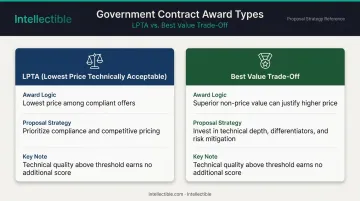
Misreading the evaluation method is a costly mistake. A contractor writing an elaborate technical narrative for an LPTA competition wastes proposal resources on factors evaluators won't use to rank offers.
That same misalignment can occur even earlier in the process — before evaluation begins at all.
Hard Gates That Can End a Bid Before Evaluation Begins
Several requirements can disqualify an offer before any scoring occurs:
- SAM.gov registration must be active at both submission and award (FAR 4.1102)
- Late proposals are generally ineligible under FAR 52.215-1, with very narrow exceptions
- Page limits and font requirements are enforced literally — in Horizons Youth Services (B-423202, 2025), GAO upheld elimination of a proposal that used Arial Narrow to squeeze content within a 50-page limit, ruling it created an unfair competitive advantage
- Required certifications, NAICS code alignment, and mandatory representations must all be present
Treat compliance as a gate, not a formality.
Start with a Disciplined Go/No-Go Decision
Why Bidding Volume Works Against You
Spreading limited proposal resources across too many opportunities weakens every response. A formal Go/No-Go process is how high-performing government contractors protect proposal quality and concentrate effort on winnable bids.
Key Qualification Criteria to Evaluate
Before committing to a proposal, assess these factors:
- Are you the incumbent, or are you displacing one? Incumbents hold a natural advantage that's lawful without preferential government action (Active Deployment Systems, B-422424, 2024)
- Do you have meaningful engagement with the contracting officer or program office?
- Does this work sit at the core of your capabilities, or at the edge?
- How many qualified bidders are likely, and is the market crowded or fragmented?
- Can you compete on price and still deliver profitably?
Identifying "Wired" RFPs
Some solicitations are effectively written around an incumbent or a pre-selected vendor. Warning signals include:
- Unrealistically narrow technical requirements that match one vendor's exact solution
- Very short response windows that disadvantage new entrants
- No pre-solicitation notice or market research activity
- Requirements referencing a vendor's proprietary system or methodology
The distinction that matters: incumbent advantage from natural market position is lawful. Advantage created by the government providing nonpublic information or biasing evaluation criteria is protestable — as demonstrated in MANDEX, Inc. (B-421664, 2023), where GAO sustained a protest over inadequate investigation of unequal access to competitively useful information.
When you identify a wired RFP, the strategic choice is either a differentiated counter-narrative or a disciplined decision to decline and protect your resources.
A Simple Expected Value Framework
Calculate whether a pursuit is worth the investment:
- Estimate total internal hours to produce a compliant, competitive proposal
- Assign a realistic win probability based on the criteria above
- Multiply expected contract value by that probability
- Compare against the cost of the proposal effort
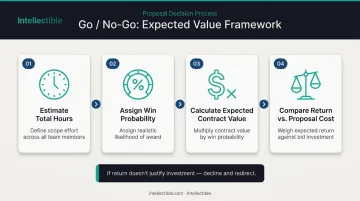
If the expected return doesn't justify the investment, decline and redirect resources to a higher-probability pursuit.
How Intellectible Automates This Decision
Running this framework manually across dozens of opportunities each month is where the process breaks down for most capture teams. Intellectible's pursuit platform handles that triage automatically, processing over 3,200 federal notices in a single 24-hour period and converting each into a structured capture record. Each record surfaces:
- Agency details, NAICS/PSC classifications, and fit rationale
- Risk signals and recommended actions
- Likely incumbent identification and bidder density assessment
- Vendor concentration analysis
For formal solicitations, the platform generates a scored Go/No-Go report covering strategic fit, capability match, competitive landscape, incumbent status, and contract terms — all before any proposal resources are committed.
Defense contractor Oceus used Intellectible to double the qualified opportunities it surfaces each month, moving from manual triage to automated scoring that routes only high-fit pursuits to the capture team. The result: 95%+ time savings on opportunity search and Go/No-Go analysis.
Structure Your Proposal Around Government Evaluation Criteria
Align Every Section to Section L and Section M
Winning proposals don't just answer the question — they answer it using the agency's own language, organized around the structure Section M defines. If Section M lists five technical subfactors, your proposal should have five visibly labeled subsections that address each one directly.
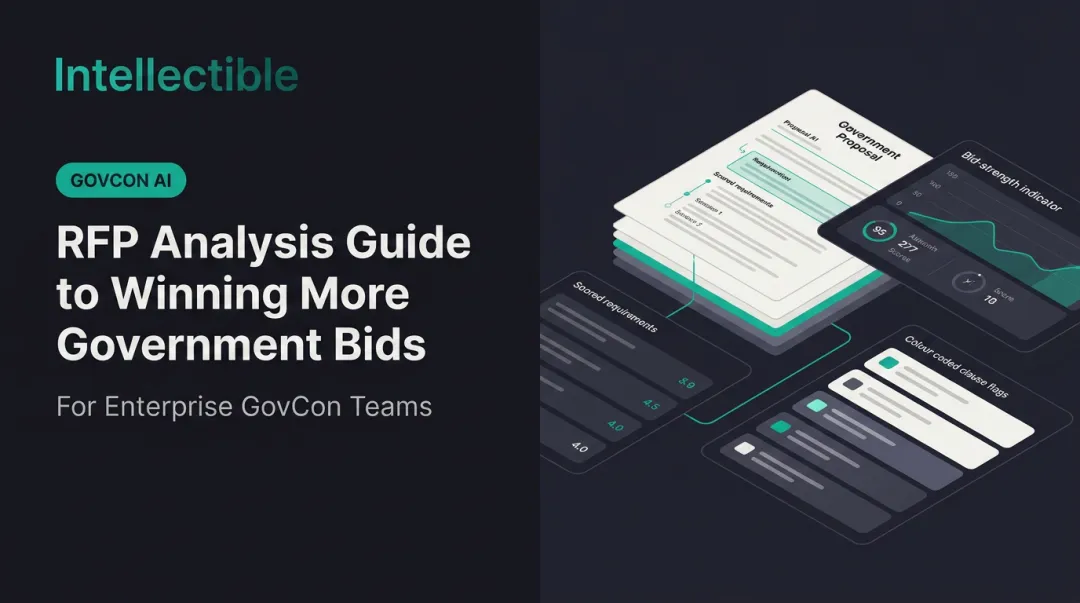
Build a compliance matrix before writing begins: a table that cross-references every RFP requirement to the specific proposal section addressing it. This serves two purposes: internal quality control to ensure nothing is missed, and — when included as a submission appendix — a clear signal to evaluators that you've been thorough. Intellectible's Proposal & Pursuit Engine generates compliance matrices automatically from uploaded solicitation documents — reading the RFP, attachments, and addenda to extract key dates, submission rules, required sections, evaluation criteria, and compliance obligations before the first draft is written. It then turns those requirements into a response plan with mandatory versus strategic sections, owners, deadlines, status, and evidence; generates section drafts grounded in the RFP, deal variables, approved knowledge, and historical proposal language; and reviews the assembled proposal against requirements, strategy, tone, and missing evidence — with versioning and export built in.
Write an Executive Summary Tied to Agency Mission
Government executive summaries fail when they lead with the contractor's credentials. Evaluators — especially source selection officials — respond to proposals that demonstrate understanding of their organizational goals.
Compare these two openings:
- Capability-centric: "We have 18 years of experience providing IT services to federal agencies across multiple domains..."
- Mission-outcome: "Our approach reduces [agency-specific problem] by [specific method], delivering [measurable benefit] directly aligned with your [named strategic priority]..."
The second version costs the same words but earns more attention. Open with the agency's mission. Connect your solution to mission outcomes. Lead with their problem, not your resume.
Demonstrate Technical Approach with Specificity
A strong executive summary earns attention, but the technical section is where scores are actually separated. Vague responses — phrases like "we will apply best practices and industry standards" — tell evaluators nothing differentiating and consistently produce low scores in Best Value competitions.
Strong technical approaches include:
- Methodologies named and tied to the specific work, not generic frameworks recycled from past proposals
- Timelines with defined milestones and decision points, not open-ended delivery windows
- Direct references to the agency's existing systems or environment, demonstrating pre-work done before submission
- Identified risks with explicit mitigation steps — under DoD source selection procedures, this is actively scored as a strength
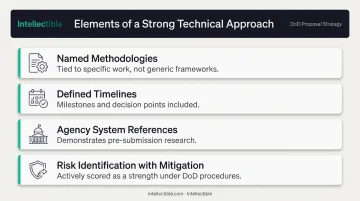
Evaluators can tell the difference between a team that studied the solicitation and one that repurposed a prior submission. Specificity is what converts a technically compliant proposal into a competitive one.
Write a Winning Past Performance and Key Personnel Section
Past Performance Is a Scored Factor — Treat It That Way
FAR 15.305(a)(2) makes past performance a formal evaluated factor. Agencies assess currency, relevance, source, context, and trends. A contractor with no relevant record may be rated Neutral — and under DoD source selection procedures, a source selection authority may determine that Satisfactory or Substantial Confidence is worth paying more for in a tradeoff.
Select past performance references that are:
- Same agency type or mission area — DoD work reads differently than civilian agency work
- Similar scope and dollar value — a $500K contract doesn't demonstrate capability for a $10M award
- Recent — check the solicitation for recency criteria; CPARS records are generally available for three years after contract completion under FAR 42.1503
Structure Each Past Performance Entry Effectively
Don't just list contracts. Structure each entry around three elements:
- The challenge — What problem did the agency face?
- Your approach — What specific actions did you take?
- Measurable outcomes — What changed as a result, in quantifiable terms?
This structure maps to how evaluators read CPARS and assess confidence in future performance.
Key Personnel and Teaming Strategy
Government evaluators scrutinize proposed personnel qualifications as a direct proxy for delivery capability. The Sancorp Consulting case (B-422985.4/.5, 2025) illustrates the stakes: when a proposed key person resigned before award and Sancorp failed to notify the agency, GAO dismissed their protest because the quotation no longer met a material solicitation requirement.
Practical implications:
- Match resumes directly to position description requirements in the RFP — address each qualification explicitly
- Confirm availability and commitment before submission, not after
- Include concrete project examples tied to the specific work, not generic career summaries
When your own record or headcount falls short, teaming fills the gap. A prime/sub arrangement covers specific technical or small business designation gaps. A joint venture pools past performance from two organizations to compete for a larger opportunity.
The key is a unified narrative. A teaming arrangement that creates complexity rather than clarity weakens the proposal — evaluators need to see one coherent capability story, not a patchwork of credentials.
Build a Repeatable Government Bid Process
The Content Library Foundation
One-off proposal efforts — where teams scramble to assemble responses from scratch — produce inconsistent quality and unsustainable workload. High-performing government contractors maintain a version-controlled content library that includes:
- Approved past performance write-ups (formatted and ready to adapt)
- Company capability statements by service area
- Standard compliance responses and representations
- Key personnel resumes, current and cleared for use
- Boilerplate sections for recurring proposal elements
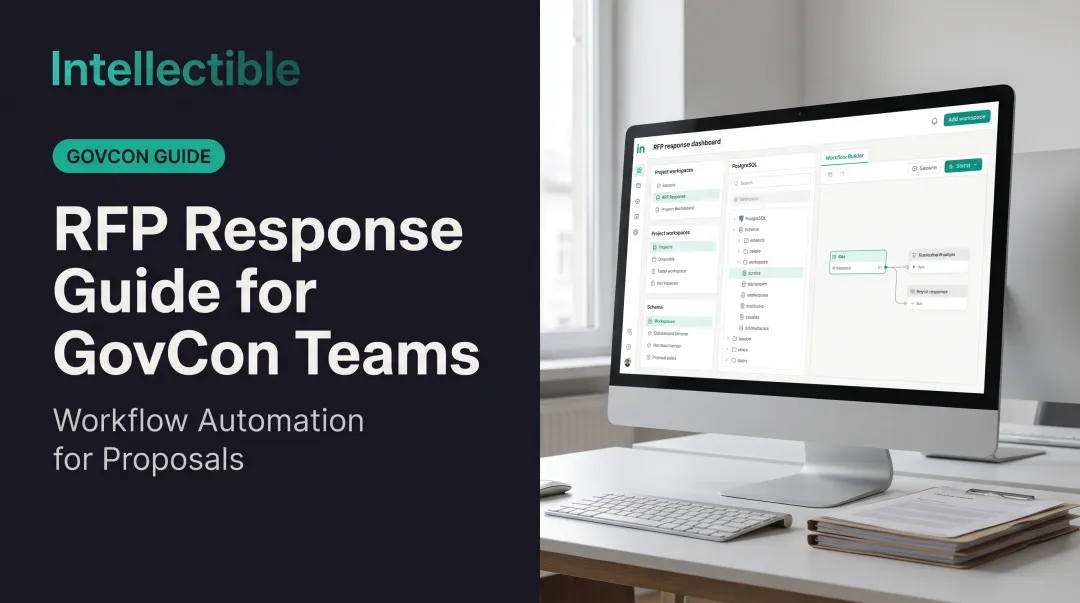
Intellectible’s platform supports this directly. Proposal teams query the knowledge base in plain language — "What past performance do we have with the U.S. Army?" — and retrieve approved, permission-controlled records instantly. No more hunting through shared drives or chasing down the person who "knows where that file is."
Core Workflow Stages for Every Pursuit
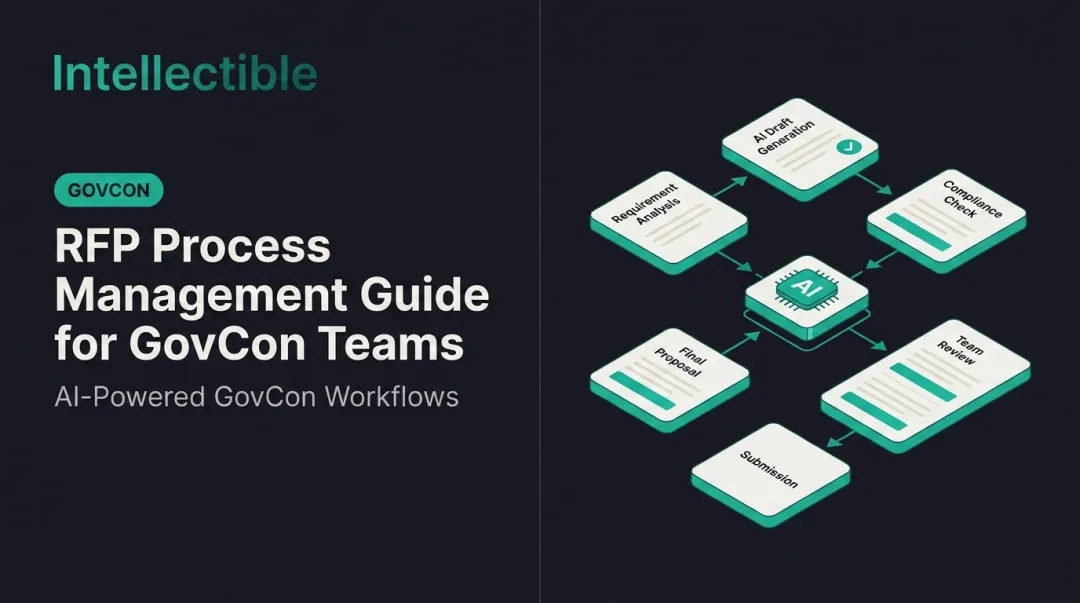
A repeatable government bid process follows defined stages with clear owners and deliverables:
- Go/No-Go decision — Qualify the opportunity before committing resources
- Kickoff and compliance review — Parse the RFP, build the compliance matrix, assign sections
- Section ownership assignment — Every section has one owner and a deadline
- Pink team review — Early draft review for structure, approach, and coverage gaps
- Red team review — Near-final evaluator-perspective review against Section M criteria
- Final compliance check — Reviewed by someone other than the primary author before submission
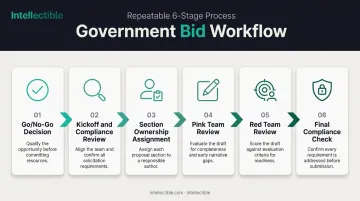
Each stage needs defined owners, not just defined tasks. Without named accountability at each gate, reviews slip, sections stall, and deadlines compress at the worst possible moment.
Intellectible's platform supports this workflow end-to-end. Automated opportunity triage feeds into compliance matrix generation, which flows into structured proposal drafting with integrated review and approval routing — so each stage connects directly to the next without manual handoffs.
Common Mistakes That Get Government Proposals Rejected
Non-Compliance Disqualification
The most avoidable losses happen before evaluation begins. Common triggers:
- Missing required sections or certifications
- Exceeding page limits (enforced literally — a single extra page can trigger disqualification)
- Submitting in wrong file formats
- Late submission
A compliance checklist reviewed by someone other than the primary author before submission is the minimum safeguard.
Generic, Boilerplate Responses
Evaluators read dozens of proposals. They recognize copy-pasted capability descriptions immediately. Generic content signals that the contractor didn't engage with the specific RFP — which is itself a negative signal about attention to detail and mission understanding.
Every section should reference the specific RFP language, agency context, and contract scope. Customization is what earns points. Proposals that mirror the RFP's own terminology consistently outscore those that don't.
Failure to Address All Evaluation Subfactors
Many proposals lose points not because of weak capability, but because they skip a specific Section M subfactor. If five technical subfactors are listed, all five must be substantively addressed — ideally with labeled subheadings that mirror the RFP's own language.
Evaluators document strengths, weaknesses, significant weaknesses, and deficiencies per factor. An unaddressed subfactor defaults to a weakness or deficiency, regardless of how strong the surrounding content is.
Frequently Asked Questions
What is the difference between LPTA and Best Value evaluation in government RFPs?
LPTA awards to the lowest-priced technically acceptable offer — once a proposal clears the technical threshold, price is the only discriminator. Best Value allows evaluators to pay more for a superior technical approach, stronger past performance, or better-qualified personnel, meaning a higher-priced proposal can win on merit.
How important is past performance in a government RFP response?
Past performance is a formal scored evaluation factor in most federal solicitations, often weighted equally to or above technical approach. Proposals lacking relevant, recent documentation are typically rated Neutral Confidence — technically not a penalty, but not enough to compete in a tradeoff evaluation.
What does it mean for an RFP to be "wired" and should you respond?
A wired RFP is shaped around an incumbent's capabilities — signals include narrow requirements, short response windows, and no pre-solicitation activity. Respond only if you can make a genuinely compelling case for your approach; otherwise, protect your resources for more competitive opportunities.
How can small businesses improve their win rate on government RFPs?
Use small business set-asides strategically — $179 billion, nearly 28% of FY2025 federal prime contracting dollars, went to small businesses, went to small businesses. Build past performance through subcontracting before pursuing prime contracts, and apply a formal Go/No-Go framework to focus limited resources on the most winnable opportunities rather than pursuing every available solicitation.
What is a compliance matrix and why does it matter in government proposals?
A compliance matrix cross-references every RFP requirement to the specific proposal section addressing it. Internally, it ensures nothing is missed before submission. When included as an appendix, it signals to evaluators that the contractor has systematically addressed all requirements — a mark of organizational discipline.
How many RFPs should a government contractor respond to at once?
There's no magic number, but volume without qualification consistently degrades proposal quality. A Go/No-Go framework built around relationship depth, solution fit, and realistic win probability will outperform chasing every solicitation that crosses your desk.