Introduction
Government contracting teams are stretched thin. More solicitations to track, tighter submission windows, and evaluators who expect fully compliant, compelling proposals — all with the same lean team that was handling half the volume two years ago.
The most common trap is reactive bid management: chasing every RFP that touches your NAICS codes, skipping formal qualification, and burning out your proposal staff on low-probability pursuits. According to the 2025 GAUGE Report, produced from more than 1,200 government contractor responses, 79% of GovCon firms experienced difficulty winning new contracts — a figure that reflects how competitive federal pursuit has become.
A structured approach to bid and proposal management improves win rates and makes your team's time count.
Key Takeaways:
- Bid management and proposal management are related but distinct functions — both matter for winning federal work
- A Go/No-Go framework stops wasted B&P spend before it starts
- Proposals must map directly to Section L and Section M to score well with evaluators
- B&P costs are allowable under FAR 31.205-18, but only with proper tracking for DCAA audits
- Automating opportunity qualification and pricing lets teams scale volume without adding headcount
Bid vs. Proposal in GovCon: Understanding the Key Terms
Two Functions, One Team
Bid management is the strategic function — identifying, qualifying, and coordinating your firm's response to a federal opportunity from first awareness through final submission. Proposal management is the tactical execution — creating, editing, reviewing, and delivering the written response.
In most GovCon shops, both functions fall on the same small team. Understanding the distinction helps allocate effort correctly — instead of treating every pursuit as a uniform writing exercise.
Federal Solicitation Types
The type of solicitation determines compliance requirements, proposal elements, and how your response will be evaluated:
| Solicitation Type | FAR Authority | How Awards Are Made |
|---|---|---|
| RFP (Request for Proposals) | FAR Part 15 | Best-value, negotiated acquisition |
| RFQ (Request for Quotations) | FAR Part 13 | Simplified acquisition; quote is not an offer |
| IFB (Invitation for Bids) | FAR Part 14 | Sealed bidding; lowest compliant price wins |
| RFI / Sources Sought | FAR 15.201 | Market research only; no award |
| Task Orders under IDIQ | FAR 16.505 | Fair opportunity; varies by vehicle |
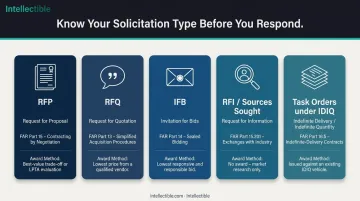
Each format has different compliance obligations. An IFB response that includes unnecessary narrative hasn't improved your position — price is all that matters. Misreading the vehicle type early is a common and costly mistake.
What "B&P Costs" Actually Means
FAR 31.205-18 defines B&P costs as expenses "incurred in preparing, submitting, and supporting bids and proposals (whether or not solicited) on potential Government or nongovernment contracts." These are allowable indirect costs allocated through the G&A pool — provided they are allocable and reasonable.
What B&P costs are not:
- Effort funded by a grant or cooperative agreement
- Work required under an existing contract (that's contract performance)
- Independent research and development (IR&D), which covers contractor-chosen R&D not tied to a specific bid
During DCAA audits, misclassification between B&P and IR&D — or between B&P and direct contract costs — results in questioned costs. Track these allocations separately from day one, not during audit prep.
The GovCon Bid Lifecycle: Stage-by-Stage Breakdown
Opportunity Identification and Pipeline Development
SAM.gov is the centralized source for federal contract opportunities. But firms that first engage with an opportunity at RFP release are already behind.
FAR 15.201 explicitly encourages pre-solicitation engagement through industry days, one-on-one meetings, draft RFPs, RFIs, and site visits. Firms that participate in those exchanges — submitting capability statements, attending market research sessions, and shaping requirements — have a structural advantage when the solicitation finally drops.
A healthy pipeline tracks opportunities by:
- Agency and office (not just department)
- NAICS and PSC codes
- Contract vehicle access (GWAC, GSA Schedule, agency-specific IDIQs)
- Anticipated award date and period of performance
- Incumbent status and contract expiration
Capture Planning
Capture planning is the intelligence-gathering phase between opportunity identification and RFP release. The goal is to enter the proposal phase knowing your customer, your competition, and your win position — not to discover all three during the writing process.
Core capture activities include:
- Mapping the customer's mission priorities and known pain points
- Identifying the incumbent and likely competitors
- Building teaming relationships where capability gaps exist
- Confirming that the opportunity fits your core competencies and strategic direction
Proposals written without capture intelligence tend to be generic — describing capabilities rather than solutions. They also miss the agency-specific language that signals to evaluators that the contractor actually understands the problem.
Proposal Development and Review
Proposal development follows a defined sequence:
- Kickoff meeting — Review solicitation requirements, assign section owners, set internal milestones against the submission deadline
- Writing and content development — Section authors draft against compliance requirements in Section L
- Pink team review — Early draft evaluated for compliance and structure (not prose quality)
- Red team review — Near-final draft scored against the evaluation criteria in Section M
- Final production and quality check — Format compliance, page counts, required forms
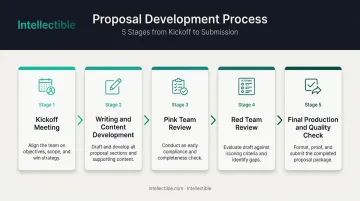
Compliance comes before persuasiveness. Agencies won't infer technical detail you omitted — GAO has repeatedly affirmed that proposals must stand on their own.
Submission, Debrief, and Lessons Learned
After submission comes the government's evaluation period, award notification, and — critically — the debrief. Under FAR 15.506, any offeror must submit a written request within 3 business days of award notification to be eligible for a debrief.
That debrief is among the most actionable sources of competitive intelligence available — and most small GovCon teams underuse it. A complete debrief delivers:
- Technical ratings by evaluation factor
- Evaluated price position relative to other offerors
- Identified weaknesses and deficiencies
- The government's rationale for award
Build a lessons-learned log that captures debrief findings by section, evaluator comment category, and pursuit type. Feed those findings back into your capture and proposal templates — so each pursuit starts stronger than the last.
Building a Go/No-Go Framework for Federal Opportunities
Why Go/No-Go Is Your Highest-Leverage Decision
Every "yes" to a low-probability opportunity consumes B&P budget, burns proposal team hours, and crowds out time for stronger pursuits. Without a formal framework, most teams default to pursuing every opportunity that matches their NAICS codes — a resource trap dressed up as business development.
A structured Go/No-Go process forces the right question: not "can we respond?" but "should we?"
Two Categories of Criteria
Evaluate every opportunity against two dimensions:
Strategic Fit
- Do we have directly relevant capabilities?
- Do we hold the required certifications (8(a), SDVOSB, HUBZone)?
- Do we have access to the contract vehicle?
- Does this align with where we want to grow?
Win Probability
- Have we engaged this customer in the last 90 days?
- Do we have at least two directly relevant past performance references?
- Can we compete on price-to-win?
- Who is the incumbent, and what is their relationship with the agency?
- Is the scope deliverable with current or near-term capacity?
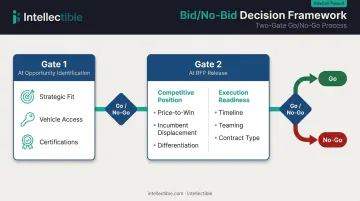
Two Decision Gates
Go/No-Go decisions should happen at two distinct points:
Gate 1 — At opportunity identification: A high-level screen based on strategic fit, vehicle access, and certifications. Takes 15–30 minutes with a standard scorecard.
Gate 2 — At RFP release: A full evaluation before committing proposal resources. This is where you answer the harder questions, grouped by risk type:
Competitive position
- Can we hit the government's likely price-to-win?
- Is there a clear incumbent, and can we displace them?
- Does our technical approach differentiate us, or are we an "also-ran"?
Execution readiness
- Is the timeline achievable without compromising quality on active proposals?
- Have we identified teaming partners for any capability gaps?
- Is the contract type (cost-plus, fixed-price) one we can manage?
Automating the Initial Screen
For teams managing high-volume pipelines, manual screening at Gate 1 burns analyst hours that should go to Gate 2 decisions and capture activities. When the framework is sound but volume is the bottleneck, automation handles the rest.
Intellectible's pursuit platform automates the initial opportunity scan — ingesting federal notices and transforming each into a structured capture record with agency, NAICS/PSC codes, fit rationale, and risk signals. Only opportunities that meet predefined criteria surface for human review.
In documented usage, the platform analyzed over 3,200 opportunities in a single 24-hour window. Outcomes for clients include 95%+ time savings on opportunity decisions and a 150%+ increase in actionable pipeline. Defense contractor Oceus doubled the qualified opportunities it reviews each month. The result: Go/No-Go discipline at scale, with no increase in headcount.
What Goes Into a Winning Federal Proposal
Executive Summary and Understanding of the Requirement
The executive summary is read first and remembered longest. It must demonstrate — in the government's own language — that you understand the mission problem, not just the stated requirement.
Effective executive summaries:
- Echo language directly from the Statement of Work or Performance Work Statement
- Articulate the agency's mission impact, not just the contract deliverables
- Preview your differentiating approach in specific, not generic, terms
The most common mistake: writing a company bio. Evaluators already know who you are. They want to know whether you understand their problem.
Technical Approach and Management Plan
Evaluators score the technical volume against the criteria in Section M. Vague approaches score low — consistently.
What strong technical volumes include:
- A clear methodology mapped to each task in the SOW/PWS
- Staffing rationale that explains why specific labor categories in specific quantities
- Quality control and risk mitigation plans tied to deliverable requirements
- A transition plan (when relevant) that shows continuity of service
What loses points: phrases like "we will leverage our robust team of experienced professionals." GAO has found proposals vague and lacking necessary detail in sustained protests — and in those cases, the agency's evaluation was upheld precisely because the offeror didn't supply the specifics.
Past Performance
Past performance is evaluated on two dimensions: relevancy first, then quality. Relevancy means similar scope, size, complexity, and agency type. Quality means CPARS ratings, reference letters, or concrete outcome narratives.
The common failure is disorganized past performance, not poor ratings. Most GovCon teams scramble to assemble references at proposal time because nothing is maintained centrally.
Maintain a living past performance library with standardized entries for each contract:
- Client name and contracting office
- Period of performance and dollar value
- Scope description (aligned to your NAICS codes)
- Key personnel assigned
- Outcome metrics and CPARS ratings
CPARS is the governmentwide system where those evaluations are recorded. Know your ratings and keep them current.
Price/Cost Volume
Price-to-win (PTW) analysis starts with research: historical awards from USAspending.gov, comparable vehicle pricing, and competitive intelligence on likely bidders.
The approach differs by contract type:
- Fixed-price contracts require competitive market pricing and margin analysis — you're bidding against the market
- Cost-reimbursable contracts require detailed cost builds including fringe, overhead, and G&A allocations — you're defending reasonableness
Small GovCon firms most often lose on pricing by bidding too high or undercutting to win and then struggling to deliver. Both outcomes are avoidable. A PTW analysis completed before writing begins — not after — gives your team the competitive anchor it needs to price with confidence.
Managing B&P Costs and FAR Compliance
What Is and Isn't a B&P Cost
FAR 31.205-18 is clear: B&P costs are incurred in preparing, submitting, and supporting bids and proposals. They're allowable as indirect expenses when allocable and reasonable.
Allowable B&P costs include:
- Labor hours directly spent on proposal preparation
- Consultant fees for proposal writing or pricing support
- Printing, reproduction, and production costs
- Travel for oral presentations
Not allowable as B&P:
- Effort funded by a grant or cooperative agreement
- Work required under an existing contract
- IR&D costs (independent research not tied to a specific bid)
This classification matters because DCAA auditors examine B&P project records directly. Per DCAA's Selected Area of Cost Guidebook, Chapter 33, auditors will review project authorizations, cost ledgers, labor and timekeeping documentation, and transaction source records — and test consistency with your disclosed accounting practices.
Tracking and Documenting B&P Costs
Best practices for audit-ready B&P records:
- Assign a unique job code to each active pursuit so labor hours are captured at the project level
- Document all direct B&P expenses — consultant fees, printing, software tools, travel — against the pursuit record
- Separate proposal labor from administrative overhead — time spent on general BD activities is G&A, not B&P
- Maintain project authorizations that describe scope, period, and approved cost ceiling for each pursuit
These records aren't just good practice — they're required. Under CAS 420, B&P costs are accumulated at the project level and allocated through the G&A pool to final cost objectives. Firms with cost-type government contracts must maintain documentation that holds up under audit and stays consistent with whatever practices are disclosed in your CAS Disclosure Statement.
B&P as a Strategic Metric
Beyond compliance, B&P tracking creates a management tool. Firms that track B&P spend against anticipated contract value — B&P as a percentage of pipeline value — can identify which pursuit types consume disproportionate resources and adjust Go/No-Go thresholds accordingly.
Untracked B&P labor bleeds into G&A with no corresponding cost recovery on new awards. For firms actively pursuing growth, that creates pressure in two directions at once:
- Overhead rates climb as unallocated proposal labor inflates the G&A pool
- Win rates stay flat because resources are distributed across pursuits without data-driven prioritization
- Pipeline visibility suffers when there's no spend-to-value ratio to guide Go/No-Go decisions
Treating B&P as a tracked metric — not just a cost category — is what separates firms that grow their win rate from those that just grow their overhead.
Scaling Your GovCon Bid Operation Without Adding Headcount
The Scaling Trap
As bid volume increases, the default response is to hire — more proposal writers, another capture manager, a dedicated pricing analyst. Each addition increases your indirect cost pool, which raises your overhead rates, which reduces your competitiveness on price. The more you hire to win, the harder winning becomes.
The alternative is process and automation first. Standardize workflows, centralize reusable content, and automate high-repetition tasks before adding headcount.
The Infrastructure That Makes Scaling Work
A scalable bid operation rests on four foundational components:
- Centralized proposal content library — Past performance entries, key personnel bios, and boilerplate stored as governed, searchable records (not buried in shared drives)
- Standardized templates for each proposal volume type — technical, management, past performance, price
- Pipeline tracker tied to Go/No-Go gates — Opportunities tracked by stage, decision status, and resource commitment
- Pricing model with pre-loaded rate structures — Labor categories, indirect rates, and scenario modeling built in, not rebuilt per pursuit
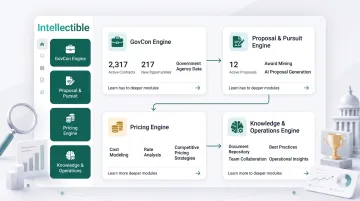
Intellectible's platform combines all four into a single environment, with each system handling a distinct layer of the operation:
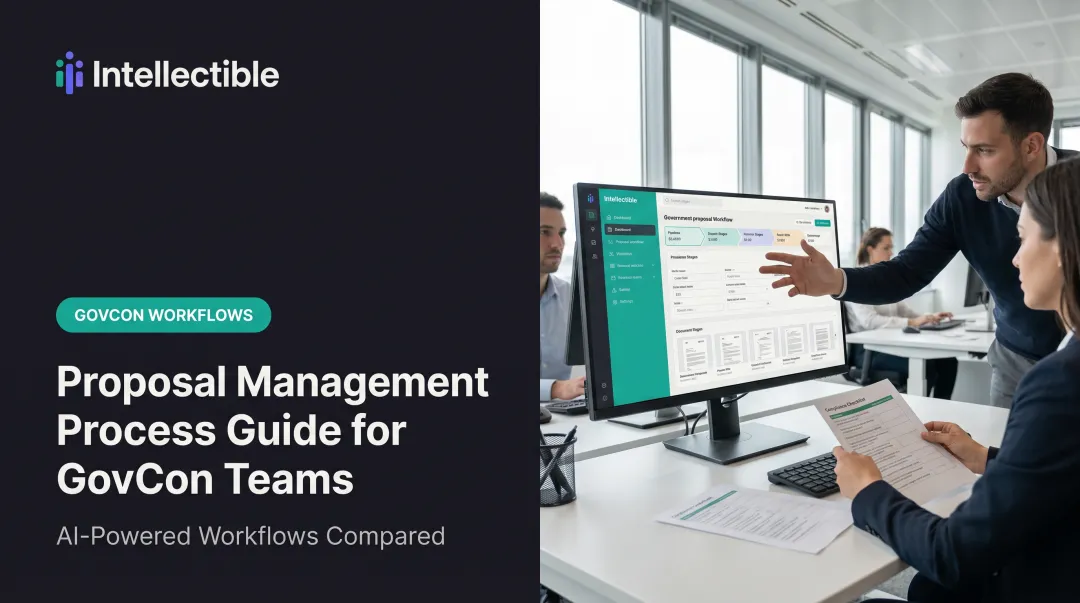
- Proposal & Pursuit Engine — A governed proposal workflow that runs the full RFP response: reads solicitations, attachments, and addenda to extract key dates, submission rules, required sections, evaluation criteria, and compliance obligations; runs a structured go/no-go covering fit, urgency, risk, contract terms, and capability match; turns requirements into a response plan with mandatory versus strategic sections, owners, deadlines, and status tracking; generates section drafts grounded in the RFP, deal variables, approved knowledge, and historical proposal language; and reviews the assembled proposal against requirements, strategy, tone, and missing evidence — with versioning and export
- Knowledge reuse — Past performance, SOPs, and boilerplate made searchable and reusable across every active pursuit
HHS's Corporate Director of Business Development described the operational shift directly: "Intellectible is taking the tedious, monotonous hours of RFP efforts out of human hands. This allows us to do what we should be doing, analyzing and selling."
KPIs That Identify Where Automation Pays Off
Track these metrics quarterly to find where process improvement delivers the highest return:
- Bids pursued per quarter — Is Go/No-Go discipline holding?
- Win rate by opportunity type — Where is your actual competitive advantage?
- B&P spend per submitted proposal — Which pursuits consume disproportionate resources?
- Time from RFP release to submission — Where are the bottlenecks?
- Revenue won per BD FTE — The efficiency measure that matters most for growth
These metrics create a feedback loop. When time-to-submission spikes, look at pricing or review stages. When B&P spend per proposal climbs, Go/No-Go discipline is slipping. That data pinpoints where to fix the process — before you consider adding a person.
Frequently Asked Questions
What is the bid and proposal process?
The B&P process covers the full lifecycle from opportunity identification on SAM.gov through capture planning, proposal development, submission, and post-award debrief. It's a repeatable cycle — each debrief sharpens the next pursuit, making discipline at every stage a compounding advantage.
What is the difference between a bid and a proposal?
A bid is a priced offer evaluated primarily on price, where the lowest compliant submission typically wins — used in sealed bidding under IFBs. A proposal is a comprehensive response evaluated on technical approach, past performance, and price under best-value source selection, which governs most competitive federal RFPs.
What comes first, an RFQ or an RFP?
Neither always comes first — the contracting officer selects the method based on acquisition strategy and dollar value. RFPs govern competitive negotiated acquisitions above the simplified acquisition threshold (currently $350,000 under FAC 2026-01); RFQs handle simplified acquisitions or task orders against vehicles like GSA Schedule.
What are allowable B&P costs under FAR?
Under FAR 31.205-18, B&P costs are allowable as indirect expenses when allocable and reasonable. Allowable costs include labor for proposal preparation, consultant fees, materials, and oral presentation travel. Excluded are grant-funded effort, work required under an existing contract, and IR&D costs.
What should a Go/No-Go decision include for a federal opportunity?
A solid Go/No-Go covers two categories: strategic fit — capabilities, certifications, contract vehicle access, and past performance relevance — and win probability — customer relationship depth, competitive landscape, price-to-win ability, and whether capture preceded RFP release.
How can a small GovCon team manage more proposals without burning out?
Three levers: stricter Go/No-Go discipline to pursue fewer but stronger opportunities, a centralized content library for reusable past performance and boilerplate, and workflow automation tools that handle opportunity screening and pricing — freeing your team to focus on strategy, relationships, and the technical narrative that actually wins.