Despite this massive opportunity, many businesses hesitate to pursue federal work. The "alphabet soup" of acronyms—SAM, NAICS, FAR, IDIQ, GSA—feels overwhelming. Regulations appear dense. Competition seems fierce.
But government contracting is navigable with the right knowledge and systematic approach. This guide walks your GovCon team through the entire lifecycle: registration requirements, opportunity discovery, contract types, bidding fundamentals, and post-award compliance. Whether you're pursuing your first federal opportunity or building a scalable capture operation, you'll find the framework you need here.
Key Takeaways
- Federal registration through SAM.gov is mandatory and free; activation takes up to 10 business days
- Small business set-asides cut competition when two or more qualified firms can bid at fair prices (Rule of 2)
- Maintain a qualified pipeline 3x your revenue target and apply strict Go/No-Go criteria
- Contract types shift risk: fixed-price for defined scopes, cost-reimbursement for R&D, T&M for uncertainty
- Leading teams automate workflows to scale pursuits without adding headcount
Why Government Contracting Makes Sense for Your Business
Market Size and Stability
The federal government is large and reliable. Contracts typically span 1-3 years, with stability built into appropriations cycles. FAR 17.204 generally limits services contracts' basic plus option periods to five years, though IT and other categories may exceed that threshold.
Unlike commercial buyers who can pivot overnight, federal agencies plan purchases months or years in advance through procurement forecasts and budget requests.
This predictability creates planning advantages. You can track agency buying patterns, identify expiring contracts, and position for recompetes before solicitations drop. When you win, you're working with a customer whose funding is congressionally authorized and whose payment obligations are backed by the U.S. Treasury.
Small Business Advantages
Federal law mandates that agencies award at least 23% of prime contract dollars to small businesses. FY2025 results show the government exceeded that target, awarding nearly 28% and $179 billion in prime contracts to small firms. Including subcontracts, the total reached nearly $273 billion.
Specific set-asides further reduce competition:
- Women-Owned Small Business (WOSB): 5% goal
- Service-Disabled Veteran-Owned Small Business (SDVOSB): 5% goal
- HUBZone: 3% goal
- 8(a) Business Development: Subset of the overall small business goal
These programs create opportunities where only qualified small businesses can compete, which improves your odds versus full-and-open procurements.
The Competitive Reality
Yes, government contracting is competitive. But agencies actively seek small business partners and diverse suppliers to meet their statutory obligations. Contracting officers use the "Rule of 2": if they reasonably expect offers from at least two small businesses at fair prices, the contract must be set aside.
Set-asides exist because the government wants you to win. Your real challenge is demonstrating you can deliver quality work on time and within budget.
Getting Started: Registration & Core Requirements
System for Award Management (SAM.gov)
SAM.gov is the mandatory, free registration system for all federal contractors. Every business pursuing prime contracts must register and maintain an active profile. Do not pay anyone to register you—scammers charge hundreds or thousands of dollars for a service that is always free.
What You Need:
- Validated legal business name and address
- Taxpayer Identification Number (TIN) and IRS consent
- CAGE (Commercial and Government Entity) code data
- Banking information for electronic funds transfer (EFT)
- NAICS codes and size certifications
- Representations and certifications
- Points of contact
Timeline:
SAM registration takes up to 10 business days to become active. You must renew every 365 days to remain eligible for federal contracts.
Unique Entity Identifier (UEI):
As of April 4, 2022, SAM.gov uses the UEI (a 12-character alphanumeric identifier) instead of the DUNS number. GSA issues the UEI through SAM at no cost.
NAICS Codes & Size Standards
North American Industry Classification System (NAICS) codes define what your business does and determine your size standard. You'll select one primary code and can add multiple secondary codes.
Size standards vary by industry and are based on either:
- Average annual receipts over the past three years, or
- Average number of employees over the past 12 months
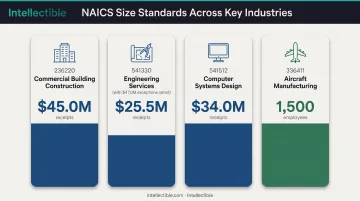
Examples of current NAICS thresholds:
| NAICS | Industry | Threshold |
|---|---|---|
| 236220 | Commercial Building Construction | $45.0M receipts |
| 541330 | Engineering Services | $25.5M receipts (exceptions: $47.0M) |
| 541512 | Computer Systems Design Services | $34.0M receipts |
| 336411 | Aircraft Manufacturing | 1,500 employees |
Choose carefully: Your selected NAICS codes must accurately reflect your business activities. Misrepresenting size or capabilities can result in penalties, including disqualification from set-aside competitions.
Small Business Certifications
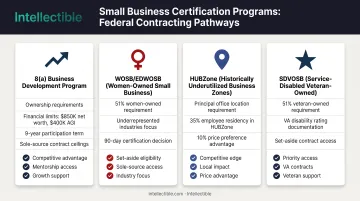
Certifications give you access to set-aside contracts with reduced competition. The main programs include:
8(a) Business Development Program:
- For small, socially and economically disadvantaged firms
- Must be at least 51% owned and controlled by qualifying U.S. citizens
- Owner financial limits: $850K net worth, $400K adjusted gross income, $6.5M assets
- Provides 9-year program participation
- Sole-source ceiling: $5.5M (services) or $8.5M (manufacturing)
- Application decision within 90 days of complete submission
Women-Owned Small Business (WOSB/EDWOSB):
- At least 51% owned and controlled by U.S. citizen women
- EDWOSB (Economically Disadvantaged WOSB) adds financial limits
- Set-asides in industries where women are underrepresented
- Decision within 90 days when practicable
HUBZone:
- Principal office in a HUBZone
- At least 35% of employees reside in a HUBZone
- Provides set-asides and a 10% price-evaluation preference in full-and-open competition
Service-Disabled Veteran-Owned Small Business (SDVOSB):
- At least 51% owned and controlled by VA-rated service-disabled veterans
- Access to SDVOSB set-asides and sole-source opportunities
Certifications take time but are worth pursuing if you're eligible. Eligible firms gain set-asides with fewer competitors and a clearer path to targeted wins.
Finding & Evaluating Opportunities
Where to Find Government Contracting Opportunities
Primary Sources:
- SAM.gov Contract Opportunities: Central federal repository for pre-solicitation, solicitation, award, and sole-source notices. Replaced FedBizOpps in November 2019.
- Agency procurement forecasts: Most agencies publish annual acquisition plans highlighting upcoming opportunities.
- GSA eBuy: Tool for federal buyers to post requirements, request quotes, and conduct RFIs for GSA Schedule holders.
- APEX Accelerators (formerly PTACs): Free local resources offering no-cost government contracting guidance nationwide.
Understanding Solicitation Types
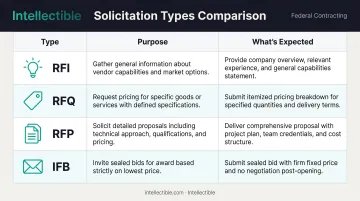
Federal buyers use different solicitation formats depending on the requirement:
| Type | Purpose | What's Expected |
|---|---|---|
| RFI (Request for Information) | Market research before formal solicitation | Input on solutions, capabilities, pricing approaches—not a binding offer |
| RFQ (Request for Quotation) | Pricing for defined needs, often standard products/services | Quote with pricing; evaluation emphasizes price and delivery |
| RFP (Request for Proposal) | Detailed solution including approach, capability, and price | Comprehensive proposal addressing technical, management, past performance, and price factors |
| IFB (Invitation for Bid) | Sealed bidding under FAR Part 14, typically emphasizing price | Bid with pricing; award generally goes to lowest responsive, responsible bidder |
Developing Your Go/No-Go Process
Not every opportunity deserves a bid. Pursuing the wrong opportunities drains resources, lowers win rates, and demoralizes teams. Experienced GovCon teams qualify opportunities rigorously before committing proposal resources.
Key Evaluation Criteria:
- Capability alignment: Can you deliver the scope with existing staff and resources?
- Competitive positioning: Do you have differentiators, incumbency, or relationships?
- Past performance requirements: Do you meet the minimum qualifications?
- Contract size and profitability: Does the value justify the pursuit cost?
- Relationship with agency: Have you engaged the customer or identified a teaming partner?
The Challenge of Scale:
As teams grow, managing multiple simultaneous opportunities becomes much harder. Tracking dozens of notices, parsing complex RFPs, coordinating capture activities, and maintaining compliance across pursuits requires systematic operations.
Workflow automation platforms like Intellectible reduce opportunity evaluation time by 95%+ and increase qualified pipeline by 150%+, helping teams make faster Go/No-Go decisions without adding headcount.
Pipeline Management for GovCon Teams
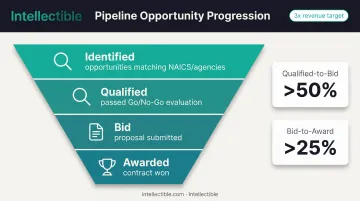
Maintain a pipeline 3x your revenue target. Not every qualified opportunity results in a bid, and not every bid wins. A healthy pipeline accounts for attrition at each stage.
Track opportunities through stages:
- Identified: Opportunities matching your NAICS codes, agencies, or scope
- Qualified: Passed Go/No-Go evaluation; assigned to pursuit team
- Bid: Proposal submitted; awaiting evaluation
- Awarded: Contract won; transitioning to delivery
Monitor conversion rates at each stage. If your qualified-to-bid rate drops below 50%, tighten qualification criteria. If your bid-to-award rate falls below 25%, revisit competitive positioning and proposal quality.
Understanding Contract Types & Vehicles
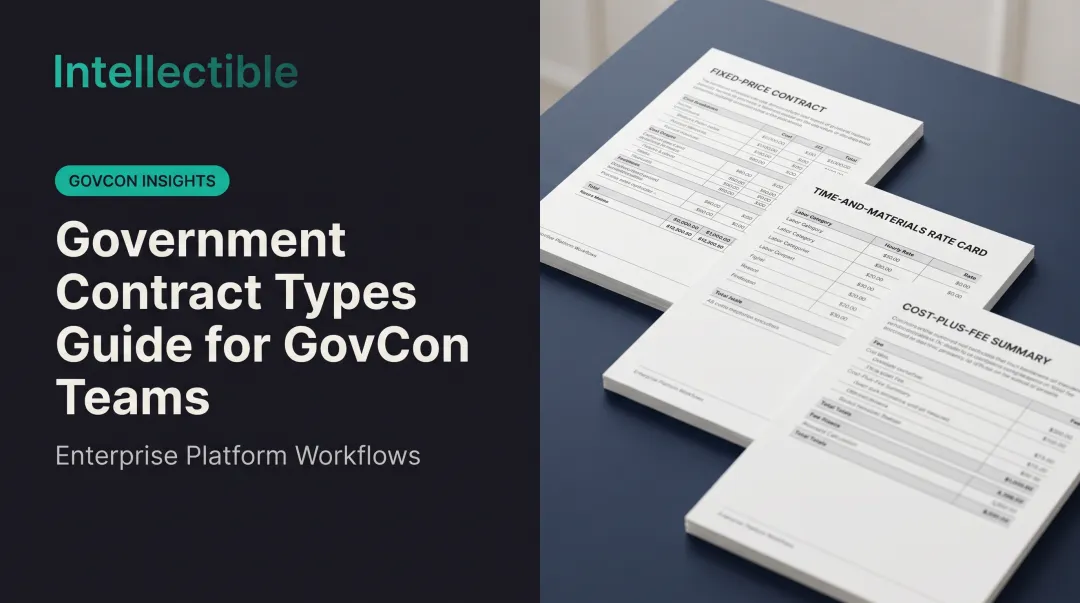
Primary Federal Contract Types
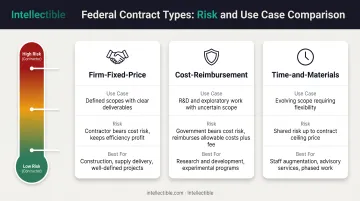
The contract type determines who bears performance risk—you or the government. Choose the wrong type, and you may lose money even when you deliver successfully.
Firm-Fixed-Price (FFP):
- Use case: Well-defined requirements with predictable costs
- Risk: Contractor bears all cost risk; price doesn't adjust for overruns
- Reward: Keep any profit from efficient delivery
- Best for: Commercial products, recurring services, clearly scoped projects
Cost-Reimbursement:
- Use case: Uncertain scope or costs, common in R&D
- Risk: Government reimburses allowable costs plus fee; assumes cost risk
- Reward: Lower financial risk for contractor; fee negotiated upfront
- Best for: Research, development, complex technical efforts with unknowns
Time-and-Materials (T&M):
- Use case: Scope or duration uncertain; no other type suitable
- Risk: Government pays labor hours and materials at agreed rates up to a ceiling
- Reward: Flexibility to adjust as requirements evolve
- Best for: Staff augmentation, support services, projects with evolving needs
Contract Vehicles & Mechanisms
Contract type sets the risk split. Vehicles and pursuit paths decide where work shows up and how you compete for it.
GSA Multiple Award Schedules (MAS):
Pre-negotiated contracts with government-approved pricing that speed up ordering for agencies. FY 2024 MAS sales exceeded $51.5 billion. Schedule holders can compete for task orders through GSA eBuy and other channels.
Indefinite Delivery/Indefinite Quantity (IDIQ):
Framework contracts allowing agencies to issue task orders as needs arise. IDIQs establish terms, pricing, and ordering procedures upfront, then release specific requirements over time. They're ideal for recurring needs with unpredictable timing or quantities.
Government-Wide Acquisition Contracts (GWACs):
Pre-competed, multiple-award IDIQs for IT solutions available to all federal agencies. GSA manages several GWACs including Alliant 2, 8(a) STARS III, and VETS 2.
Subcontracting:
Working under a prime contractor is often the fastest entry path for small businesses. It builds past performance, establishes relationships, and provides revenue while you develop capabilities for prime pursuit.
Set-Asides & Preference Programs
Small business set-asides restrict competition to qualified small businesses only. The Rule of 2 requires contracting officers to set aside acquisitions when they reasonably expect offers from at least two small businesses at fair market prices.
Set-asides can be:
- Competitive: Multiple qualified firms compete
- Sole-source: Awarded directly to one firm (subject to dollar thresholds and justification)
When set-asides apply, large businesses and ineligible firms cannot compete. That improves your odds in a real way.
The Bidding & Proposal Process
Capability alone does not win federal contracts. You still have to prove it in a clear, compliant proposal that can compete on the agency's terms.
Typical Proposal Components
- Technical approach: How you'll perform the work, methodology, staffing, management plan
- Past performance: Relevant contracts demonstrating your capability and quality
- Pricing: Cost or price breakdown, supporting rationale
- Small business utilization plan: Subcontracting commitments (if applicable)
Critical Success Factors
Follow instructions exactly. Agencies disqualify non-compliant proposals. If the RFP sets font size, page limits, section order, or submission format, meet every requirement with no improvising.
Address all evaluation criteria. Section M shows how the agency will score you. Map each factor to your response. If past performance is worth 30%, give that section matching space and quality.
Know the source selection approach.
- Best value tradeoff: The agency may pay more for a stronger technical solution—lead with real differentiators.
- Lowest Price Technically Acceptable (LPTA): Award goes to the lowest-priced acceptable offer. Prioritize compliance and competitive pricing over polish that will not be scored.
Use past performance with intent. It carries heavy weight in federal evaluations. New contractors can:
- Cite subcontract work under federal primes
- Reference comparable private-sector projects
- Pursue smaller set-asides built for new entrants
- Partner with experienced teammates
Prepare for oral presentations. Many agencies hold orals or discussions after written submissions. Coach key personnel to explain the approach cleanly and handle technical questions without hedging.
Building Your GovCon Operations for Scale
Winning one contract is a milestone. Winning consistently requires operational discipline.
Ad-hoc approaches work for one or two simultaneous pursuits. Beyond that, you need defined roles, systematic workflows, and scalable processes.
Define Responsibilities
- Who finds opportunities? Business development or capture managers monitor SAM.gov, forecasts, and agency engagements.
- Who qualifies them? Capture teams apply Go/No-Go criteria and conduct competitive analysis.
- Who manages proposals? Proposal managers coordinate writers, SMEs, reviewers, and compliance.
- Who maintains compliance? Contracts or operations staff track FAR obligations, reporting, and renewals.
Systematize Workflows
Roles alone are not enough once pursuits multiply. You also need connected workflows for opportunity tracking, collaboration, and compliance so handoffs do not stall.
Platforms like Intellectible give teams a visual workflow builder that ties discovery through proposal submission into one operating system. That structure helps you scale pursuit volume—often toward 10x revenue capacity—without adding headcount.
Post-Award: Compliance & Contract Management
Federal Acquisition Regulation (FAR) Compliance
The FAR is the primary rulebook governing federal procurement. All executive agencies use it to acquire supplies and services with appropriated funds.
Defense contracts also follow the Defense Federal Acquisition Regulation Supplement (DFARS), which adds DoD-specific requirements on top of the FAR baseline.
Consequences of non-compliance vary by violation. FAR Subpart 9.4 identifies conduct that may support suspension or debarment. Knowingly false claims can trigger False Claims Act liability: three times government damages plus statutory penalties.
Ongoing Contract Obligations
Reporting Requirements:
- GSA Schedule sales: Report quarterly through the GSA portal
- Labor hours: Track and report as specified in your contract
- Subcontracting plans: Document small business utilization and submit periodic reports
Invoicing and Payment:
Standard federal payment is due 30 days after the government receives a proper invoice or accepts delivery, whichever is later. Fast Payment procedures reduce this to 15 days under specific conditions. Late payments automatically accrue interest.
Renewals:
Maintain your SAM.gov registration annually. Letting it lapse makes you ineligible for new awards and may delay payment on existing contracts.
Performance & Relationship Management
Your past performance record determines future opportunities. Agencies evaluate contractors on quality, timeliness, cost control, and customer satisfaction. Strong performance leads to:
- Favorable past-performance references for future bids
- Contract renewals or extensions
- Modifications adding scope or value
- Follow-on opportunities and recompetes
Build relationships with contracting officers, program managers, and technical leads. Stay visible. Deliver reliably. Federal contracting rewards consistency.
Frequently Asked Questions
What are the fundamentals of government contracting?
Register in SAM.gov (mandatory, free, up to 10 business days) and map your market—federal vs. state/local. Find opportunities on SAM.gov and agency forecasts, comply with FAR, and deliver quality work that builds past performance for future bids.
How do you win government contracts as a beginner?
Start with smaller set-asides or subcontracts and use small business certifications where you qualify. Build agency relationships, bid selectively on strong-fit opportunities, and learn procurement rules and proposal best practices.
What is the Rule of 2 in government contracting?
The Rule of 2 requires contracting officers to set aside contracts for small businesses when they reasonably expect at least two small businesses will submit competitive offers at fair market prices. This mandate creates exclusive small business competitions.
How long does it take to get started in government contracting?
SAM registration takes up to 10 business days. Certifications (8(a), WOSB) typically require 90 days after submitting a complete application. You can bid on opportunities within 1-2 months of registration, though relationship building and market positioning should start earlier.
What's the difference between GSA Schedule and other contract vehicles?
GSA Schedules are pre-negotiated contracts with government-approved pricing that streamline buying for agencies. They allow faster ordering without full RFP competitions. Other vehicles like IDIQs or stand-alone RFPs require individual solicitations, proposals, and awards.
Do I need past performance to win my first government contract?
While past performance is heavily weighted, beginners can start with subcontracts to build federal experience, leverage similar private-sector work, or pursue smaller set-aside opportunities designed for new entrants. FAR allows neutral evaluation when no relevant past performance exists.