Government pricing isn't like commercial quoting. FAR 15.408 requires line-item pricing tied to totals, cost breakdowns that match your accounting system, and time-phased labor rates by category. Get any of that wrong, and you're disqualified, or worse, facing a DCAA audit finding months later.
Manual spreadsheets can't keep up. Contract pricing software automates cost buildup, wrap rate calculations, and compliance checks, cutting hours of rework and speeding up Go/No-Go decisions. This comparison covers five platforms built specifically for federal, state, and prime/sub government contractors: Intellectible, ProPricer, Deltek Costpoint, Unanet, and JAMIS Software.
TL;DR
- Automates cost buildup, wrap rates, and compliance checks so government proposals stay audit-ready
- Choose based on contract vehicle complexity, team size, and ERP/GovCon system fit
- Side-by-side look at Intellectible, ProPricer, Deltek Costpoint, Unanet, and JAMIS Software
- Prioritize audit trail control, DCAA/FAR support, speed to final pricing, and ease of use
Overview of Contract Pricing Software in the Government Contracting Market
Contract pricing software builds, validates, and audits cost and price proposals against FAR, DFARS, and agency-specific requirements. That means cost-element breakdowns aligned to your accounting system, time-phased labor rates, and indirect cost bases—plus documentation a contracting officer or DCAA auditor can actually follow.
These tools sit inside the broader capture-to-contract lifecycle. Each handoff runs on a short clock:
- Capture teams identify opportunities
- Proposal teams write the technical volume
- Pricing teams build the cost volume
Deadlines are often measured in days, not weeks, so the tool you pick has to plug into that timeline without becoming its own bottleneck. Below is how five leading options stack up for that job.
Top Contract Pricing Software for Government Contractors
We evaluated each tool on five criteria: pricing accuracy, compliance depth, speed to final pricing, audit trail strength, and integration flexibility.
Intellectible
Intellectible is a horizontal AI build platform that combines production-ready pricing and revenue engines with a full developer suite. Contractors get a configurable Pricing Engine alongside a GovCon Engine, proposal automation, and CRM/operations tools on one platform. Clients include Oceus and HHS.
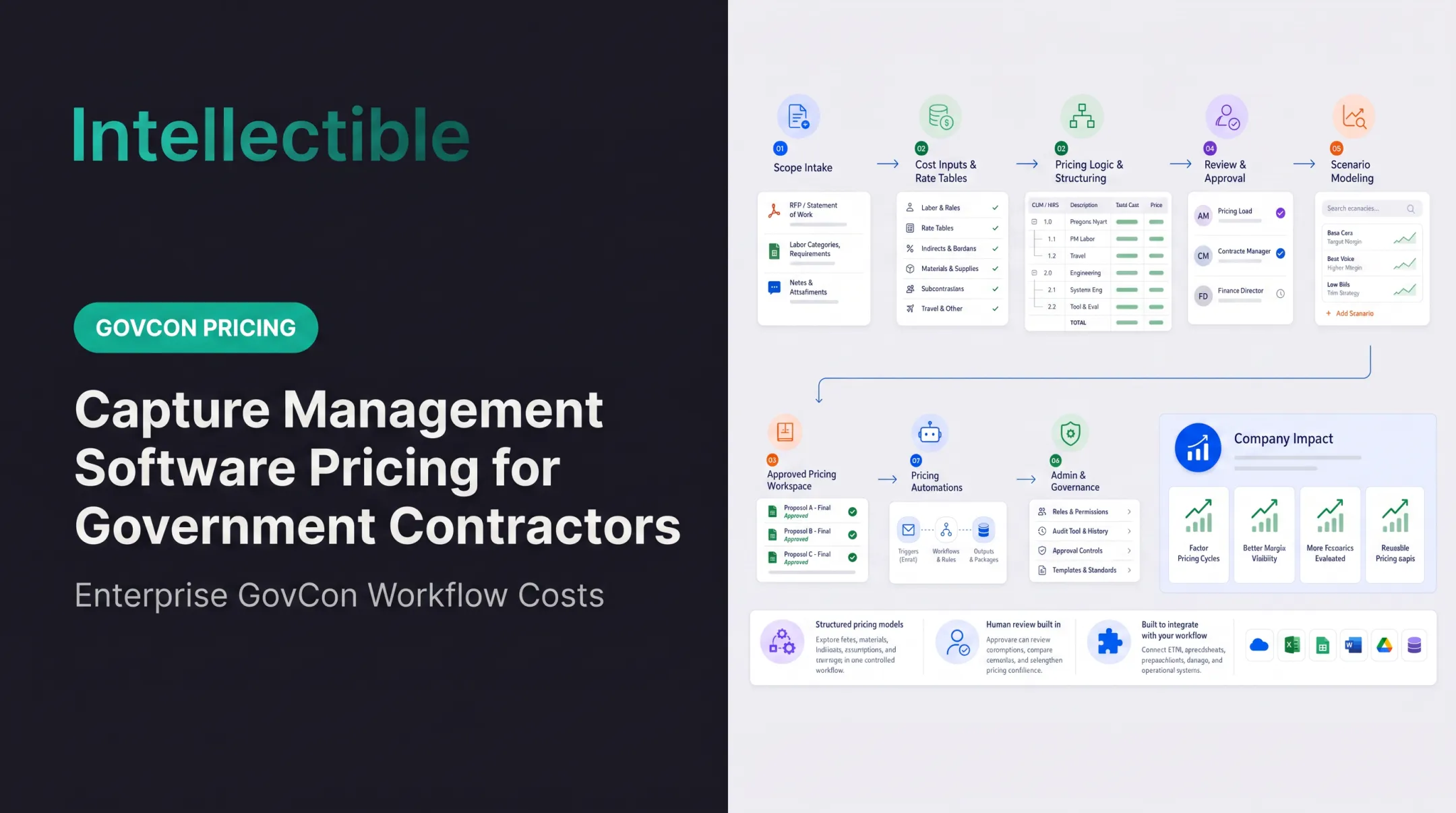
The Pricing Engine runs a five-stage workflow: Intake → Extract → Review Assumptions → Build Cost Model → Publish Pricing. AI extracts pricing inputs from RFPs, scope documents, surveys, and CRM notes, then a configurable costing workspace models labor, rates, geography, service levels, materials, travel, utilization, and risk.
What sets it apart:
- 90% reduction in time to final pricing, with traceable inputs, documented assumptions, and approval routing
- A visual workflow builder connecting AI, data, documents, and business logic in one canvas
- Zero added headcount required to scale pricing operations as volume grows
- Scenario modeling (base, competitive, protective, incumbent-displacement) built into the cost model
| Aspect | Details |
|---|---|
| Key Features | Visual pricing workflows, PostgreSQL-backed data, full audit trail, React-based pricing dashboards |
| Best For | Contractors who want one platform for pricing plus adjacent revenue operations, instead of stitching together separate point tools |
| Pricing Model | Custom, platform-based pricing scaled to workflows deployed |

ProPricer
ProPricer is the clearest example of a dedicated cost/price proposal tool in this market. It's built specifically around basis of estimate (BOE) documentation, and it's widely used by primes for complex, auditable cost volumes.
Its cost structures span labor, overhead, G&A, CLINs, and WBS elements, with rate build-ups and narratives synchronized directly to pricing data. The escalation module handles labor rate increases over multi-year periods using base dates and base rates.
BOEs attach to tasks with reusable libraries, version control, and read-only prior versions. That history helps when an auditor asks how a number changed between drafts.
ProPricer also integrates with Microsoft Excel through a dedicated add-in, letting analysts work in a familiar interface while pulling live proposal data. Deltek reports ProPricer users saw 75% faster bid cycles and 50% more proposals, though that's a vendor-reported figure worth validating against your own workflow.
| Aspect | Details |
|---|---|
| Key Features | Cost element breakdowns, labor rate escalation, BOE documentation with version history |
| Best For | Contractors needing detailed, auditable cost volumes for complex, multi-year proposals |
| Pricing Model | Concurrent-use licensing via Essentials or Enterprise packages; exact seat/site pricing quoted directly by Deltek |

Deltek Costpoint
Costpoint is an ERP-grade platform built for GovCon accounting: indirect rate management, project accounting, timekeeping, and compliance reporting all live in one system. Deltek positions ProPricer as the dedicated pricing tool and Costpoint as the accounting backbone, so think of these two as companions rather than competitors.
Costpoint's strength is tying pricing decisions directly to your live accounting data. Indirect rates, cost pools, and DCAA-compliant timekeeping feed straight into reporting, including SF-1408 and incurred-cost-proposal reports.
- Costpoint Essentials is publicly listed at $800/month for a 10-user license, with implementation included, aimed at small and growing contractors
- Enterprise licensing structure isn't publicly disclosed
- Deltek/Nucleus Research attributes a 33% reduction in audit risk to Costpoint users, though that figure is tool-specific, not a market average
| Aspect | Details |
|---|---|
| Key Features | Indirect rate calculation, integrated project accounting, DCAA-audit-ready compliance reporting |
| Best For | Established contractors who need pricing tied directly to their existing accounting system |
| Pricing Model | $800/month for Essentials (10 users); enterprise tiers are quote-based |

Unanet
Unanet blends CRM capture with project-based ERP, giving contractors pipeline visibility from opportunity identification through pricing and into project execution. It's positioned as a mid-market alternative to heavier ERP suites.
Its CRM module tracks opportunities, win rates, and open bids, then feeds proposal and pricing automation using past estimates and reusable content.
Once a bid is won, that data flows into project budgets, actuals, burn rates, and profitability tracking in a shared, real-time database.
- Strong CRM-to-pricing pipeline visibility (capture teams and pricing analysts see the same data)
- More accessible than heavyweight ERP suites for smaller teams
- No public subscription tiers; pricing is quote-based
| Aspect | Details |
|---|---|
| Key Features | Budgeting, project cost tracking, CRM-linked opportunity pricing |
| Best For | Small to mid-size contractors who want pricing directly connected to their CRM pipeline |
| Pricing Model | Subscription-based, quote provided directly by Unanet |
JAMIS Software
JAMIS is a GovCon-focused ERP built around compliance from the ground up. Its Finance and Project Accounting Suite segregates direct, indirect, and unallowable costs per FAR Part 31 and CAS requirements, with detailed cost tracking by contract, project, and subtask.
JAMIS states its system helps customers meet DCAA, CAS, and FAR requirements, though that's a vendor positioning claim, not a certification guarantee. Configurable rate types and rate-lookup rules give contractors flexibility for niche contract structures that generic tools can't handle.
- Automated direct/indirect cost tracking with a complete audit trail
- Configurable for complex or unusual contract types
- No public pricing tiers; JAMIS offers a demo and consultation instead
| Aspect | Details |
|---|---|
| Key Features | DCAA-compliant cost tracking, configurable pricing templates, detailed reporting |
| Best For | Contractors with strict compliance and audit requirements, or complex contract types |
| Pricing Model | Quote-based enterprise pricing following a demo/consultation |
How We Chose the Best Contract Pricing Software
Plenty of contractors default to generic CPQ tools, and it usually backfires. Standard CPQ software wasn't built for FAR-driven cost-element breakdowns or DCAA audit expectations. It handles commercial quoting logic, not the labor-rate-by-category detail a contracting officer will ask about.
We weighed five factors:
- Compliance depth — Does the tool support FAR 15.408 requirements: line-item detail, cost-element breakdowns, indirect cost bases?
- Audit trail strength — Can you reconstruct every assumption and approval if DCAA comes calling?
- Accounting integration — Does pricing data connect cleanly to your existing ERP, or does it live in a silo?
- Speed to final pricing — How much manual reconciliation does the team avoid?
- Scalability without added headcount — Can pricing volume grow without proportional staff growth?

NCMA's guidance on cost analysis stresses documentation and a verifiable methodology, whether you're a prime, subcontractor, or supplier. We scored each tool against that standard rather than marketing claims alone.
Conclusion
There's no universal "best" pricing tool here. The right fit depends on your contract vehicle complexity and compliance obligations. It also depends on whether you're building a dedicated cost volume, running an ERP-integrated pricing shop, or scaling pricing operations without adding analysts.
Before you commit, evaluate:
- How much audit trail control does the platform actually give you?
- Does it integrate with the accounting or CRM system you already run?
- What's the realistic time-to-price improvement over your current spreadsheet process?
If you need governed pricing workflows with room to expand into adjacent revenue operations, explore Intellectible. AI-driven pricing workflows scale without added headcount.
Frequently Asked Questions
What should a pricing group expect the software to take over?
Cost buildup, compliance checking, and the audit record — the parts of a cost volume that are mechanical but unforgiving. What stays with the team is judgment: rate strategy, risk posture, and the assumptions behind the number. Tools that blur that line tend to produce prices nobody can defend.
How is contract pricing software different from general CPQ tools?
General CPQ tools handle commercial quoting logic, not FAR/DCAA-specific cost element structures. GovCon pricing tools build in compliance requirements, like time-phased labor rates and indirect cost documentation, that standard CPQ software doesn't support.
How much does government contract pricing software cost?
Pricing ranges widely, from roughly $800/month for entry-level ERP packages to custom enterprise quotes for platforms with deeper compliance and integration needs. Most vendors quote based on user count, contract complexity, or workflows deployed.
Do I need DCAA compliance features in my pricing tool?
If you hold or expect cost-reimbursement contracts, DCAA compliance features matter. Fixed-price contractors without audit exposure may need less rigorous compliance tooling, but documentation still helps if agencies request it later.
Can contract pricing software integrate with my existing ERP or CRM?
Most modern GovCon pricing tools offer integration options through APIs, webhooks, or authenticated connections. Depth varies by vendor, so test the actual integration before signing a contract, not just the sales demo.
What's the fastest way to reduce time spent on final pricing?
Automated workflows with built-in audit trails cut pricing time more than manual spreadsheets. Platforms like Intellectible report a 90% reduction in time to final pricing by automating intake, cost modeling, and approval routing in one connected workflow.