Introduction
When federal proposal teams respond to government RFPs, they compete against dozens of experienced contractors for the same award. The difference between winning and losing often comes down to a single evaluation point or one overlooked compliance requirement.
A 2025 practitioner poll by Lohfeld Consulting found that proposal professionals attribute 57% of quality gains to early strategic reviews, and another 34% to independent assessments closer to deadline.
The proposal review process is a structured, multi-stage evaluation of draft content. It validates compliance, sharpens competitive positioning, and removes weaknesses before submission.
In GovCon, Section L non-compliance can mean immediate rejection, and Section M criteria drive scoring. Systematic reviews are the quality gate that protects your pursuit investment—not optional overhead.
This guide covers what proposal reviews are, why they matter for GovCon teams, how to run them with Color Team methodology, and what separates useful reviews from time sinks.
Key Takeaways
- Pink, Red, and Gold Team cycles validate compliance and strengthen win themes before submission
- Section L/M gaps (missing signatures, amendments, or attachments) trigger rejection in GAO cases
- Independent reviewers, recovery time for feedback, and audit-trail tools make reviews effective
- Late reviews and vague comments waste the window when course corrections cost least
What Is the Proposal Review Process?
The proposal review process is a structured evaluation of draft proposals before they go to the agency. Subject matter experts, independent reviewers, and proposal leadership check compliance gaps, strengthen the solution narrative, validate pricing alignment, and make the offer clear to evaluators.
A strong review produces a compliant, competitive proposal that answers Section M criteria, backs the value proposition with past performance, and reduces weaknesses that drag down technical scores or invite evaluator questions.
Reviews are not final proofreading (typos and formatting in a finished book) and not capture planning (which happens before writing). They judge draft content quality, compliance, and competitive positioning while the proposal is still being built.
What reviews validate:
- Every Section L instruction has a corresponding proposal response
- Technical approach feasibly supports the Statement of Work within the proposed budget
- Past performance examples directly support stated discriminators and technical claims
- Win themes appear consistently across all volumes with supporting proof points
- Evaluators will understand the solution without assuming government or technical background
- Pricing aligns with staffing levels, labor categories, and technical approach described in narrative sections
Done well, reviews turn SME draft material into evaluator-focused narrative and catch mismatches among technical approach, past performance, and price before those gaps cost points.
Why Proposal Reviews Are Critical in GovCon
Federal procurement regulations codified in FAR Part 15 require agencies to place proposal preparation instructions in Section L and evaluation factors in Section M, then evaluate proposals solely against those disclosed criteria. This creates a binary compliance requirement: either your proposal addresses every mandatory Section L instruction and presents content aligned with Section M evaluation factors, or it doesn't. There's no partial credit for good intentions.
The compliance consequence is rejection. In Distributed Solutions, Inc. (B-416394, 2018), the Space and Naval Warfare Systems Command rejected a proposal that lacked original signatures, failed to acknowledge amendments, omitted required completed forms, and used improper cross-references to previous proposals instead of providing requested information. GAO denied the protest. The proposal never received a technical evaluation because it failed fundamental Section L compliance.
In Hometown Veterans Medical, LLC (B-422751, 2024), the Department of Veterans Affairs rejected four of eight proposals during an initial compliance screening when they failed to attach responses required by specific FAR clauses. GAO ultimately sustained that protest because the RFP hadn't disclosed the attachment requirement as an evaluation basis—but the screening itself shows how quickly noncompliant submissions get cut.
Reviews catch what immersed writers miss. When authors spend weeks on technical solutions and narrative responses, they develop "writer's blindness": gaps in logic, missing requirement responses, and unclear explanations that outside evaluators spot immediately.
Independent reviewers simulate the evaluator role. They read without the writer's context and flag unsupported claims, unexplained assumptions, and requirements that simply go unanswered.
Competitive scoring demands reviewer validation. Government evaluators assign scores using the evaluation criteria and relative weights disclosed in Section M. A technically excellent solution that fails to address stated evaluation criteria will score poorly. Reviews simulate this scoring process before submission, enabling proposal teams to identify and strengthen sections that would receive low marks.
What Typically Fails Without Structured Reviews
- Compliance failures — missing signatures, unacknowledged amendments, skipped mandates, or formats that violate Section L
- Weak discriminators — nothing that sets your solution apart, so evaluators have no reason to score you higher
- Unsupported past performance — relevant experience claimed without enough detail on scope, capability, or outcomes
- Pricing disconnects — technical staffing that doesn't match labor categories and hours in the cost volume
- Unclear win themes — messages that never crystallize, so evaluators can't recognize or remember them while scoring
Deltek's 2021 GovCon industry study reported that federal contractors averaged a 40% proposal win rate (35% median) in 2020. Most proposals lose. Systematic reviews are one of the few quality-control levers teams control before that score is final.
How the Proposal Review Process Works
The proposal review process flows through three evaluation gates tied to draft maturity and what each cycle must validate:
- Pink Team (30–50% draft): Confirms win strategy, compliance planning, and technical approach before heavy writing investment
- Red Team (75–90% draft): Independent scoring that simulates government evaluation and surfaces weaknesses
- Gold Team (95–100% draft): Final compliance, formatting, and submission-readiness checks
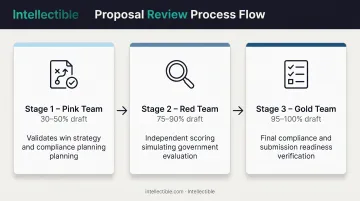
Catch strategic misalignment early, when fixes cost the least. Later gates tighten competitive positioning while schedule remains, then lock compliance before submission.
What Goes Into Reviews
Inputs include:
- Draft proposal sections at the maturity level required for that cycle
- Compliance matrices mapping Section L requirements to proposal responses
- Evaluation criteria scorecards derived from Section M
- Reviewer assignments based on expertise, independence, and evaluator perspective
- Review timelines with enough recovery time to act on feedback before the deadline
- Specific instructions defining what each cycle should validate
Outputs include:
- Actionable feedback with severity ratings (critical vs. improvement)
- Compliance gap identification showing which requirements lack responses
- Competitive assessment of where the draft would score poorly against Section M
- Prioritized revision guidance so remaining time goes to highest-impact fixes
Pink Team Review (30-50% Draft)
Pink Team reviews validate win strategy, proposal structure, compliance planning, and technical approach before teams invest heavily in prose. The goal is simple: avoid late-stage rewrites caused by the wrong strategy or missed requirements.
Reviewers should include:
- Capture manager who developed the pre-RFP strategy
- Proposal manager responsible for coordinating development
- Solution architects who will execute the technical approach
- Pricing lead who will build the cost volume
- Fresh perspective reviewers not immersed in daily proposal work
What Pink Team evaluates:
- Are win themes clear, defensible with past performance, and distinct from likely competitor approaches?
- Does the proposal outline address all Section L requirements with appropriate section mapping?
- Is the technical approach feasible within the stated budget and schedule?
- Does identified past performance support the discriminators we're claiming?
- Do technical, management, and past performance volumes tell a coherent story?
- Does the team agree on what makes this proposal different from competitors?
Shipley Associates recommends running Pink Team before prose is drafted, using storyboards, section mockups, or detailed writing plans to test win strategy execution. That early check keeps teams from writing volumes of content in the wrong direction.
Red Team Review (75-90% Draft)
Red Team is the most critical review cycle. Independent reviewers who were not involved in development simulate the government evaluator role. They score the draft against Section M criteria and flag weaknesses, gaps, and unclear content that would lower technical scores.
Reviewers should be:
- Independent subject matter experts not involved in writing or daily proposal coordination
- Former government evaluators when possible, who understand agency evaluation perspective
- Senior proposal professionals capable of objectively assessing competitive positioning and compliance
- Technical specialists who can validate solution feasibility and staffing alignment
Keep proposal writers, volume leads, and core management who built the content off the Red Team roster.
What Red Team evaluates:
- Does every proposal section directly address the corresponding Section M evaluation criteria?
- Are technical claims supported with specific past performance examples that prove capability?
- Do win themes appear consistently throughout all volumes with concrete proof points?
- Would evaluators understand the solution without specialized government or technical background?
- Are there compliance gaps where Section L requirements lack clear responses?
- Which sections would score poorly if evaluated today against the stated criteria?
OST Global Solutions recommends scheduling Red Team at approximately 70% of elapsed proposal schedule time, when the draft is 90% customer-ready and page count is within 95% of target limits. These benchmarks reflect practitioner planning guidance rather than empirically validated thresholds, but they establish clear maturity gates.
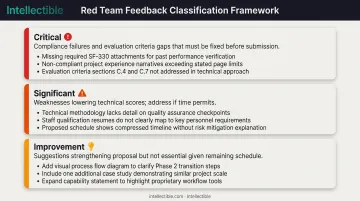
The Red Team deliverable is specific, actionable feedback with severity ratings:
- Critical: Compliance failures or evaluation criteria gaps that must be fixed
- Significant: Weaknesses that would lower technical scores and should be addressed if time permits
- Improvement: Suggestions that would strengthen the proposal but aren't essential given remaining schedule
Severity ratings tell the team what must ship fixed versus what can wait when the clock is short.
Gold/White Glove Review (95-100% Draft)
Gold Team conducts the final compliance verification, formatting validation, and submission readiness check rather than evaluating content strategy or technical approach. The objective is ensuring nothing broke during final production and all Section L submission requirements are met.
What Gold Team validates:
- Final compliance matrix confirms all requirements addressed with specific proposal section references
- Volumes meet page limits specified in Section L
- Required certifications, representations, and attachments are included
- Formatting follows RFP instructions for fonts, margins, headers, and organization
- No formatting errors were introduced during final production
- Submission package is complete per Section L instructions
APMP's Winning Business Ecosystem and Shipley Associates both recommend Gold Team as an executive sign-off gate, often including a page-turn where leadership reviews the final physical proposal before authorizing submission. This provides a final decision point before committing to the proposal as submitted.
Where the Proposal Review Process Is Applied
Types of Proposals Requiring Formal Reviews
Structured Color Team reviews are most valuable for:
- Competitive federal RFPs and RFQs where multiple contractors will submit proposals and scoring determines award
- IDIQ task orders above simplified acquisition threshold where competition is required and evaluation criteria are stated
- Complex proposals with separate technical, management, and past performance volumes requiring coordination across multiple writing teams
- High-value opportunities where the pursuit investment justifies dedicated reviewer time and review infrastructure
Review Timing in the Proposal Lifecycle
Pink Team runs after proposal outlines and compliance matrices are approved, but before heavy prose writing begins (typically 30-50% through the schedule). That window lets you correct strategy before content investment piles up.
Red Team sits at the "draft complete" stage, when every section exists in narrative form and can be evaluated meaningfully, yet enough calendar remains for substantial revisions. Most teams schedule it at 75-90% through the proposal timeline.
Gold Team falls in the final 48-72 hours before the submission deadline. By then Red Team changes are in and production is finished, so the focus narrows to compliance verification and formatting checks.
Triggers That Require More Rigorous Reviews
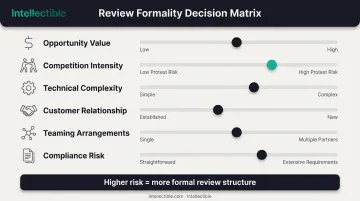
Scale review formality based on:
- Opportunity value - Higher contract values justify more reviewer investment
- Competition intensity - Protests, incumbent displacement, or known strong competitors warrant independent assessment
- Technical complexity - Solutions requiring coordination across multiple technical disciplines benefit from expert review
- Customer relationship maturity - New agency relationships increase risk of misunderstanding evaluation priorities
- Teaming arrangements - Proposals requiring coordination across prime and subcontractor teams need structured validation
- Compliance risk - RFPs with extensive Section L requirements, multiple amendments, or ambiguous instructions require systematic checking
APMP and Shipley both emphasize that Color Team reviews should be tailored to pursuit size, complexity, and environment. Review formality should scale with risk. Small task orders may need only internal peer review and compliance verification. Large competitive programs call for the full Pink/Red/Gold structure with independent external reviewers.
Key Factors That Affect Review Effectiveness in GovCon
Reviewer Selection Drives Review Value
Independent reviewers provide objectivity that internal proposal teams inherently lack. Writers who developed the technical approach and crafted the narratives can't objectively assess whether evaluators will understand their logic or find their claims credible. They know too much context that won't appear in the final document.
Former government evaluators bring the agency perspective. Reviewers who have scored proposals for federal agencies recognize what evaluators look for, how they interpret evaluation criteria, and which patterns trigger questions or lower scores—insight you need to simulate a real evaluation.
Subject matter experts validate technical feasibility. Independent specialists can judge whether the solution will work, whether staffing supports the approach, and whether past performance examples actually demonstrate the claimed capabilities.
Proposal professionals catch compliance gaps. Experienced proposal managers and compliance specialists verify that every Section L requirement has a corresponding response and that evaluation criteria map to specific proposal content.
Lohfeld Consulting emphasizes that Red Team reviewers should not have participated in proposal development and must not review their own sections. This independence standard ensures reviewers can objectively assess the proposal rather than defending their own work.
Review Timing Determines Implementation Capacity
Early reviews prevent strategic misdirection. Pink Team reviews conducted when only outlines and storyboards exist allow teams to correct fundamental strategy or approach problems before drafting thousands of words in the wrong direction.
Mid-stage reviews deliver the most value when recovery time still exists. Schedule Red Team when 75-90% of the proposal schedule has elapsed, but 5-7 days of writing time remain, so the team can implement substantial changes before deadline. Reviews with no recovery window waste reviewer effort because recommendations never make it into the draft.
Last-minute reviews only surface what you can't fix. Scheduling Red Team 48 hours before submission leaves critical findings unaddressed and pushes teams to submit known weaknesses.
Deltek's research shows federal contractors averaged 40% win rates, meaning most proposals lose. When review timing doesn't allow implementation of feedback, teams forfeit the quality improvement that could differentiate their proposal from competitors.
Review Infrastructure and Tools
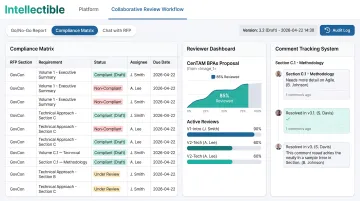
Collaborative review platforms enable distributed teams to comment on proposals simultaneously rather than sequentially, accelerating review cycles. Platform capabilities that support effective reviews include:
- Compliance matrices that reviewers use to verify all requirements are addressed with specific section references
- Scoring rubrics aligned with Section M evaluation criteria for consistent assessment across reviewers
- Comment tracking systems that assign resolution responsibility to specific proposal team members and track implementation status
- Version control that ensures reviewers evaluate current drafts rather than outdated versions
- Audit trails documenting all reviewer feedback and proposal team responses
Workflow platforms like Intellectible help distributed GovCon teams run that coordination in one place. You can map requirements to owners with deadlines, route drafts to SMEs and reviewers, and keep version history plus activity logs so accountability holds up under compressed timelines.
Pre-Review Alignment Sessions
Briefing reviewers on win strategy and discriminators focuses their assessment on whether those themes come through clearly in proposal content rather than second-guessing the competitive strategy.
Give reviewers the evaluation criteria and scoring guidance so they assess the proposal against the same factors government evaluators will use. Consistent inputs produce consistent feedback.
Setting clear expectations about review focus for each cycle prevents scope creep—Pink Team shouldn't nitpick grammar, Red Team shouldn't revisit fundamental strategy already validated, and Gold Team shouldn't suggest content rewrites when only compliance checking remains.
Schedule a debrief after each review so the proposal team understands the feedback, can ask clarifying questions, and can prioritize revisions before rewriting.
Common Review Process Mistakes in GovCon Proposals
Scheduling Reviews Too Late
The most costly mistake is scheduling Red Team reviews too close to the submission deadline, leaving too little time to act on feedback. That delay creates a cascade of problems:
- Reviewers flag critical compliance gaps or weak evaluation responses with no time left to fix them
- Proposal teams rush revisions and introduce new errors or formatting problems
- Reviewer effort is wasted because recommendations never make it into the draft
- Teams submit known weaknesses instead of a competitive proposal
Plan Red Team timing in blocks:
- 3–5 business days for reviewers to evaluate content and write feedback
- 1–2 days for debriefs
- 5–7 days minimum for writers to implement recommendations
Finishing the review fewer than 7 days before the deadline almost always leaves inadequate recovery time.
Providing Vague or Subjective Feedback
Comments like "strengthen this section" or "this feels weak" don't give writers enough to act on. Effective reviewer feedback specifies:
- What's missing - Which evaluation criteria or requirements aren't addressed
- Why it's weak - How the current content fails to meet stated evaluation factors
- What would fix it - Specific content, evidence, or past performance examples needed
Subjective opinions ("I don't like this approach") waste time unless the reviewer explains why evaluators would score the approach poorly against Section M criteria.
Failing to Validate Compliance Systematically
Compliance review failures occur when:
- Teams assume writers addressed every Section L requirement without systematic verification
- Compliance matrices aren't updated as proposal content evolves through review cycles
- No one traces evaluation criteria to specific proposal sections to confirm alignment
- Final Gold Team skips the requirement-by-requirement compliance check because "we already reviewed that"
The GAO cases cited earlier—Distributed Solutions and Hometown Veterans Medical—demonstrate that instruction-by-instruction compliance validation must be a formal review deliverable, not an assumption.
Using Only Internal Reviewers
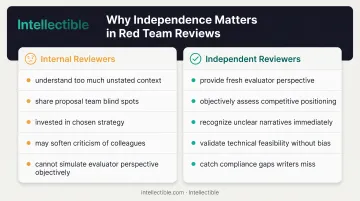
Proposal teams that review their own work share the same blind spots as the original writers. Internal reviewers:
- Can't objectively assess whether the proposal is competitive because they're invested in the chosen strategy
- Understand too much unstated context to recognize when narratives won't make sense to external evaluators
- May feel social pressure to soften criticism of colleagues' work
Independent reviewers who sat out proposal development bring the distance needed to judge the draft the way evaluators will—and to push scores up before submission.
When Proposal Reviews May Not Be Appropriate
Situations Where Formal Reviews Are Unnecessary
Full Pink/Red/Gold Color Team structure may not be justified for:
- Small opportunities under $1M: review overhead exceeds the benefit; external reviewer cost rarely pays off
- Sole-source contracts: compliance still matters, but competitive differentiation is less critical
- Compressed timelines (3–5 business days total): no room for real review cycles or recovery
- Simple, low-complexity proposals: straightforward services with minimal evaluation criteria
Constraints That Reduce Review Effectiveness
Formal reviews also lose value under these constraints:
- No independent reviewers: Internal-only peers beat no review, but you lose the evaluator simulation that makes Red Team useful
- Proposal still too incomplete: Missing sections, no past performance, or outlines instead of prose leave reviewers nothing real to score (Pink Team can use drafts; Red Team needs near-complete narratives)
- Culture won't act on feedback: If leadership overrules findings or writers ignore critical notes, the exercise wastes everyone's time
Even when formal Color Team reviews aren't feasible, basic compliance checking and peer review remain essential. The real choice is structured multi-stage reviews with independent reviewers versus streamlined internal validation, not whether to review at all.
Conclusion
The proposal review process validates compliance with Section L instructions and strengthens competitive positioning against Section M evaluation criteria. Structured Pink Team strategy checks, Red Team independent assessment, and Gold Team final verification raise proposal quality before submission to government agencies.
In competitive federal contracting, Deltek reports 40% average win rates, and GAO cases show that compliance failures trigger immediate rejection. Reviews are the quality control gate that protects the full pursuit investment: capture strategy, solution development, pricing analysis, teaming negotiations, and proposal writing.
Without structured reviews, teams risk disqualification for missed requirements, low technical scores from weak evaluation responses, or loss to competitors who invested in quality validation.
Review effectiveness depends on three factors:
- Plan with independent reviewers who think like evaluators, enough recovery time, and criteria aligned to the solicitation
- Execute with specific actionable feedback, systematic compliance checks, and scoring against Section M
- Follow through by implementing recommendations before the deadline, tracking critical findings, and verifying fixes in later review cycles
GovCon teams that treat reviews as evaluation gates—not last-minute checks—consistently submit more compliant, competitive proposals.
Frequently Asked Questions
What is the proposal review process?
The proposal review process is a multi-stage evaluation using Pink Team (strategy and compliance planning), Red Team (independent scoring that simulates government evaluators), and Gold Team (final compliance check). It confirms the draft meets Section L requirements and Section M evaluation criteria before submission.
What is the difference between Pink Team and Red Team reviews?
Pink Team reviews happen at 30-50% draft completion to validate win strategy, structure, and compliance planning before heavy writing. Red Team reviews score 75-90% complete drafts against Section M criteria to find weaknesses while time remains to fix them.
How long should a Red Team review take?
Plan 3-5 business days for reviewers to evaluate and write feedback, plus 1-2 days for debriefs. Writers then need at least 5-7 days to implement changes, so finish Red Team 7-10 days before the due date.
Who should participate in proposal reviews?
Use independent SMEs who did not write the draft, former government evaluators, senior proposal professionals, and technical or pricing specialists. Proposal writers and the core development team should not review their own work.
What's the biggest mistake teams make during proposal reviews?
Scheduling Red Team within days of the deadline. That leaves no time to act on feedback, forces rushed revisions that introduce new errors, and wastes reviewer effort when recommendations cannot be incorporated.
Do small government proposals need formal reviews?
Scale formality to opportunity size, competition, and complexity. Small task orders under $1M may need only peer review and compliance checks, while large competitive programs justify full Pink/Red/Gold reviews with independent external reviewers.