That's backwards. By the time a solicitation posts with its 15-30 day response window, the positioning window has already closed for anyone who wasn't paying attention earlier.
BD teams lose hours every week bouncing between SAM.gov and scattered agency forecast pages, each with different formats, update schedules, and thresholds. Many miss pre-RFP engagement opportunities entirely, things like Sources Sought responses, industry days, and capability briefings, simply because nobody had time to track the forecast that led there.
This article covers what forecast data actually is, why manual tracking fails at scale, and how purpose-built monitoring software turns fragmented forecast information into a structured, actionable pipeline.
Key Takeaways
- SAM.gov and agency forecast pages surface planned procurements before solicitations go live
- Manual tracking across inconsistent agency sources leaves real gaps in pipeline coverage
- Purpose-built software consolidates forecasts and feeds qualified leads into capture workflows
- Early engagement—before the RFP drops—lets BD teams shape requirements, not only respond
What Is a SAM.gov Procurement Forecast?
A procurement forecast is pre-solicitation planning information federal agencies publish so businesses—especially small and disadvantaged firms—can prepare before an RFP drops.
Under the Business Opportunity Development Reform Act of 1988, agencies must compile and share projections of contracting opportunities that small, minority-owned, and women-owned businesses may be able to perform.
A typical forecast entry includes:
- Agency, office, and place of performance
- NAICS/PSC code
- Estimated award fiscal year and quarter
- Anticipated contract type and acquisition strategy
- Set-aside or competition information
Where to find forecasts:
- GSA's Federal Contracting Opportunities tool, a centralized, governmentwide view pulling from participating agencies
- Individual agency OSDBU and small business pages (DHS, DOE, DOT, ONR, CMS, and many others)
Forecasts vs. Live SAM.gov Opportunities
Forecasts and live SAM.gov postings are not the same pipeline stage. Mixing them up wastes BD time:
| Aspect | Forecast | Live Opportunity |
|---|---|---|
| Stage | Planning | Active solicitation |
| Timing | Ahead of RFP release | 15–30 day response window |
| Commitment | None; subject to revision or cancellation | Formal RFP/RFQ |
| Use | Positioning, relationship building | Proposal submission |

GSA is explicit on this point: projected procurements in the forecast tool "are subject to revision or cancellation" and carry no commitment to award. Treat them as directional intent, not a promise.
Is FedBizOpps Still Around?
No. FedBizOpps (FBO.gov) was officially decommissioned in November 2019. Its functions, including contract opportunity postings above $25,000, were fully absorbed into SAM.gov. If you're still bookmarking FBO.gov or training new BD hires to check it, stop. SAM.gov is the single system of record now.
Why Manual Forecast Tracking Breaks Down for GovCon Teams
Scattered, Inconsistent Sources
Every agency runs its own forecast page, on its own schedule, in its own format. The Professional Services Council's 2024 Business Forecast Scorecard reviewed 70 federal agencies' forecasts and found wildly inconsistent practices:
- Department of Labor updates monthly, sometimes adding opportunities biweekly or same-day
- CMS updates around the first of each month
- ONR publishes an annual long-range forecast, refreshed as needed
- DHS covers actions only above $350,000
There's no shared schema. Some agencies post locked Excel files. Others use PDFs. A few skip structured data entirely.
PSC's own recommendation—that agencies should at minimum publish in Excel so users can search and organize the data—shows how basic the baseline still is.
Hours Lost, Opportunities Missed
Nobody has published a definitive hours-per-week figure for manual forecast monitoring. The sourcing burden alone explains the gap: dozens of agencies, no common format, no common cadence.
The result: BD staff either monitor a handful of agencies deeply and miss the rest, or skim everything shallowly and catch almost nothing early. Both outcomes push teams back into reactive RFP-response mode, exactly what forecast monitoring is supposed to prevent.

No Systematic Follow-Up or Prioritization
Even when someone finds a relevant forecast entry, what happens next?
Without automation, most teams have no consistent way to:
- Score the opportunity against go/no-go criteria
- Track whether the estimated timeline has shifted
- Flag recompete windows on expiring contracts
- Assign follow-up ownership to a specific capture manager
A forecast entry found in March and forgotten by June isn't intelligence. It's clutter.
How SAM.gov Forecast Monitoring Software Transforms the Pipeline
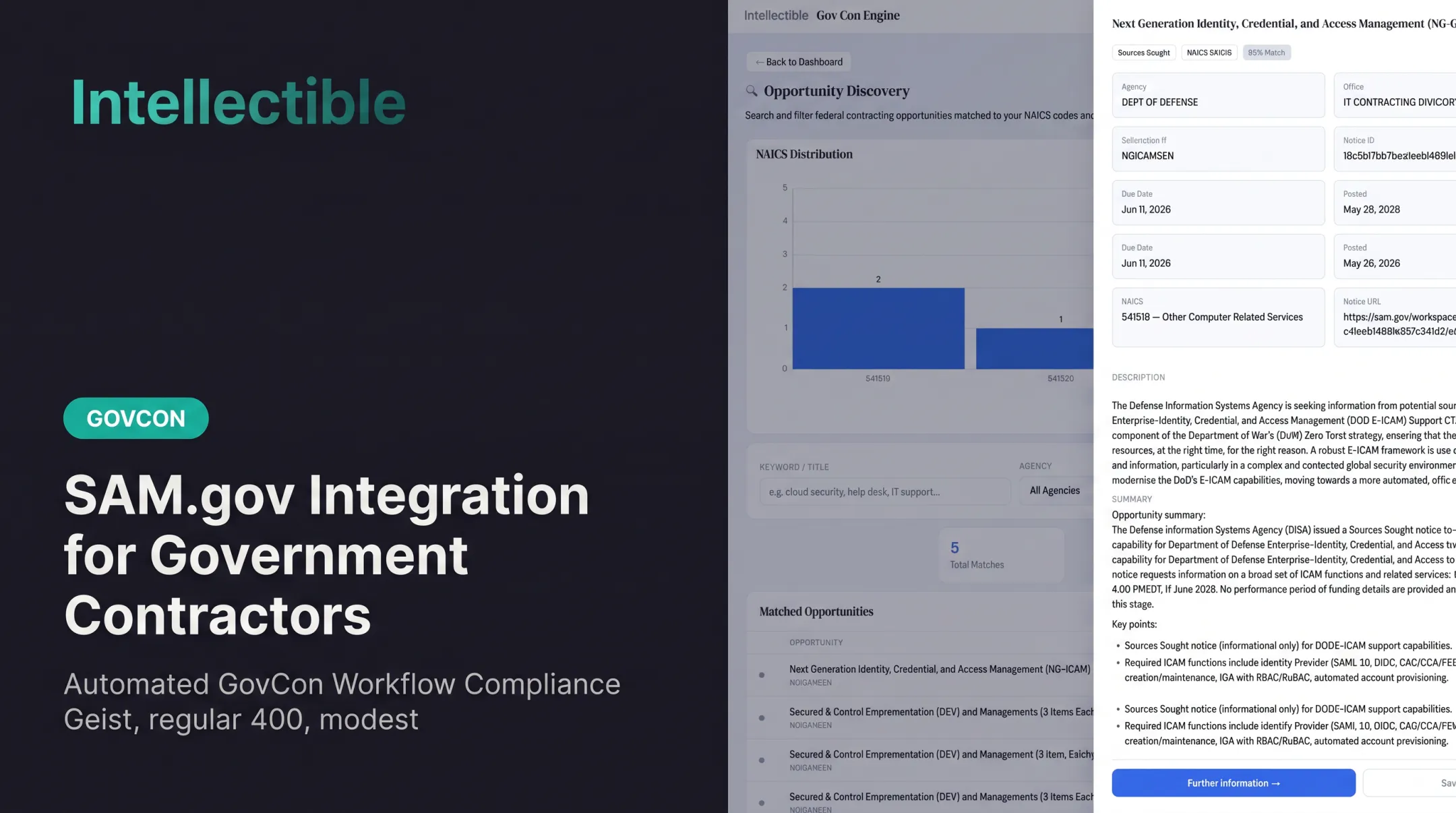
Instead of forty spreadsheets across twenty agency sites, monitoring software gives BD teams one searchable, standardized view of forecast data from SAM.gov's Forecast tool and agency-specific pages.
Core capabilities that matter:
- Intelligent filtering by NAICS/PSC, agency, set-aside, contract value, and expected release window—noise cut to what the team can act on
- Automated alerts for new matches, timeline changes, and expiring-contract recompete windows, so nothing slips because a weekly check was missed
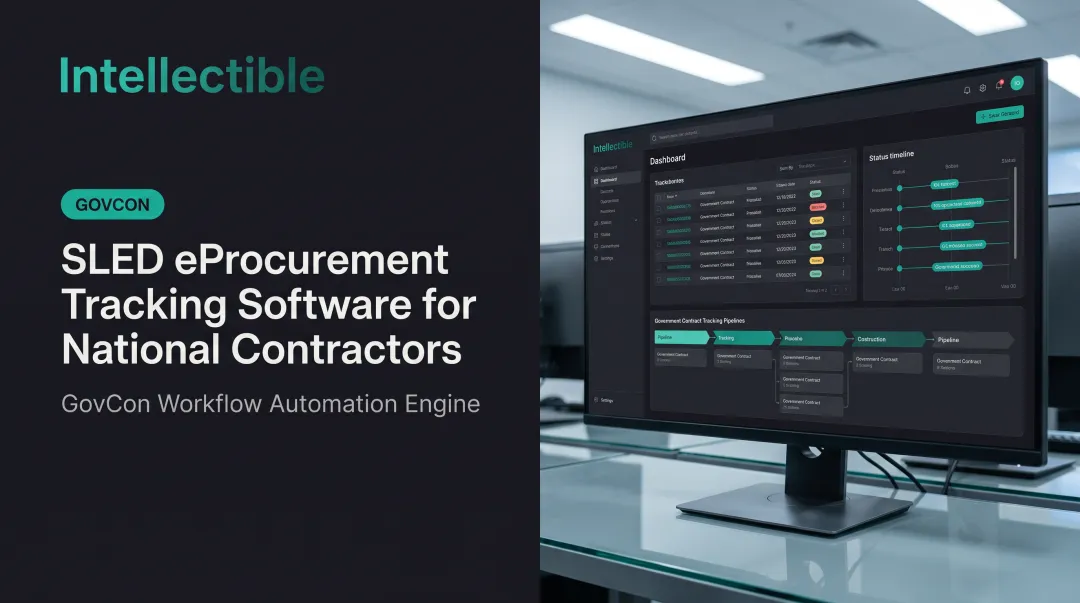
- Direct pipeline integration that pushes forecast data into qualification and capture workflows instead of a static spreadsheet
That last point is where most GovCon tech stacks fall short. A forecast tracker that never reaches your real pipeline is only a fancier version of the manual problem.
Where Intellectible Fits
Intellectible's GovCon Engine is built to close that gap. Its visual workflow builder ingests external data through API connections, webhook inputs, webpage-reading nodes, and CSV parsing.
Those inputs become structured capture records: agency, office, NAICS, PSC, timing, scope, and fit rationale. Configurable scoring then applies your own go/no-go criteria, including:
- Strategic fit and capability match
- Timing and delivery risk
- Competitive positioning
Qualified leads route straight into capture workflows and CRMs such as Salesforce—no manual re-entry.
Teams using the platform see results that match those workflow gains:
- 95%+ time saved on opportunity search and go/no-go decisions
- 150%+ increase in actionable top-of-funnel opportunities
Oceus, a GovCon customer, reported reviewing more than double its previous volume of qualified opportunities each week after adopting the platform.

Building a Forecast-Driven Capture Workflow
A forecast entry alone doesn't win a contract. It needs a process behind it. A practical structure looks like this:
- Discovery and qualification — Match incoming forecast data against your go/no-go criteria automatically, so BD staff only review opportunities worth their time.
- Buyer intelligence and relationship building — Use the lead time before RFP release to research the contracting office, identify likely incumbents, and pursue Sources Sought responses or industry days.
- RFP readiness — Build compliance matrices, risk assessments, and staffing plans ahead of the actual solicitation, so your team responds instead of scrambles.

Automating discovery is what makes this structure pay off. Capture managers stop burning hours on manual searching and put that time into relationship building and proposal quality—the trade most teams want and rarely get.
What to Look for in Forecast Monitoring Software
Not every tool claiming "forecast monitoring" does the same job. Before committing, check for:
- Multi-source aggregation: pulls from SAM.gov's Forecast tool and individual agency OSDBU pages, not just one feed
- Flexible filtering: NAICS, PSC, agency, set-aside type, and keyword—not a rigid dropdown menu
- Automated alerts: new matches plus timeline or status changes
- CRM/pipeline integration: data lands in your existing systems, not a separate silo
Customization matters more than most buyers expect. A large prime chasing $50M+ IDIQs qualifies opportunities differently than a small 8(a) firm bidding sub-$1M set-asides.
A rigid, one-size-fits-all scoring model forces at least one of those teams to work around the tool. Look for platforms that let you configure fit signals, disqualifiers, and approval routing instead of bending your process to the software's defaults.
Frequently Asked Questions
How far ahead does forecast data let you plan a pipeline?
Agency forecasts publish planned actions with estimated value, timing, and NAICS well before any solicitation posts, which is enough lead time to shape capture rather than react to an RFP. The practical limit is reliability: forecast dates slip and values change, so entries are planning signals to be re-checked, not commitments to schedule against.
Is FedBizOpps still around?
No. FedBizOpps was decommissioned in November 2019, and its functions moved fully into SAM.gov. There's no separate system to check anymore.
How far in advance do SAM.gov forecasts typically appear before an RFP?
It varies significantly by agency. Some publish annual long-range forecasts a year or more out; others update monthly with no stated horizon. Check each target agency's specific forecast page and cadence rather than assuming a universal timeline.
Can small businesses really compete using forecast data, or is this only for large primes?
Small businesses benefit more. The SBA specifically directs firms to review agency forecasts and contact small business offices early, when limited BD resources go furthest.
Do forecasts on SAM.gov always turn into real solicitations?
No. Agencies explicitly note that forecast entries can shift, be delayed by appropriations issues, or get cancelled outright. Treat them as directional planning intelligence, not guarantees.
How does forecast monitoring software fit into an existing GovCon tech stack?
It should feed directly into your CRM or capture pipeline, not run as a standalone tracker. Otherwise you've just replaced manual scattered sources with automated scattered sources.