That's the brutal math of federal contracting. Section M evaluators score what's submitted, not what you meant to submit. Formatting violations, missing citations, and misaligned section numbering aren't scoring deductions—they're pass/fail gates.
Manual compliance tracking makes this worse. Proposal teams juggle hundreds of requirements across Sections C, L, and M, often on spreadsheets, often against tight deadlines, often with lean staff. One overlooked amendment and the whole matrix goes stale.
AI proposal compliance software is changing this equation. It's helping government contractors extract requirements, build compliance matrices, and catch gaps automatically—without adding headcount to the proposal team.
Key Takeaways
- AI compliance software automates FAR requirement extraction and gap detection, cutting disqualification risk
- Federal agencies increasingly use their own AI tools to screen proposals, making machine-readable structure essential
- Human oversight remains non-negotiable for win themes and validating AI-suggested mappings
- The best platforms combine ready-made compliance workflows with flexibility to customize for specific FAR clauses
Understanding FAR Compliance Challenges in Federal RFPs
The Federal Acquisition Regulation, DFARS, and agency-specific supplements stack compliance requirements across three critical sections. FAR 15.204-1 defines the uniform contract format: Section C holds the statement of work, Section L contains submission instructions, and Section M lists evaluation factors.
Section L and M Misalignment Is a Common Failure Point
Here's where proposals go wrong: Section L tells you how to submit. Section M tells evaluators how to score. Teams often address Section M's evaluation criteria without following Section L's exact formatting or organizational instructions, and vice versa.
Evaluators can only score what's submitted, and proposals must be evaluated solely on the factors specified in the solicitation.
Manual compliance matrices break down at scale. An RFP with 200+ discrete requirements spread across dozens of pages turns spreadsheet tracking into a liability:
- Requirements get missed during copy-paste transfers
- Version control fails when multiple team members edit simultaneously
- Cross-references between Sections L and M get lost
- Nobody notices when a formatting rule (font size, page limit, section order) becomes a disqualifier
Formatting rules deserve special attention. Page limits, required fonts, and section ordering aren't suggestions. They're treated as pass/fail gates before technical evaluation even begins.
Those gates stay in force when the solicitation changes. Solicitation amendments add another layer of risk. Per FAR 15.206, agencies can amend requirements before or after proposal receipt. Every amendment demands re-verification of your compliance matrix. Miss one, and you're responding to an outdated solicitation.

How AI Proposal Compliance Software Works for FAR-Based RFPs
Modern compliance platforms follow a predictable workflow, automating the mechanical work that used to eat SME hours.
Automated RFP Shredding
AI reads the full solicitation package, including attachments and addenda, and extracts requirements, deadlines, and certifications within minutes instead of days. It identifies submission rules, required sections, evaluation factors, and scoring cues buried across dozens of pages.
Compliance Matrix Generation
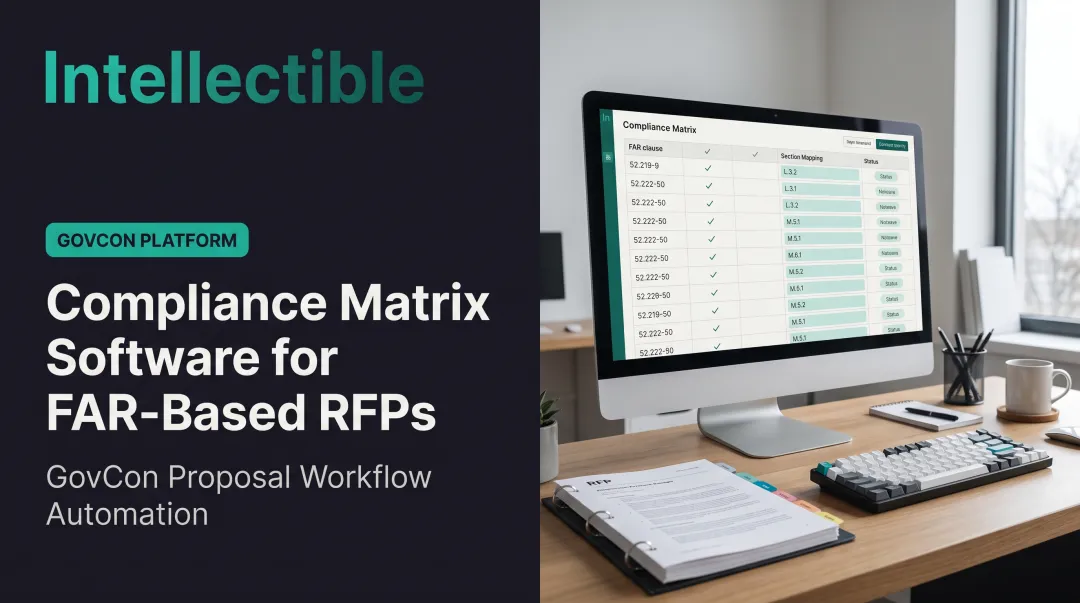
The extracted data becomes a structured matrix mapping each requirement to a specific response section, owner, deadline, and evidence path. This gives human and automated evaluators a clear roadmap for verifying coverage. Coverage gaps surface automatically instead of during a frantic final review.
Real-Time Gap and Conflict Detection
Before submission, the system flags:
- Missing citations or unaddressed requirements
- Inconsistent language between sections
- Requirements without a mapped response
Amendment Tracking
When agencies issue changes, the platform updates the compliance matrix automatically instead of forcing a manual re-check of every requirement against the original solicitation.
AI-Generated First Drafts
Drafts pull from past proposal content and approved boilerplate, producing a compliant structure in your company's voice. That gives writers a starting point instead of a blank page. Intellectible's GovCon and Proposal & Pursuit Engines put this same workflow in a project workspace. The Proposal Writer moves through four stages: Upload, Compliance, Variables, Draft. A visual workflow builder then ties document parsing, data structuring, and human review checkpoints together so proposal and pricing teams can set the validation logic their agency relationships require.

Preparing Your Proposal for AI-Driven Evaluation
Federal agencies receive AI-assisted proposals and evaluate them with AI as well. GSA's Contract Acquisition Lifecycle Intelligence tool uses automated machine learning to evaluate vendor proposals against solicitation requirements across requirement compliance, form compliance, and certification checks. The Army has explored similar source-selection automation.
This changes how you should write.
Structure for Machine Readability
- Open each section with a direct answer to the evaluation criterion, then follow with supporting detail
- Mirror the solicitation's exact terminology, section headings, and numbering conventions. Do not paraphrase requirement language
- State strengths and proof points in text, not buried in graphics or tables, since AI parses text more reliably than images
Whether it's a human evaluator skimming for compliance or an automated screening tool scanning for keyword matches, clear structure, exact terminology, and text-first proof points make compliance easier to find and score.

Choosing the Right AI Compliance Tool for Your Team
Not all AI tools are built for FAR compliance. Choosing the wrong category of tool shows up fast in matrix gaps, rework, and missed Section L requirements.
Generic AI vs. Purpose-Built GovCon Tools
A generic chatbot can summarize a document. It does not inherently know FAR structure.
It cannot auto-build a compliance matrix tied to Sections C, L, and M, and it has no memory of your past proposals unless you re-feed that context every time.
Purpose-built GovCon platforms differ in three ways:
- Compliance matrix automation tied to proposal structure, not generic summarization
- Content retrieval from your organization's own approved proposal library and boilerplate
- Workflow integration with the tools your team already uses
Integration Matters More Than Features
A tool that doesn't connect to your existing stack creates more friction than it removes. Look for native support for:
| System | Why It Matters |
|---|---|
| SharePoint | Retrieving proposal libraries and source documents |
| Salesforce/CRM | Opportunity routing and pipeline coordination |
| Word (DOCX) | Drafting in the format your reviewers expect |
| Excel | Pricing workflow intake and matrix exports |
Intellectible supports native SharePoint and Salesforce connections, DOCX parsing, and Excel-based pricing intake, plus public APIs and code nodes for custom logic.
Underneath that sits a full developer suite—workflow runtime, project databases, document parsing, and governance controls—so contractors can build compliance and pricing workflows without new infrastructure for every RFP.

Security, Ethics, and Best Practices for AI in FAR Compliance
Speed means nothing if it exposes proprietary content or misrepresents your qualifications.
Data Protection for CUI
If your workflows touch Controlled Unclassified Information, NIST SP 800-171 Rev. 3 applies to any nonfederal system component that processes, stores, or transmits it.
Confirm your AI vendor's data retention and processing policies before uploading proprietary win themes or past performance data. Not every platform is built for CUI-level handling, and you shouldn't assume zero retention without checking the vendor's actual policy.
Validate Every AI Suggestion
- Cross-check every AI-suggested compliance mapping against the original solicitation
- Verify certifications, past performance claims, and technical assertions before submission
- Treat AI drafts as a starting point, not a final answer
Check Solicitation Restrictions
Some solicitations explicitly restrict AI-generated content. Review RFP terms and applicable FAR clauses before integrating AI tools into your response process. Don't assume permission by default.
Maintain a Current Content Library
AI retrieval is only as accurate as the library behind it. Keep past performance write-ups, certifications, and approved language current so AI-assisted drafts reflect your actual capabilities, not stale boilerplate.

Frequently Asked Questions
What should a buyer verify before approving AI on proposals?
Work a checklist: where CUI is processed and stored, alignment with NIST 800-171 handling, whether the vendor trains on your content, how solicitation-specific restrictions on AI-generated text are enforced, and what audit record exists showing human validation before submission. Those answers, not model quality, are what clears internal security review.
What are the new AI regulations expected to be implemented in 2026?
No single AI regulation package is locked for 2026 yet. Agencies are still formalizing evaluation tools and acquisition guidance such as OMB's M-25-22, so contractors should track FAR Council updates and agency-specific AI policies as they land.
Can AI generate a compliant FAR compliance matrix without manual formatting?
Specialized AI compliance software can auto-generate matrices mapped to Sections C, L, and M. Still, teams should always verify mappings against the original solicitation before relying on them.
How much time can AI compliance software save on FAR-based proposals?
Automated extraction and matrix generation typically cut hours of manual SME review down to minutes of AI processing plus a validation pass. Exact savings depend on RFP complexity and team readiness.
Is it risky to use AI on proposals involving classified or export-controlled data?
Yes. Sensitive, classified, or ITAR/CUI-restricted content should only go through in-house review and secure, vetted AI environments, never a general-purpose tool without confirmed data controls.
Do AI compliance tools replace proposal managers and SMEs?
No. AI handles extraction, mapping, and drafting mechanics well. Strategy, win themes, and technical accuracy still require human expertise that AI can't replicate.