AI is changing that equation. It's not replacing the human judgment that wins contracts, but it's systematically removing the bottlenecks that prevent teams from applying that judgment at scale. From opportunity discovery through contract execution, AI-powered workflows are automating the pattern-based, high-volume work that has historically consumed most of the workweek.
This guide covers how AI applies across the full government contracting lifecycle, what security and compliance requirements matter, how to choose the right platform, and how to implement AI strategically without creating new risks.
Key Takeaways
- AI automates discovery, qualification, proposals, compliance, and contract work, with teams reporting 50-70% time savings
- GovCon-specific AI trained on federal procurement data outperforms generic business AI that lacks FAR/DFARS context
- Security compliance (FedRAMP, CMMC, CUI handling) must be built in from day one, not retrofitted
- Keep humans in the loop for technical accuracy, customer relationships, and strategic decisions
- Strategic AI implementation enables 2-3x higher bid volume without adding headcount
Understanding AI in Government Contracting
AI in federal procurement covers a spectrum of capabilities, each with a different role in your workflow.
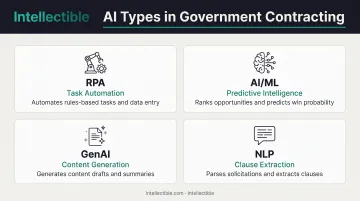
Core AI Types in GovCon:
- RPA (Robotic Process Automation): Software bots that automate rules-based tasks like data entry, form population, and file routing. GSA's CLARA uses RPA for contract closeout, while officers retain decision authority.
- AI/ML (Artificial Intelligence & Machine Learning): Systems that rank opportunities, match capabilities to requirements, and estimate win probability by learning from historical data.
- GenAI (Generative AI): Models that produce synthetic content (first drafts, summaries, compliance matrices) based on input patterns. Requires source-checking and human approval.
- NLP (Natural Language Processing): Processes human language to parse solicitations, extract clauses, detect dates, and map evaluation factors from Section L and M.
The Evolution: From Bots to Intelligence
Early automation focused on repetitive screen tasks: copying data between systems, populating forms, and routing files.
Today's GovCon AI goes further. It parses full solicitation packages, extracts requirements from Sections C, L, M, and the Statement of Work, and generates compliance matrices. It can also draft proposal content from approved libraries, predict win probability, and flag compliance gaps during contract execution.
The critical distinction: GovCon-native AI trained on FAR, DFARS, CPARS, and procurement data understands solicitation structures, handles government forms correctly, and generates compliant matrices.
Generic business AI like ChatGPT can sound plausible but often violates compliance rules or misses mandatory elements. It lacks federal procurement context.
Current Adoption Data
According to Deltek's 2026 Clarity Report, 90% of government contractors now use AI in some capacity—but only 5% describe their maturity as fully developed. The gap between adoption and mastery remains wide.
Teams using GovCon-specific AI report 50-70% faster proposal cycles, though these are vendor-reported figures rather than controlled studies. What's clear from customer examples: AI is compressing timelines, increasing bid volume, and freeing capture teams to focus on strategy rather than spreadsheet maintenance.
Mindset Shift: AI as Teammate
AI does not replace subject matter expertise. It acts as a specialized teammate for high-volume, pattern-based work so humans can focus on what machines cannot: building customer relationships, making strategic trade-offs, interpreting agency intent, and applying technical judgment.
AI Applications Across the GovCon Lifecycle
Opportunity Discovery and Intelligence
AI monitors SAM.gov, agency forecasts, spending data, and CPARS to surface relevant opportunities before formal RFPs are released.
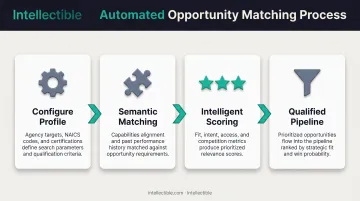
Instead of searching federal portals daily, teams configure a capture profile once: target agencies, NAICS codes, contract vehicles, geographies, deal sizes, certifications, and disqualifiers. The system then scores every new notice against those criteria.
How automated opportunity matching works:
- Semantic matching based on past performance, capabilities, and company profile (not just keyword searches)
- Agency buying-pattern analysis that flags likely follow-ons and expiring contracts
- Competitive intelligence that identifies incumbents, bidder density, and teaming opportunities
- Configurable scoring rules that downweight low-fit opportunities automatically
One defense contractor using Intellectible's GovCon Engine reported reviewing more than double the qualified opportunities per week, with approximately seven to eight opportunities per month passing their threshold—compared to the handful they previously had bandwidth to evaluate.
Bid Qualification and Go/No-Go Decisions
AI scores opportunities on four dimensions:
- Fit: How well do our capabilities, past performance, and certifications align with the requirement?
- Intent: What buying signals is the agency showing? (Forecast timing, RFI activity, incumbent contract status)
- Access: Do we have existing relationships, relevant past performance, or contract vehicle access?
- Competitive position: Who are the likely competitors? What's the bidder density? Are we positioned to win?
Predictive PWIN (Probability of Win) scoring uses historical data, competitor analysis, and requirement alignment to produce management estimates (not certified probabilities) that help teams prioritize where to invest capture resources.
Proposal Development
AI reads the full solicitation package (Sections L, M, C, SOW), extracts requirements, deadlines, and evaluation criteria, then converts them into structured pursuit intelligence.
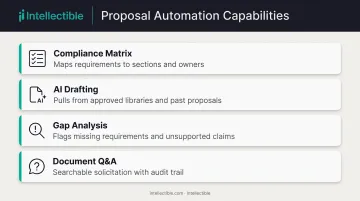
Automated proposal capabilities:
- Compliance matrix generation: Maps every requirement to proposal sections, owners, deadlines, dependencies, and evidence paths
- AI-generated first drafts: Pulls content from approved libraries, past proposals, and technical documentation based on RFP requirements
- Gap analysis: Flags missing requirements, unsupported claims, and coverage gaps before review
- Document Q&A: Lets teams ask questions about the solicitation while maintaining an audit trail
Critical caveat: Human SMEs must validate all AI-generated content for technical accuracy, alignment with evaluation criteria, and regulatory compliance. AI accelerates drafting. It does not replace expertise.
Pricing and Cost Proposals
AI assists with labor rate analysis, cost benchmarking, and pricing model development by extracting labor categories, estimated hours, hourly rates, loaded costs, and indirect rates from historical contract data, RFPs, and internal rate cards.
Teams can compare base-case, competitive, strategic, and custom pricing scenarios across revenue, cost, margin, and risk. Audit trails and approval routing stay intact throughout.
Security warning: Never enter proprietary pricing, detailed cost build-ups, subcontractor quotes, or internal rate structures into public AI systems. Use GovCon-specific platforms with appropriate security controls, or keep sensitive pricing data on-premises.
Post-Award Contract Management
After award, AI helps teams execute the contract with the same audit discipline used in capture and proposal work.
Configurable workflows can:
- Track deliverables and performance metrics against contract requirements
- Flag potential compliance issues during execution
- Attach approvals, files, comments, and decision history to contract records
- Preserve activity timelines for CPARS evaluations and future past-performance references
Choosing the Right AI Platform for Your Team
Generic business automation won't handle Section L/M parsing. A proposal-writing tool won't help with opportunity discovery. Disconnected point solutions recreate the handoff problems you're trying to eliminate.
Key Evaluation Criteria
GovCon-specific training:
- Does the platform understand FAR and DFARS?
- Can it parse Sections C, L, M, and SOW correctly?
- Does it generate compliant matrices, not generic outlines?
Security posture:
- What FedRAMP certification class does it hold? (Classes A-D describe evidence assurance; agencies still authorize each use)
- Can it handle Federal Contract Information (FCI) under FAR 52.204-21's 15 safeguards?
- Is it suitable for Controlled Unclassified Information (CUI) under DFARS 252.204-7012?
Lifecycle coverage:
- Does it connect discovery through proposal submission, or just one stage?
- Can it integrate with your CRM, document systems, and approval workflows?
Customer outcomes:
- What documented time savings, bid-volume increases, or cycle-time reductions have customers achieved?
- Are those results specific to GovCon teams, or generic business use cases?
Point Solutions vs. Unified Platforms
Point solutions excel at specific tasks (proposal writing, compliance checking, pricing analysis) but require manual handoffs between tools. Every handoff is a place where deals stall and requirements get missed.
Unified platforms connect the full revenue cycle in one system: opportunity scoring, capture planning, RFP parsing, compliance matrix generation, proposal drafting, pricing, approvals, and CRM handoffs. Deltek's 2026 research found that 85% of GovCon firms use two to five tools for one project, and only 5% have a fully integrated system.
The Workflow Integration Test
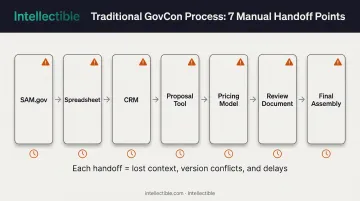
Map every system your team uses from opportunity discovery through proposal submission. Then count the manual handoffs:
- SAM.gov to spreadsheet
- Spreadsheet to CRM
- CRM to proposal tool
- Proposal tool to pricing model
- Pricing model back to proposal
- Proposal to review document
- Review document to final assembly
The right platform eliminates the most handoffs. Platforms like Intellectible connect opportunity qualification, compliance analysis, proposal development, pricing, and revenue operations in one governed workspace, so requirements stay attached to the work instead of living in export files and version threads.
Implementation: Getting Started with AI
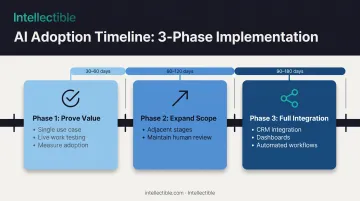
Roll out AI in stages: prove value on one use case, expand to adjacent work, then connect the full pursuit lifecycle. Confirm team readiness and lock usage policies before you scale.
Phased Adoption Framework
Phase 1: Prove value on one high-impact use case (30-60 days)
- Start with opportunity scoring or compliance matrix generation
- Run the tool on live work, not test scenarios
- Measure time saved, coverage accuracy, and team adoption
Phase 2: Expand to adjacent stages (60-120 days)
- If you started with discovery, add proposal parsing
- If you started with compliance, add drafting assistance
- Maintain human review at every expansion
Phase 3: Connect the full lifecycle (90-180 days)
- Integrate CRM handoffs, pricing workflows, and approval routing
- Deploy dashboards for leadership visibility
- Establish recurring workflows and batch automation
Team Readiness Assessment
Before implementing AI, confirm you have:
Clean, organized content libraries:
- Past proposals, technical documentation, and approved language
- SOPs, policies, and delivery procedures
- Capability statements and past-performance summaries
Clearly defined capabilities:
- Target agencies, contract vehicles, and certifications
- NAICS and PSC codes that align with your work
- Geographic and deal-size parameters
Documented workflows:
- Capture process and go/no-go criteria
- Proposal development stages and approval gates
- Pricing model assumptions and margin requirements
Without these foundations, AI speeds up messy processes instead of fixing them.
AI Usage Policies
Define clear policies before deployment:
What data can/cannot be entered:
- Public opportunity data: Yes
- FCI or CUI: Only in authorized platforms
- Proprietary pricing: Never in public AI
- Classified information: Never without CSA authorization
Review and approval processes:
- Assign named owners to validate AI-generated proposal content
- Send low-confidence or high-risk outputs to human review before use
- Escalate compliance gaps through your capture and proposal chain
Prompt engineering and quality control:
- Train teams to write specific, context-rich prompts
- Require source citations for all AI outputs
- Maintain audit trails for regulatory review
Security, Compliance, and Risk Mitigation
One weak AI workflow can expose FCI, CUI, or pricing data and put contracts, clearances, and past performance at risk. Use the controls below to decide what stays out of public tools, which frameworks apply, where workloads can run, and where humans must stay in the loop.
What Should NEVER Enter Public AI Systems
Keep the following out of consumer or unapproved public AI tools—no exceptions for “just a draft” or “we’ll scrub it later”:
- Federal Contract Information (FCI): Nonpublic information provided by or generated for the government
- Controlled Unclassified Information (CUI): Government information requiring safeguarding under law or policy
- Classified data: Information that needs Cognizant Security Agency authorization, even on approved systems
- Proprietary pricing: Internal rates, cost build-ups, subcontractor quotes
- PII (Personally Identifiable Information): Names, SSNs, contact details
- System security plans: Architecture, controls, vulnerabilities
- Source-selection-sensitive content: Evaluation criteria, scoring, agency deliberations
Understanding Current Security Frameworks
Match each AI use case to the framework that governs the data—not the vendor’s marketing label.
FedRAMP Certification Classes (2026 update):
As of 2026, FedRAMP uses Classes A-D to describe evidence assurance, not system sensitivity:
- Class A: Supports pilots and negligible-risk uses
- Class B: Generally supports Low impact systems
- Class C: Generally supports Low and Moderate impact systems
- Class D: Generally supports most systems, including High impact
Agencies still categorize systems and authorize each use. Certification class alone does not determine suitability.
CMMC 2.0 Status:
CMMC Phase 1 began November 10, 2025. Phase II was suspended July 13, 2026. Current requirements:
- Level 1 (FCI): Annual self-assessment against 15 FAR 52.204-21 safeguards
- Level 2 (CUI): 110 NIST SP 800-171 Rev. 2 requirements; self-assessment or C3PAO status; three-year validity with annual affirmation
- Level 3 (High-priority CUI): DIBCAC assessment; three-year status with annual affirmation
DFARS Cloud Requirements:
External cloud providers handling DoD CUI must meet security equivalent to FedRAMP Moderate, report cyber incidents within 72 hours, and preserve affected media for at least 90 days.
Secure Deployment Options
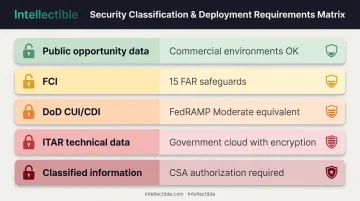
Use this matrix to pick a minimum environment before you connect proposals, pricing, or agency documents to any AI workflow:
| Data/Workload | Minimum Deployment Rule |
|---|---|
| Public opportunity data | Commercial environments allowed |
| FCI | 15 FAR 52.204-21 safeguards required |
| DoD CUI/CDI in cloud | Provider must meet DFARS-required FedRAMP Moderate equivalent |
| ITAR technical data | Government cloud allowed when encryption, recipient, and registration conditions are met |
| Classified information | CSA authorization required; on-premises not universally mandated |
AI Limitations and the Need for Human Oversight
Even in an approved environment, model output is not a compliance decision. GAO's 2025 report states that GenAI lacks human judgment and can produce biased, misleading, or false output. NIST flags confabulation (confidently stated false content), inaccurate citations, data-privacy leakage, and harmful bias as core risks.
What AI cannot do:
- Interpret FAR clauses or apply agency-specific supplements
- Understand unstated agency priorities or evaluation nuance
- Replace customer relationships or capture strategy
- Make final bid/no-bid decisions without context
- Generate compliance certifications or security policies
AI can supply inputs, analysis, and speed. Your team still owns bid decisions, certifications, and anything that binds the company.
Measuring ROI and Proving Value
Proving AI value in GovCon means tracking the metrics leadership already cares about. Build a baseline, validate tools against real solicitations, and weigh full platform cost against labor saved.
Key Metrics to Track
Opportunity qualification:
- Hours per opportunity (baseline vs. AI-assisted)
- Number of qualified opportunities reviewed per week
- False-positive rate (opportunities scored high but declined after human review)
Proposal cycle time:
- Days from RFP release to submission (baseline vs. AI-assisted)
- Hours spent on compliance matrix generation
- Number of proposal sections drafted vs. manually written
Bid volume:
- Quality bids submitted per month
- Ratio of qualified opportunities to submitted proposals
- Proposal backlog and team capacity utilization
Win rate and cost:
- Win rate before and after AI implementation (controlling for market changes)
- Cost per proposal (labor hours × loaded rate)
- Revenue per business development FTE
These numbers show what changed after rollout. Before you commit spend, validate any platform against your own workload.
The Time-to-Value Test
Before committing to a platform, run this test:
- Take a recently completed solicitation (RFP, RFQ, sources sought)
- Upload it to the AI platform
- Measure:
- Requirement extraction accuracy (did it catch every SHALL/MUST?)
- First-draft usability (how much rewriting was required?)
- Compliance coverage (did it flag missing sections?)
- Remaining manual effort (hours saved vs. hours still required)
This single test reveals more than any demo. One platform might extract 95% of requirements but produce unusable drafts. Another might generate compliant text but miss evaluation factors. Test with your actual work.
Calculating Total Cost of Ownership
Time saved only matters if the platform’s full cost still pencils out. Factor in every cost line, not just the subscription:
- Seat-based pricing: Monthly or annual per-user fees
- Onboarding time: Implementation specialist hours, workflow configuration, and initial training
- Content migration: Effort to organize and upload past proposals, technical docs, and approved libraries
- Integration costs: API development, CRM connections, document-system links
- Ongoing enablement: Prompt-engineering skill-building and refresher sessions after go-live
- Replaced tools: Subtract the cost of tools the AI platform eliminates
A $199/month tool that still requires 80% manual effort can cost more than a premium platform that removes 60% of the work. Labor is your real cost.
Frequently Asked Questions
How is AI being used in government contracting today?
AI automates opportunity discovery on SAM.gov, bid qualification (PWIN), compliance matrices, proposal drafting from approved libraries, pricing analysis, and post-award tracking. Teams often cite 50–70% time savings and 2–3x bid volume, though those figures are usually vendor-reported rather than from controlled studies.
Can ChatGPT review contracts?
No. Generic AI like ChatGPT is not trained on FAR, DFARS, or federal procurement regulations and can miss mandatory clauses or produce non-compliant text. Use specialized GovCon AI, and have legal and contracts experts validate every output.
What tasks should government contractors NOT use AI for?
Never process CUI, FCI, or classified data in unauthorized systems; upload proprietary pricing or subcontractor quotes to public tools; generate compliance certifications or system security plans; or interpret FAR clauses without human validation. AI speeds the work but does not replace judgment.
Do I need FedRAMP-authorized AI tools for government contracting?
FedRAMP authorization is strongly recommended for teams handling CUI or sensitive proposal content. Under CMMC 2.0, non-authorized tools for CUI create audit risk and can disqualify firms from defense contracts. Match platform security to your data: 15 basic safeguards for FCI, DFARS-required controls for DoD CUI.
How can AI help with proposal writing without sacrificing compliance?
AI parses solicitations, builds compliance matrices, drafts from approved libraries grounded in the RFP, and flags gaps or unsupported claims. Human SMEs must still validate technical accuracy, evaluation alignment, citations, and final approval before submission.
What's the difference between AI tools built for GovCon vs. general business AI?
GovCon-specific AI is trained on FAR, DFARS, CPARS, and procurement data. It understands Sections C, L, M, and SOW structures, builds traceable compliance matrices, and applies federal procurement logic. Generic business AI follows commercial patterns and often misses mandatory elements or applies the wrong contracting rules.
Ready to put AI to work across your GovCon workflow? Intellectible's platform connects opportunity discovery, capture planning, proposal development, pricing, and contract management in one governed workspace, cutting manual handoffs and proposal cycle time by up to 90%. Visit intellectible.com or contact jesse@intellectible.com to learn more.