Introduction
Enterprise sellers face long account lists, big buying committees, and not enough hours. Forrester found an average of 13 people involved in a B2B purchase, and 89% of purchases involved two or more departments. No rep can watch every account closely.
For a CRO, CFO, or RevOps leader facing an intent-platform renewal, account scores are not the business case. A six-figure commitment needs an evaluation scorecard connecting accounts surfaced to rep acceptance, qualified conversations, sales-accepted opportunities, and attributable pipeline, with full operating cost included.
This article covers a decision framework: business fit, signal quality, workflow integration, adoption, measurement, and a controlled pilot.
Key Takeaways
- Intent data pays off when it surfaces in-market accounts that also match your ICP.
- A signal is not proof of purchase intent. It needs CRM, fit, and engagement context.
- Without a clear ICP, clean records, and seller adoption, skip it.
- Run a pilot with baselines, activation rules, privacy controls, and a control group.
What Enterprise Sales Teams Actually Get From Intent Data
Intent data is behavioral information showing that an account or buying group is researching a problem, category, vendor, competitor, or related topic. It adds timing to firmographic and technographic data. It does not replace ICP qualification, relationship history, or seller judgment.
Three Signal Sources
- First-party: repeat visits, pricing-page views, downloads, event attendance, demo requests, and product usage. It is direct, but it only covers accounts that already engaged with you.
- Second-party: another organization's behavioral data shared with you, such as review or comparison platform activity. It often points to later-stage vendor evaluation.
- Third-party: signals aggregated from publisher networks, B2B media, and co-ops. These can reveal interest before an account ever visits your site.
Account-Level vs. Person-Level
Much web activity is anonymous and gets matched to companies through IP addresses and digital fingerprints, according to 6sense documentation. That produces an account inference, not necessarily an identified person.
Enterprise teams need account-level prioritization, then must map the wider buying committee themselves. Forrester's 2023 survey named identifying specific contacts inside intent-showing accounts as a top execution challenge. Treat any promise of named-contact precision with suspicion.

When Intent Data Is Worth the Investment (and When It Is Not)
Conditions That Favor Intent Data
- Your market is large or complex enough that sellers can't research every target account by hand.
- Cycles are long, contract values are high, and calling the wrong account is costly.
- You have a defined ICP and can tell strategic accounts from merely active ones.
- Sales, marketing, and RevOps agree on what a useful signal is and what happens next.
Benefits to Test
- Better prioritization that combines fit, recency, topic relevance, frequency, and buying-group breadth
- More relevant outreach aligned to what the account is researching
- Earlier engagement, before a shortlist forms
- Coordinated ABM: alerts, nurture, advertising, and re-engagement plays
- Less manual research time
Forrester's 2023 survey found more than 85% of intent-data users reported business benefits, including better outbound response. That figure is self-reported. It is not a measured causal lift. Forrester also found a gap between expected and achieved benefits, and trouble measuring impact deeper in the revenue process.
Include subscription, contact data, seats, integrations, implementation, source access, and operating time in the cost model. For an illustrative break-even calculation, divide annual program cost by contribution profit per incremental win; label assumptions clearly. An expected benefit is a model, not a promised customer result.
When It Usually Isn't Worth It
- Your market is narrow and sellers can already research every account.
- The ICP is fuzzy or CRM data is unreliable. Validity's 2024 survey found 24% of CRM administrators said less than half their data was accurate and complete.
- The provider offers broad scores with no visible topics, recency, sources, or account matching.
- Nobody owns alerts, scoring, plays, or false-positive review.
- Leadership expects intent to replace prospecting, discovery, and a strong value proposition.
Count the Full Cost
Licensing is the smallest line item in many programs. Budget for implementation, data cleanup, integrations, enablement, campaign development, seller time, governance, and ongoing tuning. Public price benchmarks are thin, so get quotes that itemize signal coverage, integrations, and account matching.
Decision rule: test intent data when the expected value of better prioritization, earlier engagement, or less research time can be measured against software, implementation, and adoption costs.
How to Operationalize Intent Data Across an Enterprise Sales Process
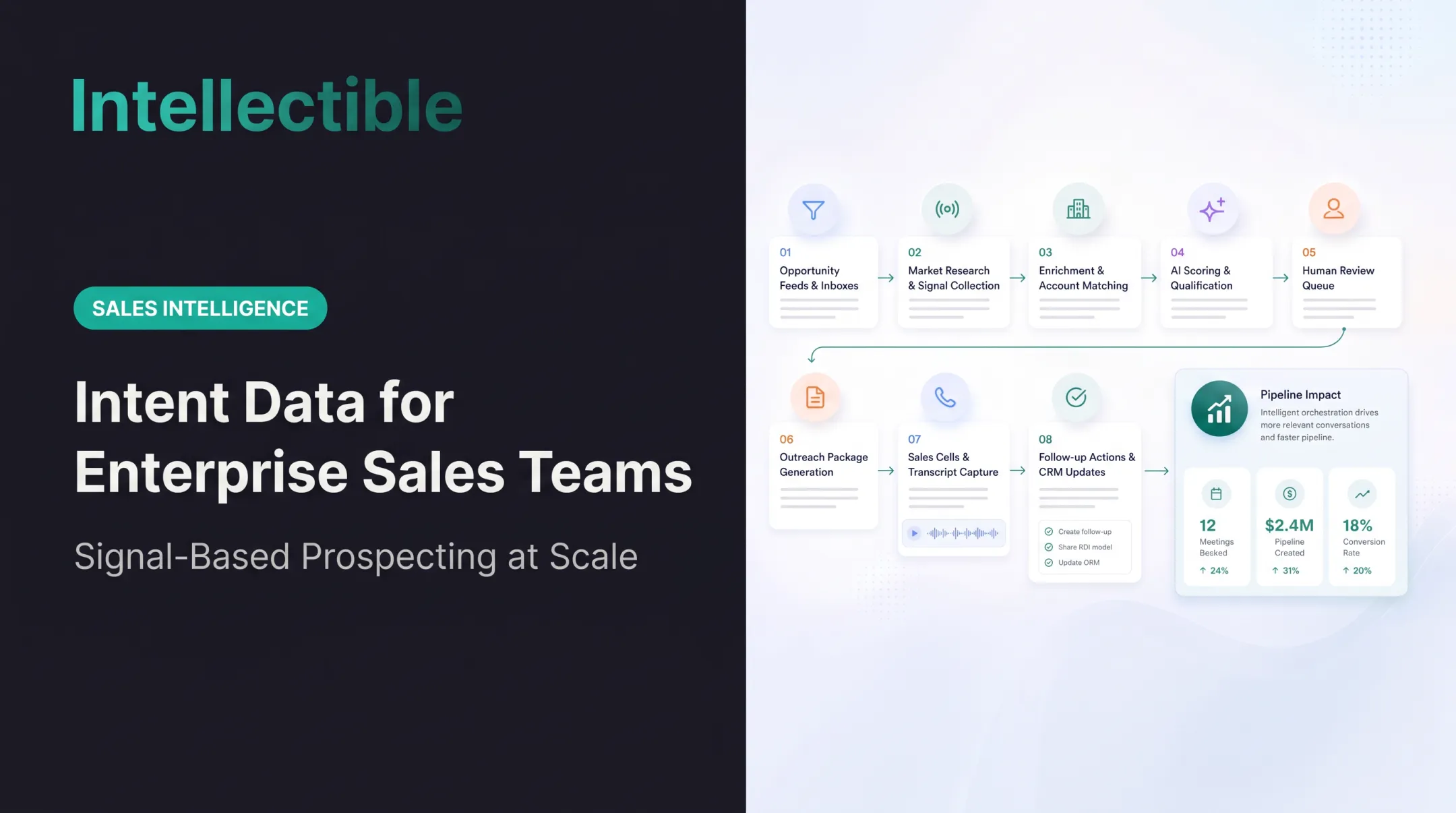
The Workflow
- Detect relevant activity.
- Enrich it with account and CRM context.
- Score it against ICP fit.
- Route it to the right owner.
- Activate the matching play.
- Record the outcome.
6sense recommends looking for sustained activity across multiple signals instead of reacting to one spike. Set thresholds and follow-up SLAs around that pattern. No independent benchmark exists for response times on intent alerts, so set your own and test them.

Prioritization Model
Weigh these factors together:
- Topic relevance and signal strength
- Recency and frequency
- Account fit and opportunity stage
- Buying-group participation
- Competing explanations (competitor research can look just like buyer research)
Match Patterns to Plays
- Category or problem research: educational outreach or marketing nurture.
- Comparison, pricing, or implementation research: fast seller review and tailored messaging.
- Dormant or closed-lost accounts: a re-engagement motion.
- Current customers researching competitors: retention, expansion, or executive outreach.
Put signals where sellers already work: CRM account records, sales engagement tools, marketing automation, dashboards, and manager reports.
Where Intellectible Fits
Intellectible is a horizontal AI build platform. It connects data sources, workflow logic, human review, interfaces, and automation into a custom revenue operating system. It does not supply third-party intent data. It operationalizes signals.
Its Revenue Discovery engine follows a Detect, Gate, Promote, Draft, Approve, Call, Qualified sequence. Fit and urgency scores use editable weights. Salesforce refreshes nightly. The engine drafts outreach but sends nothing automatically, with no bulk email, LinkedIn automation, or auto-CRM writes.
Human Controls and Governance
- Approval thresholds before outreach or CRM updates
- Suppression rules for active opportunities
- Contact-frequency limits
- Escalation paths for strategic accounts
- Never tell a prospect you tracked their individual behavior
For U.S. programs, document data sources, review provider privacy practices, define permitted uses, and protect sensitive data. Involve legal or security when you handle regulated data. State rules differ.
The California privacy agency says CCPA's B2B and employment exemptions expired December 31, 2022, so don't assume business-contact data is exempt. Colorado's guidance excludes data from commercial contexts. Get a state-by-state legal review.
How to Measure ROI and Run a Low-Risk Intent Data Pilot
Baseline First
Before buying, record:
- Account-contact and meeting rates
- Opportunity creation and pipeline value
- Sales-cycle length and win rate
- Seller research time
- Share of target accounts getting meaningful engagement
Use an evaluation scorecard with eligible accounts surfaced, evidence completeness, rep acceptance rate, time to first touch, meetings per signal type, sales-accepted opportunities, and pipeline from accepted signals. Give each metric an owner, denominator, reporting period, and a definition that sales and RevOps both accept.
Design the Pilot
- Pick a representative account set and a comparable control group on the existing process.
- Limit scope to a few high-value topics, territories, or sellers.
- Set thresholds, response-time expectations, plays, owners, and review cadence before launch.
- Have sellers label each signal: useful, irrelevant, late, inaccurate, or actionable.
Test outcomes, not activity: high-fit account coverage, research time, qualified meetings, opportunity progression, and dormant-account reactivation.
Metrics to Compare
- Cost per qualified meeting
- Opportunity conversion and pipeline created
- Progression speed and win rate
- Seller hours saved
- Account coverage and response time
No published benchmark gives standard meeting rates or win-rate lift for intent programs, so don't borrow target percentages. Your baseline is the benchmark.
Separate Correlation From Causation
A before/after comparison or a high-intent vs. low-intent comparison doesn't prove lift. Use a holdout group.
Google's Conversion Lift documentation defines incremental conversions as treatment conversions minus control conversions. That's an ad-testing method, but the logic carries over. Also account for existing brand engagement and open opportunities.

Go/No-Go Review
- Expand if results improve measurably, sellers act on signals, data quality holds, and the workflow scales without heavy manual effort.
- Revise if signals are useful but poorly routed, ICP filters are too broad, or messaging needs work.
- Stop if coverage is unreliable, alerts get ignored, or the economics lose to cheaper first-party and CRM methods.
Final Verdict: Is Intent Data Worth It?
Yes, with conditions. Intent data is worth it when it solves a specific prioritization or timing problem and sits inside a measurable operating process. As a standalone dashboard, or a substitute for strategy and execution, it isn't.
Put it to work in this order:
- Start with first-party signals and existing CRM data
- Test external intent coverage in a controlled pilot
- Expand only when account-level outcomes that matter to revenue leadership improve
Frequently Asked Questions
What should a six-figure intent contract be judged on?
A six-figure contract buys access to capabilities and data, not a guaranteed pipeline outcome. Begin with the accounts and service purchases the team must find, then test whether the program supplies evidence that sellers can use. Define success before the renewal conversation or vendor demonstration.
What belongs in the evaluation scorecard?
Use an evaluation scorecard with eligible accounts surfaced, evidence completeness, rep acceptance rate, time to first touch, meetings per signal type, sales-accepted opportunities, and pipeline from accepted signals. Give each metric an owner, denominator, reporting period, and a definition that sales and RevOps both accept.
How is rep acceptance measured?
Rep acceptance rate is accepted accounts divided by accounts submitted for review. Track acceptance reasons and rejection reasons separately. A high acceptance rate still needs to translate into qualified conversations and sales-accepted opportunities; do not substitute account engagement or marketing-qualified volume for that handoff.
How should pipeline be attributed?
Connect each opportunity to the originating signal and source record. Distinguish sourced pipeline from influenced pipeline, remove duplicate opportunities, and compare like-for-like segments. Use a pilot cohort and a comparable baseline to understand whether the program improves results rather than merely attaching credit to deals already underway.
How should total program cost and break-even be calculated?
Include subscription, contact data, seats, integrations, implementation, source access, and operating time in the cost model. For an illustrative break-even calculation, divide annual program cost by contribution profit per incremental win; label assumptions clearly. An expected benefit is a model, not a promised customer result.
How should the renewal decision be made?
Make the renewal decision from accepted-opportunity economics, seller use, coverage gaps, and the quality of the evidence-to-action process. Continue, change, or stop the program according to the agreed scorecard. More warm accounts on a dashboard are not sufficient proof of commercial value.