The earlier signals sit upstream. Funding, a new contract, an expansion, a leadership change, or a reorganization often creates hiring demand before a single role is posted.
This article covers three things: which account-level triggers matter, how to recognize buying intent in conversations with hiring managers, and how to turn both into timely outreach. One caution up front. A buying signal indicates potential need. It does not prove an account is ready to sign with a recruiting firm.
Key Takeaways
- Repeated, specialized, urgent, or long-open roles beat a single generic vacancy.
- Funding, expansion, and leadership changes can precede public job postings.
- Questions about timelines, skills, fees, and next steps show active intent.
- Score accounts on fit, strength, freshness, urgency, and decision-maker access.
What Are Buying Signals in Staffing and Recruiting Sales?
Salesforce defines buying signals as cues from prospects that indicate interest in a product or service. In staffing, that means any observable event, behavior, or statement suggesting a company may soon need outside recruiting or talent support.
Three terms get blurred, so separate them:
- Lead: a company or person that may fit your offer and has purchase authority
- Buying signal: evidence of a possible need, such as a funding round or a rush request
- Confirmed purchase intent: a defined need, timeline, and next step agreed with a buyer
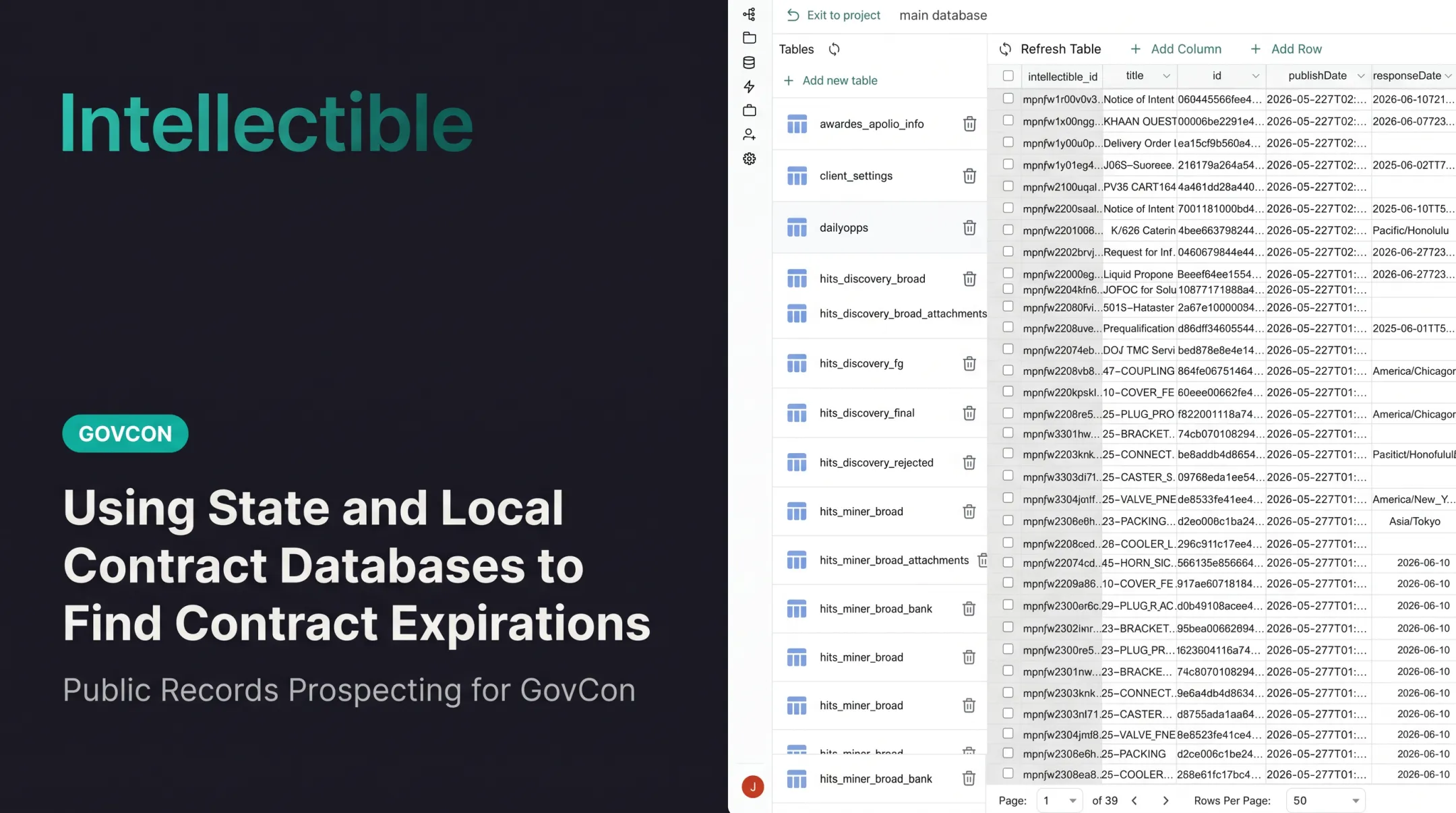
For services sold to hospitals, universities, school districts, cities, and counties, start with the relevant state and local procurement systems. Search award registers, executed contracts, board packets, purchasing pages, and amendments by agency, service category, incumbent, and contract number. A federal awards tool is not a substitute for these local records.
Four Questions to Ask About Every Signal
- Is it relevant to the roles your firm fills?
- Is it current?
- Does it suggest urgency or budget?
- Is there a plausible decision-maker to contact?
If you can't answer yes to at least three, log it and move on.
The Most Valuable Account-Level Buying Signals
Public Contract Timing Alongside Hiring Activity
Record the incumbent legal entity, buying organization, service scope, award identifier, base term, current end date, renewal options, amendments, and source document. A maximum potential expiration after options is not the same as the currently exercised term. Unknown end dates should remain research tasks.
Greenhouse's 2024 survey found 3 in 5 candidates suspected a ghost job across the US, UK, and Germany. Treat generic, evergreen, duplicated, or stale listings with suspicion.
Stronger patterns:
- Several openings for related roles at once
- The same position reposted repeatedly
- Unusually specialized requirements
- Vacancies that stay open despite active recruiting
Median time-to-fill runs about a month and a half, according to SHRM's 2025 benchmarking. A role open well past that is a candidate for outside help.
Funding, Major Contracts, and Expansion
Funding rounds, big customer wins, government or commercial contract awards, new markets, and new offices can compress hiring timelines. A company that just closed a round or won a contract needs people fast.
Verify the event first. SEC Form D filings confirm an exempt offering, and USAspending.gov lists federal awards. Neither proves hiring.
Your job is to connect the event to likely roles: a new federal contract might mean cleared engineers, while a new warehouse means shift supervisors and operators. Not every growth announcement needs a staffing partner.
New Executives and Organizational Change
New executives, department launches, mergers, acquisitions, and restructurings often reset hiring plans. A new VP of engineering typically builds a team in the first months, and may bring a different view on recruiting vendors.
Before reaching out, check three things:
- Does this leader own hiring outcomes?
- Can they approve external vendors?
- Will they lean on an existing talent-acquisition team?
Hard-to-Fill Roles and Talent Surges
Repeated demand for scarce skills signals strained internal recruiting. US evidence points to several pressure areas:
- Healthcare: HRSA projects a 187,130 FTE physician shortage in 2037 and RN shortages of 6% nationally
- Cybersecurity: CyberSeek counted 514,359 employer listings from May 2024 to April 2025
- Construction: ABC estimated the industry needs 439,000 net new workers in 2025
- Skilled trades and medical roles: SHRM's 2024 research found 46% of respondents called skilled-trades positions very difficult to fill
These measure different things (projected gaps, listings, workforce need), so don't compare them as shortage rates. As a signal, though, a single account posting several of these roles at once is worth a call.

Technology, Workplace, and Operational Changes
AI implementation, digital transformation, return-to-office mandates, relocations, and new service launches can all create hiring. Census data for late 2025 to early 2026 shows 18% of firms using AI in a business function and 22% expecting to within six months.
Timing is the catch. Announcements precede recruiting by an unknown lag, and no standard US figure exists.
RTO mandates, for instance, have been linked to higher turnover and longer time-to-hire in SHRM's coverage of a large study. Treat these as reasons to start a conversation, not guaranteed demand.
Conversation-Level Buying Signals From Hiring Managers
Account signals get you in the door. What the buyer says next tells you how serious they are.
Questions About Timing and Start Dates
"How fast can you send a shortlist?" or "Can you cover temporary gaps?" usually points to an urgent problem. Answer with your real process and timeline. Don't promise speed or candidate volume you can't back up.
Detailed Questions About the Role
Buyers who ask about specific constraints are picturing you solving a real problem:
- Scarce skills or certifications
- Shift patterns, location, or compensation
- Retention issues or past failed searches
Drop the generic capability pitch. Talk about that role directly: what the last search missed, where candidates dropped off, and what you'd do differently.
Questions About Fees, Terms, and Guarantees
Questions about fees, replacement guarantees, exclusivity, and candidate ownership can mean commercial evaluation. They can also be routine information gathering. Confirm the hiring need and decision criteria before treating a pricing question as a late-stage signal.
Know the model. SIA describes two common structures:
- Contingent search: Open to multiple agencies; only the placing agency is paid
- Retained search: Exclusive engagement; paid in stages
Requests for Proof
Asking for case studies, references, fill-rate evidence, or sector experience means the buyer is comparing suppliers. Share only verified, relevant proof, and tie each example to their role type, urgency, or constraint.
Questions About Next Steps
Requests for a proposal, intake meeting, service agreement, candidate sample, or procurement review suggest movement toward a decision. But enthusiasm isn't commitment. Without all three of the following, you have interest, not a deal:

- A named owner
- A defined next step
- A date
How to Prioritize and Act on Staffing Sales Buying Signals
Confirm Freshness and Source
Check when the event happened, whether the job is still open, and whether the announcement is official. Record the source, date observed, role category, likely business impact, and confidence level in your CRM.
Enrich Before You Contact
Combine the signal with company size, sector, hiring history, open roles, recent leadership changes, existing recruiting infrastructure, and known decision-makers. Every data point should help answer one question: do we have a credible reason to call? Skip the rest.
Match the Message to the Signal and Buyer
Reference the event plainly, without sounding like you've been watching them.
- Repeated vacancies: "I noticed the senior QA role has been open a while. Is that search stuck on a specific skill?"
- New contract: "Congratulations on the award. Teams ramping up on new contracts often need people faster than internal recruiting can move."
- New executive: "Congrats on the new role. Are you rebuilding the team?"
Adjust by buyer:
- Hiring managers care about role specifics and speed
- HR leaders care about process and capacity
- Operations executives and founders care about outcomes and cost
- Procurement wants terms and compliance
- Referrals from existing clients should lead with the relationship
Use a Simple Priority Framework
Score each account on fit, urgency, signal strength, recency, role difficulty, and access to a decision-maker. One trigger alone shouldn't decide.
The 80/20 rule helps here. The Pareto principle holds that roughly 80% of effects come from 20% of causes. Apply it as a planning heuristic: put disproportionate research and follow-up on the small group of accounts most likely to qualify. It is not a guaranteed ratio.
Build a Repeatable Workflow
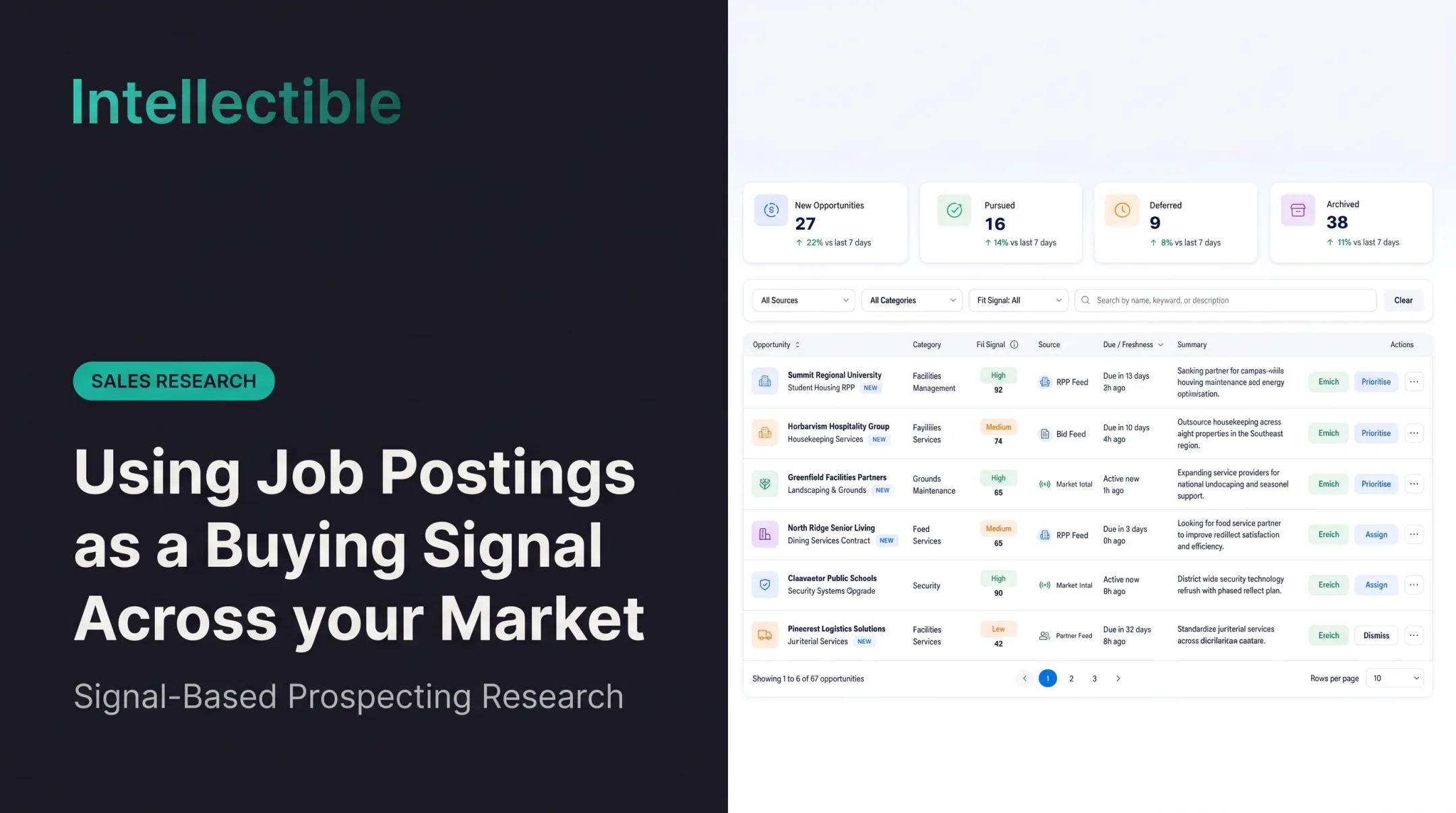
Manual monitoring breaks down fast. A workable workflow routes public signals, account research, scoring, alerts, outreach tasks, and follow-up history into one system.
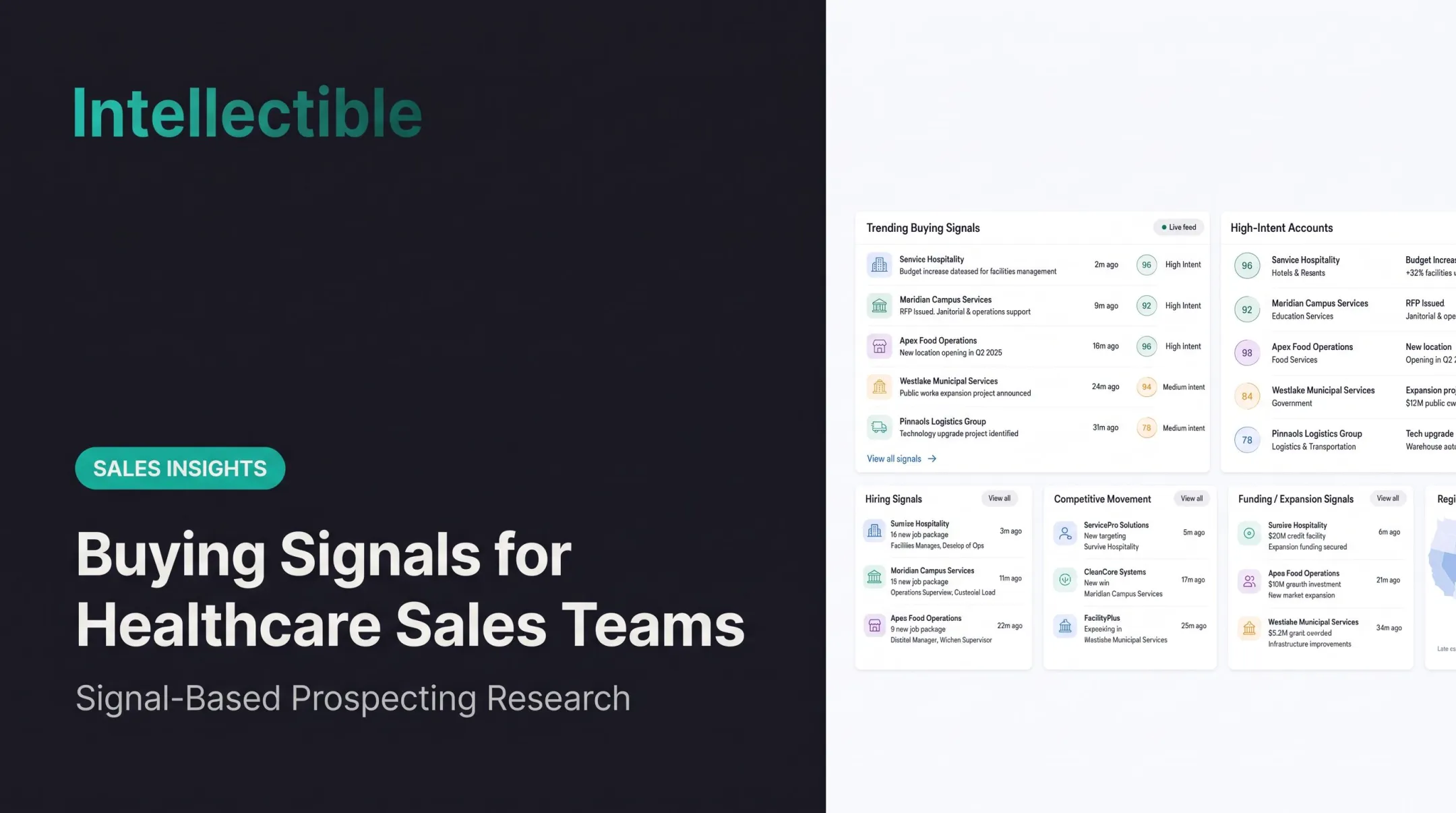
Intellectible is one example of a configurable AI and workflow platform built for this. Its Revenue Discovery engine runs user-defined signal rules through a Detect, Gate, Promote, Draft, Approve, Call, Qualified sequence, with human approval gates and checks that can run nightly, daily, or weekly.

Its Signal Monitor tracks signals such as Hiring Pressure, Funding Round, Leadership Change, Expansion, and M&A. The platform connects to systems like Salesforce, Outlook, and Slack. It organizes and routes signals; it does not supply candidates.
Then review results regularly:
- Which signals produce qualified conversations?
- Which create false positives?
- When should an account be recycled for later outreach?
Frequently Asked Questions
Where should teams find state and local contract evidence?
For services sold to hospitals, universities, school districts, cities, and counties, start with the relevant state and local procurement systems. Search award registers, executed contracts, board packets, purchasing pages, and amendments by agency, service category, incumbent, and contract number. A federal awards tool is not a substitute for these local records.
Which contract dates must be kept separate?
Record the incumbent legal entity, buying organization, service scope, award identifier, base term, current end date, renewal options, amendments, and source document. A maximum potential expiration after options is not the same as the currently exercised term. Unknown end dates should remain research tasks.
What belongs in a market-wide renewal calendar?
Build a renewal calendar for the whole eligible market: account, incumbent, current term, potential option dates, notice requirements where stated, likely procurement window, last verification, and responsible rep. Recheck the original record for extensions or successor awards before acting on an apparent expiration.
How should staffing and other services segment records?
Segment the calendar around the service you sell: facilities, food service, staffing, environmental, or transportation. For staffing and recruiting firms, verify the labor categories, geography, buyer eligibility, and incumbent scope rather than treating any agency vacancy as an open staffing contract.
How should this process be put into practice and measured?
Use documented dates to investigate before the RFP, not to claim that a competitor is certain to lose the account. Confirm how the organization buys, who owns the need, whether an option has been exercised, and which communications are permitted. Let the evidence determine the next action. Maintain the calendar as a monitored process, with source checks, amendment alerts where available, owner assignment, research-needed queues, and rep feedback. Track verified renewal records, timely accepted accounts, pre-RFP conversations where appropriate, sales-accepted opportunities, and missed or stale dates.