Introduction
Capture management is the strategic process of positioning your company to win a specific government contract before the RFP is released. For government contractors, federal proposal professionals, and BD leaders, it is what separates consistent wins from expensive near-misses.
Without disciplined capture, you are hoping evaluators favor your proposal over competitors who spent months building relationships, shaping requirements, and positioning their solutions.
This guide breaks down what capture management is, why it matters in federal contracting, the step-by-step process, and common pitfalls to avoid. You will learn how to move from reactive bid-chasing to proactive strategic positioning—the foundation of higher win rates and smarter resource allocation.
Key Takeaways
- Capture is pre-RFP work: research the buyer, build relationships, and shape your solution before the solicitation drops
- Core work includes opportunity qualification, competitive intelligence, stakeholder engagement, and win strategy
- Capture is not proposal management (post-RFP) or broad BD (account-level ties, not one procurement)
- Disciplined capture focuses resources on winnable deals and deepens federal customer relationships
- Teams that start early enter the RFP with a clearer strategy and a stronger preferred position
What Is Capture Management?
Capture management (also called capture planning) is the structured, proactive process of pursuing a qualified government contracting opportunity before the official solicitation is released. It covers identifying the opportunity, gathering customer and competitor intelligence, building relationships with decision-makers, and developing a tailored win strategy.
What capture is NOT:
- Reactive proposal writing after the RFP drops
- Sending one email to a contracting officer and hoping for the best
- Light competitor research or generic past-performance claims
- Waiting for SAM.gov postings to start your pursuit
Done well, capture moves you from an "unknown" position with the buyer to a "favored" or "preferred vendor" position before the RFP hits SAM.gov.
How Capture Differs from Related Disciplines
Capture vs. Business Development:
- BD pursues new customer accounts broadly, building relationships across agencies and programs
- Capture focuses on winning one specific procurement with a defined scope, timeline, and solicitation
Capture vs. Proposal Management:
- Capture shapes the opportunity before the solicitation exists
- Proposal management executes after RFP release, managing compliant document creation and submission
You need both. Capture owns the strategic pre-RFP window; proposal management owns execution after release.
Why Capture Management Matters in GovCon
Federal contracting operates differently than commercial sales. The Federal Acquisition Regulation (FAR) encourages early engagement from the first identification of a requirement through RFIs, draft RFPs, one-on-one meetings, conferences, and site visits.
Those exchanges help agencies gauge industry capabilities, refine requirements, and spot feasible solutions before the formal solicitation is released.
What typically goes wrong without capture management:
- Companies chase every opportunity without qualification, wasting scarce resources
- Teams submit generic proposals that miss the mission and fail to land with evaluators
- Competitors who engaged early have already shaped requirements and built trust with decision-makers
- Win rates decline because you're competing against vendors who positioned themselves months earlier
Federal agencies expect mission alignment, proof of capability, and a clear grasp of their challenges—the kind surfaced in audits, GAO reports, and strategic plans. Trust comes from early engagement, not from a polished response after the RFP drops.
Wait until release day and you start behind vendors who already mapped pain points, built relationships, and shaped how the requirement is framed. Agencies increasingly favor contractors who show up in market research and RFI phases and prove mission fit before the procurement is locked in.
The Capture Management Process: Step-by-Step
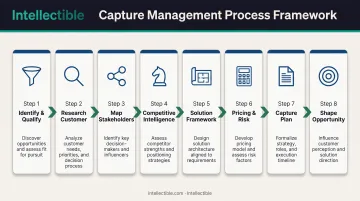
The capture process is a structured sequence that transforms a raw opportunity into a winnable pursuit. It typically involves coordination across sales, technical, pricing, and proposal teams, and the intensity of your capture effort should match the opportunity's strategic value and complexity.
Step 1: Identify and Qualify the Opportunity
Finding opportunities early: Monitor sources that surface upcoming procurements aligned with your capabilities and contract vehicles:
- GSA's Forecast of Contracting Opportunities
- SAM.gov presolicitations
- Market intelligence platforms
- Industry days, budget justifications, and Congressional testimonies
GSA's forecast can provide months of lead time, though entries remain subject to change or cancellation.
Qualification criteria: Assess whether the opportunity matches your:
- NAICS codes and past performance requirements
- Contract vehicle access (GSA Schedule, GWAC, agency-specific IDIQ)
- Small business designations (8(a), HUBZone, SDVOSB, WOSB) if relevant
- Technical capabilities, certifications (such as CMMC for covered DoD systems), and current capacity
Bid/no-bid framework: Use formal qualification gates to evaluate:
- ROI: Does the potential revenue justify the capture and proposal investment?
- Win probability: Do you have a credible path to win given incumbency, relationships, and differentiation?
- Risk: Can you deliver if you win, and are there unacceptable compliance, schedule, or cost risks?
- Leadership buy-in: Does executive sponsorship exist for this pursuit?
Clear gates keep capture spend on pursuits you can actually win.
Step 2: Research the Customer and Mission
Customer research essentials: Study the agency's mission, strategic priorities, recent program audits, Inspector General reports, GAO findings, budget pressures, and leadership statements. Sources include:
- Agency strategic plans
- Congressional Budget Justifications
- GAO reports and testimony
- Inspector General audit reports
- Public program reviews and performance assessments
Identifying customer pain points: Look for recurring challenges in public documents: "legacy system inefficiencies," "lack of interoperability," "budget constraints," "workforce shortages." Those signals define success from the agency's perspective and shape how you frame the solution against documented needs rather than generic capabilities.
Step 3: Map Stakeholders and Build Relationships
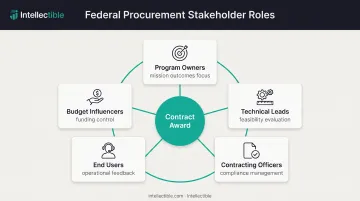
Who matters in federal procurements:
- Program owners: Define mission outcomes and functional requirements
- Technical leads: Evaluate technical approaches and feasibility
- Contracting officers: Ensure compliance and manage the procurement process
- End users: Provide operational input and performance feedback
- Budget influencers: Control funding and prioritize initiatives
Each stakeholder has different priorities—mission outcomes, compliance, cost control—and effective capture requires understanding and addressing all of them.
Building relationships ethically:
- Attend industry days and conferences
- Participate in RFI responses with substantive insights
- Offer white papers or capability briefings that demonstrate understanding
- Schedule one-on-one meetings to discuss mission challenges (within FAR guidelines)
- Provide thoughtful feedback on draft solicitations
Critical compliance note: Information needed to prepare proposals cannot be selectively disclosed to one potential offeror; it must be made public. Always engage through authorized, transparent channels to avoid procurement integrity violations.
Step 4: Conduct Competitive Intelligence
What competitive analysis involves: Identify likely incumbents, past awardees on similar contracts, their differentiators (technical approach, pricing, past performance, teaming partners), and vulnerabilities (performance issues, staffing gaps, pricing weaknesses). Use public sources:
- SAM.gov contract awards
- Agency award histories
- USASpending.gov data
- Public performance reviews
Using competitive intel strategically:
- Highlight where you outperform competitors in evaluation criteria
- Mitigate your weaknesses through teaming, capability investments, or risk-mitigation strategies
- Position your solution to exploit competitor gaps without disparaging others
- Understand incumbent advantages (relationships, past performance, knowledge continuity) and develop strategies to overcome them
Use that intel to set win strategy, pricing posture, and teaming decisions before the RFP drops.
Step 5: Develop a Preliminary Solution Framework
Solution development in capture: Work with technical SMEs to draft a high-level approach that addresses the customer's pain points, aligns with their mission priorities, and differentiates from likely competitor solutions. This is not the final proposal. It is a strategic blueprint that:
- Guides your capture messaging and stakeholder conversations
- Validates technical feasibility and identifies capability gaps
- Informs preliminary pricing and resource planning
- Ensures your team can deliver if you win
Keep the blueprint tight enough to test feasibility and gaps before you invest in a full proposal response.
Step 6: Develop Pricing Strategy and Assess Risk
Pricing strategy in capture: With a preliminary solution in hand, collaborate with finance and technical teams to:
- Estimate labor, materials, travel, overhead, and fee/profit
- Determine competitive pricing posture (base case, aggressive, margin-protected, strategic entry, incumbent displacement)
- Compare scenarios across revenue, cost, margin, risk, and strategic fit
- Assess price-to-win based on historical awards, customer budget, and competitive analysis
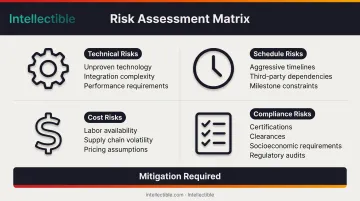
Risk assessment: Identify and document:
- Technical risks: Unproven technology, integration complexity, performance requirements
- Schedule risks: Aggressive timelines, dependency on third parties
- Cost risks: Labor availability, supply chain volatility, pricing assumptions
- Compliance risks: Required certifications, security clearances, socioeconomic requirements
Develop mitigation plans for each identified risk and incorporate them into your capture plan.
Step 7: Create the Capture Plan and Define Win Strategy
What goes into a capture plan: Document customer hot buttons, stakeholder map, competitive advantages, win themes, discriminators, teaming strategy, pricing approach, proposal outline, and action plan with milestones and owners. Use a capture plan template for consistency across pursuits.
Win strategy component: Define your 3-5 primary win themes—for example:
- Proven mission success with relevant past performance
- Innovative technical approach that reduces risk
- Superior value through efficiency and cost control
- Strong teaming with complementary capabilities
- Deep understanding of agency priorities and constraints
State why the customer should choose you over competitors, then align stakeholder conversations, RFI responses, and proposal content around those themes.
Step 8: Shape the Opportunity (Where Appropriate)
Ethical shaping: Influence how the customer thinks about the requirement by:
- Offering insights during RFI responses
- Highlighting industry best practices and emerging technologies
- Identifying capability gaps or inefficiencies in current approaches
- Proposing performance-based evaluation criteria that favor outcomes over inputs
The goal of shaping: Increase alignment between the final RFP requirements and your solution, reduce barriers to your participation (such as unrealistic past performance thresholds or overly narrow scope), and position your approach as the logical solution before competitors engage.
Compliance boundary: Contractors who prepare work statements may be barred from supplying the resulting system or services unless a FAR exception applies. Always shape through authorized channels and avoid conflicts of interest.
Running the process at scale: Across all eight steps, capture teams need one place for customer intel, stakeholder touchpoints, competitive data, and go/no-go records. Workflow platforms built for GovCon pursuits replace scattered spreadsheets with structured opportunity files so pricing, solution, and relationship work stay coordinated as the chase matures.
Key Factors That Influence Capture Success
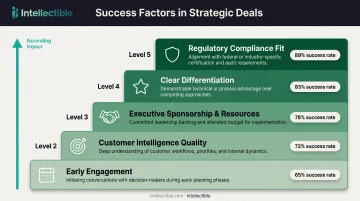
Capture success rarely hinges on one advantage. These five factors consistently separate teams that win from those still scrambling after the RFP drops.
- Early engagement beats late sprints. Start well before RFP release to build relationships, shape requirements, and lock competitive position. Late starts limit all three.
- Customer intelligence quality drives solution fit. Accurate insight into mission priorities, budget constraints, decision-maker preferences, and procurement timelines beats thin research every time.
- Executive sponsorship and real resources matter. Wins need buy-in, a dedicated capture lead, cross-functional coordination, and budget for research, travel, and teaming. Half-hearted efforts yield poor results.
- Clear differentiation wins competitive procurements. Discriminators such as technical edge, past performance, unique teaming, or cost advantage must map to customer hot buttons. Generic "me too" solutions rarely win.
- Regulatory and compliance fit shapes the pursuit. FAR/DFARS rules, socioeconomic set-asides under the Rule of Two, CMMC, and contract vehicle eligibility affect strategy and teaming. Confirm eligibility early.
Common Capture Management Mistakes
Even strong GovCon teams undercut win rates with a few predictable habits.
Waiting too long: Many teams delay capture until the draft RFP drops. By then, competitors have already shaped requirements, built relationships, and positioned their solutions. Late capture cuts win probability and limits strategic options.
Chasing every opportunity: Pursuing unqualified pursuits without rigorous bid/no-go discipline wastes scarce resources: capture manager time, SME bandwidth, executive attention, and proposal budget. Qualification based on ROI, win probability, risk, and strategic fit is what keeps win rates healthy.
Treating the capture plan as a static document: Effective capture plans are living documents. Update them as intel, stakeholder conversations, competitive moves, and strategy shifts come in. A one-time plan goes stale and leaves your team working off outdated assumptions.
Relying on scattered tools: Teams that run capture from spreadsheets, email threads, and manual trackers often lose intel or miss action items. Centralized platforms organize workflows, track tasks, keep structured opportunity records, and give leadership visibility—so you can scale capture without adding headcount.
When to Skip (or Simplify) Capture Management
Situations where full capture is unnecessary:
- Low-value task orders on existing IDIQs where you have a strong relationship
- Routine recompetes as the incumbent with strong performance and stable requirements
- Opportunities with extremely short timelines where early engagement isn't feasible
- Contracts where the customer has clearly committed to a solution (wired solicitations)
When abbreviated capture makes sense:
Even for lower-priority opportunities, a condensed capture process (lighter research, fewer stakeholder meetings, streamlined competitive analysis) can raise win probability. It clarifies customer needs, assesses competition, and sharpens messaging. Focus on:
- Basic customer research (mission, budget, pain points)
- Qualification against hard requirements (NAICS, past performance, vehicles)
- Competitive landscape assessment
- High-level solution validation
Signals that capture is being used by default rather than need:
If your team runs full capture on every opportunity regardless of value or probability, resources are likely misallocated. Match effort to the opportunity:
- Intensive capture for high-value, high-probability, strategically important pursuits
- Abbreviated capture for mid-tier opportunities
- No pursuit for poor-fit, low-ROI bids
Conclusion
Capture management shifts GovCon work from reactive bid-chasing to early, deliberate positioning. Teams that engage before the RFP can shape requirements, earn customer trust, and align solutions to mission priorities while decisions are still forming.
That timing matters. Most federal procurement decisions take shape before the solicitation posts. Teams that run disciplined capture spend those months on relationship-building, intelligence gathering, and solution positioning instead of reverse-engineering the RFP after release.
Apply capture where it pays off. Not every pursuit needs a full capture effort. Reserve the full process for high-value, complex federal procurements—and treat lighter bids with a right-sized go/no-go and pursuit plan.
Frequently Asked Questions
What is capture management?
Capture management is the strategic, pre-RFP process of researching customer needs, building relationships, gathering competitive intelligence, and positioning your company as the preferred solution for a specific government contract—before the solicitation is released.
What is the rule of 2 in government contracting?
The Rule of Two is a federal regulation requiring contracting officers to set aside procurements for small businesses if there is a reasonable expectation that at least two small business contractors will submit offers at fair and reasonable prices.
When should capture management start for a government contract?
Capture should start when the opportunity first appears on agency forecasts or during market research—well before the RFP. That window supports relationship-building, requirement shaping, and competitive positioning. Starting after the draft RFP sharply cuts win probability.
What is the difference between capture management and proposal management?
Capture management occurs before the RFP is released and focuses on strategy, intelligence, and positioning, while proposal management happens after the RFP and focuses on compliant, compelling document creation and submission.
What does a capture manager do?
A capture manager leads the pursuit of a specific government contract by gathering customer and competitive intelligence, developing win strategy, coordinating cross-functional teams (technical, pricing, contracts), and transitioning the opportunity to the proposal team once the RFP is released.
How long does the capture process typically take?
Timelines vary by complexity, value, and competition. Major federal pursuits often run months of capture work; smaller or fast-turn opportunities may use a shorter cycle focused on qualification, research, and win strategy.