The right price point depends on your team size, how many proposals you push out monthly, how deep your FAR/DFARS compliance needs run, and whether you actually need full pursuit automation or just a place to store boilerplate. This article breaks down the pricing tiers, what drives cost up, the hidden fees nobody mentions upfront, and how to budget based on the contracts you're actually chasing.
TL;DR
- Entry tools are free; self-serve GovCon platforms run $79-$699/month depending on proposal volume and seats
- Per-user tools like DeepRFP run ~$89/user/month; intel platforms like HigherGov run $500–$2,500/year
- Cost drivers: proposal volume, seats, compliance depth, and Go/No-Go or pricing automation
- Small teams chasing sub-$1M contracts should stay in flat-rate self-serve tiers
- Teams at 200+ proposals/year—or needing audit trails and past-performance DBs—justify custom pursuit platforms
How Much Does GovCon Proposal Software Cost? (Pricing Overview)
There's no single price for GovCon proposal software. Cost depends on proposal volume, how much compliance workflow you need, and whether you're buying a document tool or a full pursuit engine.
Teams get this wrong in predictable ways. They underbudget for AI draft overages, buy enterprise seats a three-person shop doesn't need, or pick a cheap document tool with no Go/No-Go or pricing workflow—then build a spreadsheet to fill the gap anyway.
Free / Entry Tier
SAM.gov itself is free and lets anyone search contract opportunities without an account. Adding an account gets you saved searches and change alerts, but no proposal drafting.
Best for: Teams still qualifying opportunities before committing to a paid tool.
Self-Serve Small-Business Tier
Published pricing here varies by vendor and volume tier:
- GovHub: $129/month (3 proposals), $349/month (15 proposals), $699/month (50 proposals) — annual billing gets 2 months free
- DeepRFP: $89 per user, per month
- BidSpeed: $79/month (GovReady, up to 5 users) up to $1,595/month (Executive, up to 9 users)

Best for: Teams running a handful of proposals monthly, pursuing contracts under $1 million.
Opportunity-Intelligence Tools
These tools focus on discovery and qualification rather than drafting. HigherGov publishes annual tiers:
- $500/year for a single user
- $2,500/year for up to 10 users
- Custom Enterprise pricing above that
Enterprise RFP Platforms
Some vendors, like GovDash and Deltek's GovWin IQ, don't publish pricing at all. You talk to sales. That model is typical once you need SSO, CRM integrations, and dedicated onboarding support.
Best for: Larger primes running high proposal volume that need integrations beyond what a self-serve plan offers.
Managed / Consultant Services
Consultant pricing runs $100-$300 per hour, with project fees from $5,000 to $50,000+ depending on complexity, according to GovDash's proposal consultant guide. A separate industry heuristic pegs proposal development cost at roughly 1.5%-3% of contract value.
Best for: Complex, high-value pursuits where in-house proposal expertise is thin.
Full Pursuit-Automation Platforms
This tier covers the full pursuit lifecycle in one workflow: qualification, Go/No-Go, compliance, drafting, and submission.
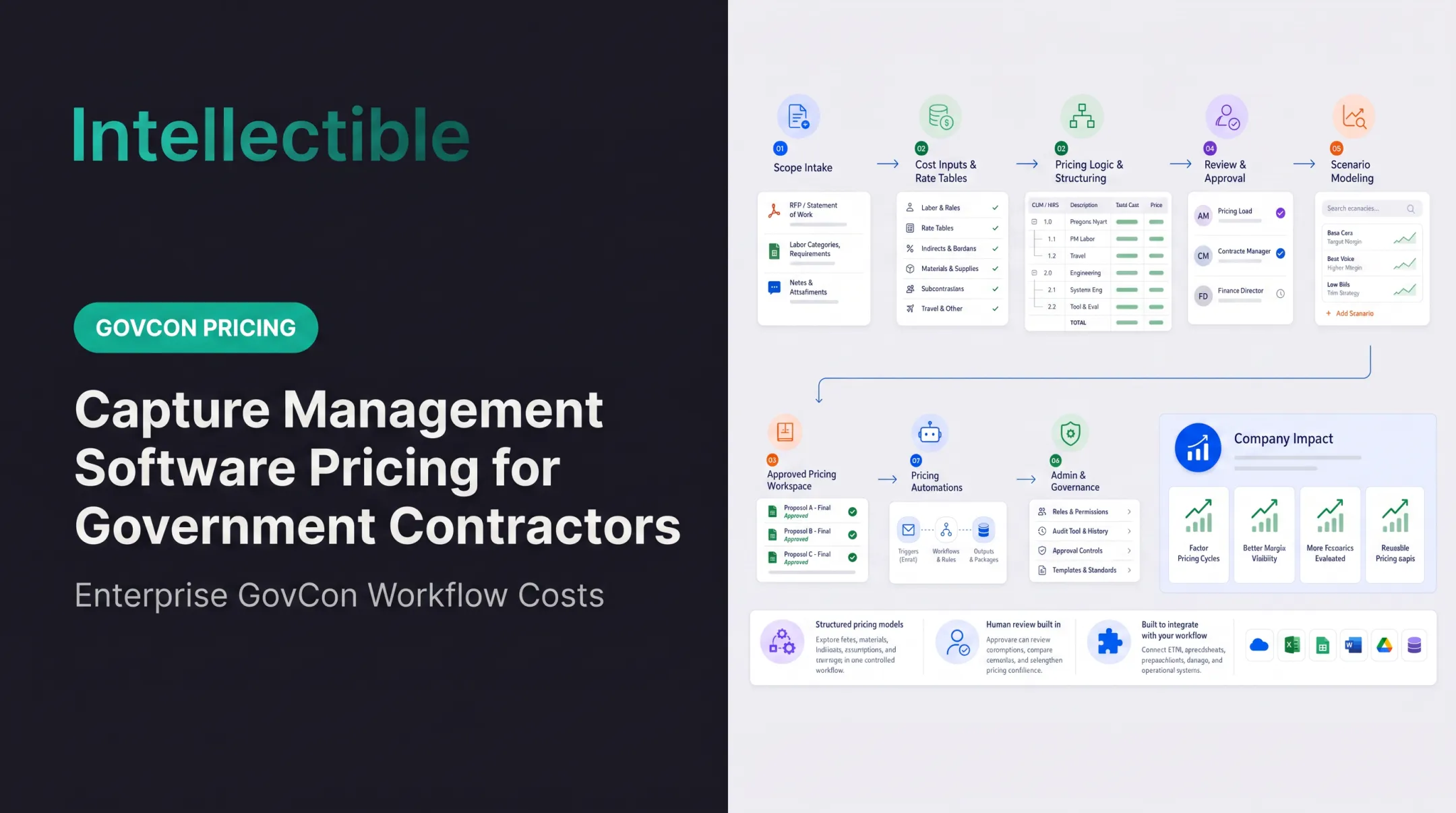
Intellectible's Proposal & Pursuit Engine sits in this tier. It connects portal data, CRM records, and market signals into one pursuit process rather than a folder of documents. Pricing is custom-quoted with no published starting rate, so you talk to their team directly.
Best for: GovCon teams that want pursuit automation and pricing operations, not just a place to write proposals.
Key Factors That Affect the Cost of GovCon Proposal Software
Price scales with how much of the pursuit lifecycle the tool actually automates, not just the sticker price on the pricing page.
Proposal Volume and AI Draft Credits
Most modern tools meter usage by proposal count or AI credit. GovHub's tiers cap out at 3, 15, or 50 proposals a month. Blow past that limit and you're either upgrading or paying overage fees.
Number of Seats and Roles
Per-seat pricing escalates fast on enterprise tools. DeepRFP charges $89 per user flat; other platforms cap users per tier instead (HigherGov's Standard plan tops out at 10 users for $2,500/year). Watch out for:
- Read-only reviewers (finance, pricing leads) that still count as billable seats
- Enterprise tools that charge more per additional seat as you scale
- Minimum seat floors that push you into a higher tier before the team needs the capacity
Compliance and Security Requirements
CUI handling, audit trails, and FAR/DFARS-aligned workflows cost more than generic commercial proposal software. Platforms like GovDash advertise FedRAMP Moderate Equivalent controls and NIST SP 800-53 alignment that a generic RFP tool simply won't have.
Scope of Automation
A content library and drafting assistant is one price point. Add Go/No-Go scoring, pricing workflow, and a past-performance database, and you're in a different category entirely. Map the modules your pursuit process actually uses before you compare list prices.

Integrations and Opportunity Feed Access
Bundled SAM.gov or opportunity-feed access inside your proposal platform saves you from paying separately for a standalone alerting tool. That bundle can erase a second monthly subscription from the stack.
Support, Onboarding, and Contract Terms
GovHub's annual plans include two months free — roughly a 16.7% discount versus paying monthly. Enterprise platforms, by contrast, often add setup fees and custom contract minimums you won't see until you talk to sales.
Cost Breakdown: One-Time vs. Recurring Expenses
The subscription line is rarely your total cost. Here's what else to budget for:
| Expense | Type | Description |
|---|---|---|
| Setup/onboarding | One-time | Implementation, configuration, and training (common on enterprise and pursuit platforms) |
| Subscription/license fees | Recurring | Monthly or annual seat and credit costs |
| AI credit overages & add-ons | Recurring | Costs when draft volume, seats, or opportunity feeds exceed plan limits |
Some vendors waive implementation fees; many do not. Ask each provider directly rather than assuming terms match another platform's.
Self-Serve vs. Enterprise vs. Full Pursuit Automation
Here's what changes as you move up the price tiers:
| Capability | Self-Serve | Enterprise | Full Pursuit Automation |
|---|---|---|---|
| Compliance depth | Basic templates, manual checks | Shared templates with light automation | Automated Section L/M compliance matrices and audit trails |
| Pricing & Go/No-Go | None, or manual spreadsheets | Partial scoring and cost-volume support | Automated Go/No-Go scoring, cost-volume workflows with audit trails |
| Scalability | Manual coordination grows with volume | Better multi-user coordination | Pipeline filtering and drafting scale without proportional headcount growth |

APMP's guide to gate decisions notes that high-performing teams say no more often and still win more: bidding on 15 opportunities and winning 10 beats bidding on 100 and winning 10. A tool that filters opportunities before you commit writing hours does something a document editor never will. Intellectible's platform metrics report 95%+ time saved on opportunity search and Go/No-Go decisions, and a 90% reduction in time to final pricing with full audit-trail control. Those gains show up only after you move past document-only tools into full pursuit automation.
How to Estimate the Right Budget for GovCon Proposal Software
Your software spend should track the contracts you're pursuing, not just your headcount.
Factors to weigh:
- Rule of thumb: Keep software cost under roughly 1% of the typical contract value you pursue
- Match tier to contract size: Sub-$500K pursuits fit self-serve tiers; $1M+ pursuits justify Professional plans, consultants, or full pursuit-automation platforms
- Break-even math: One $10,000 consultant-drafted proposal often costs more than a year of self-serve software. If you run more than one or two proposals a year, software usually wins on cost
Mistakes to avoid:
- Choosing based on review-site star ratings without filtering for GovCon-specific use cases
- Underestimating pricing-workflow automation until you're buried in spreadsheets
- Adopting a generic commercial RFP tool that requires manual workarounds for FAR/DFARS compliance
Frequently Asked Questions
What is proposal pricing?
"Proposal pricing" can mean two things: the cost volume you submit to the government, or the cost of the software you use to build it. This article focuses on the second: software cost, not your bid price.
What is the best proposal software?
Match the tool to volume and workflow depth. Self-serve platforms suit small teams running a few proposals a month; full pursuit platforms like Intellectible's Proposal & Pursuit Engine fit teams that need Go/No-Go and pricing automation in one place.
What is the best software for contractors?
GovCon-specific platforms generally outperform commercial proposal tools because they're built around FAR/DFARS compliance workflows, past-performance reuse, and pricing audit trails. Generic RFP software wasn't designed for those requirements.
Which AI tool is best for business proposals?
Generic AI writing tools lack GovCon compliance context. Purpose-built platforms trained on federal proposal language and Section L/M requirements produce drafts your team can actually use without heavy rewriting.
How much does RFP software typically cost?
Published bands run from free entry tools to $79-$699/month for self-serve GovCon platforms, roughly $89/user/month for per-seat tools, and custom quotes for enterprise and full pursuit-automation platforms.
Are there hidden costs with GovCon proposal software?
Yes. Common extras include:
- Per-seat escalation as you add reviewers
- One-time setup fees on enterprise platforms
- AI credit overages after you hit plan limits
- "Contact us" pricing that lands well above self-serve rates