Introduction: Why Business Development Is the Lifeblood of GovCon Success
Winning government contracts isn't about scrambling when an RFP drops. The contractors who succeed treat business development as a continuous, disciplined lifecycle—starting long before solicitations appear and extending through contract award and delivery.
In FY2025, federal contract commitments reached approximately $793 billion, up $17.8 billion from FY2024 after inflation adjustment. Access to that market still takes more than registration and hope.
Successful GovCon BD teams run a structured process: build compliance and certifications, engage customers early, plan capture, submit compliant proposals, and learn from every outcome.
This guide walks through that full BD journey. You'll learn how to:
- Identify high-probability opportunities
- Shape requirements before the RFP
- Make defensible bid/no-bid decisions
- Use technology to scale your pipeline without adding headcount
- Build skills that separate winning BD pros from reactive bidders
- Track the metrics that matter—and avoid costly mistakes
Key Takeaways
- Treat GovCon BD as a full lifecycle: market research, capture, bid/no-bid, proposal, and post-award lessons
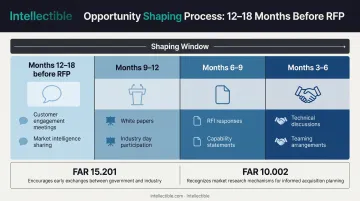
- Engage customers 12–18 months before RFP release to shape requirements and raise win probability
- Complete SAM registration, certifications, and DCAA-compliant systems before you pursue work
- Technology platforms deliver 95%+ time savings on opportunity decisions and 150%+ more qualified pipeline
- Measure pipeline health at every stage and run regular reviews to improve win rates
Understanding the GovCon Business Development Lifecycle
The GovCon BD lifecycle is a structured process spanning market research, opportunity identification, capture planning, proposal development, and post-award activities. Unlike commercial sales, where deals can close in weeks, government contracting typically requires 12-24 months from opportunity identification to contract award.
A defined lifecycle brings discipline to resource allocation and raises win probability by letting teams shape requirements early instead of reacting to RFPs. FAR 15.201 encourages exchanges from the earliest identification of a requirement through proposal receipt. Agencies expect and often welcome that early engagement.
The Five Core Phases of the BD Lifecycle
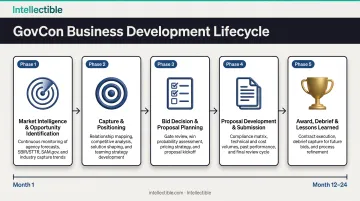
Phase 1: Market Intelligence & Opportunity Identification
Start by monitoring SAM.gov opportunities, agency forecasts, and GSA's Forecast of Contracting Opportunities, which can reveal procurements months before formal solicitations appear. FAR 10.001 requires agencies to conduct market research before developing new requirements, creating natural windows for contractors to position themselves.
Build a qualified pipeline by:
- Attending industry days and pre-solicitation conferences
- Responding to requests for information (RFIs) and sources-sought notices
- Searching USAspending.gov for award history, incumbent contracts, and spending patterns
- Tracking NAICS and PSC codes aligned with your capabilities
Phase 2: Capture & Positioning
Capture is where deals are won or lost—long before proposal writing begins. The 2024 GAUGE Report found that 74% of contractors named personal relationships among their top two sources of new opportunities.
During capture, prioritize:
- Mapping customer mission challenges and pain points
- Sharing market intelligence and relevant past performance
- Positioning your firm as a trusted advisor, not just a vendor
- Analyzing competitors' past performance, pricing strategies, and teaming relationships
- Developing win themes that address customer hot buttons
- Building teaming arrangements before the RFP drops
FAR 7.104 states that planning should begin when the need is identified, preferably well before the award fiscal year. This means your capture efforts should precede the forecast, not start when the solicitation appears.
Phase 3: Bid Decision & Proposal Planning
Not every opportunity deserves a bid. Establish a go/no-go framework that evaluates:
- Strategic fit with your target agencies and capabilities
- Competitive position against the incumbent and other bidders
- Past performance you can substantiate with relevant experience
- Technical capacity across people, systems, and expertise
- Pricing competitiveness at acceptable margins
- Bandwidth to deliver a compliant, compelling proposal
Phase 4: Proposal Development & Submission
Create compliant, compelling proposals that directly address FAR 15.302 best-value evaluation factors. Your proposal must:
- Trace every requirement to a clear response
- Articulate value propositions tied to customer priorities
- Coordinate technical, management, and cost volumes
- Conduct rigorous color team reviews (Pink, Red, Gold)
- Meet all submission deadlines and format requirements
Phase 5: Award, Debrief & Lessons Learned
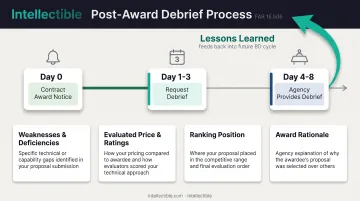
Post-award activities are often overlooked but critical for continuous improvement. Within 3 days of award notice, request a debrief. Agencies should provide debriefs within 5 days when practicable.
A useful debrief covers significant weaknesses or deficiencies, evaluated price and ratings, ranking, and award rationale.
Capture lessons to improve future BD efforts:
- Document what worked and what didn't
- Update competitive intelligence files
- Refine your capture process based on win/loss patterns
- Build relationships with the contract team for future recompetes
Building Your BD Foundation: Essential Capabilities
Before pursuing contracts, build core capabilities in registrations, certifications, and compliance systems. Agencies verify these prerequisites before award.
Registrations and Certifications
Required registrations:
- SAM.gov registration (free; includes your Unique Entity ID)
- U.S. CAGE code (assigned through SAM/DLA; never purchase from a third party)
Certifications that strengthen competitive position:
| Certification | Eligibility | Contracting Benefit |
|---|---|---|
| SBA 8(a) | Small business; generally 51% owned and controlled by socially and economically disadvantaged U.S. citizens | Competitive and sole-source eligibility up to $8.5M (manufacturing) or $5.5M (other) |
| WOSB/EDWOSB | Small; at least 51% owned and controlled by U.S. women (EDWOSB adds financial-disadvantage tests) | Set-asides in SBA-designated underrepresented NAICS industries |
| SDVOSB | Small; at least 51% owned and controlled by service-disabled veterans | Federal set-aside and sole-source contracts |
| HUBZone | Small; principal office in HUBZone; 35%+ of employees live in HUBZone | Set-asides plus 10% price-evaluation preference in full-and-open competitions |
Research which certifications align with your business and target agencies. In FY2025, nearly 28% ($179 billion) of prime awards went to small businesses, with small disadvantaged businesses receiving $75.3 billion and service-disabled veteran-owned businesses receiving $32.5 billion.
Establishing Compliant Business Systems
You will need:
- DCAA-compliant accounting: The SF 1408 Pre-Award Accounting System Adequacy Checklist targets contractors new to cost-reimbursement work and progress payments
- Timekeeping systems: Track labor hours by contract, task, and employee
- Project management systems: Monitor deliverables, milestones, and performance
- Contract management systems: Maintain compliance with terms, modifications, and closeout requirements
These systems matter most when you pursue cost-type work. FAR 16.301-3 permits cost-reimbursement work only when the accounting system can determine costs applicable to the contract. For DoD contracts containing DFARS 252.242-7006, the accounting system must satisfy the clause's specific criteria.
Cost Accounting Standards (CAS) coverage is contract-specific. Current 48 CFR 9903.201 exempts sealed bids, small-business awards, and negotiated awards not exceeding applicable TINA thresholds.
Understanding Contract Types and Their BD Implications
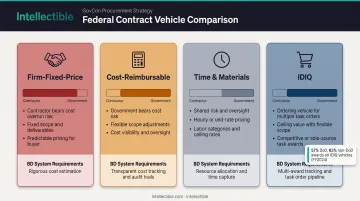
| Contract Type | Risk Profile | BD Implication |
|---|---|---|
| Firm-Fixed-Price | Contractor bears overrun risk | Requires disciplined specifications and pricing assumptions; suitable when fair prices can be established at award |
| Cost-Reimbursable | Government bears more cost risk | Requires adequate accounting and surveillance; used when requirements or costs cannot be estimated accurately |
| Time & Materials | Requires government surveillance | Fixed hourly labor rates plus actual material costs; no positive profit incentive for cost control; ceiling required |
| IDIQ | Ordering vehicle, not single pricing method | Government orders within stated limits; multiple-award holders generally receive fair opportunity above thresholds |
According to CRS, in FY2024 approximately 57% of DoD and 63% of non-DoD contract-award dollars were obligated on indefinite-delivery vehicles. Your systems and past performance must align with the contract types you pursue.
Mastering the Capture Process: From Intelligence to Win Strategy
Capture is the most critical BD phase in GovCon. Deals are won or lost long before proposal writing begins. Winning contractors invest 12-18 months engaging customers, shaping requirements, and building competitive intelligence.
Building Relationships That Lead to Contracts
The 2024 GAUGE Report found that 74% of contractors used personal relationships as one of their top two sources of new opportunities. Contracts are not awarded on relationships alone. Relationships provide access to early intelligence.
Provide value in customer interactions by:
- Sharing market intelligence about emerging technologies and industry trends
- Understanding their mission challenges and budget constraints
- Positioning your firm as a trusted advisor who solves problems
- Demonstrating technical credibility through white papers and capability briefings
- Attending industry days, conferences, and agency-hosted events
Those early exchanges are not only smart BD—they are supported in regulation. FAR 15.201 encourages early exchanges, and FAR 10.002 recognizes RFIs, industry experts, presolicitation conferences, and database research as appropriate market-research mechanisms.
Conducting Competitive Intelligence and Analysis
Before you bid, know who you're competing against. Research competitors using:
- USAspending.gov for award history, incumbent contracts, and spending patterns
- Agency forecast documents and past solicitations
- LinkedIn to identify key personnel and recent hires
- Industry publications and press releases
Once you have the raw data, pressure-test each rival on:
- Competitors' past performance and customer relationships
- Pricing strategies and labor rates
- Teaming relationships and subcontractor networks
- Technical approaches and differentiators
Understanding the "notional winner benchmark" (what the ideal solution looks like from the customer's perspective) helps you position your strengths against competitors' weaknesses.
Developing Your Win Strategy
Your win strategy defines how you differentiate your solution and prove you are the strongest fit. Identify discriminators such as:
- Unique technical capabilities or proprietary tools
- Relevant past performance with quantified results
- Key personnel with specialized expertise
- Innovative approaches that reduce cost or risk
- Strong incumbent relationships or customer familiarity
Develop win themes that address customer hot buttons. For example, if the agency is concerned about schedule risk, your win theme might emphasize your proven project management methodology and on-time delivery record.
Shaping the Opportunity
Influence requirements and evaluation criteria during the pre-solicitation phase through:
- Customer engagement meetings and technical discussions
- White papers that demonstrate thought leadership
- Industry day participation and RFI responses
- Capability statements that highlight relevant past performance
Shaping must be done ethically within FAR 3.104 procurement integrity rules and FAR 9.5 organizational conflict of interest guidance. Never seek nonpublic competitor proposals, evaluation material, or procurement-sensitive information.
Leveraging Technology to Streamline BD Processes
Using Technology to Scale BD Processes
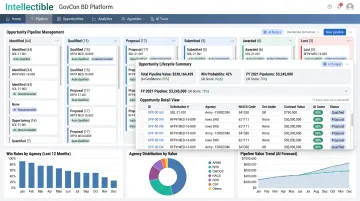
Manual BD processes and spreadsheets cannot scale. Modern GovCon teams need integrated technology to manage complex pipelines, increase win rates, and grow revenue without adding headcount.
GovCon-focused CRM systems track opportunities, manage relationships, monitor RFP deadlines, and provide pipeline visibility across the BD lifecycle. They organize opportunity records by agency, NAICS, contract type, pursuit stage, owner, and next action—giving leadership real-time visibility into pipeline health and team workload.
AI-powered automation platforms speed up how contractors discover, qualify, and pursue opportunities. Platforms like Intellectible digitize BD workflows with AI-driven systems. Teams see 95%+ time savings on opportunity search and Go/No-Go decisions, plus 150%+ growth in qualified pipeline opportunities.
AI automation platforms handle:
- Federal opportunity discovery and semantic matching against your target profile
- Award history analysis to identify incumbents and competitive patterns
- RFP parsing to extract requirements, deadlines, and evaluation criteria
- Go/No-Go scoring based on strategic fit, competitive position, and resource availability
- Proposal compliance tracking and requirement-to-response mapping
- Pricing workflows with approvals, variance checks, and audit trails
Oceus, a defense and technology contractor, more than doubled the qualified opportunities it reviews each week after adopting Intellectible's AI GovCon Engine. About seven to eight opportunities per month now clear its qualification threshold.
Developing Winning BD Team Skills and Traits
Top GovCon BD performers share seven competencies that show up again and again in winning teams:
- Strategic thinking: Connect today's capture work to next year's pipeline and long-term growth
- Interpersonal communication: Build trust with customers, partners, and internal teams; translate technical ideas for any audience
- Subject matter expertise: Earn credibility in your domain and speak the customer's language
- Entrepreneurial drive: Take calculated risks, test new approaches, and persist through long sales cycles
- Relationship building: Stay visible at industry events and on LinkedIn; keep regular customer contact
- Industry fluency: Know agency missions, budgets, procurement cycles, and decision-makers
- Adaptability: Pivot when requirements change or the competitive landscape shifts
Those skills only matter if your firm can develop them. How you build BD capability depends on stage:
- Early-stage firms: Hire an experienced BD professional or partner with a consultant who already knows your target agencies
- Growing firms: Train the team on procurement, FAR basics, proposal practices, and relationship development
- Scaling teams: Pursue APMP Foundation or Practitioner certification and standardize how capture work gets done
Measuring BD Success: Metrics That Matter
Measure BD effectiveness with specific KPIs at each lifecycle stage. The right numbers show where to invest capture effort, when to walk away, and how your win patterns are shifting.
Pipeline metrics:
- Number of qualified opportunities by agency and contract type
- Total contract value in pipeline
- Win rate (separate submitted, competitive, recompete, and task-order rates)
- Pipeline conversion rate at each stage gate
Capture metrics:
- Number of customer engagements per month
- Competitive assessments completed
- Teaming agreements signed
- Early opportunity intelligence (RFIs, sources sought) reviewed
Proposal metrics:
- Proposal submission rate (% of pursued opportunities that reach submission)
- Proposal development cycle time from final RFP to submission
- Color team scores and compliance findings
Financial metrics:
- BD cost as % of revenue (set your own baseline; no universal benchmark)
- Average deal size by agency and vehicle
- Revenue from new vs. existing customers
- Cost per opportunity and cost per win
Win rate is the KPI most teams watch—and the easiest to misread. In Deltek's 2026 GovCon study, more than half of respondents reported win rates between 41% and 70% on the contracts discussed. Your number depends on how you define "bid" (submitted proposals only, or all pursuits?) and where you sit competitively.
Run pipeline reviews on a fixed cadence: monthly for active pursuits, quarterly for strategic planning. Use them to judge opportunity quality, reallocate resources, and spot win/loss trends before they harden into habits.
Common BD Pitfalls and How to Avoid Them
Even experienced GovCon firms make predictable BD mistakes that waste resources and reduce win rates.
Chasing every opportunity: Establish clear bid/no-bid criteria covering strategic fit, competitive position, past performance alignment, technical capability, pricing competitiveness, and resource availability. A disciplined no-bid frees resources for winnable pursuits.
Starting capture at RFP release: Begin customer engagement 12-18 months early. By the time the RFP drops, the incumbent or best-positioned competitor has already shaped requirements.
Neglecting competitive intelligence: Map competitors' strengths, weaknesses, pricing strategies, and customer relationships. Use USAspending.gov, LinkedIn, and industry sources.
Overlooking compliance requirements: Confirm systems, certifications, and past performance meet contract requirements before you bid. DCAA accounting system readiness, relevant certifications, and documented past performance are prerequisites, not nice-to-haves.
Failing to build past performance: Even as a subcontractor, document performance for future prime bids. Request recommendation letters, maintain project files, and track quantified results.
Skipping post-award debriefs: Learn from wins and losses. Request debriefs within 3 days of award notice to understand evaluation strengths, weaknesses, and how your proposal compared to the winner.
Underestimating the sales cycle: Government contracts often take 12-24+ months from opportunity identification to award. Plan cash flow and resource allocation accordingly.
Frequently Asked Questions
Can you make money with government contracts?
Yes, government contracting can be highly profitable, with $793 billion in FY2025 federal contract commitments. Success requires solid systems, compliance, competitive positioning, and disciplined BD processes.
What's the easiest government contract to get?
Micro-purchases (under $15,000 as of October 1, 2025) and subcontracts are typically the easiest entry points. Focus on work where you already have past performance and certifications that give you an edge in your NAICS codes.
How long does it take to win your first government contract?
Expect 12-24 months from starting BD to your first prime contract award. Subcontracts can come faster (6-12 months) when you network actively and build relationships with primes in your target agencies.
What systems does a GovCon need for business development?
You need a GovCon CRM, DCAA-compliant accounting and timekeeping, contract management, and proposal tools. Platforms like Intellectible cut manual work by automating opportunity discovery, Go/No-Go analysis, and capture planning.
What is SBA in US government?
The Small Business Administration (SBA) certifies small businesses for set-aside contracts through programs like 8(a), WOSB, and SDVOSB. It provides resources, counseling, and access to government buyers seeking small business partners, but certification does not guarantee an award.
How does the MBDA help with funding?
The Minority Business Development Agency (MBDA) is a U.S. Department of Commerce agency that provides business consulting, access to capital resources, and connections to contracting opportunities specifically for minority-owned businesses pursuing government contracts and commercial growth.