Introduction
Government contracting proposals are complex, high-stakes work. Compliance, past performance documentation, and process discipline often decide who wins.
Unlike commercial RFPs, federal proposals follow strict frameworks (FAR, DFARS, and agency-specific rules) that dictate structure, content, format, and evaluation criteria. Miss a requirement, and you can lose before evaluators score a single page.
GovCon teams face pressure on every front:
- Hard deadlines with no tolerance for late submissions
- Multi-volume responses covering technical, management, past performance, and price
- Mandatory compliance documentation and scored evaluation factors
- Steep competition from incumbents and established contractors
The stakes match the complexity. The federal government committed approximately $793 billion in contract obligations in FY2025, yet most contractors still struggle to win their share. According to the 2026 GAUGE Report, only 27% of surveyed GovCon firms posted win rates above 50%, and 79% reported challenges winning new contracts.
This guide shows how to build a proposal management process fit for that environment: tighter qualification, clearer collaboration, and reusable knowledge so your team raises win probability without adding chaos.
Key Takeaways
- Win government work with FAR/DFARS fluency, scored evaluation criteria, and strong past performance
- Improve competitiveness with go/no-go gates, clear team roles, and formal review checkpoints
- Cut cycle time through cross-functional collaboration and centralized knowledge management
- Pair people, process, and platforms so teams respond faster and win more work
What Makes Government Proposal Management Different
Government proposal management differs from commercial work in how regulation, scoring, past performance, compliance paperwork, and sales-cycle length shape the pursuit. Each difference changes how you plan, write, and staff a bid.
Regulatory Frameworks and Compliance Requirements
Government procurement follows strict regulatory frameworks that commercial proposals don't face. The Federal Acquisition Regulation (FAR) establishes uniform acquisition policies and procedures for all executive agencies. The Defense Federal Acquisition Regulation Supplement (DFARS) adds DoD-specific requirements on top of FAR.
Individual agencies layer additional regulations, creating a complex compliance landscape that varies by solicitation. These rules govern proposal structure, required content, submission format, and evaluation methods.
FAR 15.305 requires agencies to evaluate proposals against solicitation factors and assess offerors' ability to perform. FAR 15.208 establishes rules for timely receipt and treatment of late proposals—with zero tolerance for non-compliance.
Government proposals also require certifications, representations, and documentation commercial proposals rarely demand:
- Representations and certifications: FAR 4.1201 requires offerors to complete electronic annual representations and certifications in SAM.gov and review them at least annually
- Socioeconomic requirements: FAR Part 19 governs small business programs, NAICS assignment, size/status representations, set-asides, and subcontracting plans where applicable
- Security clearances: Many contracts require facility clearances and personnel security clearances before contract award or performance
- Agency-specific requirements: Individual solicitations may require additional certifications, financial disclosures, or compliance documentation
These requirements are solicitation-specific, not universal. Successful proposal teams maintain current corporate credentials and verify compliance against each RFP's requirements.
Scored Evaluation Methods and Past Performance Weight
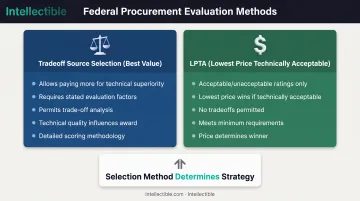
Government evaluations use formal scoring methodologies that differ from commercial assessments. Agencies employ two primary methods:
Tradeoff source selection (FAR 15.101-1) permits award to other than the lowest-priced or highest-technically-rated offeror when the solicitation authorizes tradeoffs. The solicitation must state evaluation factors and their relative importance, allowing agencies to justify paying more for superior technical solutions.
Lowest Price Technically Acceptable (LPTA) (FAR 15.101-2) uses acceptable/unacceptable ratings for non-price factors and selects the lowest-priced technically acceptable proposal. Tradeoffs are not permitted. If your proposal meets all technical requirements, price determines the winner.
Which method applies shapes your entire proposal strategy, from solution design to pricing approach.
Past performance evaluation follows structured protocols. The Contractor Performance Assessment Reporting System (CPARS) is the government's official repository for contractor performance records. Evaluators access CPARS data when scoring past performance, examining currency, relevance, source credibility, context, and performance trends.
FAR 15.305 requires consideration of these factors when evaluating past performance. An offeror with no relevant record may not be rated favorably or unfavorably solely for that absence.
Strong, relevant past performance still provides a measurable competitive advantage. That makes CPARS management, past performance narrative development, and strategic teaming decisions critical to proposal success.
Longer Sales Cycles Demand Early Engagement
Government contracting sales cycles extend far beyond commercial timelines. Opportunities may appear in pipeline forecasts 12-24 months before solicitation release. Pre-RFP relationship building, customer shaping, and early capture activities often influence win probability more than the proposal itself.
Successful contractors engage early, understand agency priorities, shape requirements where possible, build relationships with decision-makers, and develop win themes long before the RFP drops. This extended sales cycle requires dedicated capture management separate from proposal execution.
The Government Proposal Lifecycle
Opportunity Identification & Qualification (Go/No-Go)
Effective opportunity qualification protects limited proposal resources from unwinnable pursuits. Government opportunities are published on SAM.gov and agency-specific portals, generating thousands of notices daily. Finding notices is easy; the hard part is deciding which pursuits you can realistically win.
Win probability factors include:
- Incumbent status and relationship strength
- Past performance relevance and quality
- Technical capability gaps and solution maturity
- Pricing competitiveness and cost structure alignment
- Customer relationships and pre-RFP engagement level
- Contract vehicle access and teaming partner availability
Formal go/no-go process: Establish documented decision criteria, gate reviews with executive participation, and resource allocation commitments before starting proposal work. Qualified opportunities receive dedicated resources; unqualified opportunities are declined early, protecting capacity for winnable work.
Disciplined bid qualification is one of the highest-leverage activities in government contracting, yet many firms skip this step under pressure to "bid everything." The result: wasted resources, burned staff, and missed opportunities to pursue truly winnable work.
Capture & Proposal Planning
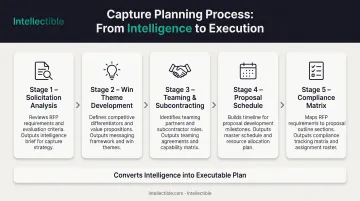
Once an opportunity passes go/no-go, capture planning begins. This phase connects pre-RFP intelligence with proposal execution:
Solicitation analysis: Review the RFP, amendments, attachments, and Q&A responses to understand requirements, evaluation criteria, submission format, compliance obligations, and deadlines.
Win theme development: Translate customer priorities and evaluation criteria into compelling win themes that differentiate your solution. Win themes should address how you solve the customer's problem better than competitors, not just that you're qualified.
Teaming and subcontracting: Identify capability gaps, recruit teaming partners or subcontractors, negotiate teaming agreements, and define roles, responsibilities, and workshare allocation.
Proposal schedule: Map RFP requirements to proposal sections and assign ownership for each volume and deliverable. Set review gates and work backward from the submission deadline with contingency buffers.
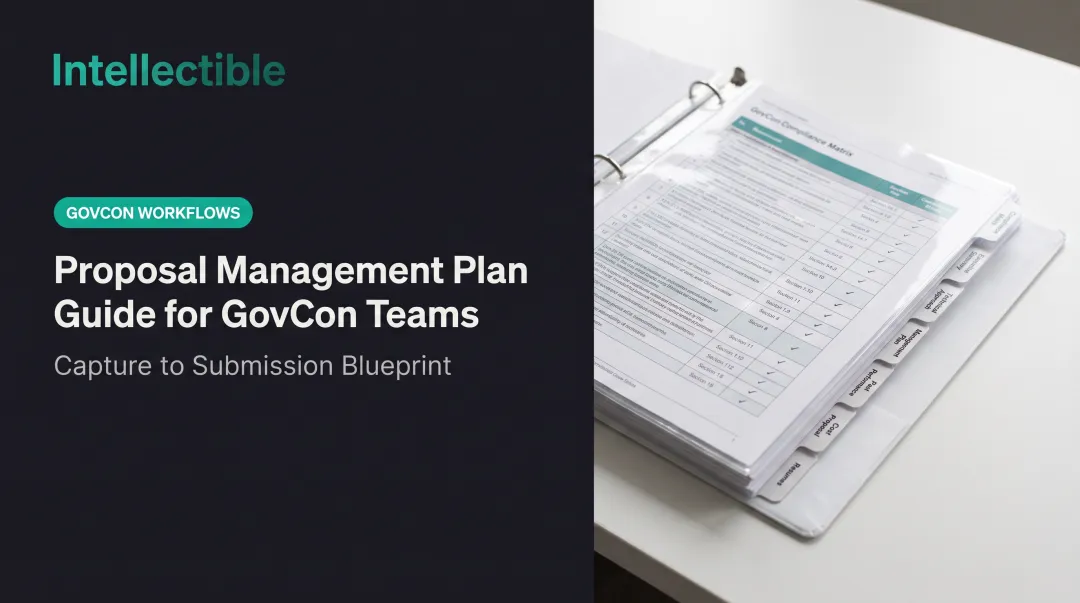
Compliance matrix: Map every RFP requirement to a specific proposal section, owner, and evidence source. This matrix becomes the proposal's backbone, ensuring nothing is missed.
Capture planning converts opportunity intelligence into an executable proposal plan. Teams that skip this phase inevitably face chaos, missed requirements, and last-minute scrambles.
Content Development & SME Coordination
Proposal development requires coordinating subject matter experts across technical, past performance, management, and pricing sections while maintaining quality and consistency.
Technical sections require SMEs who understand the solution, can articulate technical approach, and demonstrate capability to meet requirements. These experts often have competing priorities and limited proposal experience.
Management sections require process descriptions, organizational charts, key personnel qualifications, and management approach aligned with evaluation criteria.
Past performance sections require identifying relevant contracts, gathering performance data, securing customer references, and crafting narratives that demonstrate successful performance on similar work.
Pricing sections require labor category definitions, loaded rates, indirect cost structures, subcontractor quotes, material costs, travel estimates, and Other Direct Costs (ODCs). Every figure needs defensible assumptions and audit-ready documentation.
According to Deltek's 2026 GovCon research, 38% of contractors identified pricing defensibility as the number-one reason proposals were not selected.
Writing to evaluation criteria: Every section must directly address how you meet or exceed the specific evaluation criteria stated in the RFP. Use the customer's language, reference their requirements, and demonstrate understanding of their priorities. Generic boilerplate that doesn't address the specific evaluation criteria weakens your competitive position.
Color Team Reviews (Pink, Red, Gold)
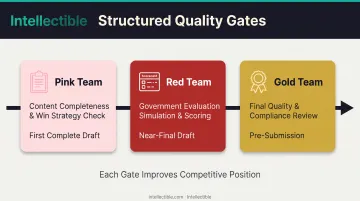
Color team reviews provide external perspectives and structured quality gates throughout proposal development.
Pink Team verifies content completeness and execution of your win strategy. Reviewers check that all requirements are addressed, win themes are incorporated, compliance is maintained, and the proposal is on schedule. Pink Team typically occurs when the first complete draft is available.
Red Team simulates the government evaluation. External reviewers score the proposal against evaluation criteria from the evaluator's perspective, identifying weaknesses, gaps, unsupported claims, and competitive vulnerabilities. Red Team feedback is the most consequential gate in the cycle; acting on it improves evaluation scores.
Gold Team conducts final quality review before submission, checking formatting, consistency, grammar, graphics quality, and compliance with submission requirements. Treat Gold Team as a final polish, not a window for major content changes.
Color team reviews are standard practice in high-performing GovCon proposal operations. Running them on schedule keeps compliance gaps and weak win themes out of the copy evaluators score.
Final Production & Submission
Government proposals demand exact compliance with formatting, organization, and submission requirements.
Compliance verification: Conduct final checks against the compliance matrix, ensuring every requirement is addressed, all certifications are included, and all mandatory content is present.
Formatting requirements: Follow government specifications precisely—page limits, font sizes, margin requirements, section labeling, electronic file formats, and naming conventions. Non-compliance can result in proposal rejection.
Electronic submission: Teams submit most federal proposals electronically through SAM.gov or agency-specific portals. Learn the submission system, test uploads early, and submit with time to spare. SAM.gov does not accept late submissions; deadlines are absolute.
Meeting deadlines: Government RFP response periods vary based on acquisition method, urgency, and complexity. FAR 5.203 generally requires at least 30 days from solicitation issuance for covered actions, though actual timelines depend on the specific solicitation. Build your schedule with contingency buffers; late submissions are rejected without review.
Post-Submission & Debrief
The proposal lifecycle doesn't end at submission. Post-award activities provide critical intelligence for future bids.
Debriefing requests: FAR 15.505 and 15.506 require eligible offerors to submit written debriefing requests within 3 days of notice. Post-award debriefings should occur, to the maximum extent practicable, within 5 days after a timely request. Request debriefs for all losses—the feedback is invaluable.
Debrief analysis: Government debriefs reveal your strengths, weaknesses, how you ranked against competitors, and why another offeror was selected. Document this feedback systematically.
Lessons learned: Conduct internal lessons learned sessions for both wins and losses. Capture what worked, what didn't, and what to change for future proposals.
Content capture: Document reusable content, pricing data, teaming relationships, past performance narratives, and proposal artifacts in your knowledge repository. Stored artifacts shorten the next draft cycle and keep past performance language consistent across pursuits.
Building Your Government Proposal Team & Roles
Successful government proposals need clear roles and real accountability. Without them, even strong technical solutions break down in production.
Core Proposal Team Structure
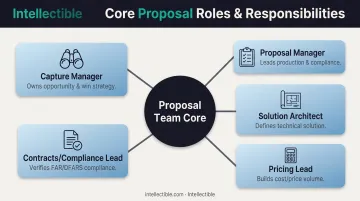
Five roles form the backbone of most GovCon proposal teams:
Capture Manager owns the opportunity from identification through submission. They build customer relationships, shape requirements through pre-RFP engagement, and develop the win strategy that guides the proposal.
Proposal Manager leads production of responsive, compliant proposals. They run the schedule, coordinate stakeholders, verify compliance, manage color team reviews, and own deliverable quality. In GovCon, this role needs project management skill plus deep knowledge of procurement processes and evaluation criteria.
Solution Architect (or Technical Lead) defines the technical solution and leads technical volume development. They coordinate technical SMEs and keep the proposed approach feasible, compliant, and competitive.
Pricing Lead builds the cost/price volume, coordinates subcontractor quotes, and develops labor and cost models. They keep pricing competitive and defensible through structured reviews and approvals.
Contracts/Compliance Lead verifies FAR/DFARS compliance, manages certifications and representations, and reviews terms and conditions. They assess contractual risk and confirm the proposal meets legal and regulatory requirements.
Extended Team Members
Beyond the core, most pursuits also pull in:
- Subject Matter Experts who supply domain expertise, solution detail, and technical writing from delivery teams
- Past Performance Coordinators who gather performance data, secure customer references, and draft narratives
- Proposal Writers/Editors who turn SME input into clear, compelling, compliant content
- Graphic Designers who produce process diagrams, org charts, and solution graphics that support the narrative
- Executive Reviewers who set strategic direction, approve bid decisions, join color teams, and sign final submissions
RACI Definitions & Matrixed Teams
Clear RACI (Responsible, Accountable, Consulted, Informed) definitions prevent confusion at color team reviews and approval gates. Document who owns each deliverable, who approves it, who must be consulted, and who only needs to stay informed.
Most proposal teams are matrixed, which creates a practical problem. SMEs juggle competing priorities: delivering on existing contracts, supporting business development, and contributing to multiple proposals at once. Ways to secure their time and commitment:
- Executive sponsorship and prioritization
- Early SME identification and commitment
- Realistic schedules with SME availability buffers
- Clear scope definitions that limit SME time demands
- Recognition and incentives for proposal participation
Essential Capabilities & Skills for GovCon Proposals
Must-Have Capabilities
Successful government proposal operations require:
- Regulatory compliance knowledge — FAR, DFARS, agency rules, evaluation methods, and submission requirements must live on your team; you cannot fully outsource this
- Past performance records — Current contract details, scope, outcomes, and customer references organized so writers can find proof points fast
- Proposal content libraries — Version-controlled technical approaches, management plans, resumes, and qualifications with clear ownership and approvals
- Pricing and cost volumes — Defensible cost models, subcontractor quotes, rate cards, documented assumptions, and audit-ready backup
Strong pricing operations also need structured intake, scenario modeling, and governed approvals. Teams using Intellectible's Pricing Engine report a 90% reduction in time to final pricing, with a full audit trail.
Core Proposal Skills
Capabilities only matter if people can execute. High-performing GovCon proposal teams build strength in:
- Compliance mapping (Section L/M crosswalks, matrix discipline)
- Persuasive, evaluator-focused writing under tight page limits
- Volume leadership across technical, management, past performance, and price
- Graphics and desktop publishing that clarify complex solutions
- Color-team facilitation and recovery after Red/Gold reviews
- Orals coaching and final production/QC under deadline pressure
Maintaining Corporate Credentials
Keep certifications, representations, and corporate credentials current and ready for rapid proposal inclusion:
- Annual SAM.gov registration and representations renewal
- Current financial statements and accounting system documentation
- Active security clearances and facility clearance status
- Small business certifications and socioeconomic documentation
- Quality system certifications (ISO 9001, CMMI, etc.)
- Cybersecurity compliance documentation (NIST 800-171, CMMC)
Update them year-round. Scrambling during crunch time slows production and signals weak operations discipline.
Content Management as Critical Capability
Enterprise service providers often spend 30–40% of proposal writer or delivery lead time hunting for past performance language, technical descriptions, or policy interpretations. Centralized knowledge management cuts that search tax.
Effective content management requires:
- Ingest PDFs, DOCX files, proposals, contracts, and SOPs with usable metadata
- Parse and index content so teams can run semantic search, not folder archaeology
- Enforce role-based access, approvals, and clear content ownership
- Keep approved boilerplate, past performance narratives, resumes, and solution text ready to reuse
- Version current material and retire what is stale
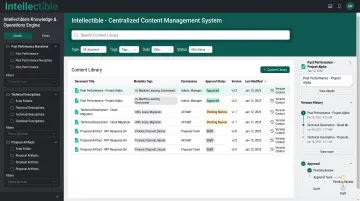
Intellectible's Knowledge & Operations Engine is built for this loop—so writers pull approved, current content instead of rebuilding it each pursuit.
Common Challenges & Solutions in GovCon Proposal Management
Challenge: Accurately Qualifying Opportunities
Many GovCon firms struggle to distinguish truly winnable opportunities from attractive-looking distractions. The result: wasted resources on unwinnable bids and missed focus on high-probability pursuits.
Solution: Workflow automation platforms speed up go/no-go analysis by combining opportunity data, past performance matching, and capability assessments into data-driven bid recommendations.
Intellectible's GovCon Engine turns federal notices into structured capture records with agency details, NAICS and PSC codes, timing, scope, fit rationale, risk signals, and recommended actions. It matches opportunities to target agencies, geographies, deal sizes, vehicles, and capture rules using semantic fit analysis, not just keywords.
Teams using this approach report:
- 95%+ time saved on opportunity search and Go/No Go
- 150%+ increase in actionable top-of-funnel opportunities
- More than double the qualified opportunities per week (Oceus)
Challenge: Time-Intensive Pricing Process
Pricing development is uniquely demanding in government contracting. Cost volume development requires coordination across labor categories, loaded rates, indirect cost pools, subcontractor quotes, material costs, and ODCs. Every figure needs audit-ready documentation and defensible assumptions.
Solution: Automating pricing workflows and approval chains cuts cycle time without losing audit trails. Practical building blocks include:
- Structured pricing intake that captures customer, scope, volume, and deadlines in one record
- AI document extraction that pulls labor, cost, service, and workload inputs from RFPs, Excel files, and attachments (with source evidence retained and gaps flagged)
- Configurable cost modeling that turns spreadsheet logic into reusable workflows with rate cards and cost libraries
- Governed review routes to finance, operations, executives, and SMEs with full audit trails
Intellectible's Pricing Engine supports this path and produces customer-facing pricing that protects internal rates and margins.
Challenge: Maintaining Current Past Performance Data
Outdated or incomplete past performance weakens proposals. FAR 15.305 requires evaluation of past performance currency, relevance, source, context, and trends. While lack of information isn't automatically disqualifying, strong relevant past performance provides measurable competitive advantage.
Solution: Use centralized knowledge management with structured past performance records. Keep a searchable database of active and completed contracts that includes:
- Customer, scope, and period of performance
- Contract value and points of contact
- Performance outcomes and narrative descriptions
Update records at contract closeout and milestone completions, not during proposal crunch time. Intellectible's Knowledge & Operations Engine organizes this material with filters by customer, project, permission group, approval status, and business metadata, so teams spend less time hunting through folders for relevant examples.
Best Practices for Winning More Government Contracts
Winning more government work is less about writing harder and more about choosing the right pursuits, running a repeatable process, and reusing proven content with discipline.
Implement Formal Bid Qualification Gates
Document go/no-go criteria before anyone starts writing. At minimum, score:
- Incumbent status and customer relationship strength
- Past performance relevance to the requirement
- Technical capability match
- Pricing competitiveness
- Resource availability for the full pursuit
Require executive sponsorship and a clear resource commitment before proposal work begins. Decline opportunities that miss your thresholds so capacity stays on pursuits you can actually win.
Establish Standard Proposal Processes
Create a repeatable operating rhythm:
- Kickoff meetings that lock win themes, roles, schedule, and compliance requirements
- Daily standups during execution to track progress and clear blockers
- Color team reviews with external evaluators for an independent read
Shops that run this cadence catch compliance gaps earlier and hand leadership fewer last-minute surprises.
Build and Maintain a Proposal Content Library
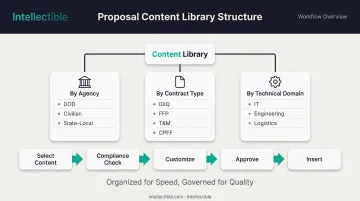
Organize approved content by agency, contract type, and technical domain:
- Boilerplate and corporate qualifications
- Past performance narratives with customer details and outcomes
- Staff resumes with current skills, clearances, education, and experience
- Technical solution descriptions and architecture diagrams
- Artifacts from winning submissions
Critical rule: Reuse content only after an opportunity-specific check for compliance, accuracy, and recency. Blind reuse creates compliance risk and weakens your score.
Intellectible supports proposal libraries with structured records, role-based permissions, approval workflows, version control, and semantic search so teams pull current, approved material instead of outdated files.
Frequently Asked Questions
What does "proposal management" mean?
Proposal management is the end-to-end process of planning, coordinating, developing, and delivering proposals in response to customer requests. In GovCon, it covers the full lifecycle from opportunity qualification through post-submission debrief, including compliance, content development, quality reviews, and submission.
What is the role of a proposal manager?
A proposal manager is the project manager for the response, owning schedule, stakeholder coordination, compliance, and deliverable quality. In GovCon, they also align the proposal to evaluation criteria, run color team reviews, secure executive approvals, and verify submission requirements.
How long does a typical government proposal take to complete?
Timeline depends on RFP complexity and the response window the government sets. FAR 5.203 generally requires at least 30 days for covered actions. Large federal proposals often need substantial full-time effort across multiple volumes, while task orders under existing vehicles may allow shorter periods.
What's the difference between LPTA and best value evaluation?
LPTA (Lowest Price Technically Acceptable) awards to the lowest-priced proposal that meets all technical requirements. Tradeoffs are not permitted. Best value (tradeoff source selection) lets agencies pay more for a stronger technical solution when the solicitation's evaluation factors justify the premium.
Do I need proposal management software for government contracting?
Not required by regulation, but dedicated tools become essential as bid volume grows. Platforms that manage compliance matrices, content libraries, pricing workflows, and approvals cut search time, strengthen compliance checks, and free teams to focus on strategy and selling.
What are color team reviews and why do they matter?
Color team reviews are structured quality gates during proposal development. Pink Team checks content completeness and win strategy. Red Team scores the draft against evaluation criteria like a government evaluator. Gold Team runs the final formatting and compliance check before submission.