This guide walks you through understanding consultant roles, identifying when external expertise justifies the investment, evaluating candidates, managing costs, and working effectively with consultants to turn complex RFPs into winning proposals.
Key Takeaways
- Proposal consultants run RFP strategy, compliance, writing, coordination, and production—not capture or technical solution design
- Hire them for high-value bids when capacity is maxed, expertise is missing, or win rates lag
- Vet candidates with APMP credentials, domain portfolios, working interviews, and GovCon peer references
- Pricing uses hourly, fixed-fee, or retainer models; cost tracks experience, complexity, and timeline
- Clear roles, full background materials, direct SME access, and early capture engagement drive results
What Is a Proposal Consultant?
A proposal consultant is a specialized professional who manages and executes the government contract RFP response process. According to APMP (Association of Proposal Management Professionals), these consultants lead, advise, or supplement proposal efforts for high-priority or complex opportunities. They typically exit after submission or lessons learned, rather than staying on to execute the awarded contract.
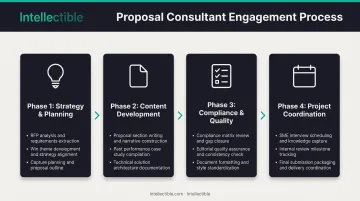
Core Services Proposal Consultants Provide
Strategy and planning:
- RFP analysis and interpretation
- Milestone and deadline management
- Resource allocation and coordination
- Win theme development
Content development:
- Technical volume writing
- Management approach narratives
- Past performance compilation
- Executive summary drafting
Compliance and quality:
- Requirement tracking and matrices
- Section responsiveness review
- Formatting and instruction adherence
- Final production and submission
Project coordination:
- SME scheduling and input collection
- Review cycle management
- Approval routing
- Version control
Where Proposal Consultants Fit in the Pursuit
Proposal consultants focus exclusively on the formal proposal development phase, from RFP release through submission. Per APMP, capture leads own pre-RFP strategy, relationship building, and solution shaping. Proposal consultants translate that foundation into compliant, compelling written responses.
The boundary is critical: consultants execute your documented strategy. They don't create it from scratch.
Typical Engagement Models
Project-based (single RFP):
- Defined scope tied to one specific opportunity
- Clear start and end dates
- Deliverables aligned to solicitation requirements
- Best for occasional high-value pursuits
Retainer arrangements (ongoing support):
- Monthly fee for predictable availability
- Suitable for firms with steady proposal volume
- Consultant becomes familiar with your offerings
- Enables faster mobilization when RFPs drop
Embedded consultant roles:
- Integrated with internal teams for extended periods
- Functions as temporary proposal manager or volume lead
- Fills gaps during hiring transitions or capacity surges
- Provides institutional knowledge transfer
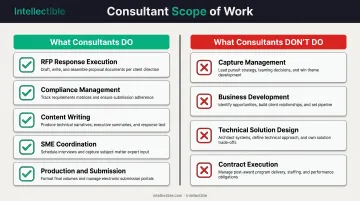
What Proposal Consultants Do NOT Do
Capture management: Building customer relationships, shaping requirements, and developing win strategies before RFP release remains your team's responsibility.
Business development: Identifying opportunities, qualifying leads, and maintaining agency partnerships require continuous internal presence.
Technical solution design: Your engineers, program managers, and technical leads own the "what" and "how" of your solution. Consultants document it persuasively.
Contract execution: Once you win, consultants hand off and your delivery team takes over.
Understanding these boundaries prevents scope confusion and ensures you engage consultants for the right phase of your pursuit.
When to Hire a Proposal Consultant for Your GovCon Team
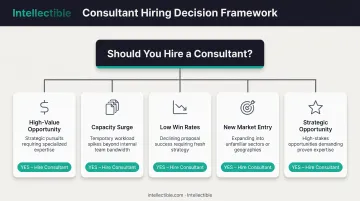
These five scenarios are the clearest signals that external proposal help is worth the cost:
High-Value or Must-Win Opportunities
When pursuing contracts that represent significant revenue or strategic positioning, the cost of losing often exceeds consultant fees by orders of magnitude. If your internal team lacks proven proposal management experience or domain-specific writing expertise for a critical opportunity, external support reduces execution risk.
Deltek's research shows government proposal windows can be 30 days or less, with non-negotiable deadlines and automatic disqualification for late submissions. On high-stakes pursuits, you can't afford learning curves or process failures.
Sudden Proposal Volume Spikes
Federal procurement activity creates predictable capacity challenges. When multiple solicitations release simultaneously or your pipeline converts faster than expected, internal teams become overwhelmed.
The typical proposal requires approximately 84 hours of effort according to Deltek's 2026 study of 917 U.S. and Canadian contractors. If your team suddenly faces three concurrent RFPs, that's 252 hours of specialized work compressed into overlapping timelines: a scenario where consultants provide essential surge capacity.
Win Rates Below Competitive Benchmarks
Deltek's 2026 Clarity study found that over half of respondents reported win rates between 41% and 70% for the contracts they discussed. If your win percentage consistently falls below your competitive set, external proposal experts can diagnose quality gaps and implementation weaknesses.
A strong solution can still lose when evaluators can't see its value in the written proposal. Experienced consultants identify where your responses lose points and implement corrections.
Entering New Market Segments or Agencies
When pursuing your first Veterans Affairs contract after years in DOD space, or bidding civilian agencies after exclusive defense work, agency-specific evaluation priorities and hot buttons matter. Consultants with direct experience in your target agency bring practical context about what resonates with specific evaluation panels.
They understand which past performance examples carry weight, which compliance details trip up newcomers, and how to position your capabilities against established incumbents.
Strategic Cost-Benefit Analysis
Every consultant engagement should pass a simple test: does the incremental win probability justify the investment? For smaller opportunities, the math rarely works. For larger contracts with multi-year performance periods, even modest probability improvements create significant expected value. Weigh contract value, competitive position, internal capability gaps, and strategic importance before you commit to external support.
Types of Proposal Consultants and Their Specializations
GovCon proposals pull in several specialized roles. Matching the right consultant type to your gap matters more than hiring one generalist who claims to cover everything.
Proposal Managers
Proposal managers serve as project leaders who own RFP response execution from kickoff through submission. According to APMP, their responsibilities include:
- RFP analysis, milestone planning, and assignment development
- Resource coordination, content management, and design oversight
- Compliance review and pricing team coordination
- Formatting supervision and submission execution
They act as the single accountable owner so nothing slips during compressed timelines. Strong proposal managers balance strategy with detailed execution and juggle priorities across SMEs, executives, and specialized contributors.
When hiring a proposal manager, prioritize:
- Experience leading proposals of similar complexity
- Ability to manage cross-functional teams under deadline pressure
- A track record of on-time, compliant submissions
Volume Leads
Volume leads own major sections of multi-volume proposals—typically Technical, Management, Past Performance, or Cost/Price. APMP does not define volume lead as a distinct ecosystem role, but the work usually covers:
- Section-level strategy and content development
- Internal SME coordination
- Compliance verification
- Integration with other volumes
Effective volume leads pair subject-matter understanding with proposal writing skill. A technical volume lead must grasp your solution architecture well enough to turn engineering input into evaluator-friendly narrative. A management volume lead needs program management depth so your organizational approach reads as credible.
Volume leads report to the proposal manager but keep real autonomy inside their assigned sections.
Subject Matter Contributors
Specialized contributors support targeted deliverables without owning full volumes:
- Technical writers: Draft sections, edit SME input, and turn complex material into clear, responsive proposal language
- Compliance reviewers: Check instructions, format rules, evaluation criteria coverage, and submission requirements
- Graphic designers: Build visuals, keep brand consistency, and improve readability with compliance-aligned information design
- Desktop publishers: Format to solicitation specs, run visual QA and accessibility checks, and prep final print or digital files
Clear role boundaries help you staff the gaps you actually have—instead of paying for a generalist who dilutes focus across the full response.
How to Select the Right Proposal Consultant
Research Through Industry Networks
Start with APMP's consultant directory and credential holders. The Association provides a verified community of professionals who've demonstrated proposal knowledge through formal certification:
- Foundation (CF APMP): 75-question, 65-minute open-book exam testing core proposal principles
- Professional (CP APMP): Impact paper and panel interview demonstrating senior expertise
- Credential maintenance: Foundation requires 20 continuing education units every two years; Professional requires 40
While certification signals commitment to the profession and baseline knowledge, it doesn't guarantee performance. Pair APMP credentials with portfolio evidence and references from actual engagements.
Tap your GovCon network for referrals. Trusted partners who've worked successfully with specific consultants provide more reliable signals than cold outreach or online profiles.
Evaluate Proposal Expertise
Request detailed portfolios with examples matching your opportunity characteristics: similar agency, contract type, technical domain, and proposal complexity. Redacted samples should demonstrate the specific role you're hiring for: proposal schedules, compliance matrices, edited sections, or final production files.
Ask direct questions:
- What percentage of proposals you've managed resulted in wins?
- Which recent proposals most closely match our opportunity?
- How do you approach tight timelines and competing priorities?
- What proposal management methodology do you follow?
Contact references from comparable GovCon firms. Verify the consultant:
- Performed the same role you need
- Worked under similar deadline pressure
- Delivered on time and managed scope appropriately
- Earned serious rehire consideration
Ask references what they'd change if they engaged the consultant again.
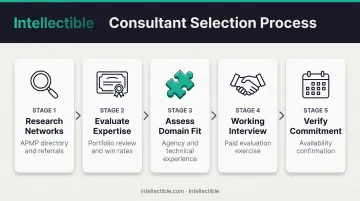
Assess Domain and Agency-Specific Experience
Generic proposal skills matter, but specific context matters more. Does the consultant understand your technical solution domain well enough to ask intelligent questions and spot gaps? Have they supported proposals to your target agency and understand its evaluation priorities?
An IT services consultant won't automatically succeed on a facilities management proposal. A consultant with deep DOD experience may struggle with civilian agency evaluation cultures. Match domain and customer familiarity to your specific opportunity.
Conduct Working Interviews
Theory differs from execution. Conduct paid, time-boxed working interviews using synthetic or past material:
- Provide a past proposal or current RFP excerpt
- Ask the consultant to identify compliance issues, strategic gaps, or improvement opportunities
- Evaluate their analytical approach, communication clarity, and practical recommendations
- Assess how they structure feedback and prioritize concerns
Strong consultants quickly spot requirements your team missed, identify scoring opportunities, and explain recommendations in actionable terms. Weak consultants offer generic observations or miss details. That is exactly what you cannot afford under deadline pressure.
Verify Availability and Commitment
Proposal consultants often juggle multiple concurrent engagements. Explicitly discuss availability expectations:
- Can they dedicate sufficient time during your proposal period?
- What other commitments might compete for their attention?
- Will they be personally performing the work or delegating to junior staff?
- How do they handle conflicts if multiple clients face simultaneous deadlines?
Confirm they can commit the hours your timeline requires, particularly during final production and review cycles when intensity peaks.
Discuss Expectations Explicitly
Document roles, deliverables, decision-making authority, communication cadence, and success measures before work begins:
Roles: Who owns content development, reviews, approvals, and final production? Does the consultant have authority to request resources and enforce deadlines?
Deliverables: What specific work products will the consultant provide? Compliance matrix, proposal outline, draft sections, formatted final document?
Decision authority: Can the consultant make tactical decisions independently or must they escalate everything? Clear authority prevents bottlenecks.
Communication: How often will you check in? Daily stand-ups during final weeks? Weekly status during earlier phases?
Success measures: Beyond winning, how will you evaluate consultant performance? On-time delivery, zero compliance defects, smooth team coordination?
Explicit agreements prevent misunderstandings when deadlines compress and pressure mounts.
Cost Structures and ROI Expectations
Common Pricing Models
Proposal consultants typically use one of three engagement structures:
- Hourly rates — Time-and-materials billing with flexibility; you own hour tracking and budget control
- Fixed project fees — One price for a defined scope; cost risk shifts to the consultant if scope stays tight
- Monthly retainers — Predictable fee for priority access; best when proposal volume is steady and turnaround must be fast
Cost drivers that affect pricing:
- Proposal complexity and evaluation criteria depth
- Timeline pressure (rush jobs command premiums)
- Level of internal support consultant can expect
- Specialized expertise requirements (graphics, compliance, specific technical domains)
Rates swing with experience, market, specialization, and project demands. Request detailed quotes from several consultants and compare scope, deliverables, and value—not price alone.
Calculating Return on Investment
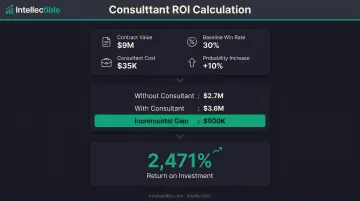
Consultant costs should be evaluated against the incremental win probability they provide multiplied by total contract value:
Example scenario:
- Contract value: $3M (base) + $6M (options) = $9M total
- Baseline win probability: 30%
- Consultant cost: $35,000
- Estimated probability increase: 10 percentage points (to 40%)
Expected value calculation:
- Without consultant: $9M × 30% = $2.7M expected value
- With consultant: $9M × 40% = $3.6M expected value
- Incremental expected value: $900,000
- ROI: ($900,000 - $35,000) / $35,000 = 2,471%
Even modest probability improvements justify consultant investment on larger contracts. The hard part is estimating a realistic probability lift—it depends on your capability gaps, competitive position, and the consultant’s fit.
Additional ROI considerations:
- Time freed for internal staff to focus on delivery and customer relationships rather than proposal writing
- Knowledge transfer that improves future internal proposal capability
- Reduced risk of disqualification due to compliance errors
- Enhanced proposal quality that strengthens win themes and differentiation
Run the math with your own win-rate assumptions, contract value, and internal opportunity cost. On larger pursuits, even a small probability gain usually covers the fee.
Working Effectively with Your Proposal Consultant
Establish Clear Roles and Responsibilities
Document who owns each element of proposal development on day one:
- Content development: Which team members draft which sections? Does the consultant write from scratch or edit SME input?
- Reviews: Who reviews technical accuracy? Compliance? Executive messaging? In what sequence?
- Approvals: Who has final sign-off authority? What triggers escalation?
- Production and submission: Who formats the final document? Who handles electronic submission in government portals?
Ensure consultants have real authority to manage schedules and request resources. A consultant without decision power becomes an expensive coordinator who can't prevent delays. Define explicitly what they can decide independently versus what requires your approval.
Provide Comprehensive Background Materials Upfront
Consultants can't read your mind or recreate institutional knowledge. Provide everything that informs your response:
- Past proposals: Winning and losing proposals to the same agency or similar opportunities. Show what worked and what didn't.
- Technical solution details: Architecture diagrams, implementation approaches, technical differentiators, and innovation elements.
- Past performance: Completed projects demonstrating relevant experience, including outcomes, challenges overcome, and customer feedback.
- Corporate capabilities: Company overview, organizational structure, certifications, facilities, key personnel qualifications, and corporate experience.
- Capture intelligence: Pre-RFP customer interactions, known evaluation priorities, competitive landscape, incumbent strengths/weaknesses, and win strategy.
Front-loading this material prevents mid-proposal surprises. Your consultant can start productive work immediately instead of spending billable hours hunting for context.
Maintain Regular Communication
Schedule consistent check-ins that increase in frequency as deadlines approach:
- Weekly status during early phases
- Multiple times weekly during content development
- Daily stand-ups during final review and production
Ensure consultants have direct access to SMEs rather than filtering through multiple layers. Every intermediary adds delay and increases message distortion. Let consultants schedule working sessions directly with engineers, program managers, and other subject matter experts who own solution details.
Platforms like Intellectible give consultants and internal teams a shared workspace to coordinate requirements, track section ownership, manage reviews, and keep version control in one place. That cuts coordination overhead and keeps everyone on current information.
Common Mistakes and How to Avoid Them
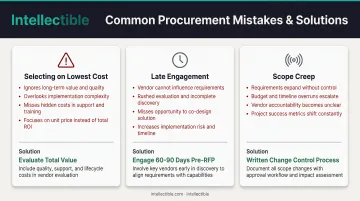
Selecting Consultants Solely on Lowest Cost
Inexperienced consultants charge less for good reason: they take longer, produce lower-quality work, and lack pattern recognition from extensive proposal experience. The "savings" evaporate through missed requirements, weak win themes, and lost proposals.
Cheap consultants often juggle too many simultaneous projects, giving your proposal partial attention when you need focused expertise. Evaluate total value: expertise, availability, track record, and deliverables—not hourly rate alone.
Waiting Until RFP Release to Engage
For must-win opportunities, bring proposal consultants into capture planning 60-90 days before anticipated RFP release. Early engagement allows consultants to:
- Shape capture strategy around proposal evaluation structure
- Identify information gaps before the clock starts
- Pre-draft boilerplate sections that don't require RFP specifics
- Establish team workflows and communication protocols
- Review past proposals and identify reusable content
Starting after RFP release compresses already tight timelines. Deltek reports proposal windows of 30 days or less are common, with non-negotiable deadlines and automatic disqualification for late submissions. Every day spent onboarding consultants is a day not spent writing.
Allowing Scope Creep Without Change Control
Unclear scope boundaries lead to disputes and relationship damage. Define deliverables explicitly in your consultant agreement:
- Named volumes or sections
- Page count or word count limits
- Number of review rounds included
- Assumptions about internal team support
- Client-provided inputs and timing
Establish a change order process for work beyond the original statement of work. When the RFP adds unexpected requirements or your team requests additional volumes, document the scope change and associated cost adjustment before proceeding.
Written agreements prevent end-of-project conflicts over what was "included" versus "extra."
Technology Tools That Enhance Consultant Effectiveness
Modern proposal consultants use technology to automate administrative tasks and put their expertise into strategy and narrative development.
Proposal Automation Software
Proposal platforms typically cover requirement tracking, compliance matrices, version control, and collaborative writing:
- Compliance tracking: Automated requirement extraction from solicitations, requirement-to-section mapping, and coverage gap identification
- Version control: Centralized document repositories preventing conflicting edits and lost changes
- Collaborative workflows: Multiple contributors working simultaneously with change tracking and review routing
- Requirement matrices: Dynamic linkage between RFP instructions and proposal sections ensuring nothing gets missed
These capabilities reduce manual coordination overhead, allowing consultants to spend time on strategic narrative rather than administrative logistics.
AI-Powered Workflow Platforms
Platforms like Intellectible automate time-consuming proposal workflows that traditionally consumed 30-40% of a proposal writer's time:
- Opportunity qualification: Analyzes solicitations for requirements, deadlines, evaluation criteria, and compliance obligations, then produces go/no-go reports and requirement summaries
- Pricing automation: Pulls scope, labor, and cost inputs from RFPs into structured pricing workflows, cutting time to final pricing by 90%
- Past performance retrieval: Uses semantic search across corporate knowledge repositories to surface relevant examples, technical approaches, and capability statements
Consultants can then spend their time on win themes, evaluator-centric messaging, and narrative strategy—the work that actually moves win probability—instead of document mining and compliance checking.
Content Management Systems
Mature GovCon firms maintain libraries of reusable content:
- Corporate boilerplate (company history, facilities, quality systems)
- Past performance examples with outcome metrics
- Staff resumes and qualifications
- Capability statements by technical domain
- Graphics and diagrams (organizational charts, process flows)
Effective content management platforms provide permission controls, approval workflows, version tracking, and integration with proposal development environments. Consultants can access pre-approved content without disrupting internal teams or violating security protocols.
Together, automation, AI processing, and centralized content management turn proposal work into a structured workflow. Consultants deliver stronger drafts in shorter cycles because less time is lost to coordination and file hunting.
Frequently Asked Questions
What does a proposal consultant do?
Proposal consultants run the RFP response end to end: strategy, compliant writing, SME coordination, compliance review, and final production. They act as specialized project managers and writers who turn technical solutions and company capabilities into evaluator-friendly narratives that score well.
How much should I pay for a proposal consultant?
Pricing varies by experience, role complexity, geography, and timeline pressure. Common structures include hourly rates, fixed project fees, and monthly retainers. Compare detailed quotes on scope and deliverables, and judge total value rather than sticker price alone.
What are the three C's of proposal writing?
Per APMP guidance, the three C's are Compliant (meet every RFP requirement), Competent (prove you can perform), and Comprehensive (cover evaluation criteria thoroughly). Compliance avoids disqualification; competence and comprehensiveness drive higher scores.
When should I hire a proposal consultant vs. building an internal team?
Build an internal team when proposal volume is steady and institutional knowledge, availability, and content reuse justify permanent roles. Hire consultants for complex or high-priority bids, workload spikes, or expertise gaps. Many GovCon firms keep a core internal team and add consultants for surge or specialty support.
How do I measure the ROI of hiring a proposal consultant?
Compare consultant cost to the gain in win probability times contract value. If a $35,000 consultant lifts win odds from 30% to 40% on a $9M bid, expected value rises by $900,000 (about 2,471% ROI). You also free internal staff for delivery work and reduce disqualification risk.
What information should I provide to a proposal consultant?
Share the full RFP and amendments, solution approach and differentiators, past performance, capabilities, resumes, pricing inputs, and capture intel on customer priorities and competitors. Add prior proposals (wins and losses), org charts, facilities, certifications, and pre-RFP interactions. Front-loading this context produces better work faster and cuts billable scavenger hunts.