Introduction
In federal contracting, understanding evaluation criteria separates a compliant proposal from a winning one. Many government contractors struggle with translating solicitation requirements into compelling, evaluation-responsive proposals. A technically capable firm can still lose if evaluators cannot easily identify where and how the proposal addresses stated factors.
Evaluation criteria determine how hundreds of pages of proposal content will be scored, often with millions of dollars in contract value on the line. According to FAR 15.305(a), proposals must be evaluated solely against solicitation factors, meaning your response strategy must map directly to what the government says it will measure.
This guide breaks down common federal evaluation factors, explains LPTA versus best value approaches, and provides tactical guidance for building evaluation-responsive proposals that help evaluators find and score your strengths quickly.
Key Takeaways
- Evaluation criteria are predetermined standards stated in the solicitation—proposals are scored solely against these factors
- Federal evaluations assess technical approach, past performance, management, personnel, and cost/price under FAR 15.304
- LPTA awards to the lowest price that passes technical review; best value allows premiums for superior merit
- Build a compliance matrix that maps every evaluation factor and subfactor to proposal sections with evidence
- Keep the technical narrative and cost proposal aligned so labor hours, staffing, and methodology match
What is Proposal Evaluation in Government Contracting?
Proposal evaluation is the government's structured process for assessing contractor submissions against predetermined criteria stated in the solicitation. FAR Part 15 governs the evaluation process for negotiated procurements, requiring agencies to evaluate proposals solely on stated factors and subfactors—not on unstated preferences or undisclosed criteria.
The process serves two purposes:
- Determining which offeror represents best value to the government
- Maintaining a fair, transparent, and defensible source selection
Under FAR 15.303, the source selection authority establishes an appropriately skilled evaluation team and approves the strategy before solicitation. Evaluators then assess each proposal independently, document strengths and weaknesses, and support their ratings with narrative justification.
This structure protects both parties. Contractors know exactly what will be measured, and the government creates a defensible record that can withstand protest scrutiny.
Common Federal Proposal Evaluation Criteria
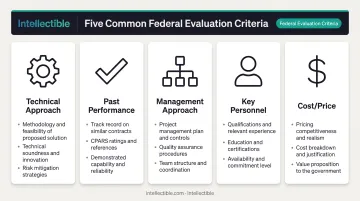
While agencies tailor evaluation criteria to specific requirements, certain factors appear consistently across federal solicitations. FAR 15.304(c) generally requires evaluation of cost/price, quality, and past performance above the simplified acquisition threshold.
Technical Approach and Understanding
Evaluators assess the soundness, feasibility, and innovation of your proposed technical solution. This includes:
- Methodology, processes, and execution approach
- Understanding of the requirement and potential challenges
- Risk identification and mitigation strategies
- Credibility and realism of proposed solutions
Technical evaluation examines whether you understand what the government needs and whether your approach will actually work. Generic descriptions earn low scores; specific, requirement-tailored solutions with supporting rationale earn high marks.
Past Performance
Past performance evaluation assesses your record on similar or relevant contracts. Evaluators review CPARS (Contractor Performance Assessment Reporting System) ratings, references, and past performance questionnaires to judge how likely you are to perform successfully.
Key considerations include:
- Currency: How recent is the performance?
- Relevance: How similar is the work to the current requirement?
- Source: Is the information verifiable and authoritative?
- Context: What were the circumstances and challenges?
- Trends: Is performance improving, declining, or consistent?
Important note: If you lack relevant past performance information, FAR 15.305(a)(2)(iv) requires neutral treatment—you cannot be evaluated favorably or unfavorably on this factor.
Management Approach and Organizational Capability
This factor covers your project management methodology, organizational structure, quality controls, reporting, and execution plan. Evaluators also weigh:
- Corporate experience and resources
- Facilities and equipment
- Demonstrated ability to perform work of similar size, scope, and complexity
- Quality assurance and quality control procedures
- Communication and reporting plans
Strong management approaches show clear lines of authority, defined escalation procedures, measurable quality metrics, and realistic timelines tied to your technical methodology.
Key Personnel Qualifications
For labor-intensive professional services contracts, evaluators assess education, certifications, relevant experience, and availability of proposed personnel. The evaluation focuses on:
- Specific experience directly related to required technical competencies
- Credentials that demonstrate qualifications
- Availability and commitment to the contract
- Resume details that substantiate claimed expertise
Avoid generic resumes. Instead, highlight experience that maps directly to evaluation subfactors and contract responsibilities.
Cost or Price
FAR 15.404-1 distinguishes between price evaluation and cost realism analysis. Price evaluation compares offers to establish reasonableness. Cost realism analysis checks whether proposed costs align with your technical approach and what the government should realistically expect to pay.
Evaluators assess whether your cost proposal matches your technical proposal in:
- Labor categories and skill levels
- Level of effort and hours
- Materials and equipment
- Subcontracting approach and costs
- Indirect rates and fee/profit
Disconnects between technical narrative and cost model are among the most common evaluation weaknesses.
Small Business Subcontracting
FAR 19.702(a)(1) requires subcontracting plans for negotiated solicitations exceeding $900,000 (or $2 million for construction) with subcontracting possibilities. Evaluators assess:
- Proposed small business utilization goals
- Adequacy of the subcontracting plan
- Prior performance meeting small business goals
- Good-faith compliance efforts
Plans must demonstrate realistic opportunities and meaningful commitments, not token percentages.
Understanding Evaluation Approaches: LPTA vs. Best Value Tradeoff
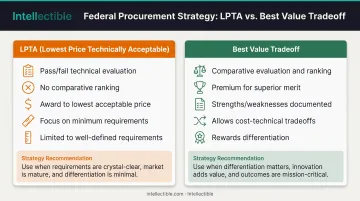
FAR 15.101 distinguishes two primary source selection approaches: Lowest Price Technically Acceptable (LPTA) and Best Value Tradeoff. Which method applies shapes your entire proposal strategy.
LPTA (Lowest Price Technically Acceptable)
LPTA is a pass/fail technical evaluation. All proposals that meet minimum requirements are treated as technically equal, and award goes to the lowest-priced acceptable offer. Technical factors are scored acceptable or unacceptable; no comparative ranking occurs.
Agencies use LPTA when:
- Requirements are well-defined with minimal performance risk
- Established commercial solutions exist
- Exceeding minimum requirements provides no additional value to the government
- Lowest price reflects best value
Strategic implication: Under LPTA, superior technical solutions earn no premium. Focus on meeting every minimum requirement at the lowest defensible price.
Important restrictions: DFARS 215.101-2-70 limits DoD's use of LPTA for IT, cybersecurity, systems engineering, and other knowledge-based professional services. In FY2018, GAO estimated LPTA was used for 25% of DoD competitive awards valued at $5 million or more, far less often than tradeoff evaluations.
Best Value Tradeoff
Best value tradeoff allows the government to pay a premium for superior technical merit, past performance, or other non-cost advantages. Agencies conduct comparative evaluations and may select higher-priced, higher-rated proposals when documented benefits justify the cost difference.
Under tradeoff:
- Proposals are ranked and compared across all factors
- Strengths, weaknesses, deficiencies, and risks are documented
- The source selection authority weighs cost against non-cost benefits
- Award decisions must be independently reasoned and documented
Strategic implication: Best value rewards differentiation and demonstrable superiority. Invest in discriminators: quantifiable advantages that justify paying more for your solution.
Strategic Implications for Proposal Development
LPTA is a compliance-and-price game: hit every minimum, document it cleanly, and price aggressively. Best value is a differentiation game: prove superior outcomes that justify a premium.
Identify the approach during capture. Heavy win-theme investment under LPTA wastes effort; thin technical content under best value leaves money on the table.
How to Build an Evaluation-Responsive Proposal
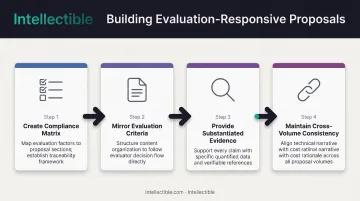
Winning proposals explicitly demonstrate responsiveness to every stated evaluation factor and subfactor with clear, substantiated evidence. Make it effortless for evaluators to find and score your strengths.
Create a Compliance Matrix
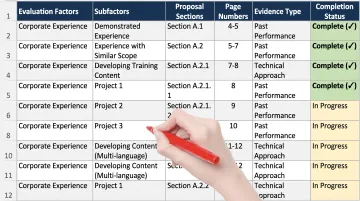
Develop a compliance matrix that maps each evaluation factor and subfactor to specific proposal sections, page numbers, and supporting evidence. Compliance matrices serve as planning tools during development and quick-reference guides for evaluators during source selection.
Your matrix should include:
- Evaluation factor/subfactor language from Section M
- Corresponding proposal section and page number
- Type of evidence provided (past performance reference, resume, technical data)
- Status (complete, in progress, pending)
Link each matrix row to the live draft section (and owner) so status stays current as writers revise content and nothing ships unmapped.
Use Evaluation Criteria as Content Organizers
Structure proposal sections to mirror evaluation criteria. Use evaluation language as section headings and subheadings where appropriate. This approach makes it easy for evaluators to locate responsive content without searching through unrelated material.
For example, if the solicitation lists "Risk Identification and Mitigation" as a subfactor, include a clearly labeled subsection with that exact title. Don't bury risk discussion in a generic "Technical Approach" narrative.
Provide Direct, Substantiated Responses
Address evaluation criteria explicitly with specific evidence:
- Quantified results from past performance: "Completed 14 similar contracts totaling $47M with zero CPARS ratings below 'Very Good'"
- Credentials of proposed personnel: "Project Manager holds PMP certification and led three HHS contracts exceeding $10M"
- Technical data supporting feasibility: "Our proposed encryption meets FIPS 140-2 Level 3 requirements, validated through NIST testing"
Avoid generic claims like "we have extensive experience" or "our team is highly qualified." Evaluators discount unsubstantiated boilerplate.
Maintain Consistency Across Proposal Volumes
One of the most common evaluation weaknesses is a disconnect between the technical approach and the cost proposal. Evaluators routinely catch misalignment between:
- Proposed labor hours and technical methodology
- Staffing plans and organizational charts
- Senior-level expertise descriptions and junior labor rates
- Extensive quality control processes and minimal QC labor hours
Conduct cross-functional reviews to verify alignment across management, technical, past performance, and cost volumes. Keep labor categories, hour estimates, and technical commitments in one shared assumptions log so every volume stays aligned before review.
Conduct Red Team Reviews with Evaluation Lens
Conduct internal red team reviews where independent reviewers score your proposal using the government's stated evaluation criteria and rating scales. Document scores for each factor and subfactor, and flag gaps where the content fails to prove responsiveness.
Red team reviewers should ask:
- Can I find the answer to this evaluation factor within 30 seconds?
- Is the evidence specific, verifiable, and requirement-related?
- Does the cost proposal support what the technical volume describes?
- Are subfactors addressed directly, not just implied?
Fix identified weaknesses before submission. Discussions may not occur under FAR 15.306(a)(3), so your initial proposal must be complete.
Common Evaluation Mistakes to Avoid
Even experienced contractors make recurring mistakes that weaken evaluation scores and reduce win probability.
Ignoring Subfactors and Their Relative Importance
Solicitations list subfactors beneath each evaluation factor. Skip a subfactor and you leave an incomplete response—and a lower score. If the RFP states that "Technical Approach" includes subfactors for "Methodology," "Risk Mitigation," and "Innovation," you must address all three explicitly.
Best practice: Allocate proposal content proportionally to evaluation weights. If past performance is worth 40% and technical approach 30%, content volume and level of detail should reflect that relative importance.
Generic, Unsubstantiated Claims
Boilerplate language, unverified assertions, and corporate capability statements that don't specifically address the requirement earn low scores. Evaluators are trained to identify and discount generic content.
Examples of weak claims:
- "We have extensive experience in federal contracting"
- "Our team is highly qualified"
- "We deliver superior quality"
Examples of strong claims:
- "We have completed 23 federal IT contracts for DHS, DoD, and HHS since 2020, with an average CPARS rating of 4.8/5.0"
- "Our proposed Project Manager has led five similar cybersecurity implementations, each delivered on time and under budget"
- "Our quality control process caught 94% of defects before delivery on our most recent VA contract"
Concrete, verifiable facts win evaluations.
Proposal-Cost Misalignment
A disconnect between what your technical proposal describes and what your cost proposal prices is one of the most damaging evaluation weaknesses. Cost realism analysis under FAR 15.404-1(d) tests whether costs align with your unique technical method.
Common misalignment examples:
- Proposing senior-level expertise but pricing junior labor rates
- Describing extensive quality control processes without corresponding labor hours in the cost model
- Including subcontractor tasks in the technical volume but omitting them from the cost proposal
- Claiming proprietary tools or systems without accounting for licensing, maintenance, or training costs
Reconcile labor mix, hours, rates, materials, and assumptions before submission. Run a cross-functional review with technical writers, contracts personnel, and finance before you submit—these reviews catch the disconnects.
Conclusion
Proposal evaluation criteria are guideposts. They tell you exactly what the government values and how to structure winning proposals. Your job is to make it effortless for evaluators to find and score your strengths against those stated criteria.
Evaluation-responsive proposal development is a continuous discipline. It takes early solicitation analysis, structured compliance planning, and rigorous internal review before submission:
- Confirm whether the procurement uses LPTA or best value tradeoff
- Map every factor and subfactor to specific proposal content
- Substantiate every claim with verifiable evidence
- Keep the technical narrative and cost proposal consistent
Follow these principles and your proposals stand out for a practical reason: evaluators can score your strengths quickly and defensibly.
Frequently Asked Questions
How do you evaluate a proposal?
Government evaluators score proposals against the criteria and rating scales in the solicitation. They document strengths, weaknesses, and risks factor-by-factor, then select the offer that wins under the stated source selection approach.
What are some examples of evaluation criteria?
Common federal factors include technical approach, past performance, management capability, key personnel, cost/price, and small business subcontracting. Criteria vary by agency, though FAR 15.304 requires cost, quality, and past performance above the simplified acquisition threshold.
What is the difference between LPTA and best value evaluation?
LPTA is a pass/fail approach: the lowest-priced technically acceptable proposal wins, and no tradeoffs are permitted. Best value lets the government pay more for stronger technical solutions or past performance when documented benefits justify the premium.
How should past performance narratives address evaluation criteria?
Address relevancy, recency, and quality with contracts that match scope, technical requirements, contract type, and outcomes. Cite value, duration, customer references, CPARS ratings, challenges, and corrective actions.
What is a compliance matrix and why is it important?
A compliance matrix maps solicitation requirements and evaluation criteria to proposal sections and page numbers. It proves full responsiveness, helps evaluators find content quickly, and tracks coverage during proposal development.
How do evaluation factors influence proposal page allocation?
Allocate pages and detail in proportion to evaluation weights. Higher-weighted factors need more coverage and evidence—if technical is 40% and past performance is 30%, your content mix should match that emphasis.