Unlike generic business proposals, government RFPs demand strict adherence to Federal Acquisition Regulation (FAR) architecture, evaluation-factor mapping, and traceability protocols. A well-constructed outline doesn't just organize your response—it systematically addresses evaluation criteria, coordinates distributed teams across volumes, and provides evaluators with a clear path to scoring your strengths. According to Deltek's 2026 GovCon analysis, top performers achieve a 72% win rate versus a 48% industry average—and much of that gap closes during the planning phase, before a single draft paragraph is written.
This guide provides a GovCon-specific blueprint for building proposal outlines that enforce compliance, accelerate coordination, and improve your probability of win.
Key Takeaways
- Map every RFP requirement to response sections, authors, and evaluation criteria with a proposal outline as your structural blueprint
- Compliance matrices trace Section L instructions and Section M evaluation factors to specific outline headings, preventing orphaned requirements
- Structured outlines allocate word counts by evaluation weight, assign clear ownership, and embed review milestones before drafting begins
- Failure to follow RFP formatting instructions (even font choices) has resulted in proposal eliminations upheld by GAO
What is a Proposal Outline?
A proposal outline is the structural blueprint that organizes your response to an RFP, RFQ, or RFI. It's the skeleton that determines where every requirement is addressed, who writes each section, and how evaluators will navigate your proposal.
The outline differs from the final proposal. The finished document holds polished narratives, proof points, graphics, and resumes. The outline holds headings, subheadings, content placeholders, compliance cross-references, and author assignments.
It is both a planning tool that prevents gaps before drafting starts and a management tool that coordinates distributed teams across volumes.
Three Critical Functions
Ensures Compliance with Solicitation Requirements
Every Section L instruction and Section M evaluation criterion must map to a specific outline section. FAR 15.305 requires agencies to evaluate proposals solely on stated factors and subfactors—if your outline doesn't address a criterion, your proposal can't earn points for it.
Facilitates Team Coordination Across Volumes
Government proposals often require separate technical, management, cost, and past-performance volumes. The outline assigns ownership, sets deadlines, allocates word counts, and identifies dependencies so subject-matter experts, pricing analysts, and capture managers work in sync.
Provides a Roadmap for Reviewers
Evaluators score proposals against weighted criteria under tight timelines. A well-constructed outline makes your response easy to navigate, placing compliance callouts, cross-references, and win themes exactly where evaluators expect them.
Direct Impact on Pwin
Your outline directly influences probability of win by addressing evaluation criteria systematically. When requirements map to sections with the right emphasis (word count, detail, and proof), evaluators can score your strengths efficiently.
Missing or buried requirements create scoring gaps. In one GAO protest decision, 5 of 8 revised proposals were eliminated for submission noncompliance.
Key Components of a GovCon Proposal Outline
Compliance Matrix as Foundation
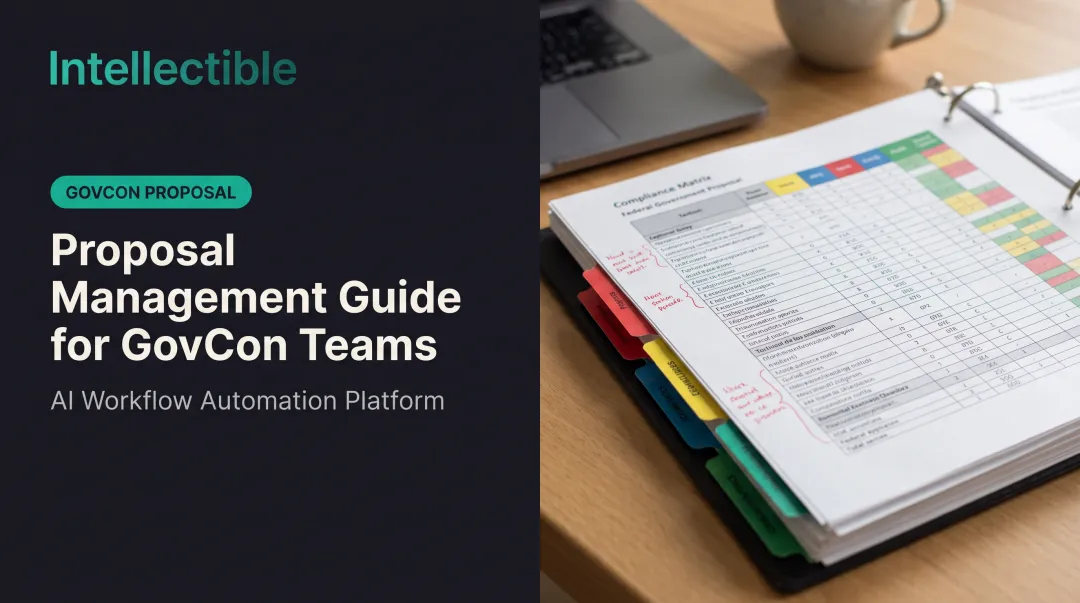
The compliance matrix is the traceability layer beneath your outline. It maps every Section L requirement and Section M evaluation criterion to specific outline sections, ensuring nothing is orphaned.
FAR 15.204-1 assigns scope to Section C, proposal instructions to Section L, and evaluation factors to Section M. Your compliance matrix must extract every "shall," "must," and "will" from these sections, then cross-reference each to an outline heading, content placeholder, author, and evidence source.
For example:
- Section L Requirement: "Offerors shall provide resumes for all Key Personnel demonstrating three years of relevant experience."
- Compliance Matrix Entry: Requirement → Outline Section 3.2 (Key Personnel Qualifications) → Author: HR Lead → Evidence: Personnel files, certifications
- Section M Criterion: "Key Personnel qualifications will be evaluated using an Adjectival rating (Outstanding / Good / Acceptable / Marginal / Unacceptable) worth 150 points."
- Compliance Matrix Entry: Criterion → Outline Section 3.2 → Rating: Adjectival → Points: 150
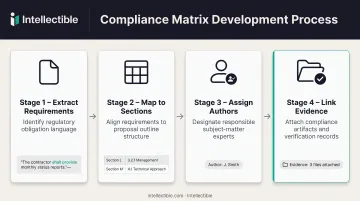
Automated tools can speed compliance-matrix build-out. Intellectible's GovCon Engine parses solicitations, attachments, and addenda for requirements, evaluation factors, and deadlines, then maps them to proposal sections so teams can spot coverage gaps before drafting begins.
With requirements traced, structure the outline the way evaluators will read it—usually by volume.
Volume-Based Organization Structure
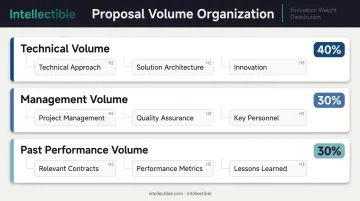
Government RFPs typically require:
- Technical Volume – Your approach to the statement of work
- Management Volume – Staffing, project management, quality control
- Cost Volume – Pricing, labor rates, cost narratives
- Past Performance Volume – Relevant contracts demonstrating capability
When the RFP mandates separate volumes, follow that structure exactly. When it allows flexibility, pick an integrated document or distinct volumes based on page limits, evaluation flow, and how easy the package is to navigate.
Inside each volume, writers still need a clear hierarchy, page budgets, and placeholders they can execute against.
Outline Structure Elements
Hierarchy
Use heading levels that mirror the RFP's organization:
- Main headings (H2) address major requirements (e.g., Technical Approach, Project Management)
- Subheadings (H3) address sub-requirements (e.g., Risk Mitigation, Quality Assurance Plan)
- Content placeholders describe what each section must prove (e.g., "Demonstrate understanding of agency mission; cite three relevant past-performance examples")
- Win theme callouts highlight where discriminators and unique value propositions will appear
Page Allocations and Word Count Budgets
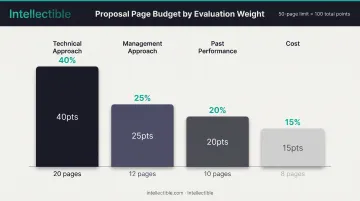
Allocate space by evaluation weight and point value. If Technical Approach is worth 40% of the score and Management is worth 20%, Technical should get roughly twice the words.
For a 50-page technical volume scored on 100 points, weight pages to points:
- 30-point section → about 15 pages
- 20-point section → about 10 pages
- 15-point section → about 8 pages
- Remaining lower-weight sections → balance of the volume (~17 pages)
Page budgets only help if every section is also tagged to how evaluators will score it.
Evaluation Criteria Mapping
Annotate each outline section with:
- Corresponding evaluation criterion (e.g., "Section M Factor 3: Technical Approach")
- Rating approach (Acceptable/Unacceptable or Adjectival: Outstanding / Good / Acceptable / Marginal / Unacceptable)
- Point value (e.g., 200 points)
This keeps writers focused on what evaluators will score. FAR 15.304 requires all award factors and their relative importance to be stated clearly, so use the solicitation's exact language when labeling outline sections.
How to Create a Proposal Outline for Government Contracts
A strong proposal outline turns RFP requirements into a writing plan your team can execute without guesswork. Use these six steps to build an outline that stays compliant and gives evaluators what they score.
Step 1: Analyze the Solicitation
Review Section L, Section M, Section C, and Templates
Thoroughly read:
- Section L (instructions) – Format, page limits, font, submission deadlines
- Section M (evaluation criteria) – Factors, subfactors, weights, rating methods
- Section C (PWS/SOO/SOW) – Work requirements, deliverables, performance standards
- Provided templates – Any agency-mandated formats or appendices
Create a Compliance Matrix
Extract every "shall," "must," and "will" requirement. Cross-reference each item with the evaluation criteria. Tools like Intellectible can pull deadlines, required sections, and compliance obligations from the solicitation while keeping source evidence attached.
Step 2: Determine Outline Structure
Decide on Volume Organization
Base your structure on the RFP's explicit requirements. If the RFP specifies three volumes with defined page limits, follow that exactly.
Choose Heading Levels
You can mirror solicitation sections verbatim or create persuasive custom headings, but only when the RFP allows it. Custom headings improve readability but require a cross-reference matrix so nothing falls out of compliance.
Plan for Page Limits
Allocate pages per section based on evaluation weight. Build in a 10% buffer for graphics, tables, and whitespace.
Step 3: Map Requirements to Sections
Assign Compliance Matrix Items to Outline Sections
Each matrix item must map to a specific outline heading. Use one-to-one or one-to-many relationships—for example, a single requirement addressed in multiple sections needs cross-references.
Ensure No Requirements Are Orphaned
Run a gap analysis: every Section L and Section M item must trace to an outline section. Any orphaned requirement is a compliance failure.
Identify Where Win Themes and Discriminators Will Be Embedded
Mark sections where you'll emphasize unique strengths, differentiators, or innovation. Don't force themes into every section. Place them where they reinforce evaluation criteria.
Step 4: Assign Responsibilities and Word Counts
Designate Section Authors
Assign each section to a subject-matter expert, volume lead, or proposal writer. Include backup authors for high-risk sections.
Allocate Word Counts Based on Evaluation Weight
If Technical Approach is worth 40% of total points, allocate roughly 40% of your total word budget to that volume.
Set Internal Deadlines for Drafts
Work backward from the submission deadline, allowing time for Pink, Red, and Gold Team reviews plus final production.
Step 5: Build in Review Milestones
Plan for staged quality control:
- Pink Team – Compliance and outline review before drafting begins
- Red Team – Full draft review against evaluation criteria and win strategy
- Gold Team – Final polish for grammar, formatting, consistency
- Orals Prep – If the RFP includes oral presentations
Intellectible's proposal review workflow keeps the draft, RFP, response plan, and review activity in one controlled flow through final export.
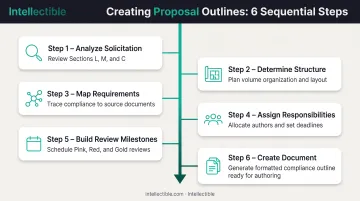
Step 6: Create the Outline Document
Format with Clear Hierarchy
Use consistent heading styles (H2, H3, H4) and numbering schemes. Make it easy for collaborators to navigate.
Include Annotations
Add compliance references, page limits, evaluation criteria, and win theme callouts directly in the outline.
Use Collaborative Tools for Team Access
Share the outline via cloud-based platforms with role-based permissions (Owner, Admin, Contributor). Intellectible project workspaces keep workflows, files, and team permissions organized per pursuit.
Set Version Control Protocols
Track every outline update with version numbers, change logs, and approval timestamps. Keep the latest version accessible to the full team.
GovCon-Specific Outline Considerations
Three proposal areas need outline structures that map directly to FAR evaluation factors and Section L/M instructions: past performance, key personnel, and the executive summary.
Past Performance Volume Outlines
Organize past-performance volumes by relevant contracts, not chronologically. Use a consistent structure for each:
- Contract description – Agency, period of performance, contract value, scope
- Relevance – How the work mirrors the current RFP requirements
- Performance metrics – CPARS ratings, KPIs, customer testimonials
- Applied lessons learned – How challenges were resolved and improvements implemented
FAR 15.305 requires evaluation of currency, relevance, source, context, and performance trends. Structure your outline to surface these elements immediately.
Key Personnel Sections
Decide between integrated (within technical approach) versus standalone sections based on the RFP's format. Structure each Key Personnel entry with:
- Resume – Education, certifications, relevant experience
- Commitment letter – Signed confirmation of availability
- Relevance narrative – How their expertise addresses evaluation criteria
FAR 15.304 lists personnel qualifications as a possible non-cost factor, but the RFP dictates whether Key Personnel is a standalone section or embedded within technical approach.
Executive Summary
Outline the Executive Summary as a standalone persuasive document that mirrors the full proposal structure but emphasizes win themes and key discriminators. Include:
- Mission understanding and alignment
- Solution overview with unique differentiators
- Risk mitigation and past-performance confidence
- Value proposition and pricing approach
FAR 15.204-1 doesn't mandate an Executive Summary, so include it only when Section L requests it or when it can support Section M factors within page limits.
Best Practices for Proposal Outline Success
Front-Load Compliance
Make it immediately obvious to evaluators where requirements are addressed. Use:
- Compliance callouts: "This section responds to Section L requirement 3.2.1"
- Cross-references: "See Section 5.3 for additional discussion of risk mitigation"
- Evaluation-criterion headers: Label sections with the exact factor/subfactor language from Section M
Build Flexibility into the Outline
Plan for change before drafting starts:
- Leave placeholders for late-breaking information such as teaming agreements and final pricing
- Keep word-count buffers on complex sections that may need more depth later
Early Stakeholder Review
Share the outline with the capture manager, solution architects, and senior reviewers before writing begins. Confirm the structure supports the win strategy and covers every evaluation criterion.
Use the Outline as a Living Management Tool
Update the outline as requirements clarify, addenda are released, or strategy shifts. Track status, coverage gaps, and blockers in real time—Intellectible surfaces open records, items due within a week, and at-risk tasks in role-specific dashboards so owners see what needs attention next.
Common Mistakes to Avoid
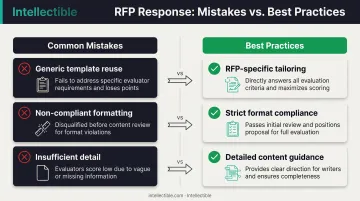
Generic Outlines Not Tailored to the Specific RFP
Cutting and pasting from previous proposals without mapping to new requirements creates compliance gaps. Every RFP is unique. Build the outline from scratch based on the current solicitation.
Beautiful But Non-Compliant Structure
Prioritizing marketing flow over directly answering what the RFP asks in the order it asks is a common trap. If Section L specifies a format, follow it exactly.
In one GAO protest, a contractor used Arial Narrow despite a closed list of permitted fonts. GAO upheld the elimination because the material deviation created an unfair advantage.
Inadequate Detail in the Outline
Providing only high-level headings without content guidance leaves writers guessing about what to include and leads to inconsistent quality across sections. Build each outline section with:
- Content placeholders for required topics
- Proof points and evidence requirements
- Examples writers can adapt
Frequently Asked Questions
What is a proposal outline?
A proposal outline is the structural framework that maps RFP requirements to your response sections and serves as the proposal team's roadmap, ensuring compliance and coordinated execution.
How detailed should a GovCon proposal outline be?
Outlines should include all Section L requirements mapped to headings, content placeholders describing what each section must prove, word count allocations, and author assignments with deadlines.
What's the difference between a proposal outline and a compliance matrix?
The compliance matrix is a tracking tool showing where requirements are addressed, while the outline is the actual document structure with headings, subheadings, and content direction that writers execute.
When should you create the proposal outline?
Create the outline during the capture phase or immediately after RFP release, before proposal kickoff. Refine it after initial solution discussions and before drafting begins.
Should proposal outlines follow the RFP order exactly?
Compliance with RFP-mandated formats is required. When the RFP allows flexibility, strategic reordering can improve persuasiveness—but only if a comprehensive cross-reference matrix ensures full compliance.
How can AI and automation tools help with proposal outlines?
Modern platforms can extract RFP requirements, build compliance matrices, and suggest outline structures automatically. Deltek's 2026 study reports that 92% of contractors plan to use AI for estimating and pricing, though 27% cannot validate AI outputs for FAR compliance. Intellectible's GovCon and Proposal engines turn parsed solicitation data into structured response plans with owners, deadlines, and evidence paths.