Introduction
Routing high-signal accounts works best inside a territory plan built from the eligible market, current signal density, and rep capacity. Confirm the buying entity and ownership first, then deliver the evidence and next action. Equal account counts or zip-code rules alone cannot guarantee balanced opportunity coverage.
Timing matters more than most teams assume. 6sense's 2025 buyer report found first seller contact now happens around 61% of the way through the buyer journey, so teams that spot signals early have a real window.
Routing outcomes depend on signal quality, account matching, data freshness, rep rules, capacity, and execution speed. An intent score alone settles none of that.
This guide covers how to:
- Define high-signal accounts
- Prepare your data
- Build a decision workflow
- Control the key variables
- Avoid common failures
- Pick an alternative when this model doesn't fit
Key Takeaways
- A high-signal account needs both intent and fit; strong intent from a poor-fit account shouldn't reach a rep.
- Route at the account level, but carry contact, opportunity, and prior-engagement context along.
- Match on expertise, territory, capacity, and availability, not round robin alone.
- Build in validation, fallbacks, human review, and audit trails.
- Measure time to action, accuracy, acceptance, and false positives, not signal volume.
How to Route High-Signal Accounts to the Right Reps
When This Routing Model Is Appropriate
Signal-based routing pays off when:
- Signals arrive from several sources
- You sell into defined segments
- Reps specialize by vertical or deal type
- Sales, proposal, pricing, or customer-success teams must coordinate
Build the eligible account universe before allocating territories. Resolve parent companies, sites, serviceable regions, and existing customer ownership, then show where verified buying events are concentrated. Equal logo counts, zip codes, or seller headcount do not necessarily represent equal opportunity or workload.
One caution on data volume: Demandbase's predictive models need at least 10 opportunities from unique accounts to train, but that's a model requirement, not a proven cutoff for rules-based routing.
What You Need Before Building the Workflow
Gather the account and rep fields the workflow will read:
- CRM account IDs, ownership, territory, segment, and tier
- Industry or use case and open opportunities
- Buying-group contacts
- Rep specialization, capacity, leave status, and escalation owner
Then check data quality. Validity's 2024 CRM survey found 53% of CRM administrators cite duplicate records as a problem. Look for:
- Duplicate accounts
- Unmatched domains
- Stale ownership
- Conflicting assignments
- Missing timestamps
- Signals with no traceable source
Step 1: Define What Counts as a High-Signal Account
Write down a signal taxonomy that covers:
- First-party engagement
- Third-party intent
- Organizational or opportunity triggers
- Product usage
- Inbound requests
- Active pursuits
- Buying-group activity
Demandbase's definitions help here: first-party signals come from your own sites and products, second-party from a partner's data, and third-party from external sites and publisher co-ops. These describe provenance, not who owns the account.
Then split signals into two tiers:
- Immediate-action: demo or pricing requests, proposal interactions, multi-contact engagement
- Directional: topic surges, single page visits, content downloads
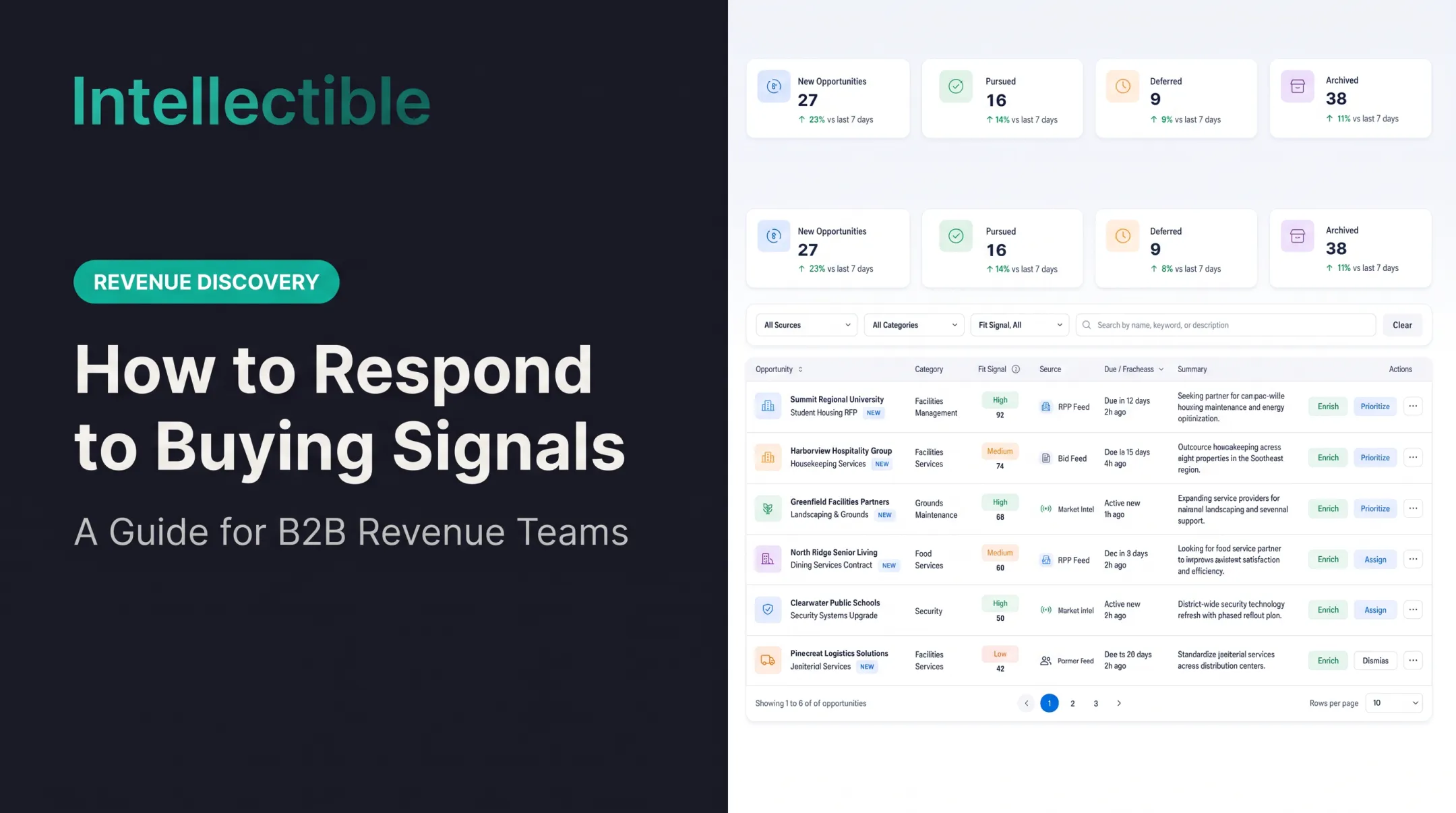
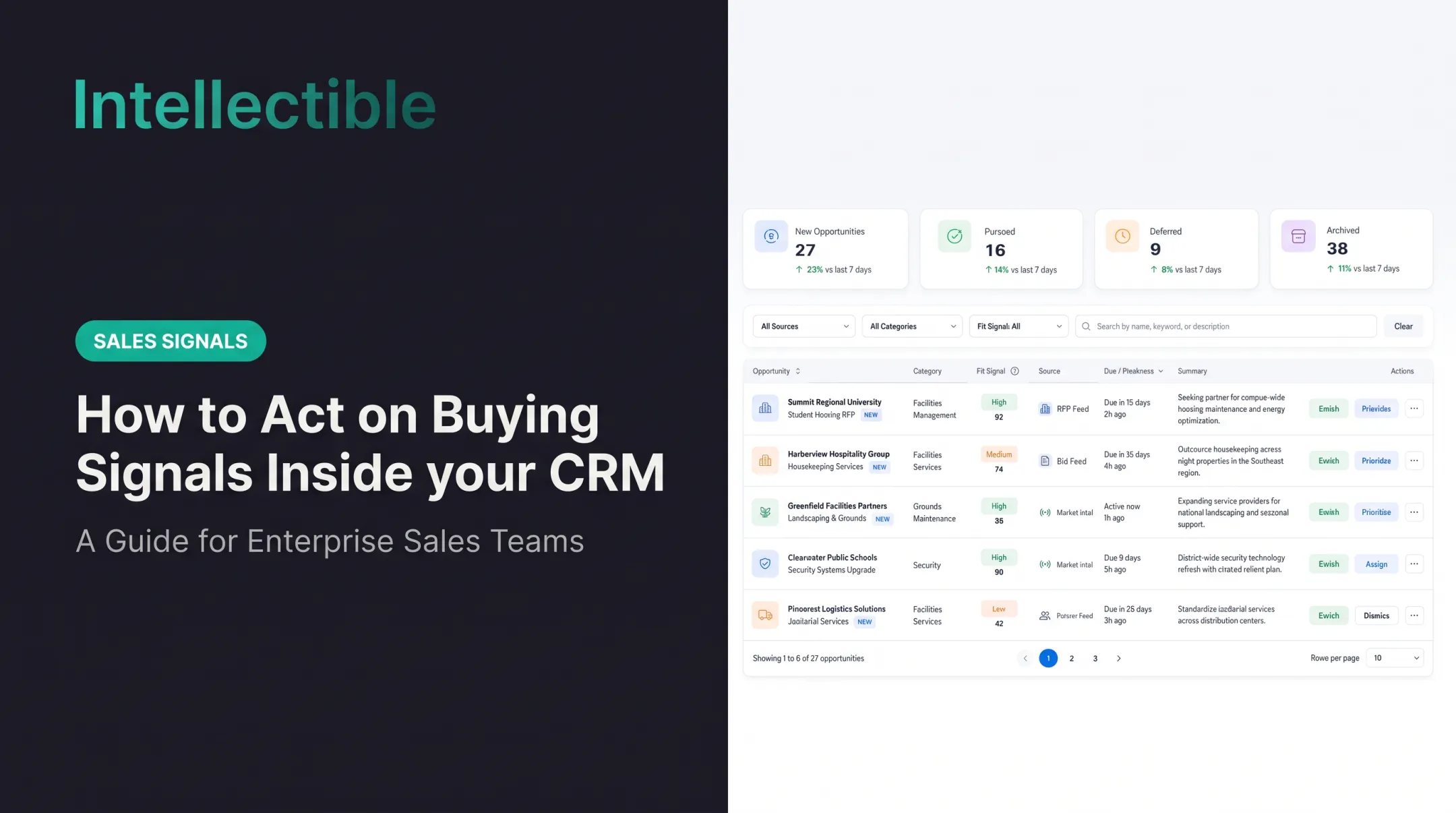
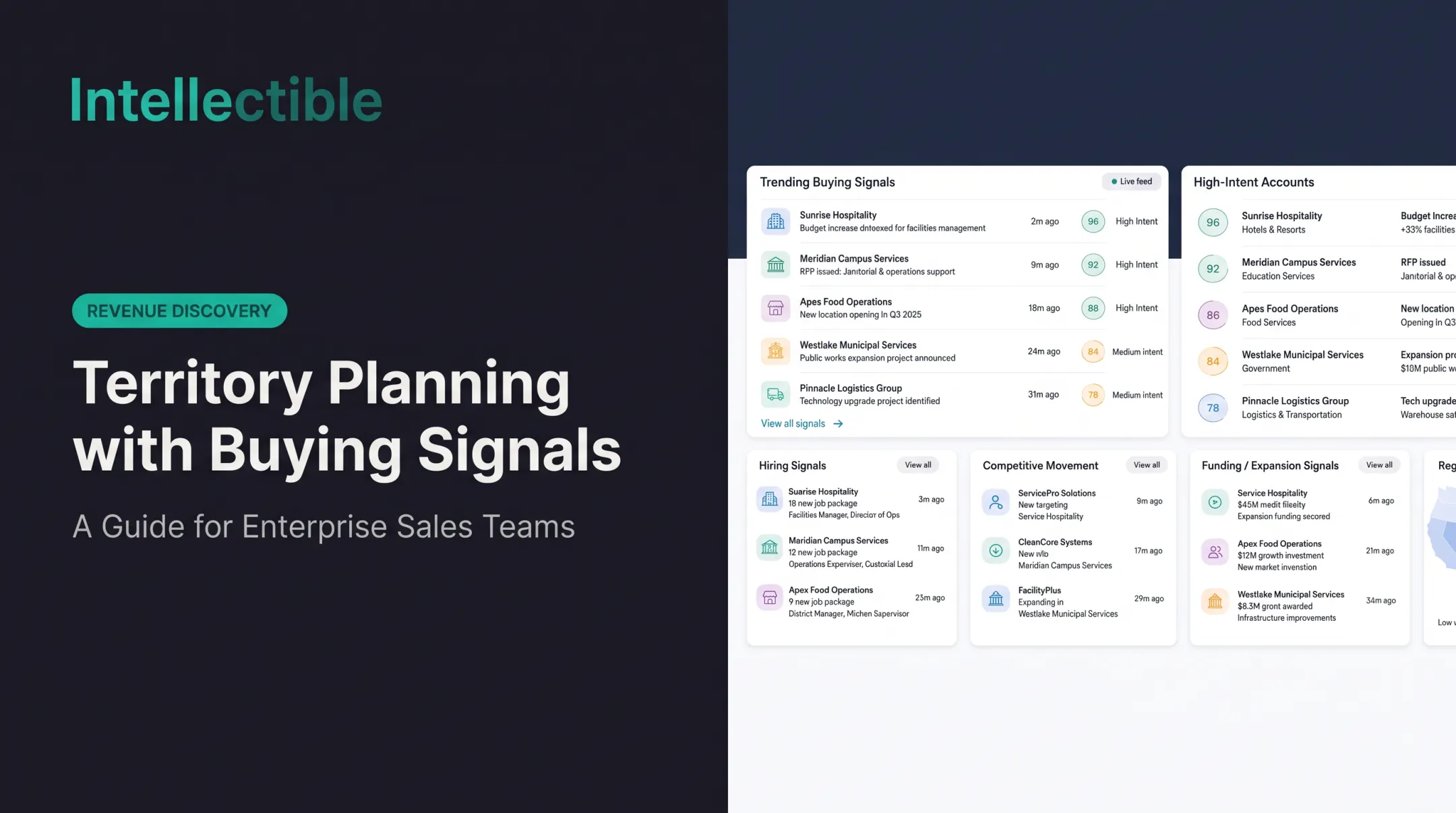
Tools like Intellectible's Revenue Discovery let teams define what a buying signal looks like. That includes custom signals such as review pain, inspection score drops, or permits filed, alongside standard feeds for funding, hiring, expansion, and M&A.
Step 2: Normalize and Match Signals to the Correct Account
Standardize signal names, timestamps, confidence, source, contact identity, and account identifiers. Then match person-level events to the right parent account before scoring or routing.
Matching is harder than it looks. HubSpot creates a separate company record for each unique domain, subdomains included, so domain matching alone won't resolve corporate families. Write explicit rules for:
- Subsidiaries and parent organizations
- Government entities
- Duplicate records
- Free-mail addresses with no company domain
LeanData's account hierarchy matching is one example of exposing parent-child relationships to routing logic.
Step 3: Combine Signal Strength With Rep-Fit Rules
Use a decision tree or scoring model that weighs:
- Fit and signal recency
- Buying-group readiness
- Current ownership
- Rep expertise and territory
- Capacity
- Conflicts with open opportunities
Decide in advance what happens when several reps qualify. Pick a tiebreaker (existing relationship, then specialty, then lowest workload) and document it.
Vendor tools show these rules are configurable. LeanData supports account caps per AE, working hours, and vacations. No universal owner-over-territory hierarchy exists, so choose the precedence that fits your sales motion.
Step 4: Route With Context, Service Levels, and a Fallback
Send the rep a short routing packet:
- Account and signal source, with its age
- Relevant contacts and prior activity
- Recommended action
- Reason for assignment
- Response expectation and escalation path
Test against historical records first, then run a controlled live pilot before expanding.
Intellectible fits here as a customizable workflow layer. Its visual workflows connect AI, data, APIs, documents, business logic, and human review, with approval and exception nodes that log each decision.
Revenue Discovery's sequence runs Detect, Gate, Promote, Draft, Approve, Call, Qualified. It drafts outreach without sending anything automatically. Confirm any integration specifics with your own systems before committing.

Key Parameters That Affect Routing Results
Use live signal density as one planning input: the number and relevance of current, evidence-backed events within eligible accounts. Separate a crowded alert feed from verified buying context. Compare potential value, segment, selling effort, existing relationships, and available rep capacity alongside the signal count.
Signal Quality and Recency
A recent pricing request or multi-contact engagement beats an old page visit or an unverified topic surge. Define decay rules, source confidence levels, and minimum evidence, plus exceptions for long sales cycles.
Be careful with benchmarks. 6sense's Temperature model compares the last seven days with the preceding 21, but that's a calculation window, not a response deadline. LeanData recommends five minutes or less for inbound demo requests, though that is vendor guidance rather than a universal threshold. No cross-vendor decay standard exists, so set yours from your own conversion data.
Account Fit and Strategic Priority
Intent without ICP fit burns rep capacity. Combine firmographics, industry, use-case fit, tier, and expansion potential with signal data. Add hard exclusion criteria so a high score can never override a clear disqualification.
Strategic accounts may deserve coverage even while activity is thin. Revenue Discovery scores accounts on both fit and urgency with editable weights, for instance showing one account at fit 91 and urgency 94 marked Contact Now.
Buying-Group and Contact Readiness
An account signal doesn't tell you who can approve or influence a purchase. Forrester's 2026 research puts a typical decision at 13 internal stakeholders and nine external influencers.
Route with known stakeholders, recent engagement, and role relevance. Then enrich in parallel. Don't hold the assignment until enrichment finishes, or the signal window closes.
Rep Expertise, Ownership, and Capacity
The right rep might be the account owner, a vertical specialist, a technical resource, or whoever has room, not the next name in a round robin. Define precedence for:
- Existing ownership and named accounts
- Territory and specialization
- Workload and absence
- Conflict resolution
Add a capacity-aware fallback for when the preferred rep can't respond. Distro, for example, reassigns after a breached SLA.
Routing Action and Feedback Loop
Routing is incomplete without a next action. Specify the destination, alert, task or sequence, SLA, human-review trigger, and outcome fields. Then review accepted, rejected, delayed, converted, and misrouted accounts on a recurring schedule and feed the findings back into the rules.
Common Mistakes and Troubleshooting
Common Mistakes to Avoid
- Treating one intent event as readiness. Require corroborating fit, recency, or engagement, and document exceptions for urgent inbound requests.
- Routing before matching and ownership validation. A wrong parent link sends signals to the wrong rep or creates duplicate outreach.
- Ignoring capacity and availability. Include an explicit conflict and availability branch.
- Building opaque rules. Every assignment needs a reason code, audit trail, and fallback queue.
Troubleshooting Issues During Execution
Signal reaches the wrong rep
- Likely cause: bad account matching, stale ownership, an outdated territory map, a parent-subsidiary conflict, or wrong rule precedence.
- Check: match evidence, ownership history, rule path, and override log. Fix the source record and retest similar records.
High-signal accounts sit unassigned
- Likely cause: missing fields, failed enrichment, no eligible rep, or a condition that evaluates to blank.
- Check: add required-field validation, a visible failure state, a manual-review queue, and an escalation alert with an owner.
Reps get too many low-value accounts
- Likely cause: noisy signals overweighted, no decay, missing fit exclusions.
- Check: compare routed accounts with accepted opportunities, review false positives, and raise corroboration requirements.
Routing is correct but nothing happens
- Likely cause: the alert lacks context or a task, or the rep lacks capacity.
- Check: include reason, action, stakeholders, SLA, and manager escalation. Measure time from detection to first meaningful action.

Alternatives to Signal-Based Account Routing
The right approach depends on signal volume, account complexity, data maturity, rep specialization, and how often rules change.
Territory or Account-Owner Routing
Best for:
- Stable ownership
- Simple territories
- Activity kept with the relationship owner
Tradeoff: Easy to maintain, but can ignore new buying signals, capacity, and specialist expertise.
Static Firmographic or Round Robin Routing
Best for:
- Low-complexity inbound flows
- Early-stage teams
- Accounts without reliable intent data
Tradeoff: Predictable, but treats urgent and routine accounts alike and can overload or misassign reps.
Human-in-the-Loop or Custom Workflow Orchestration
Best for:
- Accounts that need nuanced review
- Signals coming from several systems
- Coordination across sales, proposal, pricing, customer success, or compliance
Tradeoff: Human review improves judgment and governance but adds effort. A configurable platform reduces manual work only if ownership, data definitions, and review rules stay maintained.
These approaches combine well. Territories can feed round-robin pools, and signal rules can layer on top of owner assignment.

Conclusion
High-signal routing works when fit, intent, readiness, ownership, rep capability, and capacity are judged together. Most failures trace back to weak account matching, stale data, unclear precedence, missing fallbacks, or no action after assignment.
Automate the repeatable decisions, keep context and an audit trail attached, and send ambiguous cases to a person. Start with one signal type and one pilot team, then expand once the numbers hold.
Frequently Asked Questions
What should the territory model start with?
Build the eligible account universe before allocating territories. Resolve parent companies, sites, serviceable regions, and existing customer ownership, then show where verified buying events are concentrated. Equal logo counts, zip codes, or seller headcount do not necessarily represent equal opportunity or workload.
How should live signal density be used?
Use live signal density as one planning input: the number and relevance of current, evidence-backed events within eligible accounts. Separate a crowded alert feed from verified buying context. Compare potential value, segment, selling effort, existing relationships, and available rep capacity alongside the signal count.
How should account ownership be assigned?
Create territory scenarios that balance opportunity and coverage. Assign account and location ownership explicitly, resolve parent-child conflicts, and identify under-covered clusters. Set targets using serviceable market and realistic seller capacity rather than assuming each rep’s home region has the same potential.
What checks should happen before routing?
Route a high-signal account only after fit, entity, ownership, and decision-window checks. Include the source evidence, event date, likely buyer, urgency rationale, and next action. Establish a fallback owner and a research queue so an ambiguous match or an absent rep does not create duplicate outreach.
How often should territories change?
Refresh territory plans at a deliberate cadence while monitoring signal changes more frequently. Do not redraw boundaries for every temporary spike. Use account-lock and handoff rules to protect active opportunities and explain why ownership or priority changed.
How should territory performance be measured?
Measure eligible-account coverage, verified signals per rep, time to acceptance, first-touch time, sales-accepted opportunities, and pipeline by territory. Use those results to rebalance workload and improve source coverage, not merely to reward whichever territory produced the most raw alerts.