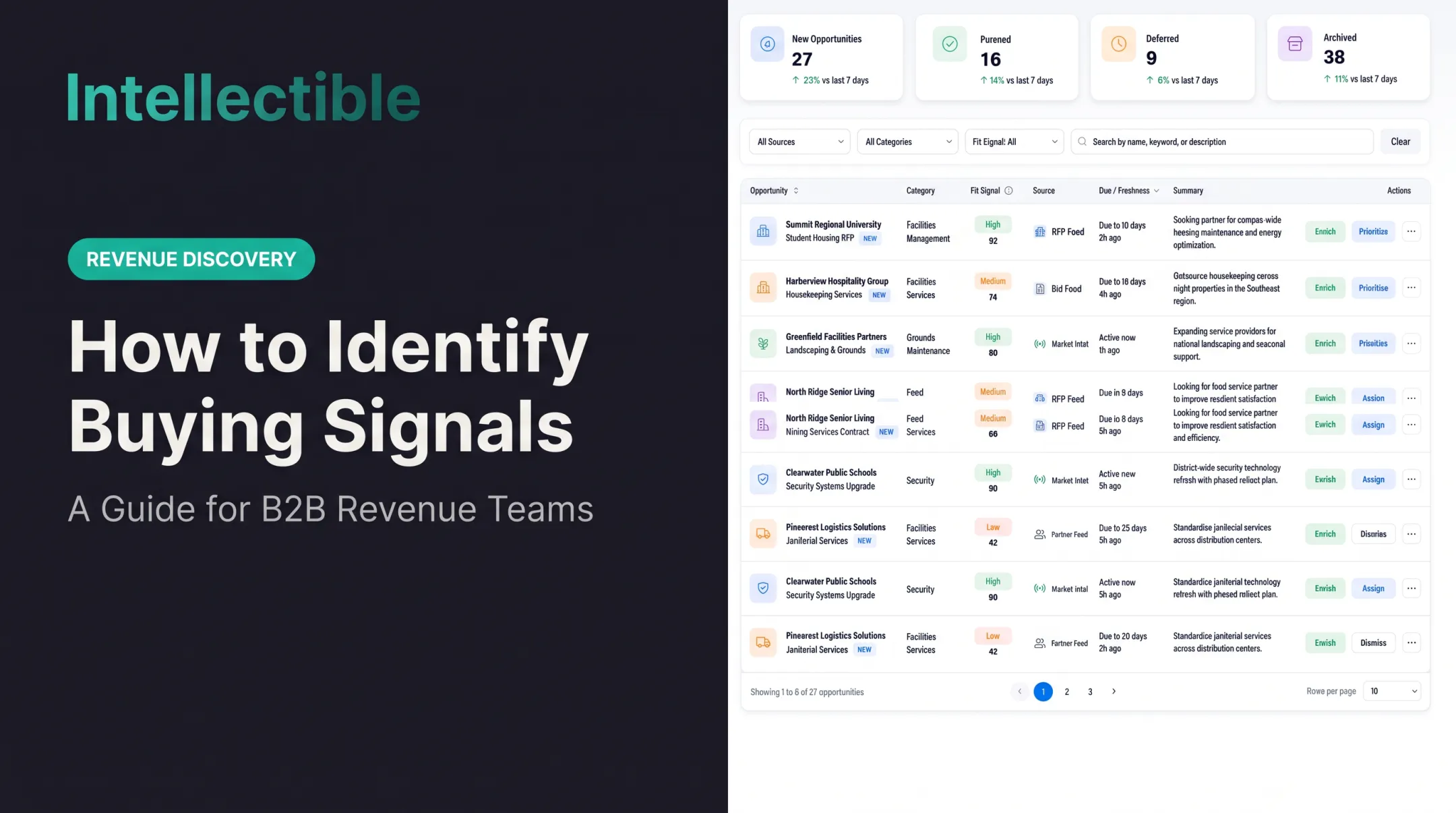
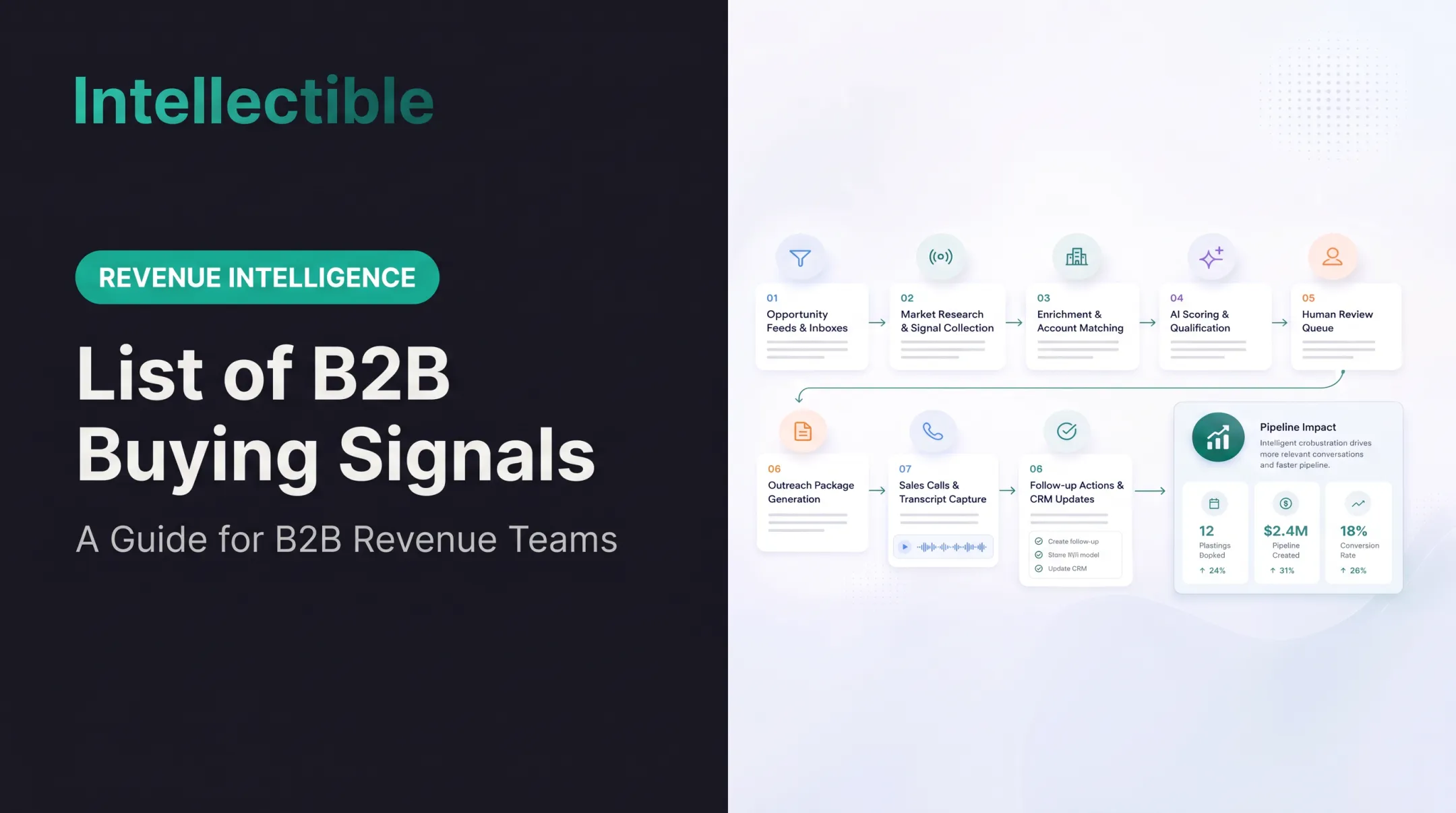
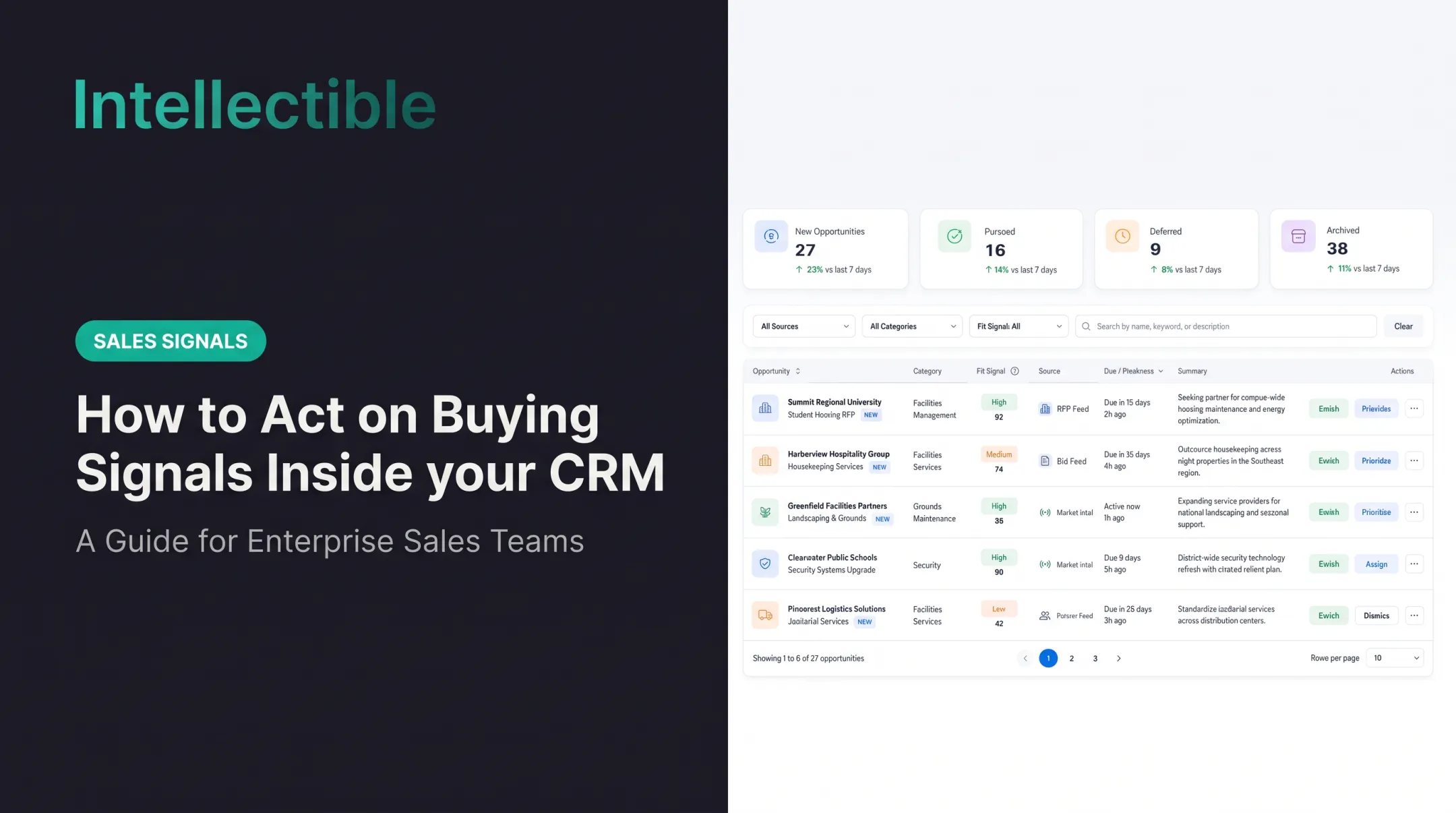
This guide gives you a complete list of sales trigger events, organized by signal type. For each category, you'll see what the event implies, how to verify it, and how to approach it without assuming the buyer is ready to buy. You'll also get a framework for prioritizing and stacking signals, outreach templates, and a way to run the whole process at scale.
Key Takeaways
- A trigger event is a dated, observable change, not proof of intent.
- Six signal types cover most triggers, from leadership moves to public-sector awards.
- Verify every event against a primary source before outreach.
- Stack independent signals to raise confidence, and measure results in your own CRM.
- Triggers improve timing; they never replace qualification.
What Are Sales Trigger Events?
A sales trigger event is a specific, observable change at a company, or in a buyer's career, that creates a new business need, a budget opportunity, a vendor review, or a reason to reconsider the status quo.
Triggers vs. Buying Signals vs. Intent Data
The terms overlap, so use this working distinction (not a formal standard):
- Trigger event: a discrete, dated change, such as an executive hire or an RFP release.
- Buying signal: evidence of possible need or interest.
- Intent data: observed research behavior used to infer interest.
6sense's glossary separates buying signals from online research activity, and notes that a single content interaction can be ambiguous. Corroborate before you act.
Buying Windows and Signal Decay
Every trigger opens a window. If you delay too long, or arrive after the company has already responded, relevance drops.
No credible universal decay interval exists. Timing also matters because buyers move early: 6sense's 2024 report found an average buying cycle of 11.3 months, with 69% of purchase activity happening before seller engagement. A trigger gets you into that process sooner. It doesn't guarantee a seat at the table.
Sales Trigger Events: Complete List by Signal Type
Leadership and Career Signals
- New executive hires: often come with a mandate to review vendors, processes, and priorities.
- Promotions and department leadership changes: may shift purchasing authority.
- Champion job changes: give you a warm relationship at a new account.
- New budget owners: can reopen decisions that had stalled.
Use six families to organize the trigger library: people; operations; technology; growth and capital; competitive and procurement; and relationship history. Each trigger needs a relevant commercial hypothesis, an eligible account, an original public or permitted internal source, and an owner. A generic alert without those fields is a research lead, not an action package.
How to verify: for public companies, SEC Form 8-K Item 5.02 covers specified officer and director changes, generally filed within four business days. Otherwise use the company newsroom and a LinkedIn profile.
Outreach angle: congratulate, then reference the likely priorities of the role. Don't assume they're buying. No strong benchmark exists for new-executive vendor-switch rates, so treat the change as a prompt to verify, not proof of authority.
Financial and Commercial Signals
- Funding rounds: can unlock budget for tools, vendors, and headcount
- Earnings or financial performance changes: may free or freeze spend
- Budget increases: reopen evaluations that stalled under prior caps
- Investor activity: often adds board pressure on growth or efficiency
- Contract wins and major customer announcements: create delivery and systems needs
- Strategic investment disclosures: show where leadership is placing bets
Where to verify:
- Private funding: press releases and SEC Form D, a notice of exempt offering due within 15 days of the first sale.
- Public companies: 10-K, 10-Q, and 8-K filings on SEC EDGAR, plus earnings commentary.
- Contract wins: award announcements and federal award databases.
A financing notice verifies an event. It doesn't establish remaining discretionary budget, vendor fit, or purchase timing. NBER research on VC-backed firms also finds that post-funding employment gains are concentrated in a small subset, so not every funded firm hires or spends.
Growth, Hiring, and Expansion Signals
- Hiring surges and department-specific recruitment: reveal capacity plans before formal announcements
- New offices, facility growth, and geographic or vertical expansion: drive process, compliance, and tooling needs
- Workforce restructuring: shifts owners, priorities, and vendor relationships
Growth creates needs in capacity, process, data, technology, and compliance. A company hiring five proposal managers is telling you what it plans to do before any announcement.
Read job descriptions for named tools, new markets, and initiatives. Then look for a pattern: repeated roles, locations, or functions over several weeks. One isolated posting is weak evidence.
BLS defines a job opening narrowly, and online postings underrepresent some establishments, particularly small and midsize ones. Postings corroborate. They don't predict.
Product, Market, and Strategic-Change Signals
- Product launches and service-line additions: often need new systems and workflows behind them
- Market repositioning and rebranding: change messaging, channels, and support tooling
- New partnerships and major campaigns: raise volume in sales, proposals, and operations
- Digital transformation programs: create demand for integration, data, and process redesign
- Changes in stated strategic priorities: redirect budget toward the new mandate
These events affect go-to-market execution, customer acquisition, proposal volume, and operational scale.
One example: EPAM documented a B2B digital-commerce transformation for Cepheid, a multilingual platform launched in six months and integrated with existing ERP systems. It's a vendor-published case, so it shows what a transformation looks like rather than proving launches cause purchases.
Verify through earnings calls, investor decks, and press releases. Listen for stated priorities, then map them to the problem you solve.
Technology and Competitive Signals
- New technology adoption and CRM or enterprise-system changes: open replacement and integration conversations
- Migrations and integrations: create project windows with defined owners and deadlines
- Competitor replacement and renewal windows: are natural decision points
- Negative incumbent feedback: signals pain you can address without quoting private reviews
- Technology-related hiring: confirms stack direction when postings name tools and platforms
Confirming technographic evidence: tools like BuiltWith detect website technologies with confidence metadata, but no universal accuracy figure exists. Website detection is not proof of enterprise-wide deployment, contract status, or renewal date. Confirm through job postings, case studies, and conversation.
Renewal windows: Gartner's renewal guidance cites changing prices, licensing, and internal requirements as renewal considerations, with no universal lead-time rule.
Dissatisfaction signals: never quote a private complaint or review back to a prospect. Instead, speak to the common challenge: "Teams moving off legacy tools often struggle with X." Review-site content can inform your read, but it stays out of the message.
Public-Sector, Regulatory, and Behavioral Signals
- Federal and state contract awards: identify winners who need delivery partners and tools
- RFP and procurement releases: are live pursuit windows with stated deadlines
- Appropriations and budget announcements: indicate where public funds will flow
- Regulatory changes and compliance deadlines: force process and documentation updates
- Industry disruptions: reopen vendor and operating-model choices
- Executive thought-leadership posts, content engagement, and research activity: corroborate need when paired with a company event
US public-sector sources for government contractors:
- SAM.gov contract data covers reportable federal actions estimated at $10,000 or more.
- SAM.gov opportunities lists active solicitations.
- USAspending.gov shows federal spending across contracts, grants, and loans.
- State portals include California's Cal eProcure and Texas's ESBD.
Timing rules: FAR 5.203 sets minimum response windows. Typical ones: at least 30 days from solicitation for covered actions above the simplified acquisition threshold, 45 days for research and development, and 40 days for covered trade-agreement procurements. Exceptions apply.

Fiscal-year effects: the federal year runs October 1 to September 30. A CRS analysis found DoD September obligations in FY2016 exceeded $43 billion, about 14% of the annual total. That's old, DoD-specific evidence, not a current all-agency rule.
Compliance deadlines: CMMC dates shift. Check the DoD CIO page for current phase status before citing a deadline.
Behavioral signals (content engagement, social posts, research activity) should corroborate a company event or need. They are not proof of purchase intent.
How to Evaluate, Prioritize, and Stack Signals
A Practical Prioritization Model
Score each event against seven questions:
- Does the account fit your ICP?
- Is the event relevant to a problem you solve?
- How fresh is it?
- How reliable is the source?
- How close is the contact to the decision?
- How large is the likely business impact?
- Can you actually solve the implied problem?
High-Intent vs. Context Signals
For every family, capture event date, publication date, ingestion date, and last verification date. Define visibility lag as publication date minus event date and processing lag as ingestion date minus publication date. Unknown event dates stay unknown. Do not invent a universal number of days for sources whose timing differs by jurisdiction or publisher.
Stacking Signals
Independent signals raise confidence. Useful combinations:
- Funding plus a hiring pattern in the relevant department
- A new executive plus a technology change
- An RFP plus a related contract award or staffing pattern
No independent research establishes a conversion multiplier for stacking, so test it yourself.
Response Protocols and Timing
Set rules by signal type. A fresh RFP needs same-day review. A leadership change may warrant a first touch within days, then a longer nurture.
Be careful with speed benchmarks. HBR's 2011 study found firms contacting web inquiries within an hour were nearly 7x as likely to qualify them as firms waiting an hour longer. That figure applies to inbound inquiries, not external company events.
Forrester reports an average of 13 people in a B2B buying decision, so one contact rarely closes the loop.
What to Measure
- Time from event to first touch
- Response and meeting rates by signal type
- Qualified pipeline and conversion by segment
- Source accuracy and false-positive rate
- Single-signal vs. stacked-signal performance
How to Turn a Trigger Event Into Relevant Outreach
A Five-Part Messaging Framework
- Acknowledge the verified event.
- State the likely business implication.
- Connect it to a relevant capability.
- Offer credible proof.
- Close with one low-friction next step.
Gong's analysis of 30,000+ prospecting emails found personalization more than doubled replies for non-managerial personas, and company-specific topics tripled director-plus replies. Treat those figures as vendor observational data; irrelevant personalization can still backfire.

Pick the Right Contact
Map the event to the person who owns the problem: the responsible executive, operator, budget owner, technical stakeholder, proposal lead, or procurement participant. A new compliance rule goes to compliance, not to the nearest C-level title.
Personalize Without Being Invasive
- Reference public facts and their business implications.
- Never reveal private monitoring practices.
- Use careful language for layoffs, restructuring, negative reviews, or financial difficulty.
Coordinate Channels
McKinsey reports buyers use an average of 10 interaction modes. Coordinate email, phone, LinkedIn, CRM tasks, and account-based follow-up, and tailor the message by audience:
- Executives: outcomes
- Practitioners: workflow detail
- Procurement: compliance and terms
- Technical evaluators: integration specifics
Compliance notes:
- CAN-SPAM applies to B2B email: accurate headers, an opt-out, and opt-outs honored within 10 business days
- LinkedIn's User Agreement prohibits unauthorized scraping and certain automated downloads
Example Frameworks
New executive
- Event: [Name] joined [Company] as [Role] on [date].
- Implication: leaders in this role often review [priority area].
- Capability and proof: [Capability]; [proof point].
- Ask: [15-minute conversation about X?]
Government opportunity or contract award
- Event: [Agency] released [solicitation] / awarded [contract] on [date].
- Implication: this likely needs [proposal capacity, pricing, pursuit support] before [response date].
- Capability and proof: [Capability]; [proof point].
- Ask: [Share a brief on the opportunity?]
Technology or process change
- Event: [Company] is [migrating/adopting] [system], per [public source].
- Implication: teams in transition often face [integration or workflow gap].
- Capability and proof: [Capability]; [proof point].
- Ask: [Compare notes on how others handled it?]
How to Monitor and Operationalize Sales Triggers at Scale
Manual vs. Automated Monitoring
Manual methods work well for a short target list: company newsrooms, SEC filings, procurement portals, job boards, executive updates, review sites, and saved searches. They break down when you track hundreds of accounts across several signal types. Coverage gets patchy and detection slows.
Published benchmarks for the manual-versus-automated gap are hard to find, so judge by your own coverage and detection time. Automation flags observable changes, but humans should still verify identity, recency, authority, and relevance before outreach.
The Minimum Trigger Record
Capture these fields for every event:
- Event type and account
- Affected department
- Source URL and event date
- Confidence level
- Likely business implication
- Relevant contacts
- Owner, next action, and follow-up status
Where Intellectible Fits
Intellectible is a configurable workflow layer, not a native trigger-data source. Its Revenue Discovery engine runs team-defined signal rules through a governed sequence: Detect, Gate, Promote, Draft, Approve, Call, Qualified.

Its Signal Monitor shows each signal's account, type, detection date, severity, and status. Fit and urgency scores carry editable weights, and human approval gates sit before outreach, Salesforce updates, survey sends, and marking a lead Qualified for Costing. The engine drafts but sends nothing: no bulk email, no LinkedIn automation, no automatic CRM writes.
Intellectible also offers done-for-you prospect research and signal-based prospecting. If you're building a trigger workflow across revenue operations, proposal, or GovCon teams, you can talk to Intellectible about mapping it.
Sales Trigger Event Playbook: Start With the Signals That Fit
Don't try to monitor everything. Pick a handful tied to your best customers and sales motion: leadership changes, funding events, hiring patterns, procurement opportunities, or technology changes.
Then implement in order:
- Define your ICP and an event-to-problem map.
- Identify reliable sources for each signal.
- Write verification rules.
- Assign ownership.
- Prepare message frameworks.
- Set response and measurement processes.
Triggers sharpen timing and relevance. They don't replace qualification. Validate every event against account fit, business need, contact relevance, and a respectful approach.
Frequently Asked Questions
What are the six buying-signal families?
Use six families to organize the trigger library: people; operations; technology; growth and capital; competitive and procurement; and relationship history. Each trigger needs a relevant commercial hypothesis, an eligible account, an original public or permitted internal source, and an owner. A generic alert without those fields is a research lead, not an action package.
Where do people and operations triggers appear?
People triggers include a new plant manager, CFO, or VP Operations, evidenced through company announcements and dated role information. Operations triggers include openings, expansions, inspections, and permits in local records. Their visibility lag varies: a job advertisement may precede a project, while a permit portal may publish after the recorded event.
How should technology and capital events be verified?
Technology triggers can appear in implementation announcements or job descriptions naming systems. Growth and capital triggers can appear in SEC filings, acquisition announcements, and investor releases. Record whether a deal is announced or completed; filing publication time and transaction completion time are different facts.
Where do procurement and relationship triggers come from?
Competitive and procurement triggers include an incumbent award, amendment, expiration, RFP, or documented vendor complaint in the relevant records. Relationship triggers come from CRM loss reasons, past champions, prior evaluations, and permitted customer conversations. Keep public evidence separate from confidential relationship history and confirm the right buying entity.
How should this process be put into practice and measured?
For every family, capture event date, publication date, ingestion date, and last verification date. Define visibility lag as publication date minus event date and processing lag as ingestion date minus publication date. Unknown event dates stay unknown. Do not invent a universal number of days for sources whose timing differs by jurisdiction or publisher. Prioritize fit, source reliability, freshness, and whether a decision is still open. Start by monitoring the families most predictive of your actual service purchase, then compare acceptance and opportunity rates by family. A faster alert only helps if the evidence is relevant and a representative has a useful next action.