Introduction
A janitorial, medical-billing, or freight purchase can begin with an operating problem rather than online category research. An intent platform may never observe that starting point. The useful question for services sales leaders is which evidence was available elsewhere and how to monitor it across the eligible market.
Intent data fails for services companies when generic digital signals get treated as qualified opportunities. Those signals need account, operational, relationship, and buying-context data behind them.
Forrester notes that provider methodologies differ, keyword mapping is complex, and signals decay.
This article explains where the standard model breaks and what to build instead.
Key Takeaways
- Generic intent shows that someone researched a topic, not that an account is ready to buy a service.
- Services demand often comes from contracts, projects, compliance, and relationships that leave little online trace.
- Intent works better when paired with fit, first-party engagement, trigger events, and timing.
- The goal is a repeatable workflow, not more alerts.
What Intent Data Is, and What It Actually Tells You
What is intent data?
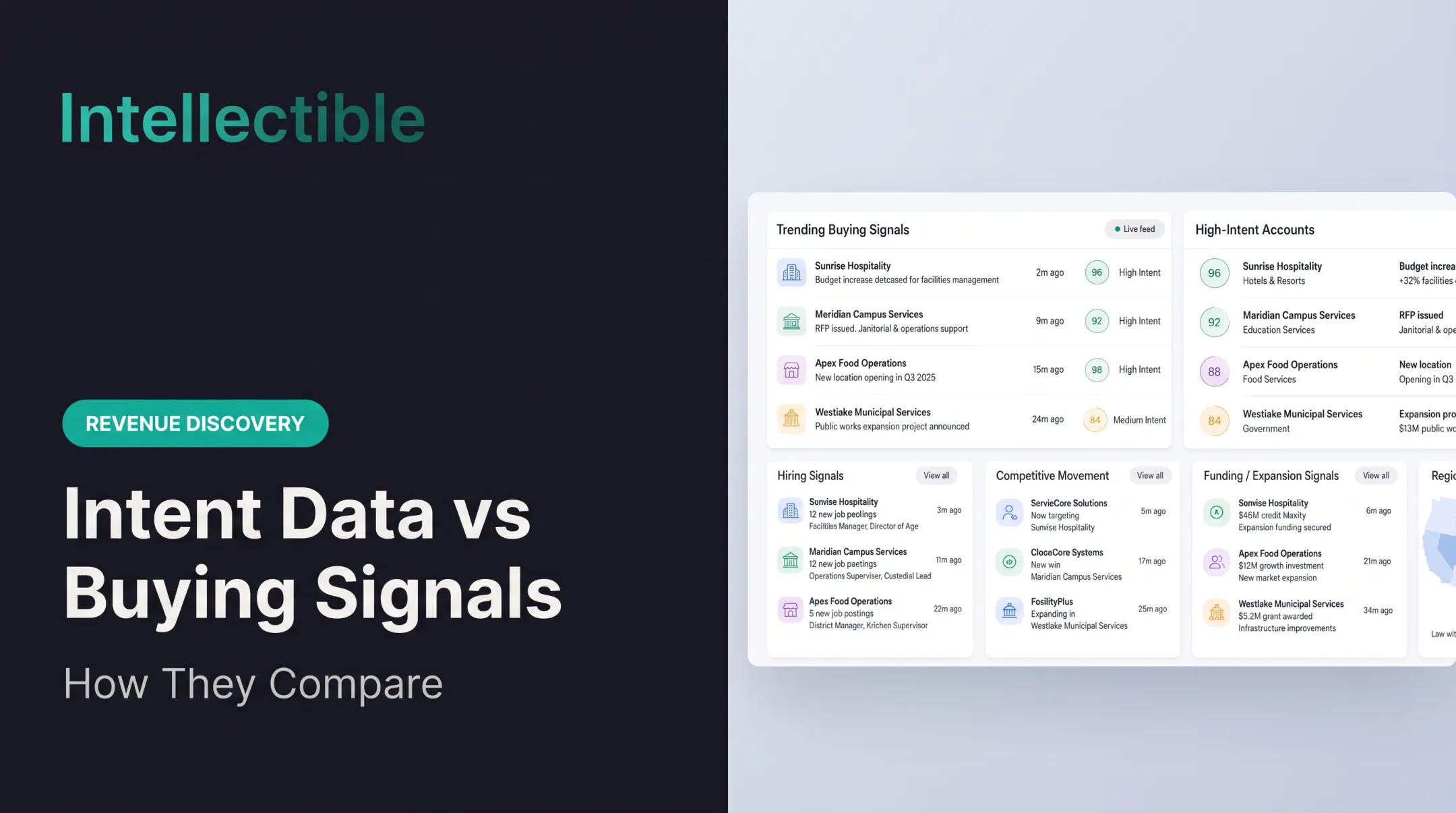
Intent data is behavioral or contextual information suggesting a person or account may be researching a category, problem, provider, or solution. Bombora describes it as evidence of accounts researching topics through content consumption.
Sources differ by who owns the data:
- First-party: observed on your own website, emails, and events
- Second-party: another organization's first-party data, shared with you
- Third-party: gathered by an aggregator that doesn't own the underlying activity
Every type indicates possible interest. None confirms buying intent.
Intent is not the same as an in-market opportunity
Four things get conflated:
- Research signal: observed behavior, such as a page visit or topic surge
- In-market account: a vendor's modeled interpretation of that behavior
- Trigger event: a dated external occurrence, such as a solicitation, inspection, or permit
- Sales-qualified opportunity: a lead a seller has actually validated
An online research feed can be useful without seeing the event that creates a services purchase. A company may review its janitorial contractor, medical-billing partner, or freight provider through internal conversations and procurement processes, without researching category content or visiting a supplier website. Missing research activity does not mean missing demand.
Why the standard model fits software better
Software buying leaves a digital trail. G2's 2024 survey of more than 1,900 buyers found that 69% usually engage a software salesperson only after deciding. Comparison pages, review sites, and demo requests make research visible.
Services buying is different. It runs through referrals, contracts, site conditions, procurement rules, and urgent operational needs. Hinge's professional-services research found personal recommendations remained key, even as digital research grew. Those software figures aren't services benchmarks, which is the point: the model was built for a different journey.
Why Generic Intent Data Fails for Services Companies
The buying decision is tied to a situation, not a topic
A services buyer usually needs help because something happened:
- A contract is up for renewal
- A new location opened
- Equipment failed
- A compliance deadline is approaching
- A vendor underperformed
- An RFP was issued
For janitorial services, consider a multi-site operator approaching a documented renewal while opening facilities or receiving repeated service complaints. The account evidence may be in procurement calendars, local permits, company announcements, and public reviews. Verify the relevant entity and whether a decision is open before treating those clues as an outreach reason.
Demand is episodic and hard to observe
Many services are infrequent, high-consideration, project-based, or recurring. Buyers often research only once a need turns urgent, lean on existing relationships, or ask peers for recommendations. Hinge reported that evaluation through an existing relationship had surged 79% over two years. Much of that happens in phone calls and inboxes, not on trackable pages.

Company-level intent misses the actual opportunity
An account showing interest is not the same as a specific division, facility, or project having a need. Account-level alerts can send reps to the wrong department, the wrong service line, or the wrong moment.
TechTarget's guide cautions that account-level intent doesn't reveal a contact's project interest, role, or timeline. Gartner puts the average buying group at 5 to 11 stakeholders across five functions, so one anonymous visitor is rarely the decision group.
Generic signals create false precision
Topic scores, anonymous activity, stale engagement, and broad keyword categories make weak interest look actionable. Gartner reports that 73% of B2B buyers actively avoid suppliers that send irrelevant outreach, so false positives carry a real cost.
Before acting on any alert, ask whether your team can identify:
- Relevant account
- Service need
- Timing
- Decision-maker
- Evidence
- Next step
If three or more answers are blank, it's a research task, not a lead.
The signal-to-action gap is often a process problem
Even accurate signals produce nothing if they sit in a dashboard, arrive without context, or lack an owner. Common failures include:
- Duplicate outreach
- Missing CRM updates
- Delayed responses
- Unclear qualification rules
- No feedback from sellers
Fixing the feed won't fix those.
The Data Model Services Companies Need Instead
Start with fit and account context
Before interpreting a signal, know who the account is. Baseline data includes:
- Ideal customer profile and industry
- Company size and contract type
- Service geography or eligibility
- Existing relationship and account owner
- Your capability to deliver the service
- Strategic value
A strong signal from a poor-fit account is still a poor opportunity.
Add operational and external triggers
Common triggers for services companies include:
- Contract expirations and RFP publications
- Site expansion and new facility activity
- Compliance activity and leadership changes
- Equipment changes and vendor disruption
- Funding and procurement events
Separate verified triggers from assumptions. A dated public record is verifiable. A guess about someone's budget cycle is not.
Useful US sources, depending on your sector:
| Source | What it shows |
|---|---|
| SAM.gov Contract Opportunities | Federal pre-solicitations, solicitations, awards, sole-source notices |
| USAspending.gov | Prior federal awards and recipient history |
| OSHA Establishment Search | Inspection and enforcement records |
| EPA ECHO | Facility and enforcement records |
| CMS Provider Data | Nursing-home ownership, staffing, deficiencies |
| SEC EDGAR / Form 8-K | Acquisitions, officer changes, material events |
| Local permit portals (e.g., NYC DOB NOW) | Approved permits by address |
Each record documents an event. None proves purchase intent. Note that FPDS ezSearch has retired, and contract-award searches now live in SAM.gov.
Treat intent as one feature in a broader score
Build each score from:
- Account fit and estimated value
- Recency and signal specificity
- Trigger strength and relationship history
- Seller confidence
Demandbase separates fit, engagement, and intent as distinct dimensions, which is a useful structure. Show evidence and a recommended action, not an opaque "hot lead" label.

Match the signal to the buying motion
| Motion | Likely trigger | Evidence before outreach |
|---|---|---|
| Recurring maintenance | Contract expiry, vendor issues | Contract term, site list |
| Project work | Permit, expansion, funding | Dated filing, project scope |
| Government contracting | Solicitation, award | Notice, eligibility, bid decision |
| Equipment services | Equipment change, inspection | Asset or compliance record |
| Site services | New facility, seasonality | Location and service window |
Buyer groups and sales actions shift with each motion. A capture manager and a regional sales rep need different evidence.
Add human review and feedback
Have reps and account owners label each signal: relevant, premature, duplicate, wrong contact, wrong service, or actionable. Use those labels to refine filters, routing, service definitions, and qualification criteria over time.
How to Make Signal-Based Selling Actionable
Audit your current feed first
Before buying another platform, sample recent alerts. For each one, record whether it identifies:
- A real account
- A relevant service
- A credible trigger
- A likely stakeholder
- Current timing
- A useful next action
The results show whether your problem is data quality, targeting, workflow design, or seller adoption. Forrester recommends testing a narrow sample for accuracy, coverage, overlap, and incremental impact.
Build a signal-to-action workflow
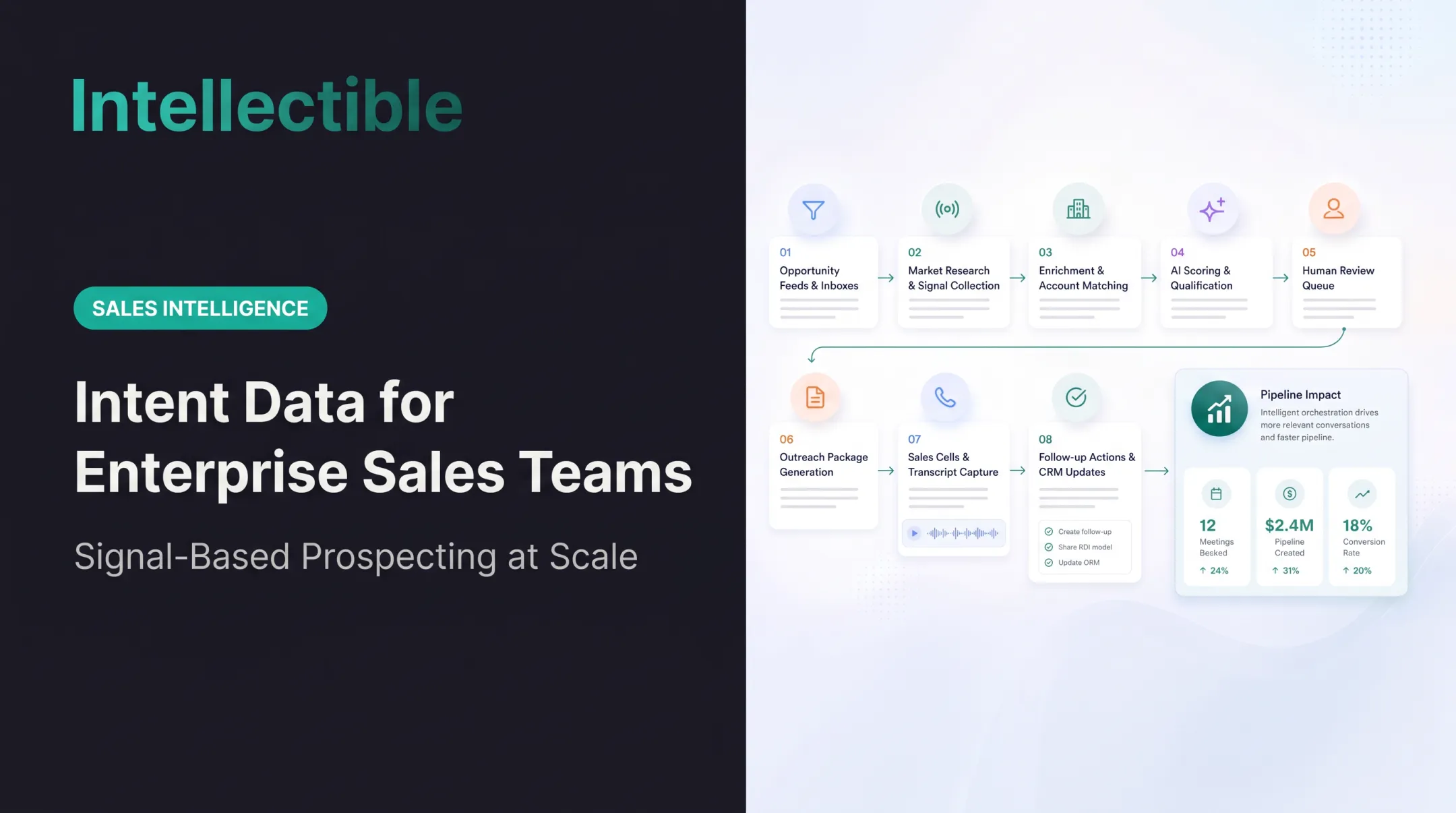
Map the path from signal to follow-up:
- Source collection and normalization
- Enrichment and account matching
- Scoring and ownership assignment
- Notification and CRM logging
- Human review and follow-up
Then define what happens when a signal is strong, ambiguous, stale, duplicated, or out of scope.
Create service-specific plays
Tie each trigger to a useful action:
- Contract event: review the upcoming term and prepare informed questions
- Project signal: confirm scope and the likely buyer group
- New decision-maker: introduce relevant past work
- RFP: run a bid decision before drafting
- Existing account: look for adjacent service lines
Lead with relevance. Don't pretend the signal proves a need.
Use an operating layer that connects data, logic, and execution
Intellectible is a horizontal AI build platform. It connects data sources, applies visual workflow logic, includes AI and human review, publishes internal interfaces, and automates revenue-process actions.
Its Revenue Discovery engine follows a Detect, Gate, Promote, Draft, Approve, Call, Qualified path. Four approval gates stay human. It doesn't contact customers or change CRM records on its own.
Teams can define custom signals such as review pain, inspection drops, permits, seasonality, hiring surges, and expansion. Qualified accounts land in queues organized by urgency, fit, evidence, recommended contact, estimated value, and next step.

This is infrastructure for operationalizing your own signals and processes. It doesn't replace accurate sources or seller judgment.
Measure outcomes, not alert volume
Track:
- Signal-to-qualified-conversation rate
- Response time
- False-positive rate
- Opportunity creation and influenced pipeline
- Conversion by signal type
- Seller adoption
- Research time saved
No reliable general benchmark exists for services-company signal-to-meeting rates, so set your own baseline. Company-reported results for Intellectible clients include 95%+ time saved on opportunity search and Go/No Go decisions, and 150%+ more actionable opportunities. HHS reports a 300% increase in qualified top of funnel.
The Bottom Line
Generic intent data says some activity may be happening. Actionable revenue intelligence explains why the account matters, what changed, who should act, and what happens next.
Keep intent data when it improves prioritization and personalization. Don't rely on it alone when your buying process depends on contracts, projects, relationships, procurement, or operational events that happen outside the web.
Frequently Asked Questions
Why can intent data miss services demand?
An online research feed can be useful without seeing the event that creates a services purchase. A company may review its janitorial contractor, medical-billing partner, or freight provider through internal conversations and procurement processes, without researching category content or visiting a supplier website. Missing research activity does not mean missing demand.
Which observations can reveal a janitorial review?
For janitorial services, consider a multi-site operator approaching a documented renewal while opening facilities or receiving repeated service complaints. The account evidence may be in procurement calendars, local permits, company announcements, and public reviews. Verify the relevant entity and whether a decision is open before treating those clues as an outreach reason.
What can public records show about medical-billing prospects?
For medical billing, look for practice ownership changes, new locations, relevant hiring, and publicly available provider or enrollment records. Those observations can guide a market-wide research process, but a registry entry does not disclose a practice’s billing contract or prove dissatisfaction. Confirm the operating problem and buying responsibility.
Which operating changes matter for freight sales?
For freight, investigate warehouse openings, shipper expansions, procurement records, and logistics job postings tied to relevant operations. A warehouse permit or new transport manager may explain a timing hypothesis even when there is no detectable topic intent. Qualify lanes, service fit, and the actual shipper rather than assuming every carrier record represents a buyer.
How should this process be put into practice and measured?
Build an eligible account universe and monitor those service-specific sources. Record the original evidence, event date, publication lag, legal entity, likely owner, and what remains unknown. Promote accounts only after fit and evidence review; keep a separate research queue for uncertain events. Compare topic intent with the accounts found through operating evidence, using rep acceptance, accepted opportunities, and pipeline rather than alert counts. This does not mean intent never helps a services company; it means the purchase can begin outside the web-research behavior that the feed observes.