Introduction
Most teams find out about a prospect's new location after the vendors, systems, and operating partners are already chosen. 6sense's 2025 buyer study found that buyers first contact sellers at 61% of their journey, and the winning vendor was already on the Day One shortlist 95% of the time.
New locations and operating expansions can create whitespace inside accounts your team already serves. The task is to monitor the entire customer base, match each event to the correct site and parent, and give account managers an evidence-backed reason to explore an additional need before the next renewal.
Key Takeaways
- A new location is an opportunity signal, not proof of intent.
- Clusters of verified signals beat any single indicator.
- Score on recency, source confidence, ICP fit, and operational impact.
- Build a workflow that verifies, routes, and measures every signal.
What Are Operations Buying Signals?
Run expansion research across the full customer base, not only new-logo prospects or accounts near renewal. New facilities, locations, acquisitions, hiring surges, and permits may change a customer’s need for your service before the account manager hears about it. Link those events to the customer hierarchy and current contract scope.
Fit, Opportunity, and Intent
These three ideas are easy to blur. Demandbase describes intent as a signal, not proof of readiness to buy. For this framework:
- Fit: the account matches your ideal customer profile.
- Opportunity: a verifiable event, such as a new location, creates a possible need.
- Intent: observed research behavior suggests the account is actively looking.
A new site is an opportunity signal. It strengthens when paired with hiring, procurement, technology, or research activity.
What Expansion Usually Creates
A new location typically triggers needs across:
- Facilities and supplier management
- Staffing and onboarding
- Pricing and quoting coordination
- Procurement and compliance
- Data management, reporting, and CRM administration
- Workflow automation across sites
Map the signal to one of these consequences before it earns sales attention.
Which Expansion and New-Location Signals Should Teams Monitor?
New-Location Announcements and Business News
Press releases, newsroom updates, investor communications, business journals, trade publications, and executive posts often reveal new offices, plants, warehouses, or branches. For example, Empire State Development reported a Rochester manufacturing facility grand opening on Nov. 13, 2024, with a commitment of up to 50 new jobs.
Read the wording. A planned or expected investment is not a completed site.
Permits, Zoning, Registrations, and Build-Out
Permits, tenant-improvement filings, zoning applications, business registrations, licenses, leases, and construction activity often show up before a grand opening. The limits are real:
- Records are fragmented across roughly 19,900 permit-issuing places, per Census methodology, and Census publishes housing-focused data, not named-company expansion lists.
- Permit applicants may be owners, contractors, or agents rather than the future operator.
- Registration rules vary by state, county, and city.
Treat a permit as a lead to verify, not a conclusion.
Hiring and Organizational Changes
Expansion hiring often shows up as:
- Job postings tied to a new geography
- Regional leadership, facilities, and procurement hires
- Operations manager roles and clusters of location-specific openings
To separate expansion hiring from backfills, check:
- Role volume relative to normal hiring pace
- Geography that matches a suspected new site
- Timing that lines up with other expansion signals
- Job description language such as "launch," "open," or "build out"
A single posting proves little. Vacancy chains can generate replacement postings, so a posting is a recruitment signal, not proof of new capacity.
Digital Footprint and Location Changes
Watch for these digital changes:
- New location pages and updated store finders
- Map listings and local phone numbers
- Careers pages with regional-entry language
Google notes that profiles can be updated from user reports and licensed sources, so a listing change alone does not confirm an open site. Verify against an independent source.
Adjacent Growth Events
Funding rounds, acquisitions, new contracts, product launches, market-entry plans, and leadership changes raise the operational stakes of an expansion. They also hint at the buying group:
- An acquisition points toward integration work in IT and operations
- A new contract points toward delivery and procurement
Be careful with claims. PwC's 2023 survey covers technology integration after M&A, but it is not a rate of new-vendor buying.

How Should Teams Interpret and Prioritize Expansion Signals?
Recency and Expansion Stage
Timing and needs change by stage:
| Stage | Likely operational need |
|---|---|
| Early planning | Market analysis, budget, systems selection |
| Site selection / permitting | Compliance, facilities, supplier sourcing |
| Build-out | Procurement, equipment, IT setup |
| Hiring | Onboarding, scheduling, CRM and data setup |
| Launch | Reporting, pricing, workflow consistency |
| Post-launch | Optimization, multi-site coordination |
Signal Strength and Corroboration
Translate the event into a whitespace hypothesis: which current service could extend to the new site, business unit, or acquired company? Compare the need with the contract’s geographic and service scope. Record both the verified change and the assumption that still needs customer confirmation.
ICP Fit and Operational Consequence
Check fit across:
- Industry and company size
- Existing footprint and geography
- Likely budget
- Relevance to your offer
Then name the concrete consequence. "Third site opening" means little. "Third site means pricing and reporting now span three locations" is something you can act on.
Stakeholder and Buying-Group Relevance
Match stakeholders to the problem: operations, facilities, procurement, IT, finance, revenue operations, proposal, pricing, or executives. The person tied to the signal may not hold the budget. 6sense reports an average B2B buying group of 10 people.
Verification and Scoring
Before scoring, confirm:
- Source date
- Company identity and location
- Project status
- Duplicates
- Whether the event is actually new
A practical score uses five factors, each rated 1 to 5:
- Recency
- Source confidence
- ICP fit
- Operational impact
- Evidence of active research
No universal cutoff exists, so set thresholds from your own conversion data.

How Can Teams Operationalize Expansion Buying Signals?
Build a Signal Taxonomy and Intake Process
Document the rules up front so every signal is handled the same way:
- Expansion types you track
- Sources you monitor
- Required evidence fields
- Target roles and confidence levels
- Action each signal triggers
Collect, Normalize, and Enrich
Capture the same fields every time:
- Company and location
- Event type, source URL, and event date
- Expansion stage
- Relevant contacts and existing CRM record
- Likely operational need
Standard fields keep research from turning into an unstructured lead list.
Add Verification and Human Review
Validate sources, remove duplicates (Salesforce recommends Duplicate Management), verify contacts, and check acceptable use before anything reaches a seller.
Compliance still applies on B2B outreach:
- The FTC's CAN-SPAM guide states the law has no B2B exception
- Texts require written consent under FCC guidance
- California's B2B exemptions expired Dec. 31, 2022
A human approves each signal before it becomes a task.
Route the Signal
Verified signals can create:
- CRM tasks and account alerts
- Research briefs and nurture tracks
- Stakeholder assignments based on strength and buying role
Set handoff rules between marketing, sales, revenue operations, proposal, pricing, and account teams.
Use Intellectible to Connect the Layers
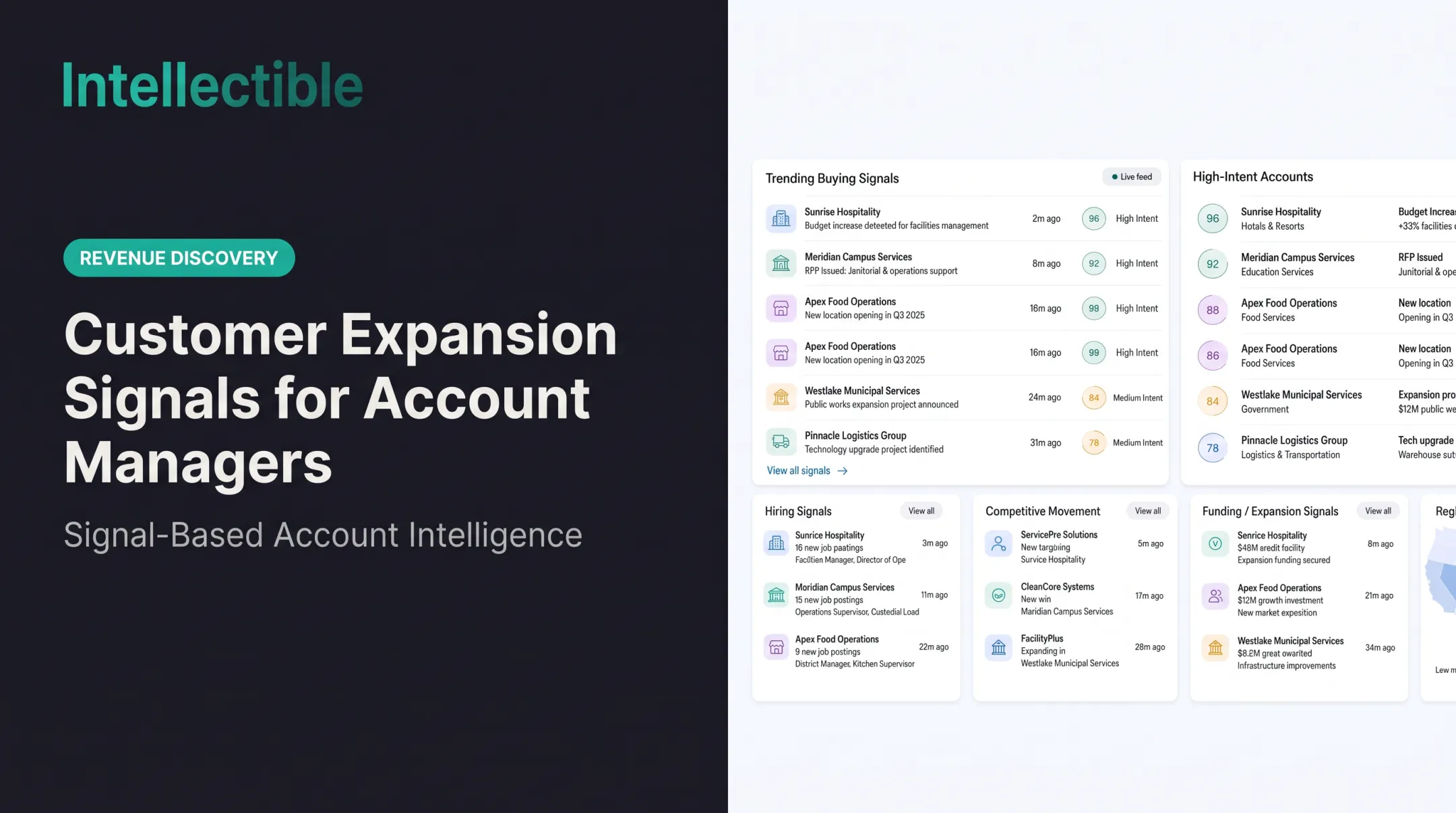
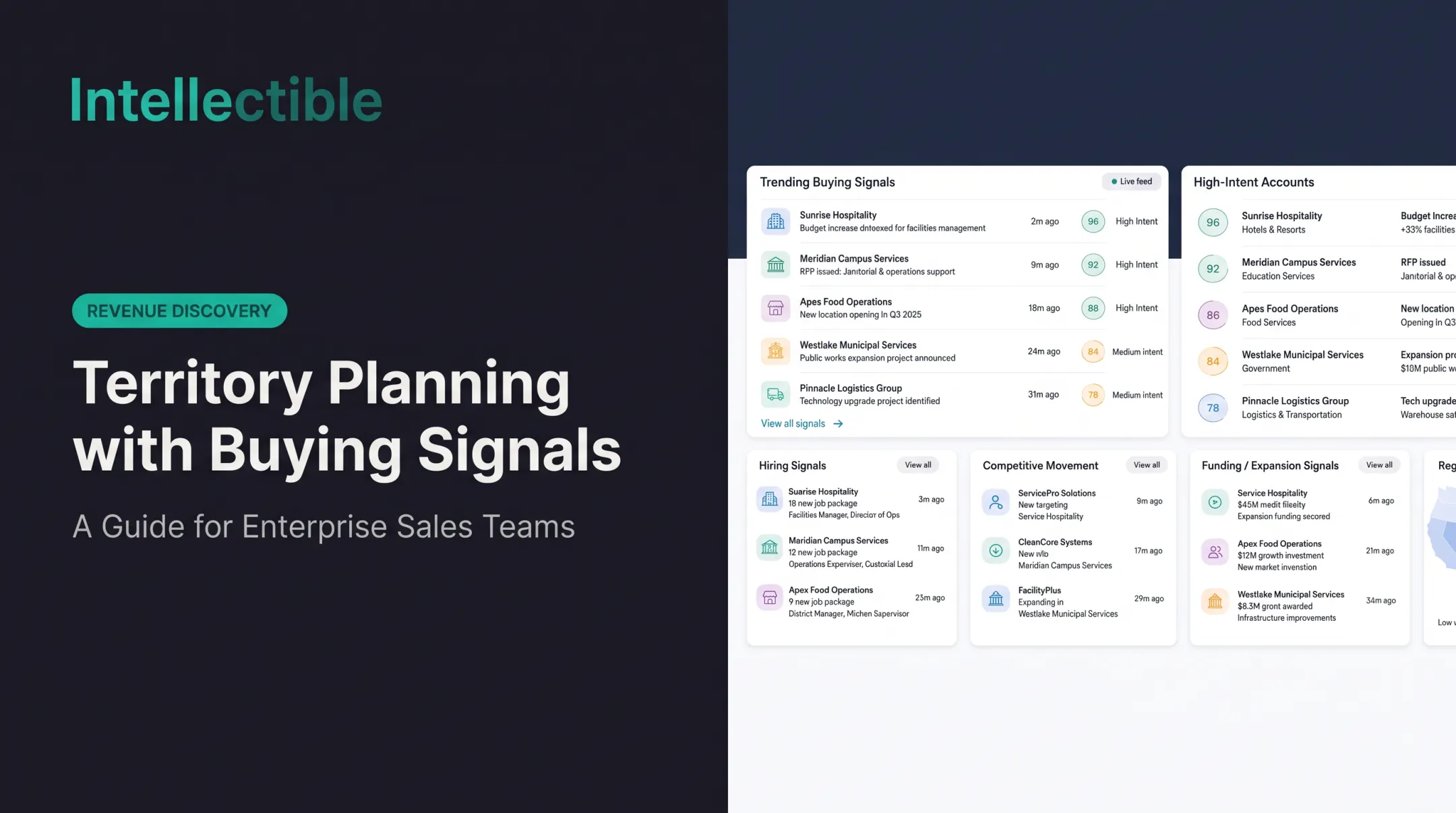
Intellectible is a horizontal AI build platform. Teams can use its visual workflow builder to connect data sources, documents, APIs, structured records, decisions, human review, interfaces, and automated actions into a custom expansion-signal system.
Its Revenue Discovery engine already lists expansion among standard feeds, alongside hiring surges, funding, and M&A. Teams can add their own "tells," such as permits filed.
Monitoring can run nightly, daily, or weekly, and signal weights stay editable. Four human approval gates cover outreach, Salesforce updates, survey sends, and marking a lead Qualified for Costing. Evidence stays attached to each account.

Measure and Refine
Track:
- Source-to-qualified-account rate
- Time from detection to routing
- Verification rate
- Response rate
- Opportunity creation and pipeline influence
- Conversion by signal type
Don't borrow benchmarks. InsideSales' 2021 study covers inbound lead response, not signal routing. Adjust the model using your own results.
How Should Teams Act on an Expansion Signal?
Match the Message and Stakeholder to the Event
Tie the event to the challenge its owner faces:
- Multi-location data consistency: operations or RevOps
- Pricing coordination: pricing and finance
- Proposal workload: proposal teams
- Supplier management and compliance: procurement and facilities
- Reporting and automation: IT and executives
Use Timely, Evidence-Based Outreach
Reference the verified event, its source, the likely implication, and a useful question. Skip the feature list. Timing should fit the stage: a planning account needs a different note than one already operating.
Generic outreach is a real problem. In Gong's 2023 survey, 91% of buyers said seller content was not personalized. That is perception data, not proof that personalization lifts conversion.
Create a Follow-Up and Learning Loop
- Run a short multi-touch sequence with clear stop conditions
- Keep account-level notes and update sources
- Collect feedback from sales and operations
- Compare outcomes by signal source, stage, role, and message
Frequently Asked Questions
Which customers should expansion monitoring cover?
Run expansion research across the full customer base, not only new-logo prospects or accounts near renewal. New facilities, locations, acquisitions, hiring surges, and permits may change a customer’s need for your service before the account manager hears about it. Link those events to the customer hierarchy and current contract scope.
What account baseline is required?
Maintain a baseline of each customer’s legal entities, parent company, operating locations, services bought, stakeholders, and account owner. Match new records to that baseline so a subsidiary opening is visible without creating a duplicate new-business account or contacting another owner’s customer.
Which sources reveal expansion?
Monitor public permits, facility announcements, ownership releases, relevant hiring, and permitted CRM history. A permit can indicate proposed work rather than an operating facility; confirm status, completion evidence, location, and buying responsibility before inferring additional demand.
Does a permit prove a new customer need?
Translate the event into a whitespace hypothesis: which current service could extend to the new site, business unit, or acquired company? Compare the need with the contract’s geographic and service scope. Record both the verified change and the assumption that still needs customer confirmation.
How should this process be put into practice and measured?
Give the account manager an evidence brief, current relationship context, potential decision owner, and a next conversation. Route uncertain matches to research and coordinate with service delivery before committing capacity. A signal should help a customer conversation rather than trigger an automatic upsell. Measure monitored-customer coverage, rep acceptance, expansion meetings, sales-accepted expansion opportunities, and attributable pipeline. Review missed changes and duplicate outreach. Expansion is a repeatable monitoring process using the same evidence discipline as new-business research.