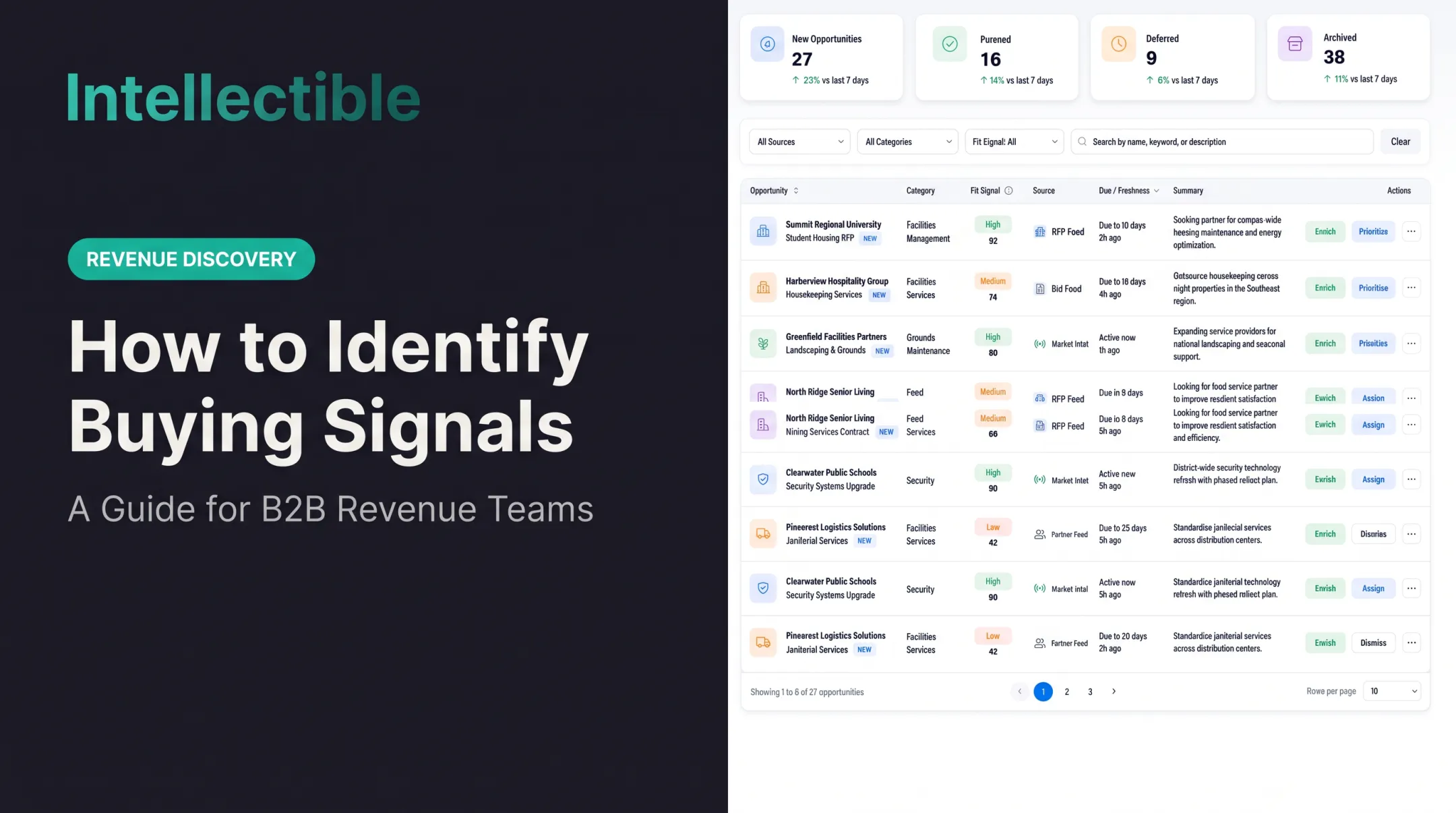
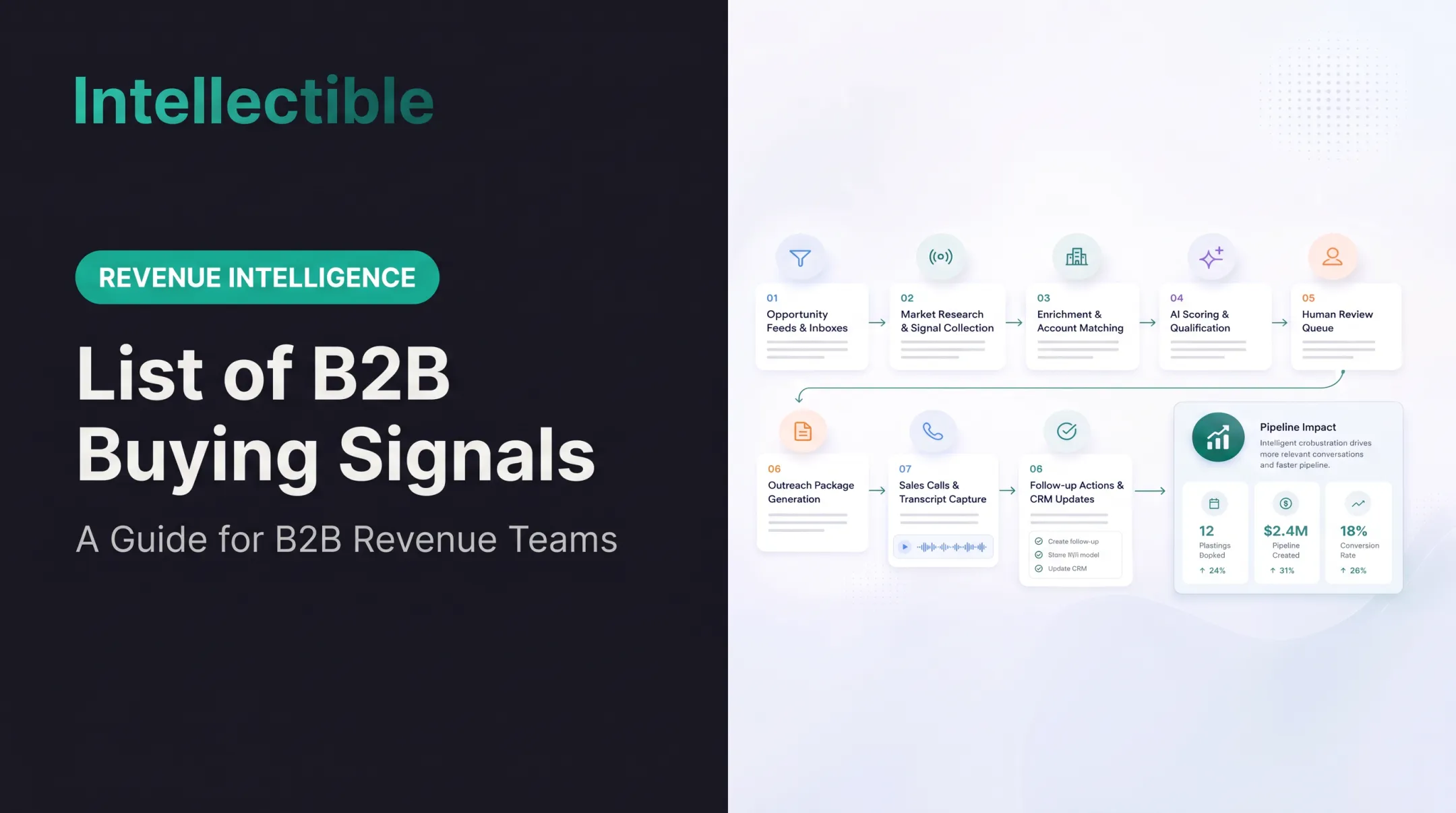
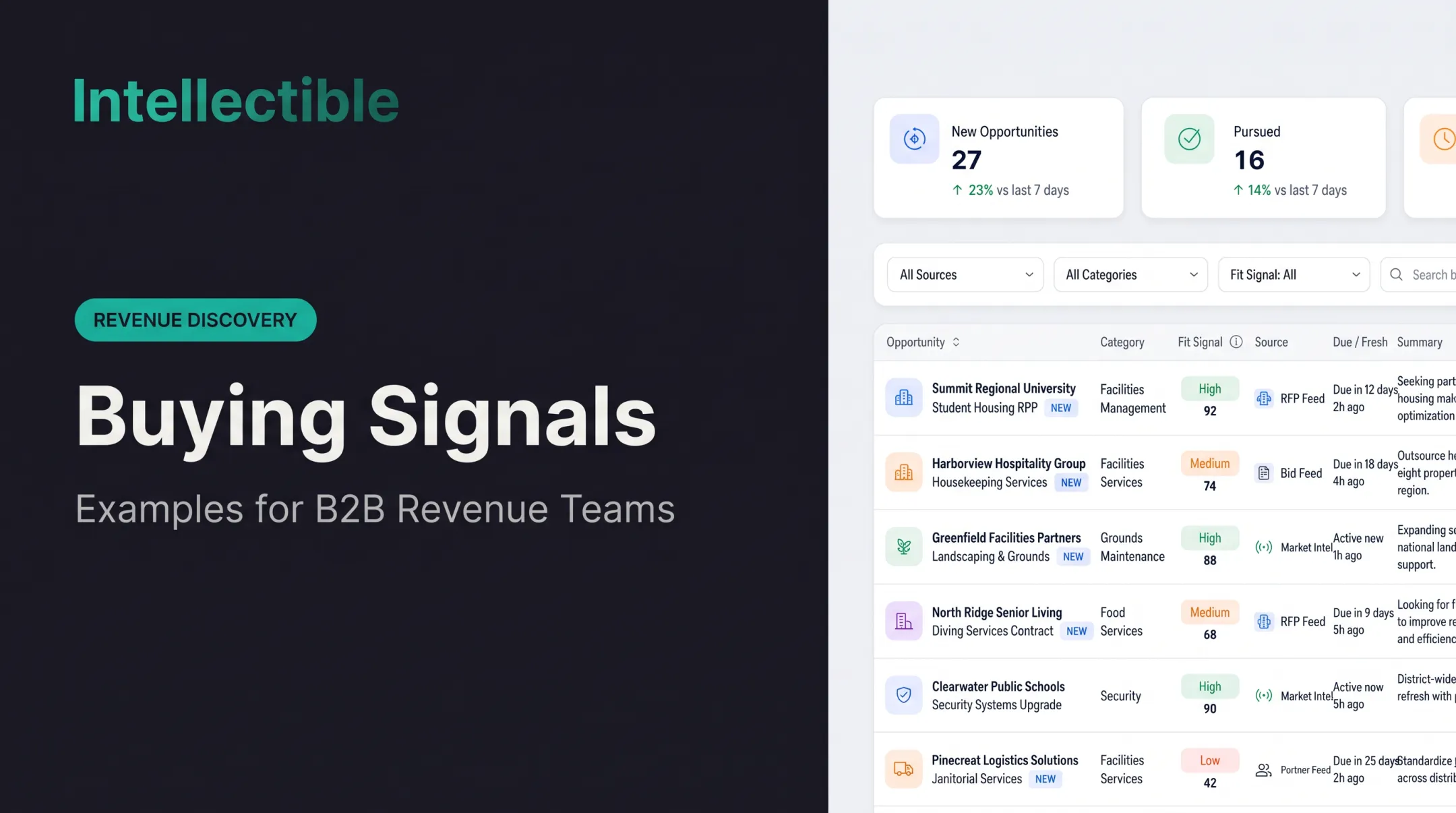
The timing gap is real. 6sense's 2025 study of nearly 4,000 B2B buyers puts first vendor contact at 61% of the journey.
This article explains what buying signals are, how to separate real strength from simple activity, and how sales, marketing, RevOps, and pursuit teams can turn signals into coordinated action.
Key Takeaways
- Buying signals show movement toward a purchase. They don't guarantee revenue.
- Judge each signal on fit, intent, timing, stakeholders, and recency.
- Stacked signals beat any single page view or job change.
- Every priority signal needs an owner, a play, a CRM record, and a feedback loop.
What Are Buying Signals?
A B2B buying signal is a statement, behavior, account attribute, or business event suggesting a person or account is researching, evaluating, changing, or preparing to buy. HubSpot's guide frames it as behavior or a statement showing a prospect is considering a purchase.
Signals show up at every stage:
- Before a prospect ever contacts you (a funding round, a new executive)
- During an active cycle (security questions, a request for a proposal)
- After purchase (renewal or expansion interest)
A buying signal is evidence, not a verdict
Topic-based intent data infers interest from patterns of online research and commonly reports it as an account-level score. It can suggest where to investigate, but it does not identify a confirmed purchase, a budget owner, or the reason an account must change suppliers. Keep that inference separate from the underlying observations.
Buying signals compared with related data
Each data type answers a different question:
| Data type | Question it answers |
|---|---|
| Fit data | Who could we serve well? |
| Intent data | Who is researching the problem? |
| Engagement data | Who is interacting with us? |
| Trigger events | Why might timing be changing? |
| Buying signals | The umbrella: all of the above plus conversations |
Intent data is probabilistic. As Demandbase notes, it doesn't confirm purchase commitment. Combine the categories rather than scoring each in isolation.
Types of Buying Signals
Verbal and conversational signals
A buying signal in this comparison is an observable company event: a named employer hired a new operations leader, a facility received a permit, a business completed an acquisition, or a public contract reached a documented renewal point. Store the original source, event date, publication date, and company identity so a representative can inspect the fact.
- Pricing and budget questions
- Contract terms and timelines
- Implementation and integration questions
- Security reviews
- Requests for next steps
Each one maps to an action. A pricing question calls for a scoping conversation. A security question calls for bringing in the right technical resource. Not every question is a closing signal, so match the response to the cue.
First-party behavioral signals
These come from systems you control:
- Repeat visits to pricing, security, comparison, or case-study pages
- Demo requests and form fills
- Trial activity and email replies
- Multi-contact engagement from one account
Frequency, sequence, and depth tell you more than a single click. Three people from one account reading implementation docs in a week is a different story from one blog visit. Keep tracking within privacy and consent rules.
External, dark-funnel, and opportunity signals
Many reasons to buy appear before anyone visits your site:
- Job changes, including a former champion joining a new company
- New leadership, funding, M&A, or market expansion
- Hiring for relevant roles
- Technology changes
- Review-site research and public complaints
Review sites matter. G2's 2025 survey found 56% of enterprise buyers at firms with 1,000-5,000 employees name them among top software research sources. That figure covers that subgroup, not all B2B buyers.
Fit and buying-group signals
Fit factors decide whether intent is commercially relevant:
- Industry and company size
- Role and geography
- Tech environment and use case
Buying groups matter too. Gartner describes buying groups of 5-16 people across up to four functions. When finance, legal, IT, or procurement joins a thread, that's a signal in itself. So is a past champion surfacing at a new account.

Buying signals by stage
| Stage | Example signals | Typical action |
|---|---|---|
| Early | Category research, educational content | Nurture, account-based marketing |
| Evaluation | Demos, comparison research | Sales follow-up |
| Decision | Pricing, legal, security, implementation questions | Advance the deal |
The same behavior can need a different response depending on fit, open opportunity stage, and who's involved.
How to Prioritize Buying Signals
Evaluate signals and stack related evidence
Rate each signal on:
- Account fit
- Intent strength
- Timing or urgency
- Stakeholder authority
- Confidence and recency
A high-intent action from a poor-fit account can be worth less than a moderate signal from a strategic account with a clear business trigger.
Signal stacking strengthens that read by combining related indicators from one person or account. Common combinations:
- Relevant job opening + repeat pricing visits + a second stakeholder: likely active evaluation
- Funding round + new executive: possible budget and mandate
- Former champion move + reply to outreach: a warm reopening
There is no proven universal conversion lift from stacking, so treat these as prioritization heuristics and test them against your own data.
Create practical priority tiers
| Tier | Action | Response window |
|---|---|---|
| Low | Nurture or monitor | Batch review |
| Medium | Targeted outreach | Within days |
| High | Immediate human follow-up | Same day or faster |
Set windows by urgency and signal type. A demo request deserves a faster response than a funding announcement.
Separate noise and close the feedback loop
Common false positives:
- Accidental page visits and automated traffic
- Low-value social engagement
- Outdated contact data
- Broad hiring unrelated to your problem
Use identity resolution, minimum evidence thresholds, human review for consequential actions, and clear opt-out controls. Data quality matters here. Validity's 2025 report found 76% of CRM users say less than half their data is accurate and complete.
Scoring only works when sellers trust it. RevOps should document signal definitions, weights, decay periods, and the reason behind each score. HubSpot's scoring tool, for example, supports decay settings where a 10-point event with 50% monthly decay contributes 5 points after a month.
Then measure which signals and combinations lead to meetings, qualified opportunities, and revenue. Recalibrate using win-loss and false-positive feedback.
How Revenue Teams Should Act on Buying Signals
Use a signal-to-action operating model
Move every buying signal through a fixed sequence:
- Detect the signal
- Resolve identity
- Gather context
- Assign an owner
- Recommend an action
- Complete human review
- Log the signal in the CRM
- Measure the outcome

Never send an unexplained alert. Each one should name the person or account, source, timing, likely business implication, and suggested next step.
Assign role-specific responsibilities
- Marketing: uses lower-intent signals for content, nurture, and account-based programs
- SDRs and AEs: use high-intent signals for personalized outreach
- RevOps: manages routing and scoring
- Customer teams: spot expansion and renewal moments
- Proposal and pricing teams: act when a signal changes the Go/No-Go call, pursuit strategy, or pricing workflow
Personalize around the signal's meaning
- Former champion changed jobs: Reconnect on the relationship, not the pitch
- Technical research: Share a relevant implementation resource
- Stated deadline: Offer a clear path to evaluation
Lead with the business problem. Don't reveal tracking details or make the prospect feel watched.
Match response speed to urgency
Form fills, direct pricing questions, and live conversations need faster human replies than a single content view.
A Harvard Business Review study of 1.25 million leads found attempts within an hour were nearly 7x as likely to qualify a lead as attempts an hour later. That study measured qualification, not closed revenue, and covered inbound inquiries rather than passive research.
Measure signal-to-revenue performance
Track:
- Time from signal to first action
- Signal-to-meeting rate
- Signal-sourced pipeline and opportunity progression
- Win rate and expansion influence
- False-positive rate and rep adoption
Record signal type, source, date, account, contact, action, owner, and outcome in the CRM so you can compare performance over time.
How to Build a Buying Signal Workflow
Start with a focused signal inventory
Pick a handful of high-value signals tied to known outcomes: pricing requests, champion moves, relevant hiring, proposal deadlines, or repeat engagement with implementation material. For each signal, define these elements before adding more:
- Source and required evidence
- Owner and urgency level
- Next action and escalation path
- Success metric
Connect data sources and automate routing
Pull together CRM records, website behavior, marketing engagement, calls, email, external company events, documents, and proposal systems. Before you go live, cover:
- Identity matching and deduplication
- Data freshness checks
- Role-based access and audit trails
Route alerts into tools people already use, not another dashboard nobody opens.
Add AI with human review and a controlled pilot
AI can summarize calls and documents, detect patterns, and suggest next actions. Humans should validate consequential decisions. Buyers want the same: Gartner's 2026 survey found 69% of B2B buyers turn to reps to validate AI-generated insights.
Intellectible's horizontal AI build platform is one option for this. It connects data, documents, APIs, business logic, decisions, and human review into custom workflows such as opportunity search, Go/No-Go evaluation, proposal coordination, or pricing review.
Its Revenue Discovery engine monitors funding, hiring, expansion, M&A, and custom signals, then ranks accounts by fit and urgency. It drafts outreach but sends nothing, and four human approval gates sit before outreach or CRM updates.
Whatever you use, pilot first:
- Start with one workflow and a small signal set
- Document governance requirements
- Review signal quality with sales and RevOps
- Expand only when adoption and measurable value hold up

Frequently Asked Questions
How is research intent different from a buying signal?
Topic-based intent data infers interest from patterns of online research and commonly reports it as an account-level score. It can suggest where to investigate, but it does not identify a confirmed purchase, a budget owner, or the reason an account must change suppliers. Keep that inference separate from the underlying observations.
What makes an observable signal verifiable?
A buying signal in this comparison is an observable company event: a named employer hired a new operations leader, a facility received a permit, a business completed an acquisition, or a public contract reached a documented renewal point. Store the original source, event date, publication date, and company identity so a representative can inspect the fact.
Does an expansion signal prove that an account will buy?
Consider a logistics business adding a warehouse. A permit or a dated job posting can establish that expansion activity occurred; the belief that it needs a new transport provider remains a sales hypothesis. Compare that evidence with a research-intent score, which can flag topic interest without establishing the operational change or identifying the decision-maker.
What should the account evidence record contain?
Make the distinction visible in the account record: observed event, source, date, matched legal entity, inferred commercial need, decision owner, and next verification step. Record observed versus inferred explicitly. A rep should be able to challenge the interpretation without losing the source evidence.
How should sales teams prioritize the resulting accounts?
Use fit criteria before timing signals. Route eligible accounts into contact-now, research-needed, nurture, or monitor queues according to evidence quality and whether the buying window is still open. Contact-now means there is a defensible reason for a conversation; it never means a purchase has been proved.
Can intent data and evidence-based signals work together?
The two approaches can complement each other. Research intent may help rank investigation, while evidence from public records, account activity, and CRM history supplies an explainable outreach reason. Measure accepted accounts and sales-accepted opportunities rather than treating a higher score or a larger alert count as success.