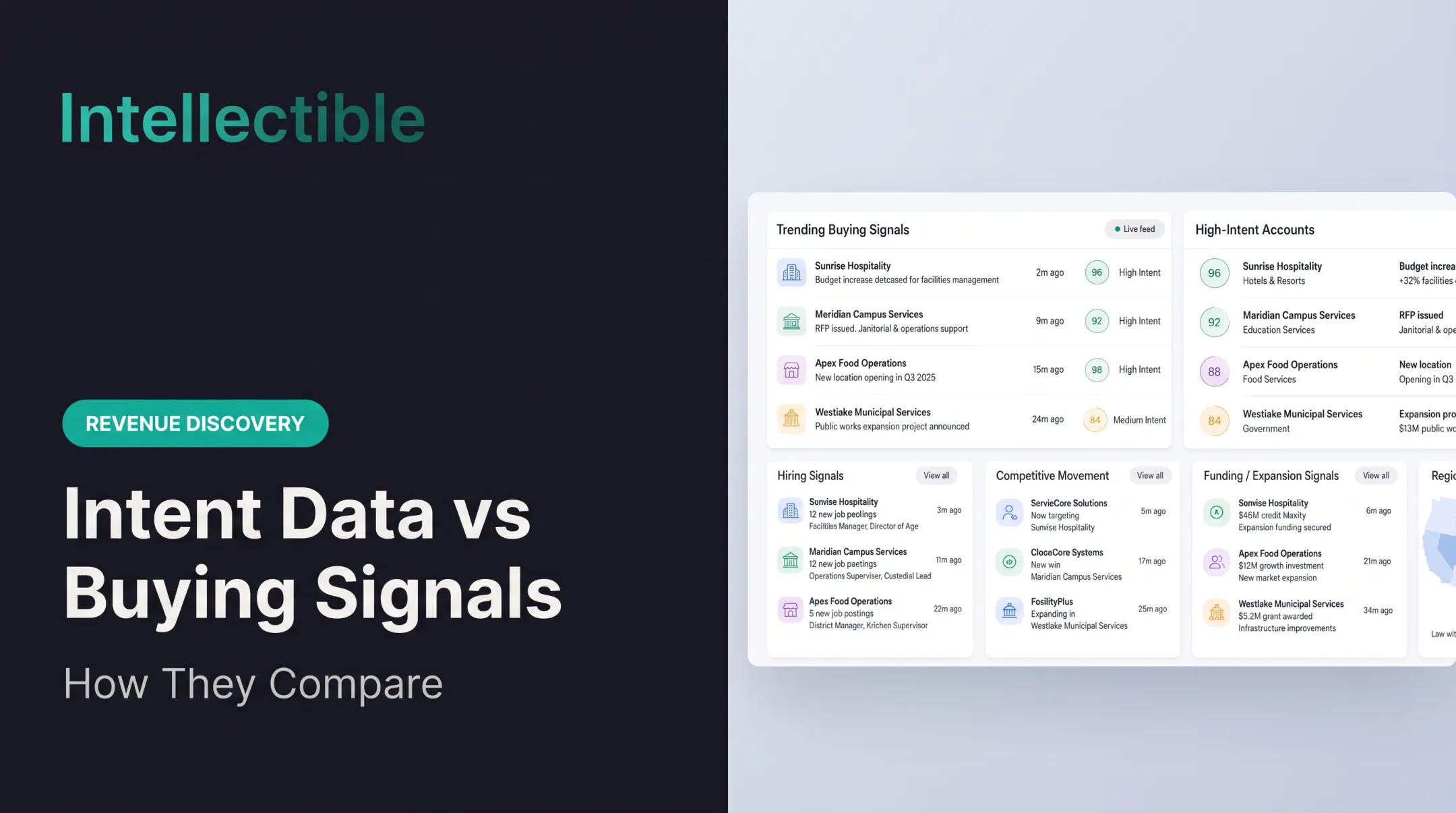
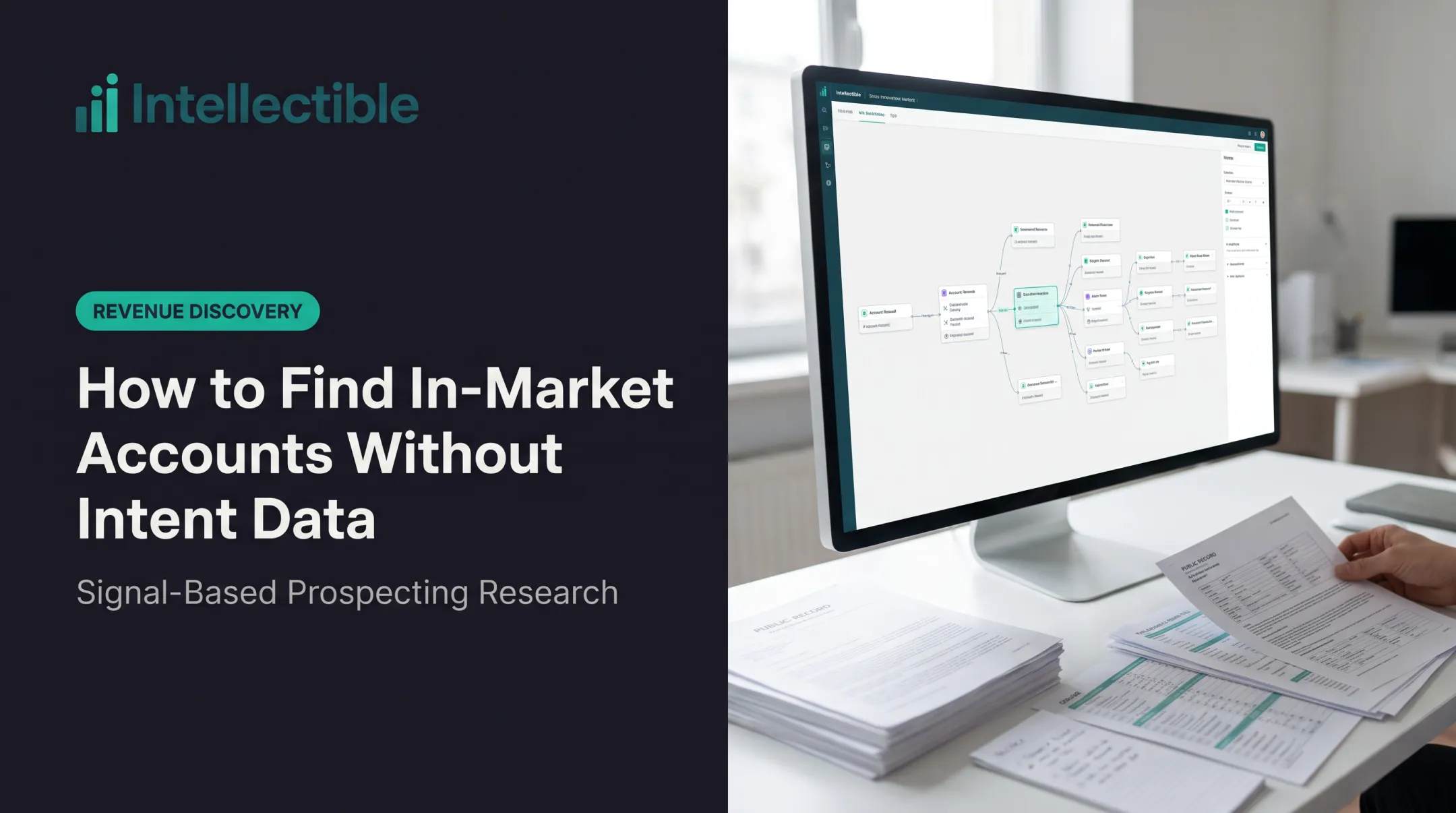
The stakes are real. Forrester's 2025 Buyers' Journey Survey found that purchases involve an average of 13 internal participants and nine external participants, and 73% span three or more departments. With that many people involved, marketing, sales, RevOps, and government contractors need a reliable way to decide which accounts and buying-group members deserve attention first.
This guide compares the two data types, shows where each fits, and explains how to combine them without treating any signal as proof of a purchase.
Key Takeaways
- First-party intent comes from your own channels and is usually more specific and easier to tie to known contacts.
- Third-party intent offers wider market coverage, but provenance and accuracy vary by provider.
- Use first-party data for personalization and follow-up; use third-party data for discovery and enrichment.
- The strongest setup combines both with ICP fit, recency, consent controls, and clear routing.
First-Party vs Third-Party Intent Data: Quick Comparison
Neither source wins everywhere. Here is how they differ on the factors revenue teams care about most.
| Factor | First-party | Third-party |
|---|---|---|
| Source and control | Your own channels and systems | Collected or aggregated by an external provider |
| Signal specificity | Pricing-page visits, demo requests, product usage, sales conversations | Broader research, category, content-consumption, and competitor signals |
| Reach | Only people and accounts that interact with you | Net-new accounts across the addressable market |
| Actionability | Direct behavioral context, easier to activate | Needs validation, identity matching, recency checks, corroboration |
| Governance and cost | You control collection and retention | Provider review, sourcing, opt-out, licensing, and integration work |
The IAB's data definitions are useful here: first-party is a company's own data collected directly from its customer base, while third-party data is sourced or aggregated by a company that was not the original collector.
Third-party intent data is not third-party cookies
Cookies are a browser technology. Third-party cookies are created by sites other than the one you visit. Third-party intent data is business or research intelligence supplied by an external provider. Cookie changes do not automatically eliminate it. Google also kept existing third-party cookie choice in Chrome through its 2025 updates, so blanket "cookies are dead" claims are wrong.
A caution: neither source proves a buyer is ready to purchase. Treat intent as a prioritization input next to ICP fit, role, timing, engagement, and opportunity stage.
What Is First-Party Intent Data?
First-party intent comes from permitted activity on your own properties and relationships, such as submitted enquiries, content engagement, and relevant CRM interactions. It can provide useful context for known accounts, but it cannot represent the full universe of companies that need your service and have never encountered your business.
- Website activity and forms
- Webinar registrations and email engagement
- CRM history and product usage
- Chat, support conversations, and sales interactions
Its value is control. You know the context of collection and can connect a signal to a known person, account, opportunity, or buying-group role far more readily than with an anonymous external signal.
Advantages
- Greater relevance for personalization
- Clearer sales follow-up
- Stronger account prioritization
- Easier feedback from campaign and opportunity outcomes
Limitations
- Only shows activity from audiences already engaging with you
- Fragments across systems (Ivanti had account and contact data scattered across disparate systems after acquisitions, with no single source of truth)
- Decays as people change jobs
- Relies on probabilistic account identification that dynamic IP addresses and remote work can throw off, as Demandbase acknowledges
Use Cases of First-Party Intent Data
Owned signals work best when they trigger a specific action:
- Account-based follow-up when a known account revisits pricing
- Content tailored to the problem a stakeholder is researching
- Retargeting engaged visitors where permitted
- Prioritizing active opportunities
A practical scoring example
Combine a high-intent action, such as a demo request or pricing interaction, with account fit, role, recency, repeat engagement, and opportunity stage. Then route it: strong, well-fit signals go to sales; weaker ones go to a nurture path. No invented weights needed. Start simple and adjust as outcomes come in.

Privacy still applies
Collecting your own data is not automatically compliant. Address notice, consent where required, purpose limitation, access, deletion, security, and retention. Some specifics to know:
- California's CCPA covers California residents, including business-customer and vendor contacts, subject to covered-business thresholds. Virginia's law excludes commercial and employment contexts.
- California requires notice at or before collection, and a retention period or criteria for each data category.
- CAN-SPAM has no B2B exception. Opt-outs must be honored within 10 business days.
What Is Third-Party Intent Data?
Third-party intent data is research, content-consumption, audience, or buying signals collected outside your owned properties. It reaches you through publishers, review platforms, data providers, and research networks.
Examples include accounts that are:
- Researching a category or reading industry content
- Comparing competitors or visiting review pages
- Searching for a business problem
- Showing a surge in activity around a topic
Detail is often account-level, not contact-level. G2, for instance, provides company-level insights and counts unique visitors for that organization.
Benefits
- Broader TAM visibility and net-new prospect discovery
- CRM enrichment with external account signals
- Account prioritization before direct engagement
- Support for outbound and ABM programs
Limitations
Research intent can be ambiguous. Informa TechTarget warns that ordinary content consumption or news-driven search surges can be mistaken for purchase activity. Intermediated data can also obscure the original source.
Other risks include:
- Signals shared across multiple vendors
- False positives and differing methodologies
- Stale records
- Mistaking general education for purchase readiness
How to vet a provider
Forrester's guidance points to signal scale within core-fit accounts, relative accuracy, overlap with what you already know, and incremental business impact. Its sample test uses narrow keywords, geographic and industry limits, and weeks rather than months. Also review:
- Data provenance and collection methods
- Refresh frequency and identity resolution
- Geographic and industry coverage
- Opt-out handling and compliance documentation
- Contractual usage rights and integration quality
State data broker laws matter too. California, Texas, Vermont, and Oregon each require registration for covered brokers, and California's DROP system begins processing deletion requests on August 1, 2026.
Use Cases of Third-Party Intent Data
External signals fill the gaps your own data cannot see:
- Find ICP-fit accounts that have never visited your site
- Enrich known accounts with firmographic or technographic context
- Identify likely buying-group members for coordinated outreach
Validate before acting
Check any external signal against:
- Account fit and role relevance
- Recent first-party engagement
- Current opportunity stage
- Known business events
- A second independent signal, where possible
A government-contracting example
Public procurement data shows how this works. SAM.gov publishes pre-solicitation, solicitation, award, and sole-source notices. GSA's market research service uses RFIs and sources-sought notices to gather industry input. These are declared procurement information, not behavioral intent.
An overnight sweep can surface a matching notice. Intellectible's GovCon workflow, for example, scores SAM.gov notices against a capture profile and has them waiting at 8 a.m. The bid decision still stays with the team.
FAR 3.104-3 also prohibits obtaining protected bid or source-selection information before award, so documented source governance and human review come before any pursuit decision.
First-Party vs Third-Party Intent Data: Which Is Better?
Both approaches can miss a company that neither visits your website nor researches the purchase online. A janitorial renewal, medical-billing review, or freight-provider change may begin with an operating problem, contract date, or leadership decision instead. An absence of intent is an absence of observed research, not proof of no need.
- Audience coverage and required precision
- Data maturity and privacy risk
- Budget and sales-cycle length
- Buying-group complexity
- Your team's ability to act on the signal
Prioritize first-party data to:
- Personalize engagement with known accounts
- Choose the next best action
- Support customer expansion
- Make precise sales follow-up decisions
Supplement with third-party data to:
- Reach beyond known audiences
- Discover net-new accounts
- Fill incomplete CRM records
- Spot category research earlier
The combined model
Forrester says using first-, second-, and third-party intent is standard practice, while evaluating providers and proving impact remain hard. Adding feeds does not automatically improve results, so structure matters.
Use third-party signals for discovery and coverage. Use first-party signals for confirmation and personalization. Apply shared scoring and routing rules to decide whether marketing, sales, proposal, pricing, or human review acts next.
An implementation workflow
- Collect and normalize signals from first- and third-party sources
- Match identities across CRM, web, and vendor feeds
- Qualify and score against shared rules
- Update the CRM or workspace with the scored record
- Route automatically to marketing, sales, or ops
- Add human review for high-stakes actions
- Measure outcomes against pipeline and win rate
Keep an audit trail so you can tell which signals actually influenced decisions.

Intellectible fits here as an optional workflow layer. It connects data sources, business logic, human review, interfaces, and automated revenue decisions, so teams do not rebuild infrastructure for each workflow.
It does not supply third-party intent data itself. Workflows can be exposed as APIs or webhooks and work with systems like Salesforce, Outlook, SharePoint, and Slack.
Its Revenue Discovery engine, for example, requires human approval before outreach, Salesforce updates, and marking a lead qualified.
Real-World Examples
Two vendor-published cases from 6sense show combined signals feeding revenue workflows. Both are vendor-reported cohort comparisons, not controlled tests.
Flexera: prioritization into Salesforce
SDRs lacked timing signals and a unified view of intent, engagement, and buying stage. Marketing, SDRs, and sellers built solution-specific target lists and tailored Salesforce reports showing intent, temperature, and engagement.
Reported results:
- Target-account pipeline grew 27% from June to July versus the prior period
- 6QA accounts grew 82% over the same timeframe
- Engagement rose 15% month over month
Ivanti: fragmented data into one workflow
Acquisitions left account and contact data scattered. Purchase history, intent keywords, competitor research, and profile fit were consolidated into seller tools, and BDRs prioritized in-market accounts. Ivanti reported:
- $263.2M in influenced pipeline
- 154% year-over-year win-rate increase
- 43% rise in average deal size
Reporting windows were not uniform across these figures.

The takeaway
Both cases combined external research signals with owned context and clear handoffs to sales. Use that pattern as a decision guide:
- Fix first-party data first when your CRM is fragmented
- Add third-party coverage when your known audience is small
- Combine both with shared rules in most mature programs
To see how connected revenue data and decision workflows can run as a controlled operating system, explore what Intellectible can build for your team.
Conclusion
First-party intent data is usually stronger for known-account relevance and precise activation. Third-party intent data adds market coverage, enrichment, and discovery of organizations that have not engaged directly.
What works is a governed, measurable workflow: validate external signals with owned context, then connect reliable signals to timely human or automated action.
Frequently Asked Questions
What is first-party intent?
First-party intent comes from permitted activity on your own properties and relationships, such as submitted enquiries, content engagement, and relevant CRM interactions. It can provide useful context for known accounts, but it cannot represent the full universe of companies that need your service and have never encountered your business.
What is third-party topic intent?
Third-party topic intent extends the view to research observed by external publishers or data networks. It can identify account-level interest outside your website, but its coverage still depends on the sources, identity matching, topics, and activity the provider can observe. It is not a census of all purchase decisions.
Which accounts can both approaches miss?
Both approaches can miss a company that neither visits your website nor researches the purchase online. A janitorial renewal, medical-billing review, or freight-provider change may begin with an operating problem, contract date, or leadership decision instead. An absence of intent is an absence of observed research, not proof of no need.
Where can teams find evidence outside online research?
Look for the evidence left elsewhere: local permit and occupancy records, employer hiring, hospital ownership files, documented procurement, filings, inspection records, and existing relationship history. Match each event to the legal entity and relevant buying role. A record supports a research hypothesis; it does not prove that the buyer is shopping.
How should the sources be combined?
Build the eligible account universe independently, then overlay owned engagement, external topic intent, and observable business changes as separate fields. That makes blind spots measurable. Count accounts found only through market sources and assess whether their evidence led to useful seller conversations.
How should teams choose their mix of data?
Use the combination to decide who deserves attention this week and why. Ask for source provenance, last verification, coverage gaps, human review, and opportunity attribution. Choose first-party intent, third-party intent, public-source research, or a combination according to the buying motion rather than assuming one feed sees the whole market.