Introduction
For enterprise services sales, an acquisition or PE ownership change matters when it changes a target account’s operating footprint or supplier decisions. Distinguish general funding news from evidence of a completed ownership event, then investigate whether service contracts, buying roles, or procurement priorities could be reviewed.
The trouble is volume and noise. Through Q3 2026, U.S. venture deal value reached $515.8B, according to the PitchBook-NVCA Venture Monitor, yet only 18 companies went public in Q3. Activity does not equal growth.
This article shows how to interpret funding and M&A signals, validate them, and turn them into timely action without treating every event as an equal opportunity.
Key Takeaways
- Event type, timing, stated use of capital, and corroborating evidence determine what a signal means.
- Pair official filings with hiring, leadership, expansion, and integration indicators.
- Detect, enrich, score, route, and measure signals through a repeatable workflow.
- AI speeds the work, but people own context, judgment, and compliance.
What Are Growth and Capital Signals?
Capital is the financial resource available to a company. Funding is the act of obtaining it. These are working definitions, not a formal legal distinction.
The sales question is which target account may review its service providers after an acquisition or PE ownership change. It is not an audit of your own software suppliers. Acquired companies may combine facilities, leadership, procurement, and service contracts, creating a reason to investigate a changed need in healthcare, logistics, or industrial services.
M&A covers mergers, acquisitions, carve-outs, and related deals where ownership, control, assets, or capabilities change hands.
A funding round is an event. The signal is your interpretation of what it may mean for hiring, technology spend, market expansion, or operating changes.
Leading indicators, not proof
A raise or acquisition suggests direction. It does not prove revenue growth, profitability, purchase intent, or successful integration. The same event can mean different things:
- Growth capital that funds expansion
- Debt that covers liquidity needs
- Acquisition driven by consolidation, capability buying, or market entry
- A deal made from a position of distress
Bain's Global M&A Report finds that 75% of frequent acquirers meet or exceed synergy targets. That is a frequent-acquirer benchmark, not a rate for all deals, so treat any single transaction with care.
A four-question framework
- What happened? Funding round, debt facility, signed agreement, or completed acquisition.
- How large or advanced is it? Stage, instrument, deal structure, disclosed amount.
- Why did it happen? Stated rationale and use of proceeds.
- What happens next? Timing and likely operational follow-through.

Then look for corroboration: executive appointments, hiring, new facilities, product launches, partnerships, or integration announcements. A headline alone is thin evidence.
Different teams also read the same event differently:
- Revenue operations and business development look for new buying needs
- Corporate development tracks competitors, targets, and partners
- Finance, procurement, and technology teams face downstream demands
- Post-merger integration teams inherit systems, contracts, and reporting
An acquirer, acquired company, investor, supplier, or service provider each has distinct priorities. This analysis supports business prioritization. It is not investment, tax, legal, or financial advice.
Sources and confidence
Useful U.S. sources include:
- Company announcements and investor communications
- SEC Form D and Form 8-K filings
- Earnings materials and official websites
- Reputable newswires and commercial databases
Speed varies. Form D is due within 15 calendar days after first sale, and most 8-K items within four business days. These are reporting windows, not live feeds. Private-market databases can also lag and revise data.
Assign a confidence level based on source quality, event confirmation, completeness, and corroborating operational signals. Time-stamp everything you record.
How to Read Funding Signals
What a funding event can reveal
Funding may point to hiring, product development, market expansion, acquisitions, infrastructure, working capital, or balance-sheet resilience. Not every raise is an expansion play, so focus on the stated use of proceeds and investor commentary.
Downstream needs often land in finance, compliance, procurement, technology, sales operations, and reporting.
One caution: a 2019 NBER working paper found about 15% of startups received first VC funding before hiring their first employee. No standard lag between financing and spending exists, so verify rather than assume.
Common funding categories
| Type | What it means | Signal limit |
|---|---|---|
| Equity | Ownership interest in exchange for capital | Ownership or control may change |
| Debt | Borrowed money that is repaid or sometimes converted | Repayment terms matter |
| Non-dilutive | Funding without equity, debt, or ownership components, such as grants (NSF's definition) | Not a universal taxonomy |
Classification varies by company, instrument, and context. A single company might raise equity for expansion, use debt for working capital, and win a grant for a specific research project.
Funding stages and what they suggest
Carta describes the common stages this way:
- Seed: early product development
- Series A: product-market fit with a scaling plan
- Series B: a proven model with growing revenue
- Series C and beyond: market expansion
Bridge rounds are extra financing between priced rounds.
These are guidance, not standards. No authoritative definitions exist for Series D through F, extensions, or pre-IPO rounds.
A late-stage announcement may signal scale, preparation for liquidity, continued private growth, or a need to extend runway. It does not guarantee an IPO. Round names alone do not reveal valuation, profitability, dilution, or use of proceeds.
Primary versus secondary transactions
In a primary transaction, the company issues new shares and receives proceeds. In a secondary sale, existing shares move between holders and the company gets no new capital, according to Carta.
That difference decides whether to expect new hiring or procurement. Watch for misleading signals from bridge rounds, extensions, undisclosed terms, and fund-entity filings.
Qualify before you act
Build a checklist:
- Funding stage and instrument type
- Disclosed amount
- Stated use of proceeds
- Sector and geography
- Leadership changes, hiring, and expansion
Score the event against your ideal customer profile and service relevance before routing it to sales, partnerships, or account teams. Set a response window by event and urgency.
No study measures the lift from acting on funding triggers specifically. HBR's 2011 inbound-lead research found fast response mattered, but it does not transfer directly to outbound triggers.
How to Read M&A Signals
Event types and what they mean
- Acquisition: one company obtains another or its assets
- Merger: two companies combine
- Asset purchase: the buyer takes specified assets and liabilities
- Carve-out: a unit separates from its parent, often requiring transition services
- Joint venture: a venture owned and operated by a small group of entities for a specific purpose
- Minority investment, roll-up, take-private: partial stakes, serial consolidation, and public-to-private deals
Monitor acquisition announcements, company and sponsor releases, public filings, and official ownership records where available. Distinguish announced deals from completed transactions, minority investment from control, and a brand change from a new legal entity. Not every acquisition results in vendor consolidation.

Acquirer versus target signals
An acquirer may be expanding, consolidating, integrating vertically, entering a geography, or buying technology. It will need to merge systems and teams.
The acquired company faces changes across:
- Ownership and leadership
- Reporting, contracts, and compliance
- Systems and customer communication
Build separate qualification and outreach paths for the buyer, the seller, the acquired business, and affected stakeholders.
Strategic rationale and growth quality
Test the stated rationale (revenue growth, cost synergies, supply-chain access, talent, IP, data, new markets) against evidence such as product overlap, geographic fit, customer concentration, and integration planning.
Deal value does not guarantee value creation. Bain's report frames Capital One's Discover acquisition as a bid to own a payments network, which is the stated rationale rather than a realized benefit. McKinsey's merger research says the first 12 to 18 months after close significantly affect success or failure.
Structure, financing, and regulation
Cash, stock, debt, earnouts, or mixed consideration can change financing pressure and post-close priorities. PitchBook LCD reported $81.4B of U.S. direct-lending buyout financing in 2025, the highest since tracking began, so private credit remains a material financing factor.
Regulatory context for U.S. deals includes:
- HSR review: the FTC's 2026 minimum size-of-transaction threshold is $133.9M, but reportability depends on additional tests and exceptions
- CFIUS: reviews certain foreign investments, including those involving sensitive technology, infrastructure, or data
- Industry rules: telecom carriers, for example, need FCC approval for control transfers
Treat these as context, not legal conclusions. Send transaction-specific questions to qualified advisers.
Post-close integration as a continuing signal
Announcement day is not the end of the window. New leadership, system consolidation, rebranding, facility changes, and revised processes reveal the next wave of needs. McKinsey notes one integration delayed a new CRM rollout and site consolidation to protect core business momentum.
Track these milestones:
- Technology: system consolidation and migration plans
- Data: ownership, governance, and cleanup
- Finance: reporting changes and close processes
- Customers: communications, contract changes
- Workforce: leadership appointments, role changes
- Reporting: new dashboards and metrics
How to Build a Signal-Driven Workflow
Detect from multiple sources
Combine official filings, company announcements, newswires, investor communications, and approved commercial data. Log each event in a central record:
- Event date and source URL
- Company and event type
- Funding or deal stage
- Stated rationale and geography
- Confidence level
Enrich and qualify
Add firmographic and relationship context:
- Industry and company size
- Leadership changes and hiring activity
- Existing account status
- Technology environment and contract exposure
- Fit with team priorities
Use a transparent scoring model with four separate fields: event strength, business fit, urgency, and confidence. Keep them separate so a strong event with weak fit does not look like a priority. Set thresholds from your own conversion data rather than borrowing universal cutoffs.
Route actions and keep humans in the loop
Create trigger-specific routes for sales, partnerships, finance, corporate development, proposal teams, or integration teams. Not every alert belongs in one queue.
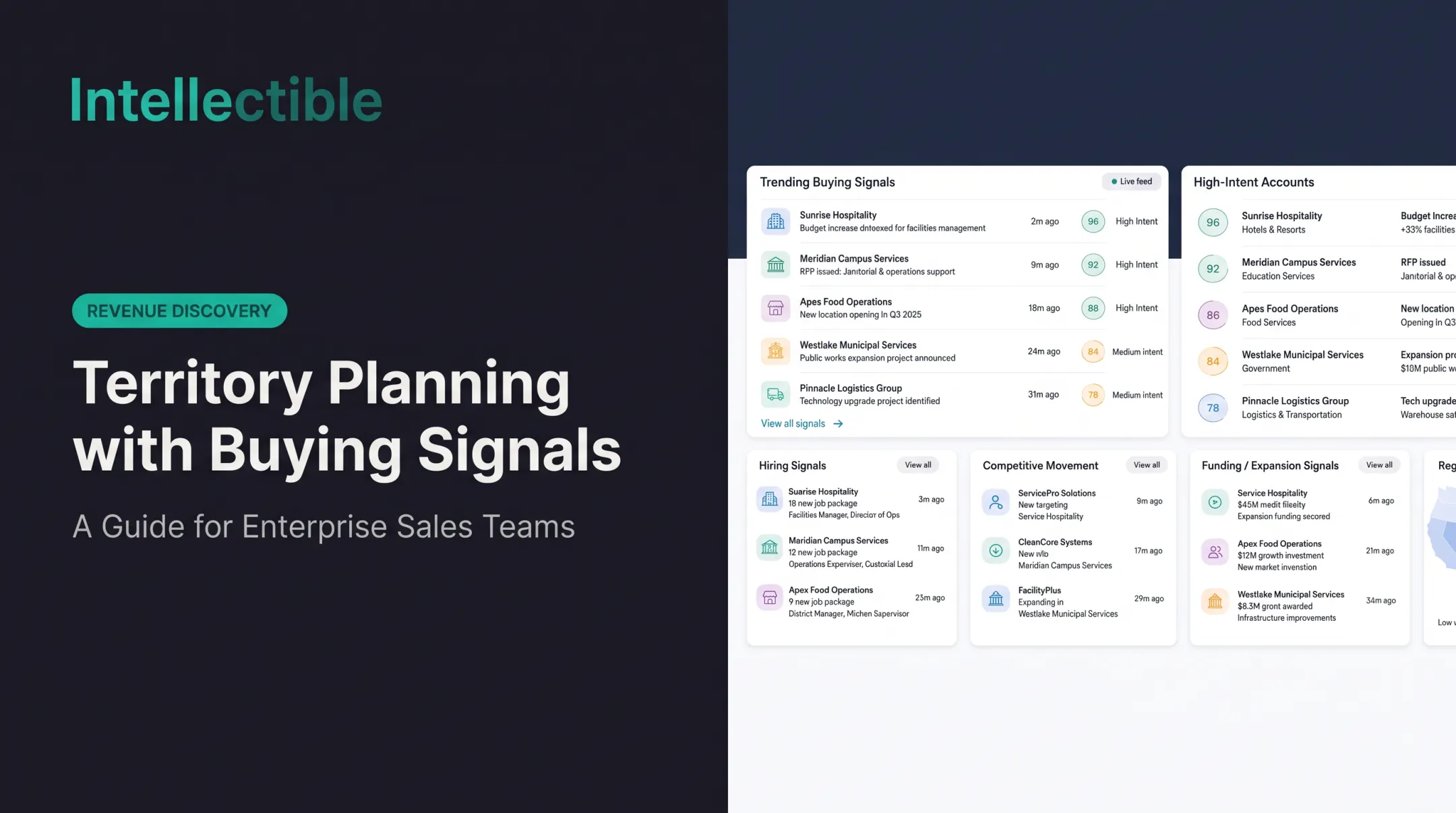
Intellectible is one example of a horizontal AI build platform for this workflow. Its Revenue Discovery engine includes a Signal Monitor that lists live signals such as funding, M&A, hiring pressure, leadership change, and expansion, ranked by severity.
Customer-defined rules run through detection, gating, promotion, drafting, approval, and qualification. The platform connects data sources via APIs and webhooks, publishes dashboards, and keeps audit trails without rebuilding infrastructure for each workflow. Review gates keep a person on exceptions and approvals.

Require human approval for ambiguous, sensitive, regulated, or high-impact actions. NIST's AI Risk Management Framework calls for documented human oversight, realistic testing, and ongoing monitoring.
Measure results
- Response time
- Accepted opportunities
- Conversion by signal type
- False-positive rate
Frequently Asked Questions
What is the sales opportunity in an ownership change?
The sales question is which target account may review its service providers after an acquisition or PE ownership change. It is not an audit of your own software suppliers. Acquired companies may combine facilities, leadership, procurement, and service contracts, creating a reason to investigate a changed need in healthcare, logistics, or industrial services.
Which ownership sources should be monitored?
Monitor acquisition announcements, company and sponsor releases, public filings, and official ownership records where available. Distinguish announced deals from completed transactions, minority investment from control, and a brand change from a new legal entity. Not every acquisition results in vendor consolidation.
How should the account hierarchy be recorded?
Map parent, acquired entity, operating locations, relevant service lines, and procurement responsibility. Retain the source, announcement date, closing date when known, and the account match. A private-company hierarchy may remain incomplete; unknown ownership must not be converted into a confident CRM fact.
Does an acquisition prove a consolidation plan?
Look for a commercial bridge between the transaction and your offer: overlapping service contracts, a centralized operating team, a new CFO or operations leader, a standardization announcement, or an approaching documented renewal. An acquisition is an observed event; a consolidation plan remains an inference until confirmed.
What should a vendor-consolidation outreach brief include?
Create an account action package with the ownership change, relevant footprint, possible decision owner, incumbent evidence, contract timing if public or provided, and a discovery question. Confirm which entity can buy and whether the process remains open. Do not assume that every subsidiary can replace a provider immediately.
How should this sales motion be monitored?
Run the research across the target market and existing customers, with owner assignment and human review. Track verified ownership matches, accepted accounts, consolidation conversations, and sales-accepted opportunities. The objective is a repeatable sales-research process, not automatic supplier termination or an unsupported promise of savings.