Introduction
A six-figure intent contract should be evaluated through a traceable sales process, not the number of accounts labelled warm. Define the account sample, acceptance standard, opportunity criteria, cost model, and reporting owner before purchase or renewal. Use the scorecard to distinguish incremental pipeline from activity that would have happened anyway.
Intent data adoption keeps climbing, but Forrester's 2026 research describes it as ubiquitous and consistently underutilized, with immature use, weak measurement, and difficult integration.
In a 2024 Intentsify and Ascend2 survey, 70% of respondents named data quality as a challenge.
This guide is for CFOs, CROs, RevOps leaders, procurement teams, and sales or marketing executives. It covers what the contract should include, how to calculate cost and payback, how to put signals to work, and when to expand, renegotiate, or stop.
Key Takeaways
- A six-figure contract should include data, integrations, support, governance, and written success criteria.
- Calculate ROI on the full first-year cost, including internal labor and unused signals.
- Intent signals show research behavior, so pair them with fit, CRM history, and triggers.
- Require a baseline, a control group, and renewal gates before crediting pipeline.
What Intent Data Means, and What It Does Not
Behavioral evidence of research
TechTarget defines intent data as behavioral information showing which accounts are researching what, how often, and through which sources. Typical inputs include content consumption, keyword research, competitor comparisons, review-site activity, and pricing-page visits.
Most signals are account-level. They suggest a company is researching a topic, not that a specific person is. Ask any vendor whether it identifies the researcher or only the account.
An intent signal does not prove budget, authority, urgency, or a qualified opportunity. Treat it as a prioritization input, never a standalone qualification decision.
How it differs from adjacent data
- First-party: behavior on your own website, emails, and product
- Second-party: another organization's directly collected data, shared with you
- Third-party: data supplied by an aggregator that does not own the original information
First-party data is the most precise but has the narrowest coverage. Third-party data reaches further, but quality varies, so test it. Intent also differs from firmographic enrichment, contact data, and predictive scoring. Broader business signals, such as hiring, funding, and leadership changes, add context that behavior alone lacks.
What you are really buying
Raw data, a signal platform, a full ABM system, managed activation, and an integrated revenue workflow are different products. Contract value should match the data quality, operational support, automation, and accountability the vendor actually delivers.
What a Six-Figure Intent Data Contract Should Deliver
Data scope and quality
Confirm these fundamentals:
- Signal origin, industries, and account types covered
- How accounts are identified and topics are configured
- Refresh frequency, timestamps, and confidence levels
- Historical access, privacy practices, and false-positive filters
Volume is not value. Signals must map to your ICP and to accounts your team can pursue. Forrester's evaluation guidance recommends testing coverage in core-fit accounts, checking accuracy, and measuring overlap with sources you already have, to see what is truly incremental.
Privacy deserves a legal review. California's CCPA exemption for certain B2B personal information expired on January 1, 2023, so intent data involving personal information may be covered.
Integration and Outcome Measurement
Evaluate these capabilities:
- CRM and marketing automation sync
- Sales engagement tools
- APIs and warehouse access
- Alerts, routing, and scoring
- Workflow triggers
Use an evaluation scorecard with eligible accounts surfaced, evidence completeness, rep acceptance rate, time to first touch, meetings per signal type, sales-accepted opportunities, and pipeline from accepted signals. Give each metric an owner, denominator, reporting period, and a definition that sales and RevOps both accept.
Implementation and support
Look for support across the full lifecycle:
- ICP definition and topic selection
- Account-list prep and integration setup
- Workflow design, training, and ongoing optimization
Separate one-time onboarding from continuing strategic support. Note which services are included, billed separately, or dependent on your internal team.
Commercial terms
Review every cost component: license, seats, monitored accounts, topics, credits, exports, integrations, overages, support, and renewal increases. No reliable public benchmark exists for six-figure, intent-only pricing, so negotiate from your own test results. Also confirm:
- Service levels and data availability
- Security obligations and data ownership
- Usage rights and renewal terms
- Scaling up or down
- An exit plan if the program underperforms
Proof of value and accountability
Require a written success plan that covers baseline metrics, target use cases, owners, milestones, and reporting cadence. Define what counts as a qualified signal, opportunity, and revenue contribution.
Run a proof of concept on your real target accounts rather than relying on a generic demo. Performance clauses, expansion gates, or shorter initial terms reduce the risk of paying enterprise prices before quality and adoption are proven.
How to Calculate ROI Before You Sign
Baseline and counterfactual
Document current performance across:
- Target-account coverage
- Opportunity creation and conversion rate
- Sales-cycle length and win rate
- Deal economics and rep capacity
- Cost per qualified opportunity
Connect each opportunity to the originating signal and source record. Distinguish sourced pipeline from influenced pipeline, remove duplicate opportunities, and compare like-for-like segments. Use a pilot cohort and a comparable baseline to understand whether the program improves results rather than merely attaching credit to deals already underway.
Use external benchmarks only when they match your industry, cycle, and deal size. 6sense's 2025 report put the average B2B buying cycle at 10.1 months, which describes buyers, not payback.
Full investment
Build a first-year model:
- Vendor fee and implementation
- Integration and enablement
- Internal RevOps and sales hours
- Campaign execution and data enrichment
- Change management
- Cost of unused or duplicate data
Separate cash costs from capacity costs, and distinguish annual contract value from total first-year cost and recurring renewal cost.
Value pools
Model value from:
- New opportunities and better conversion in target accounts
- Faster cycles and higher deal quality
- Reduced prospecting effort and capacity freed for better work
Use gross profit or contribution margin rather than booked revenue. Keep sourced pipeline, influenced pipeline, and accelerated revenue separate to avoid double-counting.
Three scenarios
Build conservative, base, and upside cases with explicit assumptions for coverage, adoption, response rates, conversion, deal economics, and time to value.
ROI = (incremental gross profit − total program cost) ÷ total program cost
Then calculate the minimum incremental opportunities or closed-won deals needed to break even. Label each assumption as measured, estimated, or needing validation.
Attribution before launch
Decide whether you will evaluate at the account, contact, opportunity, or revenue level, and set the window in which a signal earns credit. Compare intent-exposed accounts with a matched control group, adjusting for fit, territory, stage, and capacity. Track leading indicators and financial outcomes separately.

That discipline matters because vendor claims rarely hold up under scrutiny. A Bombora financial-services case study reports $800M in pipeline within three months, yet discloses no control group, attribution method, or closed-won revenue. Pipeline is not realized return.
How to Turn Intent Signals Into Revenue
Pick a few plays
Choose a limited set before launch:
- Target-account prioritization
- New-logo outbound
- Competitive displacement
- Expansion
- Renewal risk
- Reactivation
Match each play to signal types, segments, buyer roles, messaging, an owner, and a next action. A few repeatable plays prove ROI faster than unfiltered alerts sent to everyone.
Route to an accountable owner
Set thresholds for signal strength, fit, recency, topic relevance, and buying-group activity before a signal creates a task. Define:
- Who receives it and how fast they must review it
- What information must accompany it
- When a human approves the next step
- Escalation rules for duplicates, open opportunities, customer accounts, and CRM conflicts
Add context first
Combine intent with firmographic fit, CRM history, website engagement, known contacts, open opportunities, and business events.
Outreach should reference the actual research topic, not a generic "we noticed your interest" note. Human review also guards against reading anonymous, account-level behavior as a confirmed individual buying signal.
Automate the workflow, not the judgment
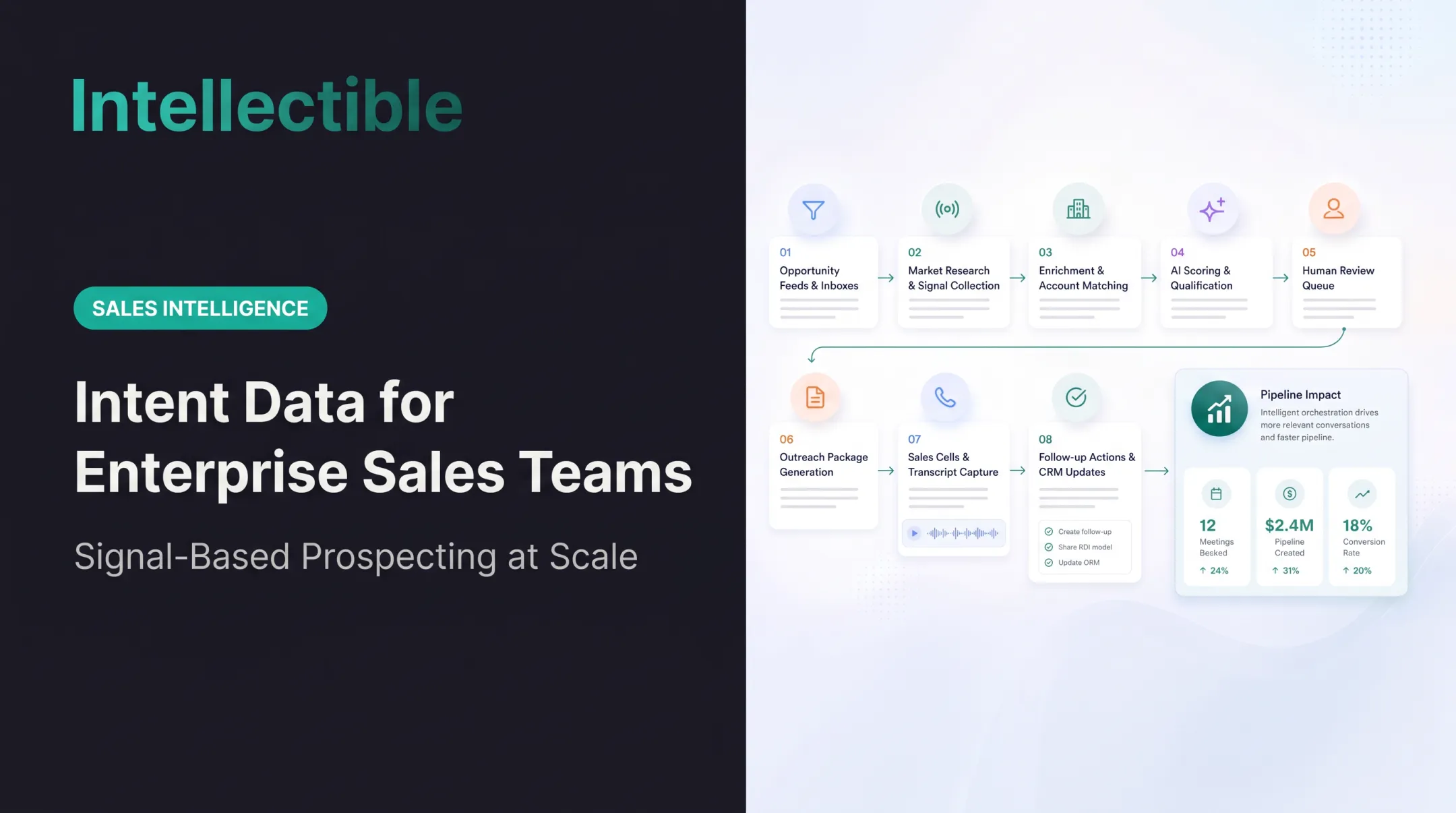
Signals can trigger enrichment, scoring, routing, research briefs, approvals, CRM updates, and follow-up tasks while people keep the decisions. Intellectible is not an intent data provider. It is an operational layer where teams connect data sources, business rules, AI steps, human approvals, databases, and audit trails into revenue workflows.

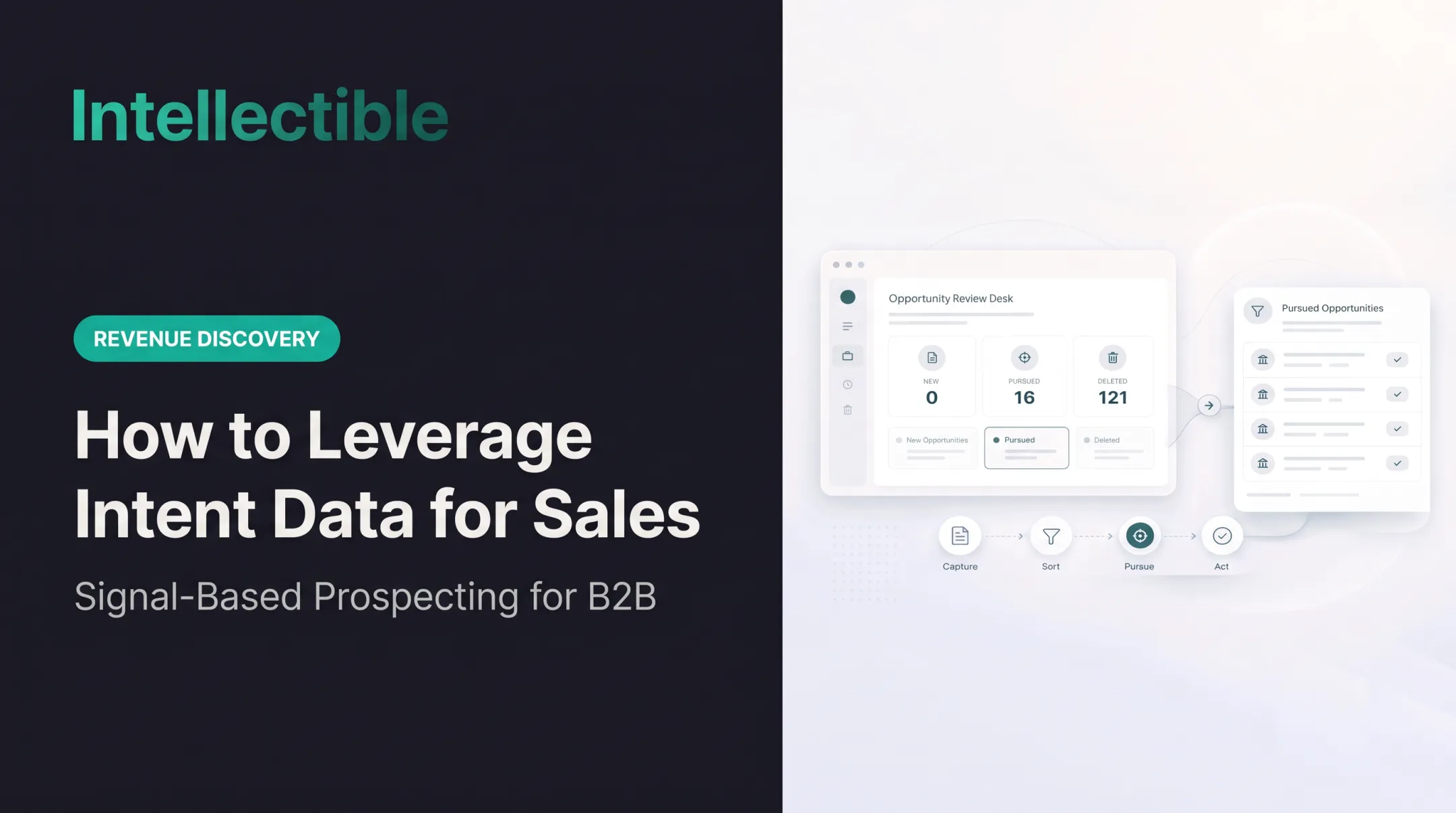
Its Revenue Discovery engine detects team-defined buying signals on nightly, daily, or weekly schedules, with four human approval gates. It drafts outreach but sends nothing automatically.
Customers report results measured in their own production numbers, such as HHS cutting search time 95% and Office Design Group reaching 4× ROI in under six months. Those results reflect each customer's workflow and measurement method, so don't treat them as universal.
Build a feedback loop
Record whether each signal was relevant, acted on, ignored, duplicated, converted, or disproven, and feed that back into scoring and routing. Give sales, marketing, RevOps, and leadership one shared view of signal quality, adoption, pipeline progression, and revenue. Continuous calibration is part of what an enterprise contract should pay for, because markets, topics, and territories shift.
How to Prove Payback and Control Risk
Measure in stages
- Set a pre-launch baseline for coverage, pipeline quality, and conversion rates.
- Run a pilot on real target accounts before full rollout.
- Review adoption and signal quality against that baseline.
- Review revenue once enough opportunities have moved through your sales cycle.

Separate leading metrics (coverage, relevance, routing speed, action rates) from lagging ones (qualified opportunities, conversion, cycle length, gross profit, closed-won revenue). Match the timeline to your own cycle instead of promising a universal payback period. Gartner's sales-technology guidance makes the same point: usage metrics describe activity, not business value.
Watch the cost of non-adoption
Track the hidden costs that erode ROI:
- Unused seats and unworked alerts
- Duplicate signals and manual exports
- Delayed routing and low-quality contacts
- Hours spent maintaining the program
Measure signal-to-action and action-to-opportunity conversion, not just alert counts. Comparing these failure costs with the license fee shows whether the problem is the vendor, the process, the integration, or the team.
Set renewal and expansion gates
Define the evidence required to renew, expand, renegotiate, or stop:
- Validated incremental value
- Sustained adoption
- Acceptable data quality
- Operational fit
- Total cost of ownership
Hold quarterly reviews by segment, use case, signal source, territory, and workflow, not organization-wide averages.
A six-figure intent data contract is justified only when measurable incremental value and a repeatable operating capability exceed the full cost and risk of the program.
Frequently Asked Questions
What should a six-figure intent contract be judged on?
A six-figure contract buys access to capabilities and data, not a guaranteed pipeline outcome. Begin with the accounts and service purchases the team must find, then test whether the program supplies evidence that sellers can use. Define success before the renewal conversation or vendor demonstration.
What belongs in the evaluation scorecard?
Use an evaluation scorecard with eligible accounts surfaced, evidence completeness, rep acceptance rate, time to first touch, meetings per signal type, sales-accepted opportunities, and pipeline from accepted signals. Give each metric an owner, denominator, reporting period, and a definition that sales and RevOps both accept.
How is rep acceptance measured?
Rep acceptance rate is accepted accounts divided by accounts submitted for review. Track acceptance reasons and rejection reasons separately. A high acceptance rate still needs to translate into qualified conversations and sales-accepted opportunities; do not substitute account engagement or marketing-qualified volume for that handoff.
How should pipeline be attributed?
Connect each opportunity to the originating signal and source record. Distinguish sourced pipeline from influenced pipeline, remove duplicate opportunities, and compare like-for-like segments. Use a pilot cohort and a comparable baseline to understand whether the program improves results rather than merely attaching credit to deals already underway.
How should total program cost and break-even be calculated?
Include subscription, contact data, seats, integrations, implementation, source access, and operating time in the cost model. For an illustrative break-even calculation, divide annual program cost by contribution profit per incremental win; label assumptions clearly. An expected benefit is a model, not a promised customer result.
How should the renewal decision be made?
Make the renewal decision from accepted-opportunity economics, seller use, coverage gaps, and the quality of the evidence-to-action process. Continue, change, or stop the program according to the agreed scorecard. More warm accounts on a dashboard are not sufficient proof of commercial value.