But a job posting is not proof that anyone is ready to buy. It's an observable clue. It becomes useful when you combine it with account context, timing, role relevance, and a human check.
Buyers also do most of their homework early. 6sense's 2024 research found that 69% of the purchase process happens before seller engagement. This article lays out a working framework: spot meaningful hiring patterns, enrich them with account data, score them, route them to the right people, and use them to start relevant conversations.
Key Takeaways
- A posting signals possible investment or pressure, not guaranteed intent.
- Patterns across roles, seniority, and timing beat any single listing.
- Enrich every signal with CRM, news, and account history before prioritizing.
- Use signals to improve timing and relevance, never to pressure or surveil.
Why Job Postings Can Function as Buying Signals
What a job posting can reveal
A job posting can reveal a budgeted role, operating priority, system requirement, or planned capability before a vendor conversation becomes public. It does not prove an external purchase, because the company may be hiring to do the work internally. Treat the posting as evidence to interpret in the context of the service you sell.
- Title: the function in play
- Seniority: how strategic the effort is
- Required skills: planned systems or workflows
- Description: current pain points or desired outcomes
Why patterns beat isolated postings
One generic opening tells you little. Stronger patterns look like:
- Several related roles in the same function
- A new leadership position followed by supporting hires
- Simultaneous hiring across connected departments
Be honest about the evidence, too. Published data doesn't yet quantify how reliably hiring predicts vendor spend. A Federal Reserve note on AI adoption and postings found no causal link, which is a good reason to treat postings as hypotheses.
Useful signals by function
- Proposal, capture, pricing, and business development roles suggest more pursuit activity. SAIC's Capture Manager posting framed the hire as a "key growth role" for new and recompete contracts.
- Data, AI, automation, and systems roles suggest modernization. Baptist Health Care's Epic analyst postings, for example, track implementation, go-live, and optimization work.
- Compliance, quality, and program roles suggest new delivery or regulatory demands.
- Equipment service companies that announce technician hiring alongside growth, as Ocean Edge Services did, may be expanding capacity.
- Economic development groups and site services companies vary widely. Treat their hiring as context for a conversation, not a trigger.
No single role guarantees a purchase.
Hiring intent versus buying intent
Hiring intent, operational intent, and buying intent are different things. A company may solve a need with a new hire, an outside provider, existing software, or a mix.
Frame the signal as a conversation hypothesis: "this account may be expanding its pricing operation." Don't assume it's actively shopping.
From signal to account hypothesis
Say a mid-size contractor posts a Pricing Manager role that requires experience with cost-volume-profit models and audit trails. Two proposal coordinator openings appear within a month.
- Hypothesis: the company is pursuing more bids and wants a repeatable pricing process.
- Likely stakeholders: VP of capture, proposal director, finance lead.
- Possible pain point: slow, manual quote turnaround.
- Outcome to explore: faster, more defensible pricing.
How to Build a Job-Posting Signal Workflow
Define accounts, roles, and hypotheses
Monitor postings for every eligible account using permitted company careers pages and licensed or authorized feeds. Match legal entities, locations, parent companies, and requisition identifiers. Deduplicate reposts and multi-location adverts so one vacancy does not become a false hiring surge.
Then build a role taxonomy that groups equivalent titles across these functions:
- Revenue operations, proposal, pricing, and capture
- Procurement, data, AI, and automation
- IT, compliance, and operations
For each group, write down the hypothesis it supports and who should review the signal.
Collect and normalize the data
Use permitted sources only:
- Company career pages
- ATS-hosted pages
- Public job boards
- Approved data providers
Check terms first. LinkedIn's User Agreement prohibits scraping, and Indeed's terms bar automated access without written permission. The hiQ v. LinkedIn ruling addressed a narrow CFAA question and isn't blanket permission.
Then normalize:
- Titles, departments, and seniority
- Locations, posting dates, and status
- Required skills and employment type
- Company identifiers
Add controls for:
- Stale postings and reposts
- Agency listings and duplicate URLs
- Multi-location roles
Greenhouse estimates that 18-22% of jobs on its platform are posted with no intent to hire, so duplicates and ghost listings are a real risk.
Enrich with account context
Combine each posting with account context where legal and ethical:
- CRM history, open opportunities, and prior conversations
- Installed technology and contract information
- Company news, leadership changes, and expansion announcements
Record whether the account is new, open, closed-lost, an existing customer, or tied to an active opportunity. Keep the original source, collection date, confidence level, and your reasoning attached.
Score strength and confidence
Build a model around:
- Role relevance, seniority, and skill specificity
- Number of related openings and recency
- Account fit and organizational change
- Corroborating evidence
Keep strength and confidence separate. A specialized executive role may matter a lot, while an old or duplicated listing may be unreliable. Test the model against your own historical opportunities and see whether higher-scoring accounts engage and qualify better. Don't borrow a benchmark; none has been validated publicly.
Route signals for review and action
Define routing rules up front:
- Who receives each signal
- What action is expected
- How fast it must be reviewed
- When it is dismissed or moved to monitoring
Add a human review step before a signal changes account priority, triggers outreach, or enters forecasting.

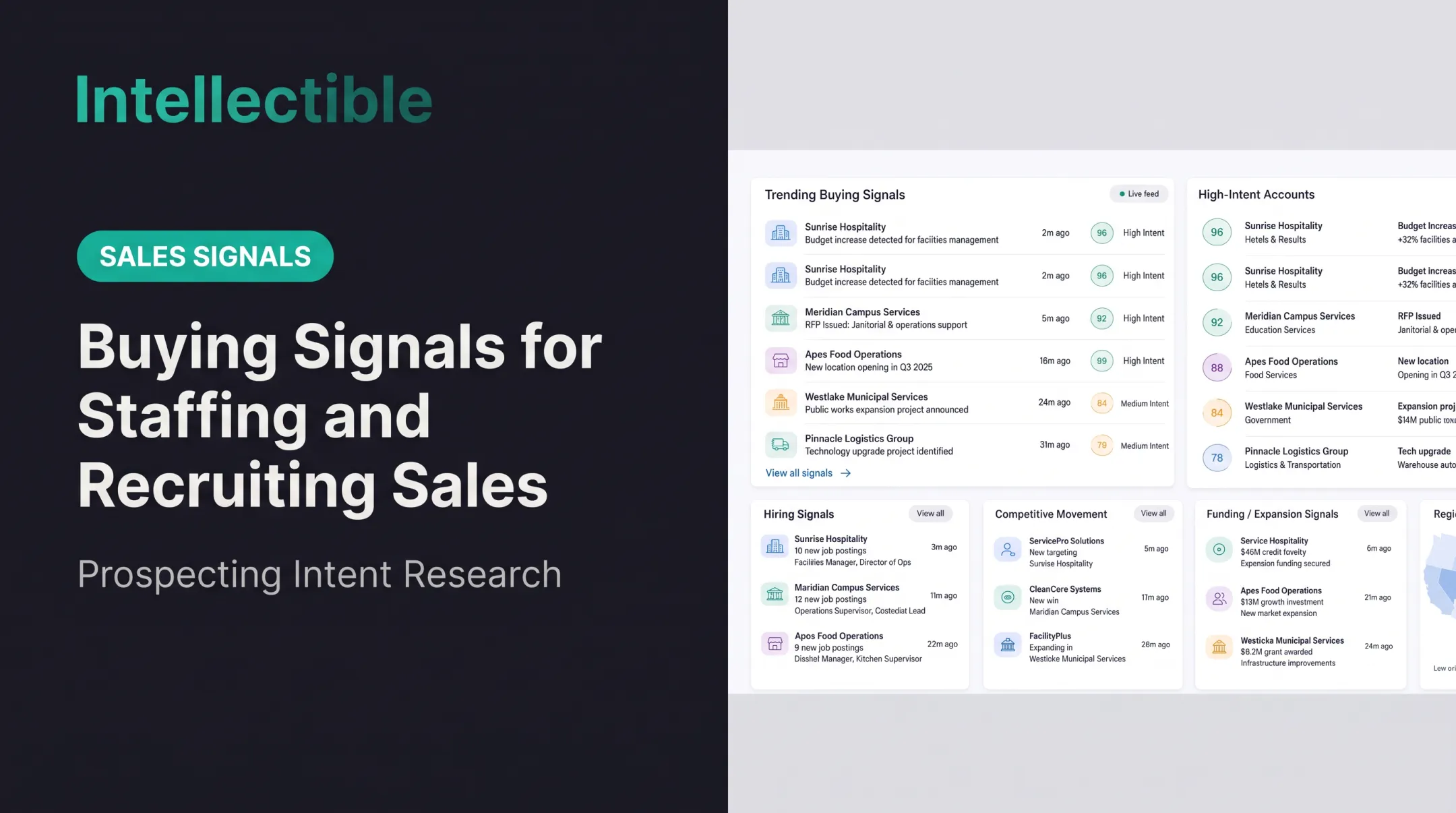
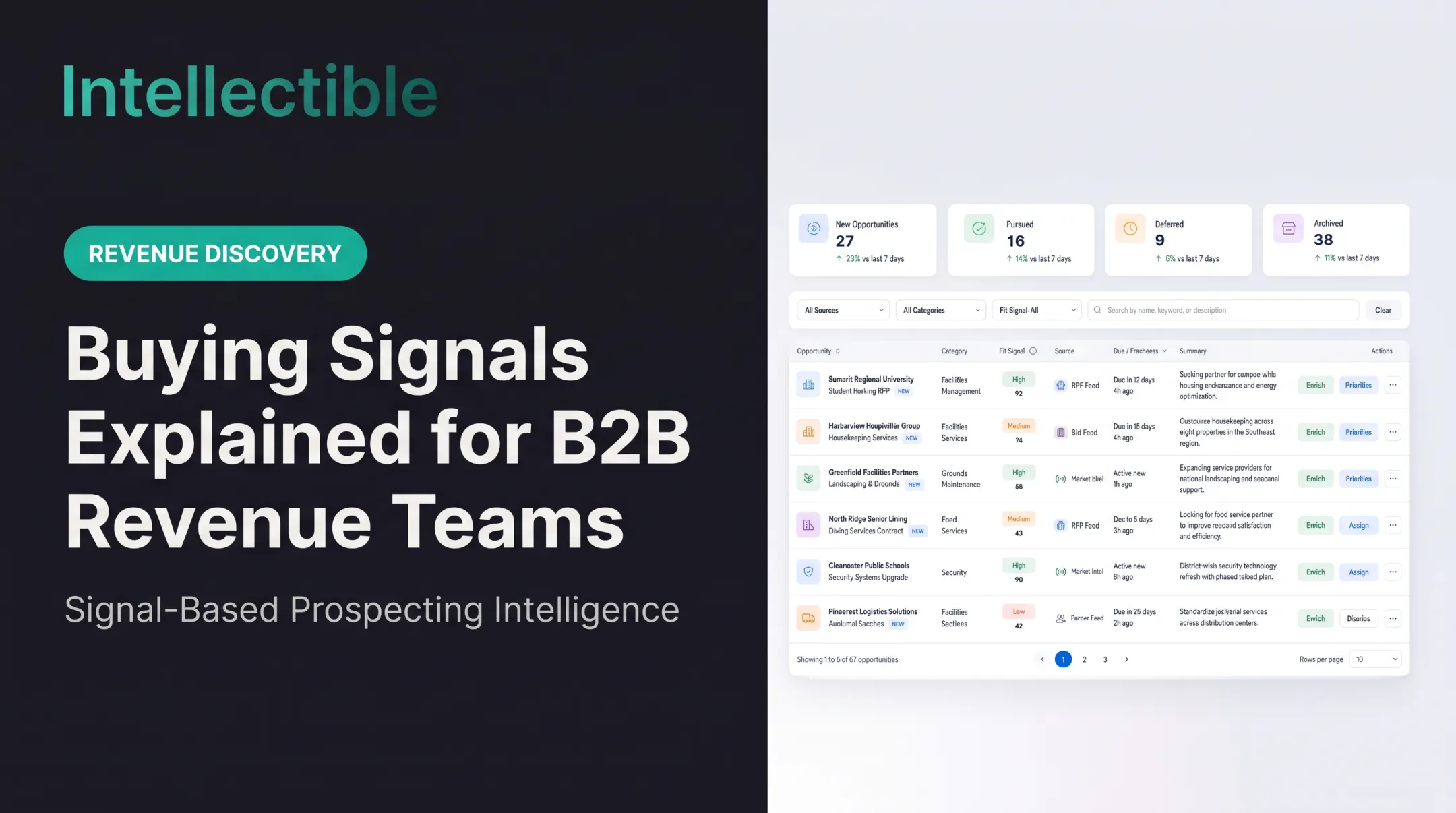
A managed platform can hold this together. Intellectible's Revenue Discovery engine, for example, monitors job postings daily and tracks Hiring Pressure among 15 live signals. It scores accounts for fit and urgency with reasoning attached, and uses four human approval gates. Its engine drafts and sends nothing on its own. Confirm current integrations and capabilities with the vendor before building around them.
How to Interpret and Prioritize Signals
Match the role pattern to the initiative
Role patterns often map to the initiative behind the hire:
- Revenue, proposal, capture, or pricing hires may point to heavier pursuit or growth goals
- Data, AI, automation, or systems hires may point to investment in internal infrastructure
The same title means different things across industries and company sizes. A "Data Analyst" at a 40-person site services firm isn't the same as one at a health system. The description and reporting line tell you more than the title.
Separate expansion from maintenance hiring
Look for language that separates net-new capability from maintenance hiring:
- Backfills
- Internal transfers
- Seasonal hiring
- Evergreen recruiting
Compare the role against the company's recent hiring history and org structure before assigning strategic meaning.
Use timing and clusters
Give more weight to these than to one long-running listing:
- Recent postings
- Coordinated hiring across related functions
- Leadership openings
- Repeated hiring for the same capability
Add a signal-decay rule so older postings lose priority unless refreshed or backed by new evidence. No public benchmark exists for the right decay rate, so set yours from your own outcomes.
Turn a signal into an outreach hypothesis
Reference a possible business challenge, not the fact that you watched a job ad. Then validate with discovery questions:
- Are you scaling an existing process or replacing manual work?
- Do you need to connect systems that don't talk today?
- Is visibility the gap?
- Are you preparing for higher volume?
The goal is relevance and timing. Don't claim knowledge the prospect hasn't shared.
Activating Signals Across the Go-to-Market Team
Sales and business development
Use validated signals to:
- Prioritize accounts
- Identify likely stakeholders
- Sharpen account research
- Pick a timely problem to explore
Pair the signal with a useful insight or operational question. "We saw you're hiring" is not a message.
Marketing and account-based activation
Segment content around likely initiatives:
- Proposal operations
- Pricing governance
- Data integration
- Workflow automation
Keep broad educational campaigns separate from account-specific personalization. Never expose overly detailed observations about an individual employee.
Revenue operations and measurement
Track these metrics:
- Review speed and accepted-signal rate
- Meetings from signal-supported accounts
- Qualification rate and opportunity creation
- Conversion versus a non-signal control group

Then check whether signals improve outcomes after accounting for account size, territory, other intent sources, and sales activity. Forrester notes that B2B intent data is widely adopted but often held back by weak measurement and integration.
Limitations, False Positives, and Responsible Use
Why signals mislead
- Stale or duplicated listings and automated syndication
- Recruiting agency postings
- Confidential replacement hiring and seasonal work
- Roles posted to build a talent pipeline
- Companies that hire without buying anything external
Silence is ambiguous too. A company may grow through contractors, internal mobility, acquisitions, or unpublicized recruiting.
Data quality, privacy, and compliance
Treat collection as a controlled process:
- Use public and permitted sources only
- Respect site terms and document how you collect data
- Limit retention windows
- Avoid inferring sensitive personal attributes from employee or job-seeker information
Privacy rules vary by state. California's exemptions for employment-related and B2B personal information expired at the end of 2022, while Virginia excludes commercial and employment contexts. Email outreach must also follow CAN-SPAM.
Have legal and compliance review automated collection, enrichment, outreach, and any use of employment-related data in account decisions.
Governance and continuous improvement
For every actionable signal, record:
- Source trail and scoring rationale
- Owner, review status, and dismissal reason
Audit periodically for bias, poor sources, over-aggressive outreach, and score inflation. Adjust scoring and playbooks from verified outcomes and feedback from sales and operations.

Frequently Asked Questions
Why can a job posting matter commercially?
A job posting can reveal a budgeted role, operating priority, system requirement, or planned capability before a vendor conversation becomes public. It does not prove an external purchase, because the company may be hiring to do the work internally. Treat the posting as evidence to interpret in the context of the service you sell.
What buying hypotheses can postings support?
Classify the evidence by the buying hypothesis: repeated roles may indicate growth, specialist vacancies may reveal operating pressure, named systems may identify an incumbent, and a transformation role may suggest a review. Keep the exact requirement and source date so another reviewer can test that interpretation.
How should postings be monitored at market scale?
Monitor postings for every eligible account using permitted company careers pages and licensed or authorized feeds. Match legal entities, locations, parent companies, and requisition identifiers. Deduplicate reposts and multi-location adverts so one vacancy does not become a false hiring surge.
Which fields and freshness checks are needed?
Record first seen, last seen, published date where available, role, location, quoted requirement, and the source. Flag evergreen, agency-posted, duplicate, or stale vacancies. Define freshness and repeat-observation rules for the market rather than assuming every advertised position is still open.
Does a named system prove a vendor-change opportunity?
Route verified changes into an account brief showing the event, likely business need, relevant role, service fit, and a next validation question. A technology name is an incumbent clue, not proof of the company’s full installed base or dissatisfaction with it.
How should job-posting signals be evaluated?
Track accepted job-derived signals, false positives, time to review, seller acceptance, and sales-accepted opportunities. Update the role dictionary from actual outcomes. The value is a consistent market-wide research process rather than an individual rep manually checking a few careers pages.