Introduction
A public contract can reveal an incumbent and a future review window before an RFP appears. Services teams selling to hospitals, universities, school districts, cities, and counties need a state-and-local renewal calendar that preserves executed terms, options, amendments, and verification dates for every eligible account.
Each fragment means little alone.
The stakes are real. In 6sense's 2025 survey, 94% of buyers ranked their vendor shortlist before engaging sellers, and they picked from that Day-One list 95% of the time. Teams that notice signals late arrive after the decision is mostly made.
Procurement and contract buying signals are observable evidence that a company is moving toward a purchase, renewal, expansion, replacement, or formal sourcing event. This guide separates signal categories, maps them to the buying process, shows how to prioritize them, and turns them into coordinated revenue plays.
Key Takeaways
- Procurement signals show a buying process forming; contract signals show an existing relationship may change.
- The strongest signals pair account fit, decision-maker involvement, a credible timeline, and budget movement.
- Route each signal into a defined play instead of treating every alert as an opportunity.
- Automation can connect detection, scoring, CRM updates, approvals, and follow-up.
What Procurement and Contract Buying Signals Mean
For services sold to hospitals, universities, school districts, cities, and counties, start with the relevant state and local procurement systems. Search award registers, executed contracts, board packets, purchasing pages, and amendments by agency, service category, incumbent, and contract number. A federal awards tool is not a substitute for these local records.
- Buying signal: evidence of a need or active evaluation, such as a buyer-defined shortlist or stated requirements.
- Procurement signal: a formal or publicly visible sourcing milestone, such as an RFI, presolicitation notice, or solicitation.
- Contract signal: an event tied to an existing agreement, such as a renewal, option period, expiration, or recompete.
A commercial example: a VP of operations asks for security documentation and introduces two colleagues.
A public-sector example: an agency posts a "Sources Sought" notice on SAM.gov, then later a solicitation and award notice. Under the FAR, an RFI can gather market information without any intent to award.
Dimensions to evaluate
Judge every signal against the same checklist:
- Business need
- Account fit
- Authority of the people involved
- Budget
- Timing
- Procurement stage
- Contract status
- Clarity of the next step
A signal is not proof of intent
Forrester cautions against using intent signals in a vacuum or letting them replace qualification. A web visit is a hint. A web visit plus a budget line plus a named stakeholder asking about implementation is a pattern. Have a human validate the pattern before committing sales resources.
Map Procurement Signals to the B2B Buying Process
Earliest pre-procurement signals
The need forms before any request appears. Watch for:
- A new strategic priority or executive mandate
- A budget allocation or grant award
- An expansion initiative
- A public meeting discussion
- Hiring tied to the problem
Generic market interest isn't useful. Tie each event to a specific account, business unit, likely owner, and use case.
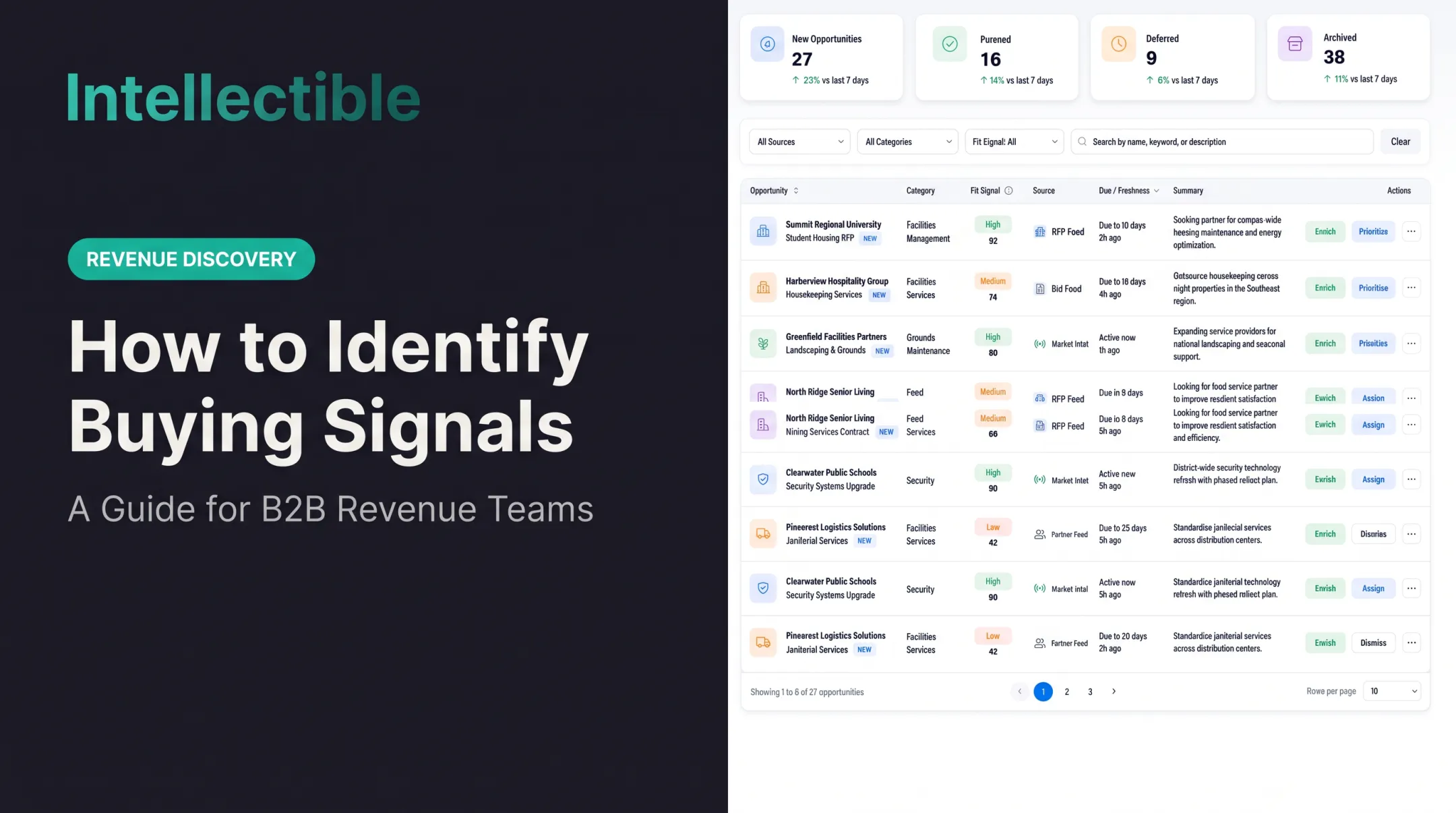
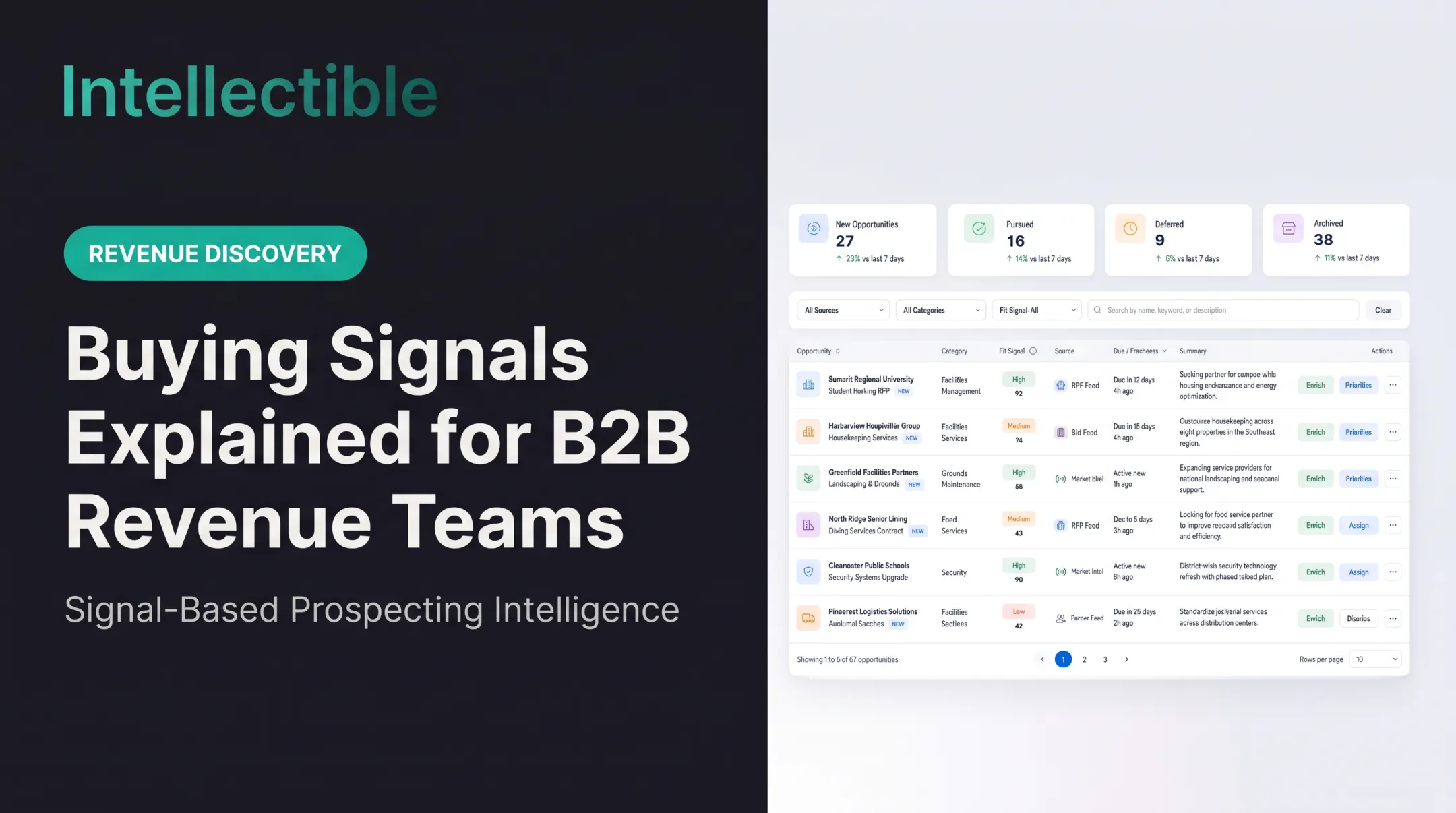
Platforms such as Intellectible's Revenue Discovery monitor funding rounds, hiring, expansion, and M&A as standard feeds, which gives teams a starting point for this connection.
Signals of active evaluation
Active evaluation shows up in concrete buyer behavior:
- Solution research and requirements requests
- Vendor discovery and stakeholder introductions
- Security questions and reference requests
- Proof-of-concept activity
- Requests for pricing or implementation details
To separate serious evaluation from casual research, look for four things:
- Multiple stakeholders involved
- Defined requirements
- A target timeline
- Next steps supplied by the buyer
The 6sense survey found typical buying groups averaged 10+ members over a 10.1-month journey, so a single curious contact rarely tells the whole story.

Formal procurement and commercial signals
| Signal | What it suggests | Prepare next |
|---|---|---|
| RFI / sources sought | Market research; no award intent yet | Capability statement, shaping input |
| RFP | Requirements and evaluation factors set | Compliance matrix, response plan |
| RFQ | Price-focused request; a quotation isn't an offer | Pricing options |
| IFB | Sealed bidding on clearly defined requirements | Precise, compliant bid |
| Vendor registration | Buyer onboarding suppliers | Registration, such as SAM.gov |
| Security review | Late-stage diligence | SOC 2, FedRAMP, or CMMC evidence where required |
| Purchase requisition / PO | Internal approval or order stage | Paperwork, legal, finance |
Security requirements are conditional. FedRAMP applies to cloud services within its scope, and CMMC applies only when the solicitation specifies a level.
Align outreach with procurement timing
- Early planning: educate and share relevant perspective.
- Evaluation: help the buyer clarify requirements.
- Formal procurement: respond precisely to what was asked.
- Legal, finance, onboarding: remove friction.
The FAR directs agencies to do market research before developing new requirements, and it encourages early exchanges through RFIs, presolicitation notices, and draft RFPs. Combined with the shortlist data, that argues for watching pre-solicitation activity. It doesn't prove every RFP is fixed, but waiting for the published RFP often means arriving late.
Build a procurement signal record
Capture the same fields every time:
- Account and signal source
- Event date and inferred buying stage
- Evidence link or note
- Affected product area and stakeholders
- Owner and confidence level
- Recommended next action
A consistent record lets sales, RevOps, proposal, pricing, legal, and leadership work from one buying context. Intellectible's GovCon records, for example, hold agency, office, NAICS, PSC, timing, scope, fit rationale, risk signals, and a recommended action.
Recognize Contract Buying Signals and Revenue Opportunities
Renewal and expiration signals
- Contract end dates
- Renewal notice windows
- Option periods
- Auto-renewal clauses
- Budget-cycle timing
- Incumbent performance reviews
Record the incumbent legal entity, buying organization, service scope, award identifier, base term, current end date, renewal options, amendments, and source document. A maximum potential expiration after options is not the same as the currently exercised term. Unknown end dates should remain research tasks.
Start outreach early enough to learn about satisfaction, changing requirements, competitive risk, and the buyer's procurement path. In government markets, reports of awards expiring within the next 365 days help teams see recompetes coming.
Expansion and usage signals
- Increased usage or additional users
- New departments or locations
- Integration requests
- Support-volume changes
- New compliance requirements
- Adjacent business initiatives
Link each signal to a customer outcome and a broader solution plan. An unsupported upsell assumption damages trust.
SaaS Capital's 2025 study found median net revenue retention of 101% and gross retention of 91% among private B2B SaaS firms. NRR blends upsells, cross-sells, and price increases, so it isn't a pure expansion rate.
Replacement and displacement opportunities
Possible replacement signals include:
- Incumbent dissatisfaction
- Missed service levels
- Leadership changes
- Supplier consolidation
- Budget pressure
- Technology modernization
- Performance issues
In the 6sense data, technical fit (29%) and price (28%) led the reasons buyers reconsidered a preferred choice.

Before investing, validate three things:
- Can the buyer actually change vendors?
- When does the contract permit action?
- Who controls the replacement decision?
Amendments and procurement friction
Scope changes, pricing reviews, change orders, statements of work, delayed renewals, legal escalations, security questionnaires, and insurance requests can mean momentum or risk.
Classify each by the buyer's stated objective and timeline. A security questionnaire from a committed buyer is progress. The same questionnaire with no timeline may be a stall.
Turn contract dates into coordinated account plays
Assign ownership by signal type and contract stage:
- Account executive: relationship and stakeholder mapping
- Customer success: outcome evidence and renewal risk
- RevOps: record hygiene and routing
- Pricing: options and scenarios
- Legal and proposal: terms, documentation, procurement-vehicle research
Finish with a documented mutual action plan the buyer agrees to.
Turn Signals into Repeatable Revenue Workflows
Centralize and normalize inputs
Pull signals from:
- CRM activity and buyer communications
- Contract repositories and procurement portals
- Customer-success data and finance events
- Public records and first-party engagement
Then standardize account names, dates, contract identifiers, signal categories, source confidence, ownership, and deduplication rules before scoring anything. Salesforce's matching-rule documentation shows how fields like email, company, and domain support identity resolution.
Score by fit, urgency, and actionability
Evaluate each signal on:
- Account fit
- Proximity to a buying stage
- Contract timing
- Stakeholder involvement
- Evidence quality
- Revenue potential
- Clarity of the next action
No single score threshold works for every team. Use qualitative tiers (act now, nurture, monitor) or a documented model your team tunes against its own outcomes.
Route to the right owner
Procurement signals go to sales, proposal, capture, pricing, legal, or RevOps. Contract signals go to account management, customer success, finance, or renewal teams. Every routed signal needs an owner, a response deadline, a recommended play, supporting evidence, and an escalation path.
Create signal-specific plays
Each play defines the outreach goal, relevant proof, stakeholders, questions to ask, CRM fields to update, and conditions for advancing or disqualifying.
- Early budget signal: confirm the problem owner and whether funds are approved.
- Active evaluation: help write requirements and set a mutual timeline.
- Expiring contract: review satisfaction and map the renewal path.
- Expansion event: tie usage growth to outcomes.
- Security review: assign a single owner and supply documentation fast.
- Competitive displacement: verify contract flexibility before pursuing.
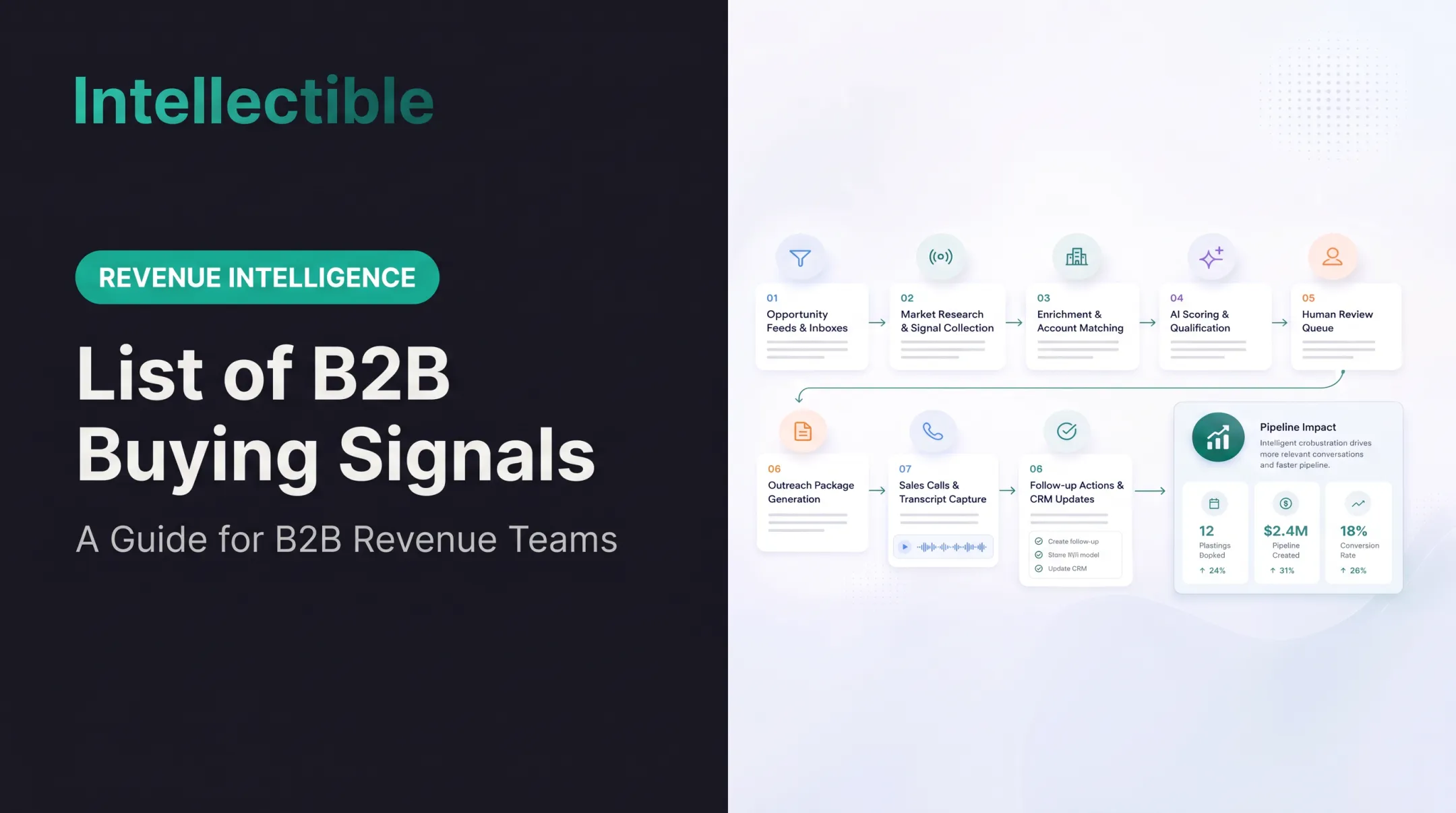
Intellectible fits here as a workflow layer. It connects data sources, business rules, AI or human review, CRM records, approval steps, and automated follow-up.
A Revenue Discovery workflow should retain the state or local contract source, incumbent, executed term, amendments, and unresolved renewal questions before routing an account to a seller. Ask Intellectible to demonstrate the relevant procurement sources and proposed CRM handoff, with human approval before outreach; confirm the connectors and coverage in the implementation scope.

Close the feedback loop
Record whether each signal produced a meeting, opportunity, proposal, renewal, expansion, disqualification, or no action. Review regularly to see which sources, signal types, timing windows, and plays produce pipeline and which produce noise.
Prioritize Signals, Avoid False Positives, and Measure Impact
Common failure modes
- Treating every engagement as intent
- Relying on stale contract dates
- Confusing a budget announcement with approved spend
- Ignoring procurement constraints
- Sending duplicate alerts
- Contacting the wrong stakeholder
Safeguards
Before high-effort pursuit, require:
- Human validation of each signal
- Source citations for every claim
- Permission-aware data handling
- Clear confidence labels
- Documented disqualification reasons
What to measure
| Metric | Working definition |
|---|---|
| Signal-to-meeting | Meetings from a signal cohort ÷ eligible signals |
| Signal-to-opportunity | Opportunities from a cohort ÷ eligible signals |
| Time to action | Signal timestamp to first logged response |
| Opportunity velocity | Opportunities × average deal value × win rate ÷ cycle length |
| Source accuracy and false-positive rate | Share of signals validated or rejected, by source |
| Revenue contribution | Closed revenue influenced by signal-sourced work |
No authoritative universal benchmarks exist for most of these, so baseline your own. For RFP work, Loopio's 2026 analysis reports a 45% average win rate, a vendor benchmark rather than a target.
Frequently Asked Questions
Where should teams find state and local contract evidence?
For services sold to hospitals, universities, school districts, cities, and counties, start with the relevant state and local procurement systems. Search award registers, executed contracts, board packets, purchasing pages, and amendments by agency, service category, incumbent, and contract number. A federal awards tool is not a substitute for these local records.
Which contract dates must be kept separate?
Record the incumbent legal entity, buying organization, service scope, award identifier, base term, current end date, renewal options, amendments, and source document. A maximum potential expiration after options is not the same as the currently exercised term. Unknown end dates should remain research tasks.
What belongs in a market-wide renewal calendar?
Build a renewal calendar for the whole eligible market: account, incumbent, current term, potential option dates, notice requirements where stated, likely procurement window, last verification, and responsible rep. Recheck the original record for extensions or successor awards before acting on an apparent expiration.
How should staffing and other services segment records?
Segment the calendar around the service you sell: facilities, food service, staffing, environmental, or transportation. For staffing and recruiting firms, verify the labor categories, geography, buyer eligibility, and incumbent scope rather than treating any agency vacancy as an open staffing contract.
Does an expiration date guarantee an open opportunity?
Use documented dates to investigate before the RFP, not to claim that a competitor is certain to lose the account. Confirm how the organization buys, who owns the need, whether an option has been exercised, and which communications are permitted. Let the evidence determine the next action.
How should the calendar remain useful over time?
Maintain the calendar as a monitored process, with source checks, amendment alerts where available, owner assignment, research-needed queues, and rep feedback. Track verified renewal records, timely accepted accounts, pre-RFP conversations where appropriate, sales-accepted opportunities, and missed or stale dates.