That gap costs more in government contracting than almost anywhere else. Federal proposals demand exact compliance with page limits, formatting rules, and evaluation criteria spelled out in the solicitation. In one 2025 case, GAO sustained a protest after an agency accepted a proposal using an unauthorized font that let the offeror squeeze in more content than the page limit allowed. Small details decide outcomes here.
Add tight timelines, heavy cross-functional coordination between BD, SMEs, pricing, and proposal writers, and the real cost of chasing a bid without a strategy, and it's clear why disciplined capture matters. This guide covers what capture management software actually does, the features worth paying for, how AI is changing the work, and how to evaluate platforms built for GovCon.
Key Takeaways
- Capture software structures pre-RFP work from qualification through proposal handoff
- Top platforms connect capture directly to proposal drafting, not a separate silo
- AI speeds analysis and organizes data, but strategy still needs human judgment
- Evaluate software by workflow fit and honest AI capability, not just dashboards
- Disciplined capture pays off for contractors of every size, not just primes
What Is Capture Management Software?
Capture management software identifies, qualifies, tracks, and strategically positions a company for opportunities before proposal submission begins. That's a different job than a CRM, which manages accounts, contacts, and sales activity. It's also different from proposal software, which handles drafting, compliance checking, and submission.
Capture answers "should we pursue this, and how do we win it?" Proposal software answers "how do we write and submit a compliant response?" Skipping the first question and jumping straight to the second is how teams end up writing polished proposals for opportunities they never had a real shot at winning.
In GovCon specifically, capture means preparing to win before the RFP even drops:
- Shaping positioning with agency stakeholders during the pre-solicitation phase
- Building relationships and past-performance narratives ahead of release
- Deciding go/no-go with enough lead time to actually influence the outcome
Bad pursuit decisions cost more here than in most commercial sales motions, where a lost deal often just means moving to the next lead. A mis-bid federal pursuit ties up SMEs, pricing analysts, and proposal writers for weeks on something that was never winnable.
The Capture Manager's Role
The capture manager is the point of accountability. They coordinate business development, subject matter experts, pricing, and proposal teams around a single pursuit strategy.
When this role is under-resourced or informal, downstream proposal risk goes up fast: SMEs get pulled in too late, pricing scrambles to build numbers without context, and writers inherit a blank page instead of a strategy.
Intellectible's GovCon Engine is built around this exact coordination gap. When drafting begins, it creates a structured capture record the proposal team inherits — agency context, fit rationale, incumbent analysis, and risk signals already organized — so writers start with a foundation instead of a blank page.
Core Steps in the Capture Management Process
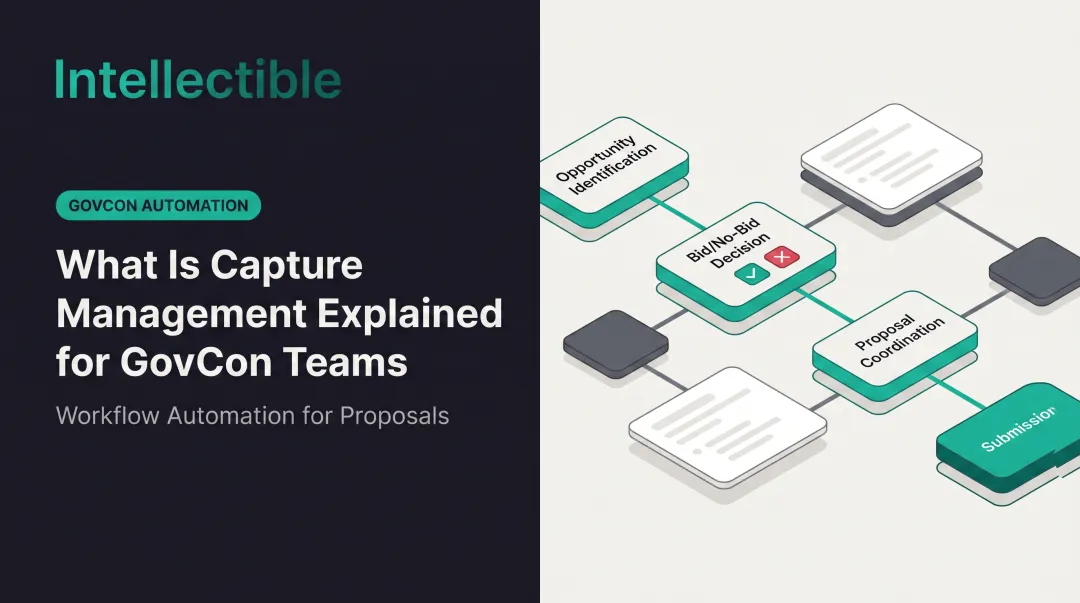
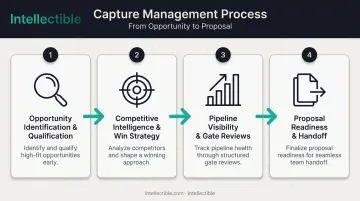
Every disciplined capture process, regardless of company size, moves through four stages:
- Opportunity identification and qualification: Assess fit against capabilities, past performance, timing, and internal bandwidth. Chasing every opportunity that looks good on paper burns capacity that should go toward pursuits with a real chance of winning.
- Competitive intelligence and win strategy development: Document customer priorities, competitor positioning, and differentiators as they emerge, not after they've been forgotten between meetings.
- Pipeline visibility and gate reviews: Track ownership, stage, and risk across active bids so leadership sees slipping deadlines before they become crises.
- Proposal readiness and handoff: Organize requirements, deadlines, owners, and win strategy before kickoff, so the proposal team builds on a foundation instead of rebuilding one from scratch.
Why Traditional Capture Workflows Break Down for GovCon Teams
Most GovCon capture problems trace back to one root issue: information scattered across tools that don't talk to each other. Opportunity notes sit in inboxes. Strategy lives in meeting notes nobody circulates. Deadlines get tracked in a spreadsheet someone forgot to update. No single person has the full picture in a form anyone else can use.
This fragmentation shows up directly in win rates. Deltek's 2021 Clarity GovCon Industry Study found a median competitive-proposal win rate of just 35%, with small businesses winning 33%, mid-sized firms 34%, and large contractors 48%. Without structured go/no-go criteria, teams pursue too many low-fit opportunities — and that pursuit investment doesn't come back.
Three failure points show up repeatedly:
- Inconsistent qualification. Without documented criteria, "gut feel" decides which bids to chase, and gut feel is inconsistent across a team.
- Fragmented documentation. Deadlines, opportunity notes, and strategy notes live in separate tools, so nothing flags a missed compliance date before it's too late.
- Handoff failure. Proposal teams inherit partial context and burn early-cycle time reconstructing strategy instead of refining it, duplicating work that's already stretched thin.
That reconstruction time comes directly out of proposal writers' schedules, time better spent sharpening the actual response.
Must-Have Features in Capture Management Software
Tracking software isn't capture software. The distinction matters when you're evaluating platforms. Look for these six capabilities:
- Structured go/no-go workflows: Consistent qualification criteria applied to every opportunity, not scattered instincts that vary by who's in the room.
- Real pipeline visibility: Ownership, deadlines, stage progression, and risk flags visible across every active pursuit, not buried in a spreadsheet someone forgot to update.
- Persistent win strategy documentation: Customer pain points, competitive positioning, and differentiators stored in one place instead of trapped in someone's meeting notes.
- Capture-to-proposal continuity: Scoring rationale and competitive intelligence flow directly into proposal drafting without manual re-entry.
- Knowledge reuse: Past performance, prior pursuits, and approved language surface in context when teams need them, not after a Slack hunt.
- Cross-functional collaboration support: Structure that reflects how capture actually works across BD, capture leads, pricing, SMEs, and proposal managers.
That fourth point, continuity, is where most tools fall short. Intellectible's platform stores each opportunity as a structured record inside project-scoped databases. Agency data, fit rationale, incumbent analysis, and risk signals generated during capture are already organized and available when drafting begins. Nobody re-summarizes a go/no-go report for the writing team.
How AI Is Transforming Capture Management for GovCon Teams
AI's biggest contribution to capture is speed and structure. Two things happen well when it's applied correctly:
Opportunity analysis accelerates as AI summarizes RFIs, RFPs, and amendments, extracting requirements, deadlines, and risk signals far faster than manual review. Scattered information gets structured, too: capture notes, historical pursuits, and customer context turn into searchable, reusable knowledge instead of sitting buried in old files.
Gartner forecasts that by 2026, B2B sales organizations using embedded generative AI will cut time spent on prospecting and meeting prep by more than 50%. That gain comes with a caveat worth taking seriously: it depends heavily on whether frontline teams actually adopt the tools under deadline pressure.
Where This Plays Out in Practice
Intellectible's platform analyzes over 3,200 opportunities in a 24-hour period and reviews 37+ RFPs weekly, generating go/no-go reports, compliance matrices, and risk lists automatically. It reports a 150%+ increase in actionable pipeline opportunities and 95%+ time saved on opportunity search and go/no-go decisions — figures that reflect the platform's structured qualification logic rather than raw volume alone.
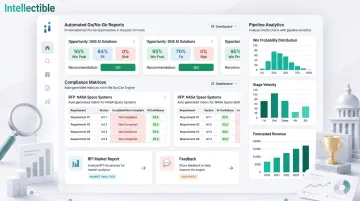
This matters because Intellectible operates as a horizontal AI build platform rather than a single-purpose capture tool bolted onto a CRM. The platform connects opportunity search, go/no-go decisions, and structured capture records into one workflow without requiring teams to rebuild infrastructure at every stage.
Oceus, for example, reported going from occasional qualified leads to seven or eight opportunities a month clearing their qualification threshold after implementation.
None of this replaces judgment. AI can summarize a solicitation and flag risk signals, but deciding what an evaluator actually cares about, and how to position against a specific incumbent, still requires a human who understands the customer.
How to Evaluate and Choose the Right Capture Management Software
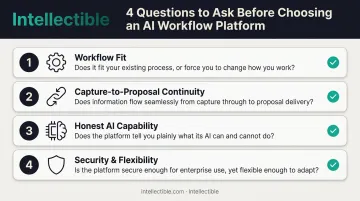
Software demos are designed to impress. Evaluations need to cut through that. Four questions separate a real capture system from a glorified tracker:
- Does it fit your workflow? Check whether the platform matches the compliance complexity, cross-functional coordination, and documentation demands of GovCon pursuits specifically, not a generic sales pipeline.
- Does continuity actually exist? Ask whether capture intelligence moves cleanly into proposal execution, or whether the handoff still depends on someone manually reconstructing lost context.
- Is the AI honest? Some platforms slap "AI-powered" branding on ordinary workflow software. Test whether it genuinely helps with summarization, structuring, and acceleration, and whether your team will actually use it once a deadline is 48 hours out.
- What about security and flexibility? For federal work involving Controlled Unclassified Information, confirm the platform's compliance posture directly with the vendor rather than assuming coverage. Also weigh whether the system lets you build custom workflows around your specific capture process, instead of forcing pursuit work into a rigid, one-size-fits-all tool.
That last point is worth sitting with. A platform that only tracks opportunities the way its designers imagined will eventually fight your actual process. One built with a visual workflow builder and database layer underneath lets you shape the system around how your team really works — including connecting capture straight through to pricing and proposal drafting.
Frequently Asked Questions
What software do capture managers use?
Capture managers typically use software that supports opportunity qualification, pursuit tracking, win strategy documentation, and proposal handoff, extending well beyond basic CRM functionality into AI-assisted analysis and cross-team coordination.
Do you replace the CRM or run capture software alongside it?
Most firms run both, because they answer different questions: the CRM holds accounts, contacts, and activity, while capture software runs the pursuit itself — qualification, strategy, competitive position, and handoff into proposal development. The evaluation question is where the boundary sits and whether pursuit data survives the handoff between them.
Why does capture management matter in government contracting?
GovCon bids are expensive, compliance-heavy, and resource-intensive. Better capture helps teams pursue the right opportunities and enter proposal development with stronger positioning and less wasted effort.
How does AI improve capture management?
AI analyzes solicitation documents faster and structures scattered pursuit information, surfacing competitive context earlier in the process. Human judgment still drives strategy and positioning decisions.
Can capture management software help smaller GovCon teams and commercial teams too?
Yes. Smaller contractors and commercial teams entering federal work face the same core problems: unclear ownership, scattered context, and weak prioritization. They often benefit more since they have less room for wasted pursuit effort.
What should GovCon teams look for when evaluating capture management software?
Workflow fit, pipeline visibility, win strategy support, seamless proposal handoff, knowledge reuse, and honest AI capability are what separate a real capture system from a simple tracking tool.