The problem: most proposal management tools were built for commercial RFP response, not federal contracting. They handle content libraries and document collaboration well enough—but they leave critical gaps in Go/No-Go decision support, past performance management, and pricing audit trails. For GovCon teams, those gaps aren't minor inconveniences. They're where bids fall apart.
This comparison evaluates five platforms specifically against GovCon needs—not general sales usability—so you can choose based on what actually matters for federal pursuits.
Key Takeaways
- GovCon proposals require multi-volume structures, color-team reviews, and compliance traceability that commercial tools weren't built for
- The biggest unmet gaps are Go/No-Go automation, pricing audit trails, and past performance reuse
- Responsive and Loopio lead on RFP content reuse but lack native GovCon compliance and pricing workflows
- XaitPorter is strong for large multi-volume co-authoring; QorusDocs suits Microsoft-centric shops
- Intellectible's Proposal & Pursuit Engine is the only platform here covering the full pursuit lifecycle, from opportunity qualification through proposal review and submission
What GovCon Proposal Teams Actually Need from Software
Why Government Proposals Are Structurally Different
Federal proposals are a different document class from commercial submissions entirely. Section L tells offerors how to structure and organize their response. Section M defines the evaluation factors agencies use to score it. SF330 forms govern architect-engineer qualifications under FAR Part 36.
Miss any of these requirements and you're not just losing — you may be found non-responsive before evaluation begins.
Color-team reviews add another layer of structure that commercial workflows don't account for:
- Pink Teams verify compliance and win-strategy execution early in the cycle
- Red Teams simulate customer scoring and surface weaknesses before submission
- Gold Teams confirm corrections are incorporated and the proposal is ready for the final go decision
Three Functional Gaps Generic Tools Leave Open
Most proposal tools address document creation and content reuse. They don't address:
- Opportunity qualification and Go/No-Go support — Generic tools have no mechanism for scoring fit against target agencies, NAICS codes, deal sizes, or contract vehicles. The result: B&P budget drained on low-probability bids
- Past performance content management — Reusing capability statements across GWACs and IDIQs requires tagged, structured content tied to contract history, not just a search bar over a document library
- Pricing and cost volume support — Federal cost volumes require audit trails, approval routing across finance and operations, and clear separation of internal rate builds from customer-facing pricing. Most proposal tools don't address this at all
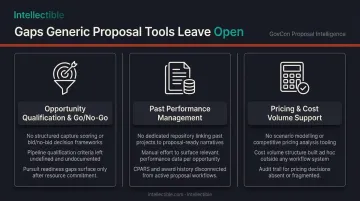
Tools vary significantly in how well they close these gaps. The comparison below evaluates each against these specific requirements.
Top Proposal Manager Software for GovCon Teams Compared
These five platforms are evaluated on GovCon-specific criteria—content reuse, compliance support, collaboration structure, and workflow automation depth—not general sales usability scores.
Responsive (formerly RFPIO)
Responsive is a widely adopted AI-powered RFP response platform used across regulated industries, including federal contractors. Its core value is a centralized content library with AI-driven answer suggestions that pull pre-approved responses based on tagged historical content—a real time-saver for teams managing similar capability statements across multiple GWACs and IDIQs.
The platform's content matching works well for high-volume RFP shops. Role-based permissions and approval workflows add governance. CRM integrations connect proposal activity to pipeline tracking.
Where it falls short for GovCon: there's no native Go/No-Go decision framework, no structured past performance database queryable by agency or NAICS code, and no pricing or cost volume support. Teams managing complex multi-volume proposals will need to supplement Responsive with other tools.
| Feature Area | Detail |
|---|---|
| Key GovCon Features | AI-assisted RFP auto-population, version-controlled content library, role-based permissions, approval workflows, CRM integrations |
| Pricing | Lite starts at $5,000/year for five users; Emerging, Growth, and Enterprise require sales contact |
| Best Fit | High-volume RFP shops with frequent, similar solicitations |
| Limitations | Limited native support for cost volume formatting, Go/No-Go automation, or GovCon-specific compliance workflows |
Loopio
Loopio is built around a structured content library and a "Magic" auto-answer system that suggests responses based on historical answers. Mid-to-large GovCon teams that process frequent RFPs find value in its ease of content organization and multi-contributor workflow—subject matter experts across technical, pricing, and past performance functions can contribute asynchronously without version conflicts.
That said, the auto-answer feature has received mixed reviews on accuracy for specialized GovCon content where nuance matters—it performs better on repetitive boilerplate than on technical or compliance-specific sections.
| Feature Area | Detail |
|---|---|
| Key GovCon Features | Dynamic content library, Magic auto-answer, team task assignments, Salesforce and Microsoft integrations |
| Pricing | Foundations includes 10 seats; Enhanced and Enterprise tiers require custom quote |
| Best Fit | RFP-heavy teams with consistent solicitation types and distributed SME contributors |
| Limitations | Auto-answer accuracy varies for GovCon-specific content; no native pricing or compliance workflow support |
XaitPorter
XaitPorter is a cloud-based co-authoring platform built for teams producing large, multi-section documents under deadline. Its core differentiator is parallel authoring—multiple writers can work simultaneously across volumes without version conflicts, using section-level locking to prevent overwrites.
The platform supports government-cloud and SCIF deployment—a confirmed use case as of 2024—making it a viable option for contractors with classified or high-security proposal environments. For teams assembling technical, management, and past performance volumes concurrently, the parallel authoring model reduces coordination overhead substantially.
| Feature Area | Detail |
|---|---|
| Key GovCon Features | Simultaneous co-authoring, section-level locking, approval workflows, document assembly automation, access controls |
| Pricing | Custom; request via xait.com |
| Best Fit | Large contractors assembling multi-volume proposals with many concurrent writers |
| Limitations | Weak pricing integration; limited GovCon-specific content templates out of the box |

QorusDocs
QorusDocs operates natively inside Microsoft Word and PowerPoint, pulling approved content from a SharePoint-connected library without requiring users to leave the tools they already use. For GovCon shops deeply embedded in the Microsoft 365 ecosystem, the reduced adoption friction is a real advantage—writers assemble compliant sections inside Word rather than migrating to a new interface.
Reported stability issues with complex templates and setup complexity in large SharePoint environments are worth evaluating during a trial.
| Feature Area | Detail |
|---|---|
| Key GovCon Features | Native Word and PowerPoint integration, SharePoint content repository, approval workflows, document assembly, AI content search |
| Pricing | ValueHub, ProposalHub, and PitchHub packages; no public pricing, requires demo |
| Best Fit | Microsoft-centric GovCon organizations with existing SharePoint infrastructure |
| Limitations | Stability issues with complex templates; IT involvement required in large SharePoint deployments |
Intellectible
Intellectible is a horizontal AI build platform with a production-ready Proposal & Pursuit Engine that automates the full pursuit lifecycle — from Go/No-Go scoring through proposal workflow and final review — without requiring additional headcount. The platform runs a governed pursuit workflow rather than a prompt box or static template: it reads the solicitation, attachments, and addenda to extract key dates, submission rules, required sections, evaluation criteria, and compliance obligations; runs a structured go/no-go covering fit, urgency, risk, contract terms, and capability match; and turns requirements into a response plan with mandatory versus strategic sections, owners, deadlines, and status tracking.
The distinction from every other tool on this list is scope. Responsive and Loopio manage content. XaitPorter manages co-authoring. Intellectible operates at the decision and pipeline layer that sits beneath all of it—automating the pursuit logic, not just the document production.
The platform covers four capability areas most GovCon tools leave unaddressed:
- Go/No-Go decisioning — ingests solicitation documents, federal market data, award history, and capture profiles to produce a compliance matrix, risk list, requirement summaries, and next-step recommendations as a structured decision document
- Pipeline filtering — transforms federal notices into capture records tagged with NAICS/PSC codes, agency details, fit rationale, and risk signals
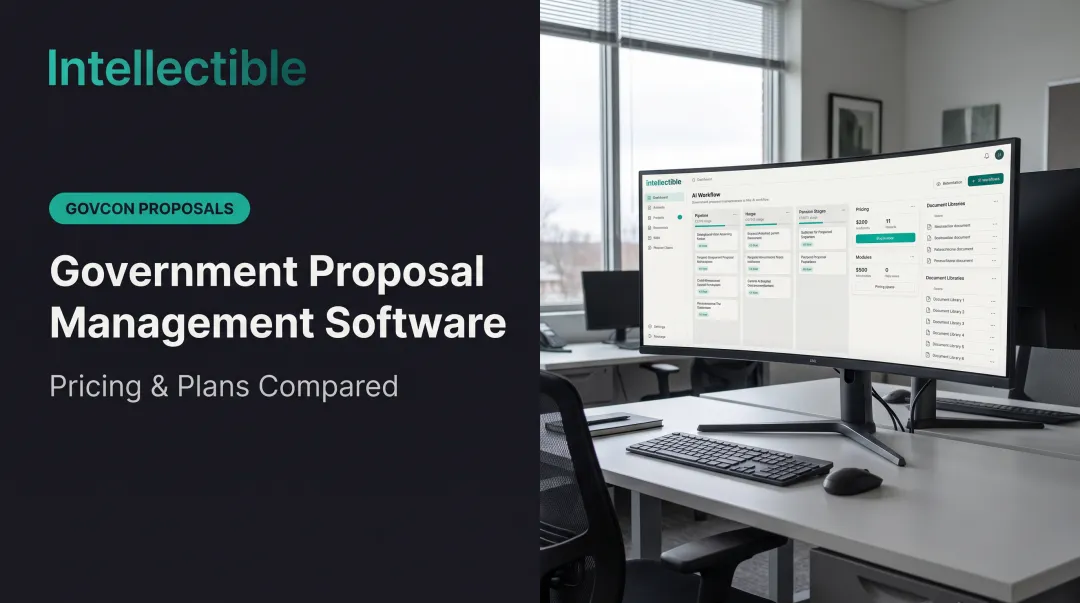
- Pricing workflow — five-stage cost volume process (Intake → Extract → Review Assumptions → Build Cost Model → Publish Pricing) with audit trail, approval routing, and internal/external pricing separation
- Past performance retrieval — PostgreSQL databases queryable by agency, NAICS code, PSC code, and award value, surfaced inside proposal drafting via semantic search
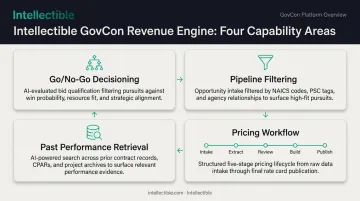
The Go/No-Go system produces a defensible decision document—not just a score. Teams report a 95%+ reduction in time on opportunity search and Go/No-Go analysis after deployment.
For pipeline filtering, the platform transforms federal notices into structured capture records with NAICS/PSC codes, agency details, fit rationale, and risk signals. Oceus, a defense and technology contractor, used this capability to more than double their qualified opportunities reviewed per month after implementation—CEO Jeff Harman noted the platform created pipeline exposure through AI-driven outreach that "didn't exist before."
Past performance content is stored in PostgreSQL databases queryable by agency, NAICS code, PSC code, and award value — then surfaced inside proposal drafting workflows through semantic search rather than keyword matching. Section drafts are grounded in the RFP, deal variables, approved knowledge, and historical proposal language, and the assembled proposal is reviewed against requirements, strategy, tone, and missing evidence — with versioning and export built in. HHS selected Intellectible specifically to automate bid revenue operations.
| Feature Area | Detail |
|---|---|
| Key GovCon Features | AI-powered Go/No-Go system, compliance matrix generation, proposal drafting and review workflow, PostgreSQL past performance database, role-based portals, visual workflow builder |
| Pricing | Custom; contact jesse@intellectible.com for GovCon Revenue System pricing |
| Best Fit | GovCon teams that need pursuit automation, pricing, and pipeline operations—not just a document tool |
| Limitations | Requires configuration onboarding for teams new to AI workflow environments |
How We Chose the Best Proposal Management Software for GovCon
Selection criteria focused on GovCon-specific requirements rather than general sales usability or G2 category ratings:
- Content reuse capability for repetitive RFP sections across multiple vehicles
- Multi-volume proposal structure support including section-level control
- Collaboration and access controls that match color-team workflows
- Pricing and opportunity qualification integration—not just proposal assembly
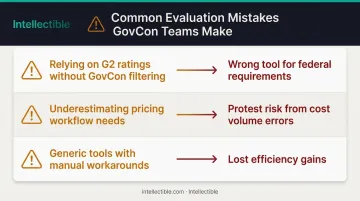
Common Evaluation Mistakes GovCon Teams Make
- Choosing based on G2 ratings without filtering for federal contractor use cases
- Underestimating pricing workflow requirements — GAO's FY2025 report found unreasonable cost evaluation was a leading sustain ground among protests resolved on the merits, meaning cost volume errors carry real protest risk
- Adopting generic tools and building manual workarounds for government-specific formats, which absorbs the time savings the tool was supposed to deliver
What the Right Tool Actually Delivers
Choosing the right tool produces measurable results across the pursuit lifecycle:
- Faster pursuit cycles that compress time from solicitation release to submission-ready draft
- Higher Pwin on bids that actually fit your capabilities and target market
- Reduced proposal overhead without scaling headcount proportionally to pipeline growth
Conclusion
GovCon proposal teams operate under constraints—compliance requirements, color-team structures, cost volume audit obligations—that commercial proposal tools were never designed to handle. Evaluating software against a general feature checklist will reliably land you in the wrong tool.
The right question is which tool actually reduces the cost and time of winning across the full pursuit lifecycle:
- Opportunity identification and Go/No-Go decisions
- Content reuse and proposal assembly
- Pricing development and audit trail control
- Review workflow and color-team coordination
For GovCon teams ready to move beyond document management and automate the entire revenue pursuit process, Intellectible's Proposal & Pursuit Engine automates pursuit workflows from pipeline to submission — delivering 95%+ time savings on opportunity decisions without adding headcount. Reach out to jesse@intellectible.com to learn more.
Frequently Asked Questions
What is proposal management software?
Proposal management software helps teams create, organize, collaborate on, and submit business proposals—covering content libraries, approval workflows, version control, and document assembly. For GovCon teams, the category extends to include RFP response automation, past performance management, and compliance with federal proposal formats like Section L/M and SF330.
How much does RFP software cost?
G2 benchmarks the broad proposal software category at roughly $19 to $70 per user per month for mid-market platforms. Enterprise tools like Responsive, Loopio, XaitPorter, and QorusDocs require custom quotes; Responsive's entry point is $5,000/year for five users. GovCon-specific platforms typically require a custom quote based on team size and workflow scope.
What features should GovCon teams prioritize in proposal management software?
Prioritize support for multi-volume proposal structures, past performance content reuse, color-team review workflows, pricing and cost volume support with audit trail controls, Go/No-Go decision automation, and compliance with federal formatting requirements like Section L/M and SF330.
Can proposal management software integrate with SAM.gov or GovWin IQ?
Most commercial proposal tools don't natively integrate with SAM.gov or GovWin IQ, though SAM.gov does offer a public Opportunities API for custom connections. AI-powered platforms like Intellectible can be configured to pull and filter federal opportunity data as part of a broader pursuit workflow.
What is the difference between commercial proposal software and GovCon proposal management tools?
Commercial proposal software is optimized for sales quoting, e-signatures, and CRM sync. GovCon proposal management tools must support compliance-driven content libraries, multi-contributor color-team reviews, pricing audit trails, and often Go/No-Go pipeline automation—requirements that commercial tools don't address natively.
How do GovCon teams manage past performance content in proposal software?
Past performance content is typically stored in a tagged content library within proposal platforms, searchable and reusable across bids. Advanced platforms like Intellectible store this content in structured databases searchable by agency, NAICS code, PSC code, and award value, then surface relevant examples inside the drafting workflow through semantic search that matches past performance to specific solicitation requirements.