The cost adds up fast. Proposal responses can take up to 84 hours of staff time per RFP, according to Deltek's 2026 pricing and estimating research. Spread that across a handful of low-probability pursuits, and you've got burned-out proposal writers and a win rate that never seems to climb.
Software-driven bid/no-bid decisions change that equation. Platforms like Intellectible's compress days of manual analysis into minutes, without abandoning the decision logic that actually matters.
Key Takeaways
- Structured bid/no-bid gates eliminate low-probability pursuits before they consume proposal hours
- Manual spreadsheet scoring breaks under real pipeline volume; dedicated software keeps criteria consistent and auditable
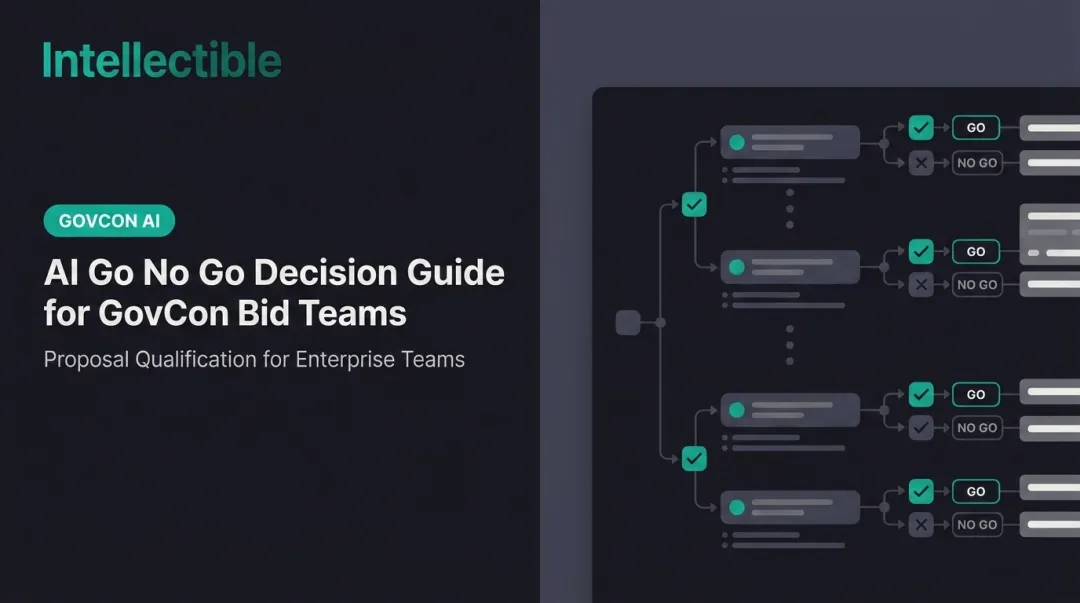
- Decisions run through multiple gates (Interest, Pursuit, Preliminary, Bid), not a single checkpoint
- AI platforms can cut opportunity search and bid/no-bid time by 95%+ while preserving audit trails
What Is a Bid/No-Bid Decision (and Why It's Hard to Get Right Manually)
A bid/no-bid decision is the structured evaluation of whether pursuing a solicitation is worth your team's time. It weighs capability fit, competitive positioning, and profitability against the cost of writing a proposal.
APMP frames this as a gate process, not a single moment. Its framework asks three questions at each stage: Is it real? Can we win? Do we want to? These gates protect resources and improve predictability, according to APMP's guide to gate decisions.
Four Solicitation Types, Four Sets of Criteria
Contractors don't evaluate every opportunity the same way. The vehicle type changes what matters:
- RFP (Request for Proposal): Negotiated acquisition evaluating technical approach, experience, and price together
- RFQ (Request for Quotation): Agency knows what it needs; response is a quotation, not a binding offer
- IFB (Invitation for Bid): Sealed bidding; award goes to the lowest responsible, responsive bidder
- RFI (Request for Information): Market research only; no award will follow, so pursuit cost should be minimal

Missing this distinction is a common manual-review failure. Teams sometimes apply full-blown RFP scoring rigor to an RFI, wasting hours on an opportunity that was never going to convert.
Why Manual Review Breaks Down
Reviewing hundreds of pages of solicitation text by hand is slow, and it's easy to miss a disqualifying clause buried on page 140. A required clearance level, a set-aside restriction, or a compliance requirement can sink a bid, but only if someone catches it before the team commits weeks of writing time.
Deltek's 2021 Clarity study reported a 40% average and 35% median win rate for fiscal year 2020, meaning roughly two out of three pursuits end in a loss. Every hour spent on a doomed pursuit is an hour not spent on a winnable one.
Why Government Contractors Are Turning to Software for Bid/No-Bid Decisions
Spreadsheet scoring matrices work fine when you're tracking five opportunities. They fall apart when you're tracking fifty.
Here's what breaks at scale:
- Scoring criteria live in someone's head, not a system, so consistency drops as more people weigh in
- Nobody remembers why an opportunity was passed on six months later
- Leadership has no visibility into pipeline health until a proposal manager sends an update
- Disqualifying terms (required clearances, set-aside restrictions) get missed in dense solicitation text
Software addresses each of these directly:
- Automated scoring applies weighted criteria the same way on every opportunity, so a Tuesday-morning review matches a Friday-afternoon one
- Keyword and dictionary scanning flags disqualifying terms instantly, instead of hoping someone catches them on page 87
- Centralized dashboards give leadership live visibility into pipeline health and the rationale behind each pursuit
- Audit trails preserve why an opportunity was passed, so the answer is documented rather than guessed

Contractors are already shifting this way. Deltek's 2025 Clarity study found 45% of nearly 900 surveyed contractors used AI to streamline business development operations, up 10 percentage points from the year before, according to Deltek's 16th Annual Clarity Government Contracting Study.
Core Capabilities to Look for in Bid/No-Bid Decision Software
Not every platform labeled "bid/no-bid software" does the same job. Here's what actually matters when you're evaluating options:
- Configurable scoring models tied to your win themes and past performance, not generic templates
- Opportunity data integration that pulls from government portals and web research automatically
- Workflow automation across gates that routes opportunities through Interest, Pursuit, and Preliminary decisions without email forwarding
- AI-assisted document review that surfaces risk language and compliance requirements in long solicitations
- PWin trend reporting that shows whether your go/no-go criteria actually predict wins
Compliance Risk Extraction in Practice
Document review tools should parse the RFP and put structure around what matters:
- Extract requirements and evaluation factors automatically
- Flag submission deadlines before they slip
- Generate a compliance matrix mapping requirements to proposal sections
- Preserve source evidence so your team can verify every flagged risk
How Intellectible's AI Platform Streamlines Go/No-Go Decisions for GovCon Teams
Intellectible's visual workflow builder connects opportunity data, AI review, and human decision checkpoints into a single automated pipeline. Opportunity data enters from government portals, web research, CRM records, and market signals. Workflow nodes structure that information, AI steps classify and score it, and the result lands with a human for the final call.
The Revenue Discovery Engine follows a Capture → Sort → Pursue → Act sequence, finding and prioritizing opportunities without adding headcount. The GovCon Engine layers in agency, vehicle, competitor, incumbent, and compliance context specific to federal and state pursuits.
Reported platform outcomes include:
- 95%+ time saved on opportunity search and go/no-go decisions
- 150%+ increase in actionable top-of-funnel pipeline opportunities
- 90% reduction in time to final pricing, with full audit trail control

These figures represent platform-level performance, not a single client benchmark. Defense contractor Oceus used the GovCon Engine to more than double its qualified-opportunity volume. CEO Jeff Harman reported seven to eight opportunities per month clearing the company's threshold. One of those leads came from an AI-drafted email that opened a pipeline opportunity that did not exist before.
HHS selected Intellectible to automate bid revenue operations and proposal management. Corporate Director of Business Development John Grady said the platform cut the monotonous hours of RFP work, freeing staff to focus on analysis and selling instead of data entry.
Faster, cleaner go/no-go decisions also pay off downstream. The 90% reduction in time to final pricing reflects the full pricing workflow, from intake through costing, finance review, and approval, with every assumption and version change preserved for audit.
Building Your Bid/No-Bid Framework: A Practical Starting Checklist
Skip the hunt for a perfect system on day one. Build a documented, repeatable one and start here:
Score every opportunity against these five criteria:
- Capability alignment with your core competencies
- Competition and incumbent presence
- Profitability and contract economics
- Past performance relevance
- Compliance risk and eligibility gaps

Set a threshold that triggers action. Define a score range that automatically escalates to leadership review or triggers a no-bid recommendation. This removes the guesswork and the awkward conversation where nobody wants to be the one to say "let's pass."
Document every decision — wins and losses alike. The pursuits you decline are just as instructive as the ones you win. Over time, this record becomes the foundation for refining your scoring model and catching blind spots you didn't know you had.
Frequently Asked Questions
How do you make go/no-go decisions consistent across many pursuits?
By fixing the criteria and their weights before the pipeline fills, then applying them the same way every time. Capability fit, competitive position, and margin get weighed against proposal cost — but the value at volume comes from a repeatable, recorded decision, not from re-litigating each pursuit on its own terms.
Can the government do no-bid contracts?
No. "No-bid" describes a contractor's decision not to respond, not a government contract type. The government's related mechanism is sole-source contracting under FAR 6.302-1, used when only one responsible source can meet the requirement.
How does solicitation type change the go/no-go criteria?
An RFP rewards technical differentiation, so capability fit dominates; an IFB reduces the decision to price and capacity; an RFQ turns on delivery terms against a known need; an RFI carries no award, so the question is whether shaping access justifies the effort. Applying one decision template across all four produces inconsistent bid decisions at volume.
How is PWin (probability of win) calculated in bid decision software?
PWin models typically weigh factors like past performance, incumbency, competitor strength, and customer relationships into a probability score. There's no universal formula. Most platforms configure this against your own win/loss history.
Can bid/no-bid software replace human judgment entirely?
No. Software augments judgment by scoring consistently and surfacing risk faster, but close-call pursuits still need a human decision-maker weighing strategic context the system can't fully capture.
How much time can automation actually save on opportunity decisions?
Reported outcomes vary by platform, but Intellectible's data shows 95%+ time saved on opportunity search and go/no-go analysis, turning a multi-day review into a same-day decision.