Introduction
Federal contractors face a relentless throughput problem. SAM.gov updates active notices daily, FAR 5.203 requires responses within defined minimum windows, and each solicitation demands a different combination of compliance matrices, section L/M responses, and cost volumes. Doing that manually — across multiple agencies, NAICS codes, and contract vehicles — puts a hard ceiling on how many opportunities a team can realistically pursue.
The choice of proposal automation software determines whether that ceiling stays fixed or moves. Not all tools are built for government contracting — and the gap matters.
Commercial proposal platforms built for sales cycles handle content libraries and RFP collaboration well. But they don't handle Go/No-Go decisioning, CLIN pricing workflows, or SAM.gov opportunity routing. Choosing the wrong category of tool means working harder on the proposals you do pursue while missing the ones you should.
This article breaks down both categories — traditional proposal automation and AI-powered pursuit platforms — and helps GovCon teams identify which fits their pipeline, team size, and compliance requirements. The difference often determines whether a team scales its win rate or just its workload.
Key Takeaways
- Traditional tools (Loopio, Qvidian, PandaDoc) handle content libraries and RFP collaboration — not FAR compliance or Go/No-Go logic
- AI-powered platforms automate the full pursuit lifecycle: opportunity discovery, scoring, drafting, and pricing in one connected system
- Deltek's 2026 GovCon Clarity study puts a single RFP response at up to 84 hours of work
- The biggest GovCon time savings come from compressing decision and pricing stages — not formatting faster
- Some mature GovCon organizations combine both tool categories: traditional for content, AI platforms for pursuit orchestration
Traditional vs. AI-Powered Proposal Automation: Quick Comparison
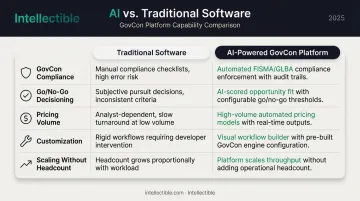
Most GovCon teams don't realize how much time traditional tools waste until they see the gap side by side. Here's how legacy proposal software stacks up against a purpose-built AI platform:
| Capability | Traditional Software | AI-Powered GovCon Platform |
|---|---|---|
| GovCon Compliance | Generic RFP templates; no FAR/DFARS or PWS/SOW logic | Configurable compliance rules and section-level response logic |
| Go/No-Go Decisioning | Manual; each opportunity reviewed individually | Automated scoring by NAICS codes, deal size, agency, and incumbent status |
| Pricing Volume | Proposal text only; pricing done separately in spreadsheets | End-to-end pricing workflows with audit trails and approval routing |
| Customization | Template-based; limited to vendor's preset structure | Visual workflow builder; teams design and own their pursuit process |
| Scaling Without Headcount | More volume typically requires more proposal writers | Workflow logic is reusable; throughput multiplies without adding staff |
What Is Traditional Proposal Automation Software?
Traditional proposal automation was built to solve a commercial sales problem: how do you respond to more RFPs without rewriting the same content from scratch every time? The answer was centralized content libraries, pre-built templates, automated task assignments, and SME collaboration tools.
For any proposal team, these tools offer real value:
- Reduced formatting time across proposal documents
- Consistent brand and compliance language through reusable content blocks
- Basic workflow tracking for review and approval stages
- Faster responses to questionnaire-style RFPs through auto-fill functionality
In a GovCon context, these tools hit a structural ceiling. Designed for commercial B2B sales cycles, they don't natively understand Section L (instructions to offerors) or Section M (evaluation factors) structures defined under FAR 15.204-5 and 15.204-6, and they carry no built-in logic for CLIN pricing requirements, compliance matrices, or the Go/No-Go stage of the capture lifecycle.
Where Traditional Tools Work Well
These platforms fit GovCon teams responding to lower-complexity solicitations — service-based IDIQs, GSA Schedule task orders — where the proposal structure is standard and pricing is straightforward.
The three most commonly referenced tools in this space:
- Loopio — Positions as AI RFP software for proposal and bid managers with a content library, auto-fill, and response AI. Covers more than pure sales use cases, but has no documented FAR/DFARS or SAM.gov functionality on core product pages
- Upland Qvidian — Leads with "sales docs across the entire deal cycle." Features include AI Assist, centralized content, and Salesforce integration; no explicit GovCon compliance claims on reviewed pages
- PandaDoc — All-in-one sales proposal platform targeting sales and RevOps teams; offers a government contract proposal template but no documented DFARS or compliance matrix support
User reviews flag consistent friction points across all three:
- Loopio users have reported GenAI refinement requiring full prompt restarts
- Qvidian users have noted difficulty adapting the proposal builder to varied bid formats
- Enterprise users across both platforms have flagged formatting export issues in complex RFP workflows
What Is AI-Powered Proposal Automation for GovCon?
AI-powered GovCon proposal automation isn't a fixed product with static templates. These platforms use visual workflow builders, connected data sources, and configurable decision logic — so a GovCon team can build a pursuit system tailored to their specific agencies, contract vehicles, and review processes.
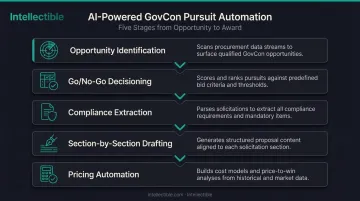
The scope difference matters. Traditional tools manage document creation. AI-powered platforms manage the entire pursuit lifecycle:
- Opportunity identification — Ingesting and filtering federal notices from sources like SAM.gov, then transforming each notice into a structured capture record with agency details, NAICS codes, timing, fit rationale, and risk signals
- Go/No-Go decisioning — Automated scoring against configurable criteria including NAICS codes, deal-size thresholds, agency targets, incumbent analysis, and risk conditions — producing a structured Go/No-Go report before resources are committed
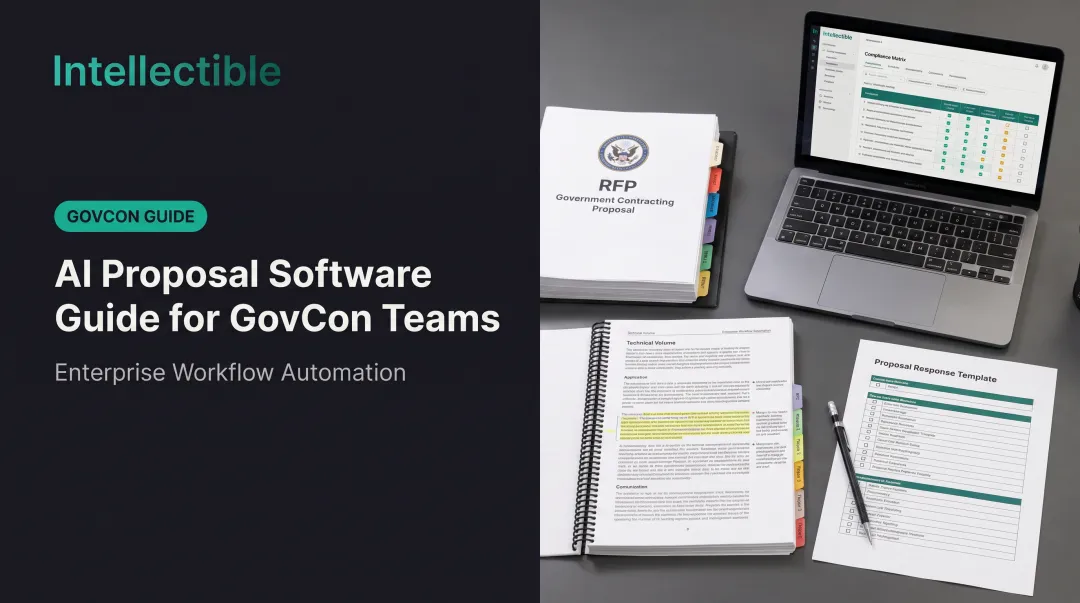
- Compliance extraction — Parsing solicitation documents to surface deadlines, submission rules, evaluation criteria, and compliance obligations in a structured format
- Section-by-section drafting — Mapping requirements to specific proposal sections with assigned owners, deadlines, and coverage gap indicators before drafting begins
- Pricing automation — End-to-end cost modeling with approval routing, scenario analysis, and audit trail documentation built into the workflow
Compliance and Traceability Advantage
For cost-reimbursable contracts, FAR Table 15-2 requires detailed cost breakdowns, supporting rationale, and audit-ready documentation. DCAA's guidance further requires that submissions show computation ties to the accounting system and that contractors make records available for audit.
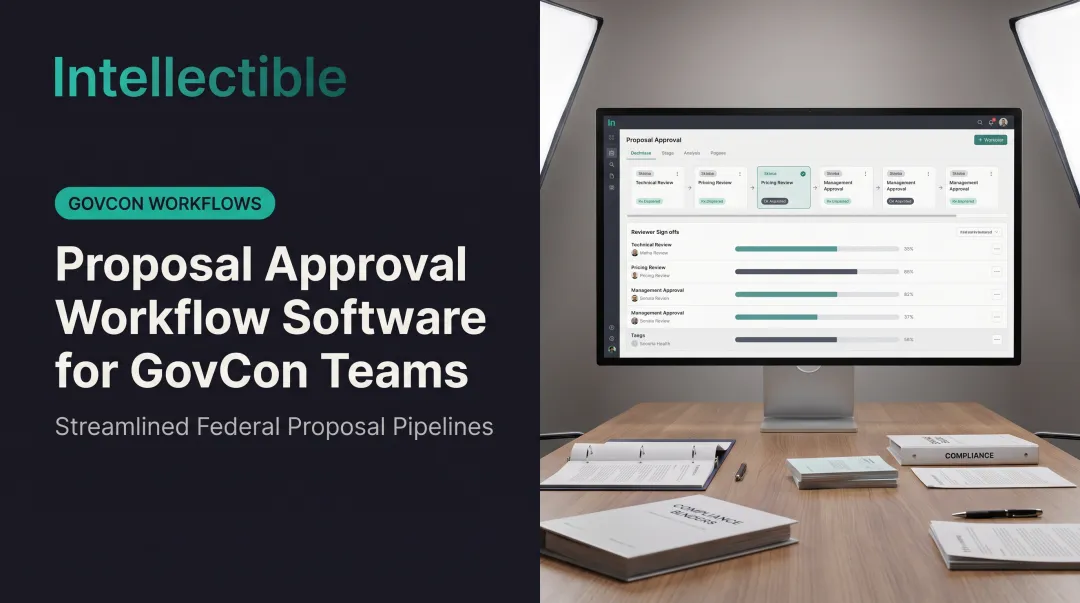
AI-powered platforms that maintain structured audit trails — documenting every pricing assumption, revision, and approval — address this requirement directly. Each assumption ties back to its source document; the approval path is preserved. The finance review package captures exceptions, escalations, and QA status in one place.
Platform in Practice: High-Volume Pursuit Operations
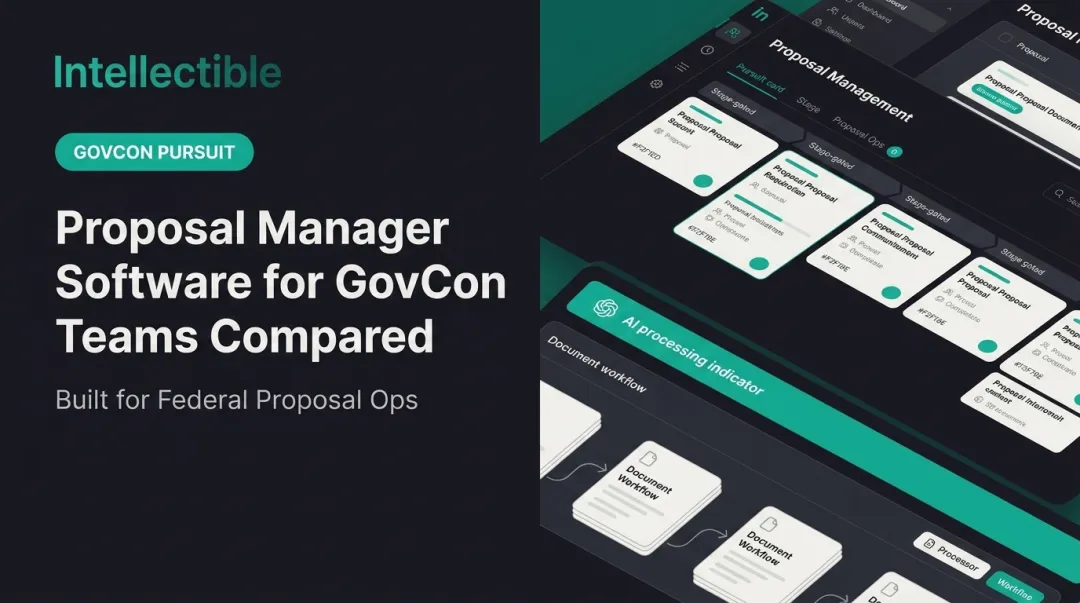
Intellectible's horizontal AI build platform combines production-ready systems with a visual workflow builder. At the center is the Proposal & Pursuit Engine — a governed proposal workflow that runs the full RFP response rather than relying on a prompt box or static template. It reads the solicitation, attachments, and addenda to extract key dates, submission rules, required sections, evaluation criteria, and compliance obligations; runs a structured go/no-go covering fit, urgency, risk, contract terms, and capability match; then turns requirements into a response plan with mandatory versus strategic sections, owners, deadlines, status tracking, and an evidence-backed compliance matrix. Section drafts are grounded in the RFP, deal variables, approved knowledge, and historical proposal language, and the assembled proposal is reviewed against requirements, strategy, tone, and missing evidence — with versioning and export built in.
John Grady, Corporate Director of Business Development at HHS, described the shift directly: "Intellectible is taking the tedious, monotonous hours of RFP efforts out of human hands. This allows us to do what we should be doing — analyzing and selling."
Where AI-Powered Platforms Work Best
These platforms deliver the most value for GovCon teams managing high opportunity volume across multiple agencies, contract vehicles, or NAICS codes — where Go/No-Go bandwidth, pricing turnaround, or proposal throughput is the primary bottleneck to growth.
A practical example: automating weekly review of federal notices filtered by agency, deal size, and incumbent status, then routing qualified opportunities to capture managers with a pre-populated Go/No-Go scorecard — cutting decision time from days to hours without adding staff.
Which Approach Is Right for Your GovCon Team?
The decision comes down to five factors:
- Proposal volume per year — How many solicitations are you actively pursuing?
- Pricing complexity — FFP service contracts vs. cost-reimbursable with DCAA audit exposure
- Current bottleneck — Is the constraint content creation, Go/No-Go decisions, pricing, or all three?
- Existing tech stack — What CRM, document, and collaboration tools are already in use?
- Growth trajectory — Are you trying to pursue more opportunities, or just manage current volume better?
Choose Traditional Proposal Automation If:
- Your team responds to moderate volume with standard solicitation formats
- Your bottleneck is content reuse and RFP collaboration
- Capture and pricing processes are already strong and just need document workflow support
Choose AI-Powered Pursuit Automation If:
- You're trying to pursue more opportunities without proportionally growing headcount
- Go/No-Go decisioning is consuming capture manager time that could go to strategy
- Pricing workflows lack audit trail control and multi-stakeholder approval structure
- You're building a scalable business development operating system, not just a document tool
The Hidden Cost of Under-Tooling
Choosing the wrong category — or skipping automation entirely — has a measurable cost.
Deltek's 2026 pricing and estimating study notes that a single government RFP response can take up to 84 hours. When that time concentrates in screening, formatting, and pricing assembly rather than technical differentiation and win strategy, pipeline throughput suffers — without advancing a single additional opportunity.
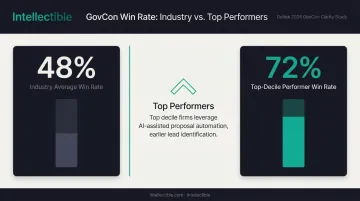
The same Deltek research found that top-decile GovCon performers — those reporting a 72% self-reported win rate versus the 48% average — use AI, proposal automation, and earlier lead identification more extensively. That's an association, not a causal claim. But the pattern is consistent: better tools at the front of the funnel correlate with stronger performance at the back.
These categories are not mutually exclusive. Some mature GovCon organizations run a traditional tool for content management alongside an AI platform for pursuit orchestration, Go/No-Go automation, and pricing. The right architecture depends on where your team's time is actually being lost — and how much of it you can afford to keep losing.
Real-World Results: What AI Automation Delivers for GovCon Teams
Oceus, a defense and technology contractor, implemented Intellectible's AI pursuit platform to address a volume problem: the team was manually reviewing federal opportunities without a structured, automated qualification process. The platform transformed their top-of-funnel.
Jeff Harman, CEO of Oceus, described the outcome directly: "Now we're looking at more than double the qualified opportunities per week — about seven to eight opportunities a month making it through our threshold." He also noted a new pipeline opportunity that came specifically from an AI-generated outreach: "We have a potential customer in the pipeline that's there because of that AI email. That exposure didn't exist before."
The platform-level metrics behind this result:
- 95%+ time saved on opportunity search and Go/No-Go decisions
- 150%+ increase in actionable top-of-funnel pipeline opportunities
- 90% reduction in time to final pricing with full audit trail control
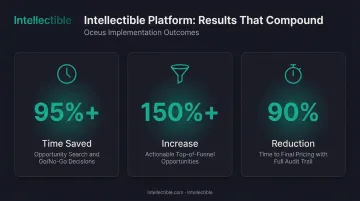
The biggest gains didn't come from faster formatting. For Oceus, the leverage was in compressing the decision and qualification stages — the phases where most proposal timelines stall before a single page is written.
For GovCon teams managing high-opportunity pipelines, Intellectible connects opportunity identification, Go/No-Go logic, proposal drafting, and review into one platform — no additional headcount required. Teams can explore a tailored demo to see how this applies to their specific pursuit workflows.
Conclusion
Traditional proposal automation tools earn their place in teams that need structured content management, faster RFP collaboration, and better reuse of existing proposal language. For straightforward solicitations with stable formats, they do the job.
AI-powered pursuit platforms are a different investment: the right fit when growth is constrained by how fast a team can evaluate opportunities, price responses, and pursue volume without adding headcount. The GAO reports approximately $793 billion in FY2025 federal contract commitments, with a 66% government-wide competition rate. The market isn't shrinking. The question is whether a team's automation infrastructure can scale to meet it.
Whether a team starts with a content library or moves to a full pursuit operating system, that choice sets the ceiling on how much pipeline they can realistically work. Teams that outgrow their tools don't lose bids on merit — they lose them on capacity.
Frequently Asked Questions
What is proposal automation?
Proposal automation uses technology to systematize the RFP response process — including content libraries, workflow routing, auto-populated templates, and AI drafting. It reduces manual effort and helps teams respond to more opportunities faster without rebuilding documents from scratch each time.
Can AI write a proposal for me?
AI can generate proposal sections, suggest past content, and auto-populate compliance language. Human review remains essential in GovCon, where section-level compliance, pricing accuracy, and technical differentiation require expert judgment that AI supports but cannot replace.
Which AI is best for proposals?
It depends on your team's biggest bottleneck. Tools like Loopio or Qvidian work well for RFP content management on commercial and moderate-complexity federal work. Platforms like Intellectible are better suited for teams that need Go/No-Go decisioning, pursuit workflows, and pricing automation connected in one system.
What are the main volumes in a GovCon proposal?
Typical volumes include Executive Summary, Technical Approach, Management Approach, Past Performance, and Price/Cost. The controlling structure is always Section L read against Section M — not a fixed rule. Automation delivers the most value in technical drafting and pricing assembly.
What makes GovCon proposals different from commercial proposals?
GovCon proposals require FAR/DFARS compliance, solicitation-specific section formats tied to evaluation criteria, formal cost documentation under FAR Table 15-2, and DCAA audit exposure on cost-reimbursable contracts. Standard commercial proposal tools are not built for these requirements.
How do I choose proposal automation software for government contracts?
Evaluate tools based on whether they support GovCon-specific workflows — Go/No-Go logic, pricing audit trails, and section L/M response structure. Prioritize platforms that integrate with federal opportunity data, scale pursuit volume without requiring proportional headcount growth, and connect opportunity identification to final submission in one governed system.