Introduction
Buyers do their homework before they talk to you. 6sense's 2025 buyer study found first seller contact happens at 61% of the buying journey. Revenue teams are left guessing readiness from scattered clues.
Buying-signal examples become useful when the team can name the source, verify the account, and explain the publication delay. The examples here are organized around people, operations, technology, growth and capital, competitive and procurement activity, and relationship history, with the next verification step kept visible.
This guide covers definitions, signal types, concrete examples, prioritization, and signal-to-action workflows for sales, marketing, and RevOps.
Key Takeaways
- Signals come from what prospects say, what they do on your channels, and what happens around their company.
- Fit, intent, and timing together beat any single page view or email open.
- Every signal needs an owner, a response, and a next step.
- Measure which signal combinations produce qualified pipeline.
What Are Buying Signals in B2B?
A B2B buying signal is an observable statement, behavior, account event, or interaction suggesting a prospect or buying group is evaluating a solution or getting more likely to buy.
Four terms get mixed up:
- Intent data: shows what people are researching
- Fit data: shows whether the account suits your solution (industry, size, tech stack, job title)
- Opportunity events: show a timely business condition, such as a new executive or funding round
- Buying signals: the umbrella covering all of the above, plus direct buyer statements
6sense treats online intent as one type of interest signal, not the whole universe.
Signals are directional, not definitive. One blog visit means little. Pricing research, two stakeholders opening your security page, and an implementation question in the same two weeks mean a great deal more.
How to Classify Buying Signals for B2B Revenue Teams
Use six families to organize the trigger library: people; operations; technology; growth and capital; competitive and procurement; and relationship history. Each trigger needs a relevant commercial hypothesis, an eligible account, an original public or permitted internal source, and an owner. A generic alert without those fields is a research lead, not an action package.
By Source
- Conversational: emails, calls, and meeting questions. Sales sees these first; RevOps needs them logged in the CRM.
- First-party: website, product, webinar, and form activity. Marketing and RevOps usually own visibility.
- Third-party: review sites, communities, social posts, job changes, and company news. Visibility is partial and often account-level.
By Meaning: Fit, Opportunity, Intent
- Fit: asks whether the account resembles your ICP
- Opportunity: asks why timing may be favorable
- Intent: asks what the buyer is actively doing
Combine them. An ICP-fit account with a new operational initiative that repeatedly reads your solution content is far more interesting than any one of those alone.
By Strength
- Low-intent: little buyer commitment (a blog read)
- Medium-intent: more engagement (a webinar, a comparison page)
- High-intent: real effort (a demo request, a pricing question)
Actual strength depends on your own conversion history. Customize the taxonomy by industry, sales motion, deal size, and buying cycle, since a $20,000 deal and a multi-year enterprise contract behave differently.
Individual vs. Account Level
Several people from one company engaging matters more than one anonymous visit. Forrester reports a typical decision involves 13 internal stakeholders plus nine external influencers. Always preserve the original context: timestamp, source, persona, and related account activity.

Reps should act on evidence, not an unexplained score.
B2B Buying Signal Examples Revenue Teams Should Monitor
For each example, ask four things: what it looks like, what it may indicate, who owns the response, and the right next step.
Conversational and Direct-Intent Signals
Practical feasibility questions. Prospects ask about pricing, contract terms, implementation timelines, security, integrations, support, or onboarding. They're testing whether this can work. Sales owns the reply: answer the question, then ask one clarifying question. Don't force a demo.
Evaluation-stage requests. A tailored demo, proof of concept, quote, ROI discussion, or customer reference signals a stronger stage. Sales and solution teams should tailor the response to the stated use case, decision criteria, and buying stage.
Pain and switching talk. Disclosed pain, vendor dissatisfaction, competitor comparisons, and switching questions suggest a business case is forming.
Example: a prospect mentions proposals stall because pricing data lives in spreadsheets and approvals depend on two overloaded people. That's a manual-process pain worth a focused discovery call.
First-Party Digital and Product Signals
- Repeat visits to pricing, comparison, security, integration, or case-study pages. Recency, frequency, and page sequence matter more than any single visit.
- Demo or contact-form submissions, trial sign-ups, product-tour engagement, chatbot questions, and late-stage downloads like implementation guides.
- Multiple contacts from one account engaging, forwarding materials, or adding users and integrations.
Marketing automation should nurture lower-intent activity and route explicit requests to sales fast. Multi-contact activity may point to a buying committee or expansion opportunity, but check account context before reaching out.
External, Account, and Opportunity Signals
- Account events: job changes, former champions joining new companies, new executives, relevant hiring, funding, M&A, expansion, product launches, and technology changes.
- Timing events: an upcoming renewal, RFP, newly authorized initiative, contract deadline, or pressure to scale delivery without adding headcount.
- Third-party research: review-site visits, community questions, peer recommendations, and public statements about a relevant challenge.
Mimecast's UserGems case credited former-customer job changes with 276 opportunities and more than $18M in pipeline in eight months. It's one vendor's result, not a benchmark.

Events create a window, not a budget. Context also varies by sector:
- Government contractors watch recompete windows and forecasts; GSA says forecast entries are planning information, not a commitment to buy
- Healthcare organizations may react to device recalls or compliance changes
- Equipment service companies may feel seasonal demand or inspection pressure
Be careful with public complaints or one-off social interactions. Respond with something useful, not an aggressive pitch.
Examples matter most when several form a pattern instead of sitting as disconnected activities.
How to Interpret and Prioritize Buying Signals
Start With Fit
Confirm fit before you weight any signal:
- Industry and company profile
- Role relevance and use case
- Tech environment
- Realistic ability to buy
For every family, capture event date, publication date, ingestion date, and last verification date. Define visibility lag as publication date minus event date and processing lag as ingestion date minus publication date. Unknown event dates stay unknown. Do not invent a universal number of days for sources whose timing differs by jurisdiction or publisher.
Stack Signals
Combine intent and timing:
- Pricing-page visit plus competitor research
- Hiring event plus integration research
- Pain disclosure plus proposal request
Then score the stack on:
- Recency and frequency
- Behavioral depth
- Number of engaged stakeholders
- Whether signals come from independent sources
Set Priority Tiers
| Tier | Trigger | Owner | Response time | Offer | Escalate when |
|---|---|---|---|---|---|
| 1 | Explicit commercial intent | Sales | Same day, ideally within hours | Discovery call, tailored demo | Stakeholders multiply or a proposal is requested |
| 2 | Active evaluation | Sales and marketing | 1-2 business days | Case study, integration review | Pricing or security questions appear |
| 3 | Early research | Marketing | Automated nurture | Educational content | Repeat visits from fit accounts |
Speed matters at the top. InsideSales' study reports conversion rates 8x greater in the first five minutes, though it covers inbound leads generally, not only B2B signals.
Separate Evidence From Inference
Record the observed behavior first, then the interpretation. Reps validate the buyer's situation in discovery.
Filter false positives:
- Bot traffic and accidental clicks
- Shared devices and generic content
- Automated email activity (Apple Mail Privacy Protection loads content regardless of engagement, so opens prove little)
- Company events unrelated to your solution
Close the Feedback Loop
Compare signal combinations against outcomes you can measure:
- Qualified opportunities and stage progression
- Win rate and cycle movement
- Influenced revenue
Build priority rules from your own conversion data. Published signal-stacking percentages rarely transfer across teams, so skip them.
How B2B Revenue Teams Should Act on Buying Signals
Build a Documented Play per Signal
Each priority signal needs a play: who gets the alert, what research happens, which message or asset fits, and what happens if the prospect stays silent.
- Marketing adjusts nurture and account-based campaigns
- Sales personalizes outreach
- RevOps maintains routing, scoring, data quality, and reporting
Reach Out Without Sounding Like Surveillance
Reference business context, not tracking. Lead with a relevant question, resource, or offer. Don't claim to know what the buyer intends.
Good next steps include:
- Focused discovery call
- Integration review
- Implementation conversation
- ROI workshop
- Proposal or multi-stakeholder meeting
Where Automation and AI Help
Automation can capture signals, connect CRM and operational data, apply decision rules, and surface recommended actions. Humans should review high-impact decisions.
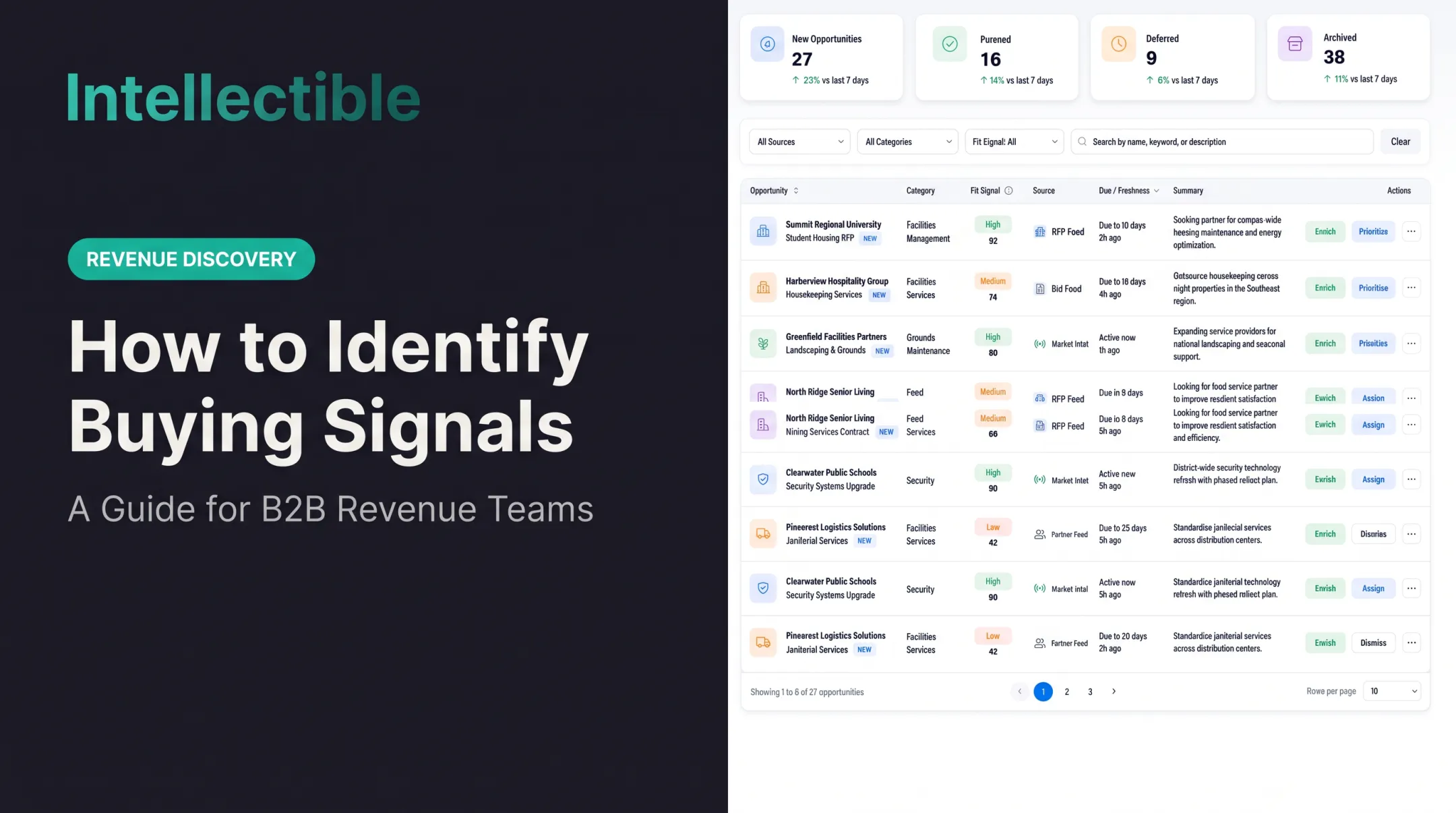
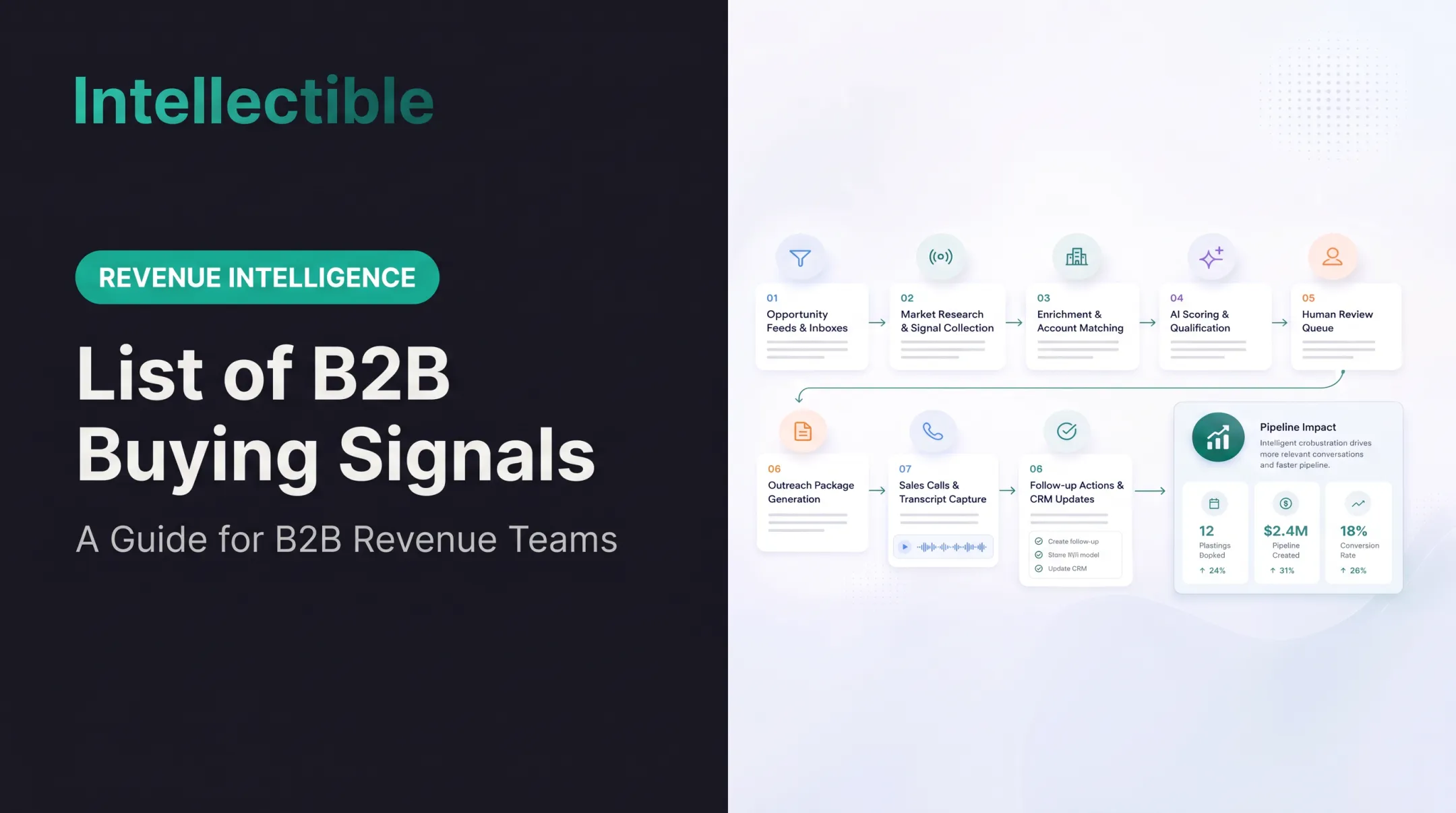
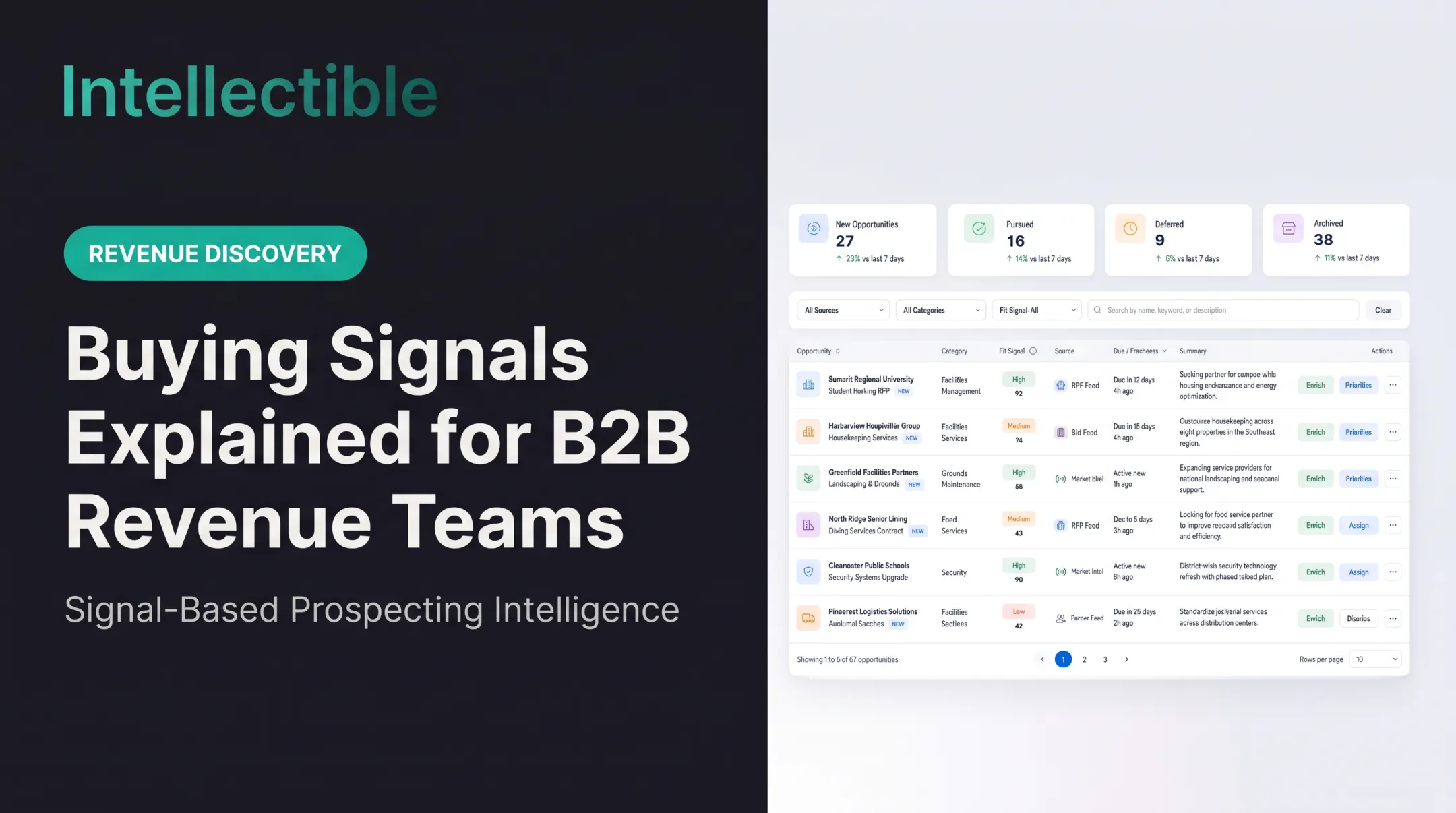
Intellectible is one example. Its Revenue Discovery engine runs a Detect, Gate, Promote, Draft, Approve, Call, Qualified workflow. It monitors tells such as:
- Hiring pressure and funding rounds
- Leadership changes
- Review pain and seasonality
It scores accounts for fit and urgency with the reasoning attached, and includes four human approval gates. It drafts and sends nothing on its own. Its configurable build platform connects Salesforce, Outlook, Slack, and other systems, so teams scale the process rather than headcount.

Frequently Asked Questions
What are the six buying-signal families?
Use six families to organize the trigger library: people; operations; technology; growth and capital; competitive and procurement; and relationship history. Each trigger needs a relevant commercial hypothesis, an eligible account, an original public or permitted internal source, and an owner. A generic alert without those fields is a research lead, not an action package.
Where do people and operations triggers appear?
People triggers include a new plant manager, CFO, or VP Operations, evidenced through company announcements and dated role information. Operations triggers include openings, expansions, inspections, and permits in local records. Their visibility lag varies: a job advertisement may precede a project, while a permit portal may publish after the recorded event.
How should technology and capital events be verified?
Technology triggers can appear in implementation announcements or job descriptions naming systems. Growth and capital triggers can appear in SEC filings, acquisition announcements, and investor releases. Record whether a deal is announced or completed; filing publication time and transaction completion time are different facts.
Where do procurement and relationship triggers come from?
Competitive and procurement triggers include an incumbent award, amendment, expiration, RFP, or documented vendor complaint in the relevant records. Relationship triggers come from CRM loss reasons, past champions, prior evaluations, and permitted customer conversations. Keep public evidence separate from confidential relationship history and confirm the right buying entity.
How should visibility lag be measured?
For every family, capture event date, publication date, ingestion date, and last verification date. Define visibility lag as publication date minus event date and processing lag as ingestion date minus publication date. Unknown event dates stay unknown. Do not invent a universal number of days for sources whose timing differs by jurisdiction or publisher.
Which triggers should sales teams monitor first?
Prioritize fit, source reliability, freshness, and whether a decision is still open. Start by monitoring the families most predictive of your actual service purchase, then compare acceptance and opportunity rates by family. A faster alert only helps if the evidence is relevant and a representative has a useful next action.