Treating all of it equally burns rep time and buries real demand. Buyers also notice. Gartner found that 73% of buyers avoid suppliers who send irrelevant outreach.
This guide covers the signals that matter in logistics, how to rank and validate them, how to respond, and how to build a repeatable workflow.
Key Takeaways
- A buying signal is any action, statement, or event suggesting a prospect is moving toward a purchase.
- The best opportunities combine fit, a trigger, recent engagement, and a real need.
- One content download or email open never justifies aggressive outreach.
- Match speed, message, and owner to signal strength and freshness.
What Buying Signals Mean in Logistics Sales
Why logistics buying signals are different
An online research feed can be useful without seeing the event that creates a services purchase. A company may review its janitorial contractor, medical-billing partner, or freight provider through internal conversations and procurement processes, without researching category content or visiting a supplier website. Missing research activity does not mean missing demand.
- Capacity gaps and service failures
- Contract cycles and new facilities
- Lane changes and seasonal peaks
- Compliance rules and cost pressure
The same signal means different things by buyer type:
- Manufacturer: A new plant often means inbound and outbound freight needs that don't exist yet.
- Retailer: Pricing-page visits in September likely point to peak-season capacity.
- Distributor: Complaints about visibility suggest a carrier or 3PL review.
- Broker or 3PL: Interest in technology may signal a vendor search, not a freight need.
Four categories of buying signals
- Conversational: Quote requests, stated deadlines, questions in calls. They reveal intent but not budget or authority.
- Operational or company trigger: New facilities, hiring, expansion, contract wins. They give a reason to talk, not proof of a project.
- First-party digital: Visits, downloads, email engagement on your own channels. They show interest, but often from students, competitors, or junior researchers.
- Third-party or market intent: Research activity on outside sites. Demandbase notes intent data is probabilistic and doesn't prove a named person is ready to buy.
Current B2B buying behavior and signal detection
Buyers research on their own. 6sense's 2025 report found 94% had a shortlist ordered before seller contact, and the preferred vendor won nearly 80% of the time. Forrester puts the average buying group at 13 people, so one contact's activity tells you little. These are general B2B findings, not logistics-specific.

Monitor accounts, not just individuals, and arrive with something useful before the shortlist hardens.
The Most Useful Buying Signals for Logistics and Transportation Sales
Decision-stage signals
These deserve the fastest response:
- Requests for a quote, pricing, or an RFP response
- Lane, capacity, or service-level questions
- Contract terms and implementation timing
- A meeting request with operations or procurement
For freight, investigate warehouse openings, shipper expansions, procurement records, and logistics job postings tied to relevant operations. A warehouse permit or new transport manager may explain a timing hypothesis even when there is no detectable topic intent. Qualify lanes, service fit, and the actual shipper rather than assuming every carrier record represents a buyer.
Operational and company trigger signals
Distribution center openings, market expansion, product launches, fleet growth, new customer contracts, and logistics hiring all create reasons to evaluate providers. A facility lease-up is context, not intent. A tenant filling a 97,000-square-foot building may or may not be shopping for carriers.
Treat a trigger as a reason to reach out with a relevant question, then look for a second signal.
Service-problem and switching signals
- Missed delivery targets and recurring claims
- Poor shipment visibility
- Capacity shortages
- Detention or dwell-time problems
- Carrier communication failures
- A contract renewal window
DAT's shipper guidance notes that annual RFP contracts bind on price, not volume, and mid-cycle mini-bids often target underperforming lanes. That makes poor lane performance a real opening.
Discovery questions to test urgency and funding:
- What changed in the last quarter?
- What does this cost you per month in claims or expedites?
- Who owns the fix, and is budget set aside?
- When does the current contract end?
Stakeholder and evaluation signals
When procurement, finance, IT, operations, or executives join the conversation, the group is evaluating fit. The same is true for detailed questions about integrations, reporting, insurance, compliance, onboarding, scalability, and service recovery. A buyer who asks how you handle a missed pickup is picturing you as their carrier.
Digital, social, and negative signals
Weak-to-moderate positives include repeat visits to service, case study, and contact pages, engagement with logistics content, public requests for provider recommendations, and trade-show conversations. Alone, none is strong evidence.
Watch for negatives:
- Postponed timelines
- A champion who goes silent
- Price-only conversations
- Repeated rescheduling
Negative signals should lower priority and trigger re-qualification.
How to Qualify and Prioritize Buying Signals
Start with ICP and account fit
Score fit before you chase intent. Review:
- Company type and contact role
- Shipment profile, modes, and freight characteristics
- Geography and lanes you can actually cover
- Operational complexity and estimated volume
Strong intent from an account you can't serve (lanes, capacity, or compliance) should not outrank a modest signal from a well-fit target.
Stack signals instead of reacting to isolated activity
Combine at least two categories. Examples:
- New facility plus pricing-page visits
- Service complaint plus a renewal date within 90 days
- Hiring for logistics managers plus a procurement contact joining a call
Then weigh the stack on four checks:
- How many people are involved
- Whether activity is consistent
- Whether the topic is relevant
- Whether signals cluster in a useful window
Apply recency and signal decay
A quote request or stated deadline needs action today. A webinar view from four months ago or an old expansion announcement should fade. There is no universal decay interval, so set your own and test it.
Log the date, source, account, contact, and observed action for every signal so stale activity stops influencing priority.
Validate intent through discovery
Ask plainly and conversationally:
- What prompted you to look at this now?
- What happens if it stays unresolved?
- Who else decides?
- Is an incumbent contract active, and when does it end?
- What timeline are you working toward?
The answers separate an information request, a market comparison, and an active sourcing project. Never cite tracking details back at the prospect. Refer to the business problem instead.
Use a simple qualification and routing model
Skip opaque scores with a dozen inputs. Rate five things only:
- Fit
- Signal strength
- Urgency
- Stakeholder involvement
- Next action
| Route | When |
|---|---|
| Immediate sales action | Quote, RFP, deadline, strong fit |
| Same-day follow-up | Multiple signals, good fit, no explicit request |
| Nurture | Fit is good, signal is weak |
| Re-qualification | Stalled or negative signals |
| Disqualify | Outside the service model |
Test the model against meetings, opportunities, and revenue, not clicks.
How to Respond to a Buying Signal Without Wasting the Opportunity
Match response speed to signal strength
Quote requests, RFPs, and stated deadlines need a named owner and a fast reply. Early research signals deserve a useful educational touch, not a cold call. Set coverage rules for evenings, meetings, holidays, and shared inboxes so a high-value request doesn't sit overnight.
Turn the signal into a relevant message
Reference the business problem, such as capacity planning, new-lane coverage, visibility, delivery reliability, or warehouse scaling. Don't reveal that you watched their pricing page. A simple framework:
- Acknowledge a plausible trigger.
- Ask one diagnostic question.
- Offer a proof point or next step.
- Avoid claiming certainty about their situation.

For example: "Teams opening a second DC often revisit regional carrier coverage. Is that on your radar this quarter?"
Use coordinated channels without creating noise
McKinsey's 2024 B2B Pulse found buyers use about 10 channels, so pick by buyer preference, urgency, relationship history, and signal source. Space follow-ups, and make each touch add something new: a lane-specific question, an operational checklist, a relevant example, or an answer to a concern.
Expand from one contact to the buying group
Ask your first contact how they make decisions and who must evaluate a provider. Bring in operations, procurement, finance, IT, safety, and executives at the right stage. Record roles, objections, requirements, decision criteria, and next steps in the CRM.
Align sales, marketing, and revenue operations
- Agree on one definition of a buying signal
- Set ownership rules and response-time expectations
- Collect sales feedback on signal quality
- Build enablement content for recurring logistics questions
Track performance by signal source:
- Signal-to-reply time
- Signal-to-meeting rate
- Meeting-to-opportunity conversion
- Win rate and sales-cycle time
- Revenue by signal source
Build a Repeatable Buying-Signal Workflow With AI
Capture signals across connected systems
A workable setup pulls activity into one account view while keeping contact context intact. Typical sources include:
- CRM records and email engagement
- Website activity and call notes
- Public company events and intent sources
- Rep observations
Add human review and responsible data practices
Use AI to summarize activity, spot patterns, suggest next actions, and route work. Require a person to review sensitive personalization and high-impact decisions. NIST's generative AI profile warns that these systems can confabulate facts and mislead reviewers.
Fold these controls into the same workflow:
- Honor opt-outs and follow CAN-SPAM, which has no B2B exception
- Check data quality before acting on it
- Record where each signal came from
- Use public information appropriately, and skip outreach that feels invasive or overconfident
Where Intellectible fits
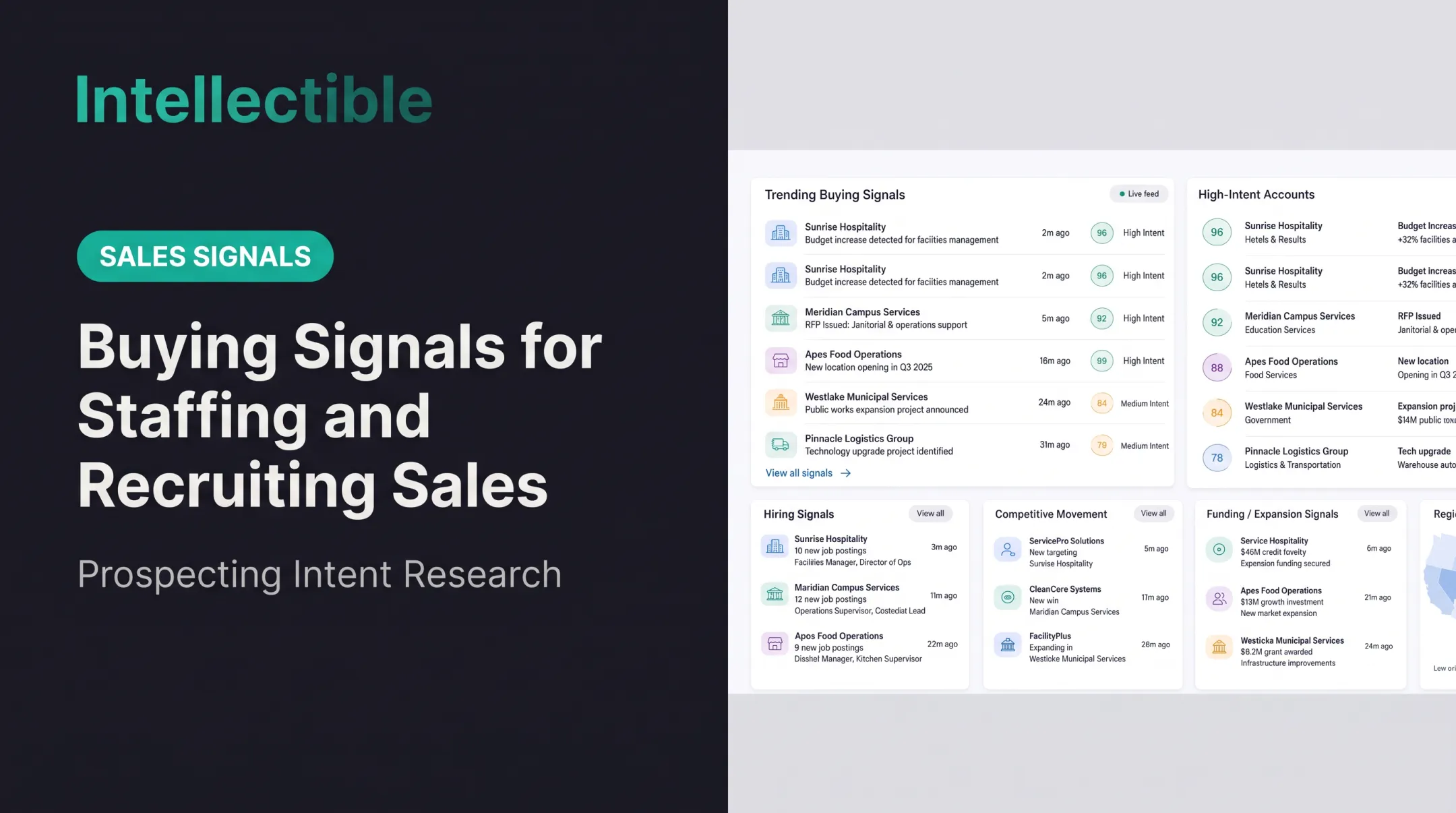
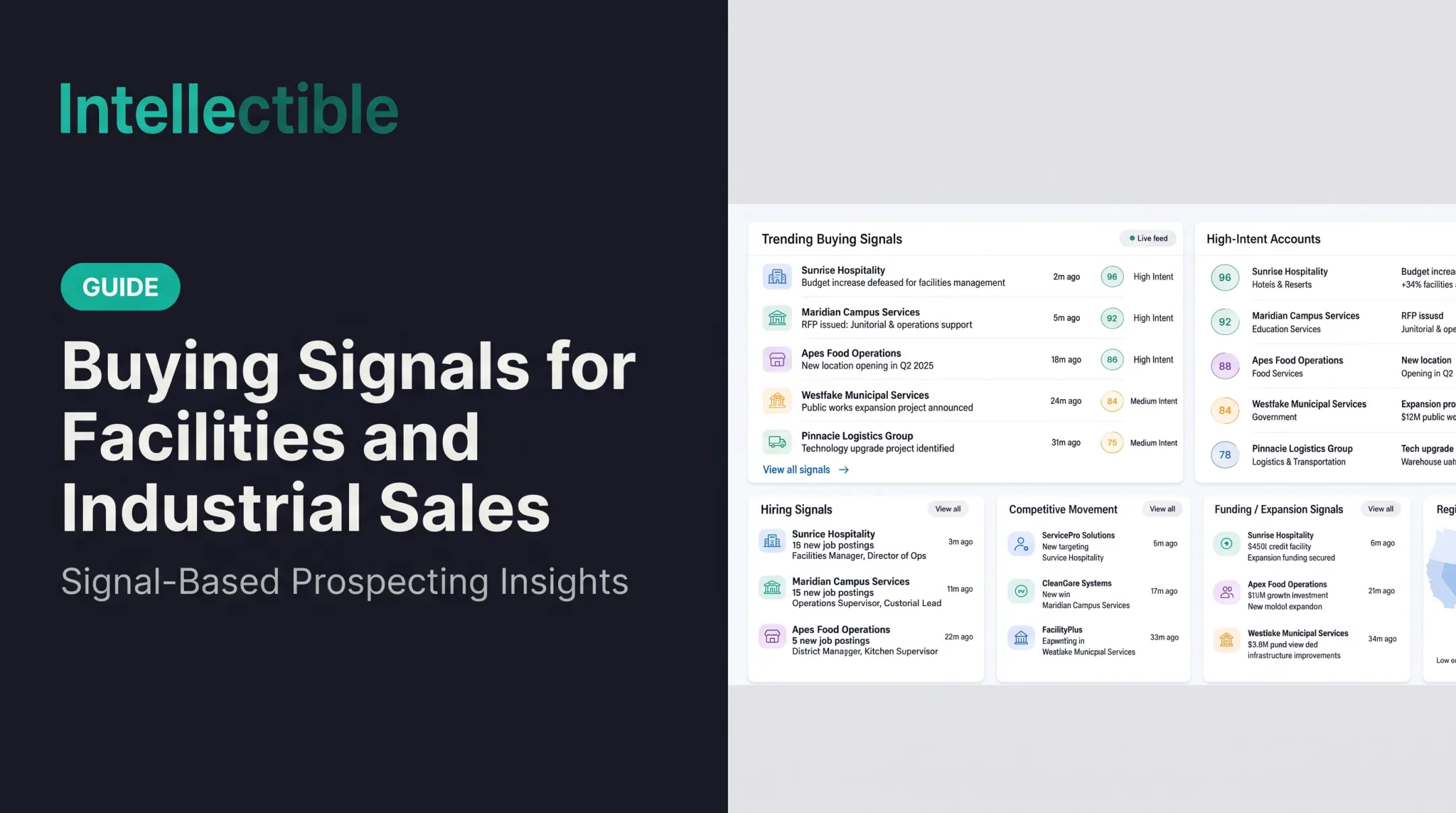
Intellectible is an AI build platform that lets revenue operations teams connect data, design visual workflows, publish internal interfaces, and automate signal-based decisions without rebuilding infrastructure for each process. It connects to systems such as Salesforce and Outlook, and its Flow Editor includes scoring and summarization nodes with human review gates.
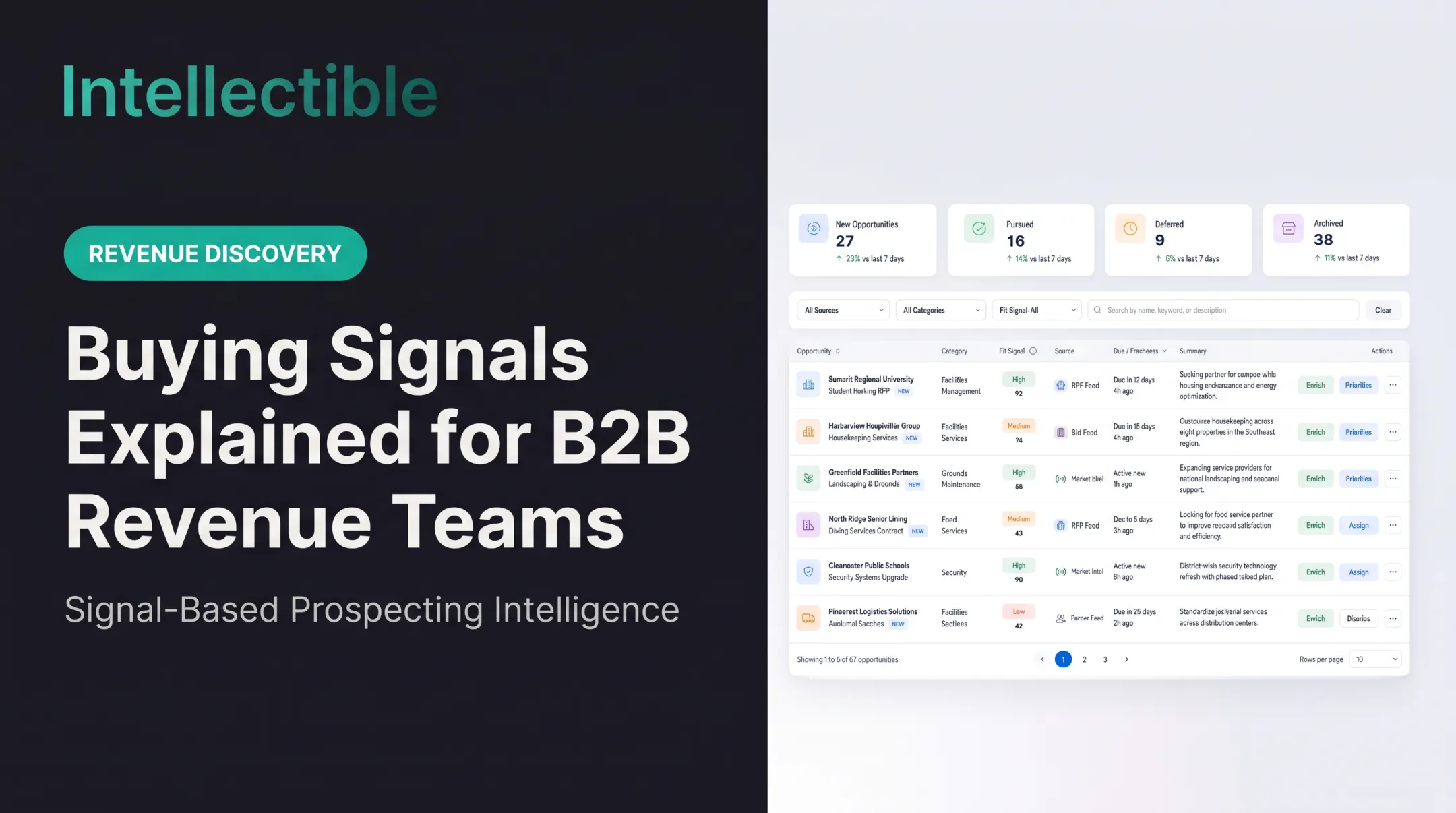
Its Revenue Discovery solution tracks standard feeds like hiring, expansion, funding, and M&A, plus company-defined signals. When a signal fires and holds up, the account lands in a queue with evidence attached. Every customer-facing action passes four human approval gates, and the system sends no bulk email or LinkedIn automation.

For a logistics team, that could mean a custom signal system that routes alerts, supports review, records outcomes, and improves over time.
Frequently Asked Questions
Why can intent data miss services demand?
An online research feed can be useful without seeing the event that creates a services purchase. A company may review its janitorial contractor, medical-billing partner, or freight provider through internal conversations and procurement processes, without researching category content or visiting a supplier website. Missing research activity does not mean missing demand.
Which observations can reveal a janitorial review?
For janitorial services, consider a multi-site operator approaching a documented renewal while opening facilities or receiving repeated service complaints. The account evidence may be in procurement calendars, local permits, company announcements, and public reviews. Verify the relevant entity and whether a decision is open before treating those clues as an outreach reason.
What can public records show about medical-billing prospects?
For medical billing, look for practice ownership changes, new locations, relevant hiring, and publicly available provider or enrollment records. Those observations can guide a market-wide research process, but a registry entry does not disclose a practice’s billing contract or prove dissatisfaction. Confirm the operating problem and buying responsibility.
Which operating changes matter for freight sales?
For freight, investigate warehouse openings, shipper expansions, procurement records, and logistics job postings tied to relevant operations. A warehouse permit or new transport manager may explain a timing hypothesis even when there is no detectable topic intent. Qualify lanes, service fit, and the actual shipper rather than assuming every carrier record represents a buyer. Buyers research independently, buying groups are larger, and evaluation is digital-first. Forrester found 89% of buyers had adopted generative AI. Relevance matters more, and trusted human expertise still counts.
How should the evidence be monitored?
Build an eligible account universe and monitor those service-specific sources. Record the original evidence, event date, publication lag, legal entity, likely owner, and what remains unknown. Promote accounts only after fit and evidence review; keep a separate research queue for uncertain events.
How should teams test the coverage gap?
Compare topic intent with the accounts found through operating evidence, using rep acceptance, accepted opportunities, and pipeline rather than alert counts. This does not mean intent never helps a services company; it means the purchase can begin outside the web-research behavior that the feed observes.