Introduction
Before using intent data in a sales process, distinguish a model’s inference from a company event a rep can verify. Research-topic scores can guide investigation; observable hiring, filings, expansions, and procurement changes can explain what happened. This guide shows how to use both without confusing interest with a confirmed buying decision.
Results depend on signal quality, ICP fit, data freshness, scoring logic, workflow integration, and how fast reps act.
Buyers are also moving without you. 6sense's 2025 Buyer Experience Report found that the vendor ranked first at the end of selection won nearly 80% of the time, and first seller contact now happens earlier in the journey.
This article walks through a practical framework: collect and evaluate signals, prioritize accounts, route actions, personalize outreach, avoid common mistakes, and measure whether intent is improving outcomes.
Key Takeaways
- Use intent to decide which accounts to prioritize, when to engage, and what to say.
- Combine first-party and third-party signals with ICP, CRM, and account-history data.
- Set clear tiers and routing rules, with one owner and one next action per account.
- Treat intent as a qualification input, then validate it against real outcomes.
How to Leverage Intent Data for Sales
Step 1: Define the ICP, sales objective, and intent use case
Topic-based intent data infers interest from patterns of online research and commonly reports it as an account-level score. It can suggest where to investigate, but it does not identify a confirmed purchase, a budget owner, or the reason an account must change suppliers. Keep that inference separate from the underlying observations.
In complex pursuits such as government contracting, healthcare, or operational services, the buying group is large. Forrester reports an average of 13 people per purchase, so define roles, not just companies.
Then pick one objective:
- Find in-market accounts
- Improve outbound prioritization
- Accelerate stalled opportunities
- Spot competitive threats
- Find expansion opportunities
One objective gives you a clear outcome to evaluate against.
Step 2: Collect and unify relevant intent signals
First-party signals come from your own website, emails, content, demos, and product use. Third-party signals come from outside your properties: publisher networks, review sites, category research, and competitor activity.
Neither is enough alone. Before trusting a feed, check:
- Account matching and identity resolution
- Topic accuracy
- Consent and source transparency
- Signal freshness
- Whether activity maps to a relevant buying group
Match rates are not accuracy. A vendor's claim of matching 70% to 90% of signals to an account says nothing about false positives.
Step 3: Score and prioritize accounts using context
Build a model that weighs:
- ICP fit and CRM status
- Signal strength, recency, and frequency
- Topic and buyer stage
- Negative signals such as an existing contract or a disqualified industry
Then create tiers:
- Monitor: fit is good, activity is thin
- Nurture: early research on a relevant topic
- SDR follow-up: repeated, recent activity from a fit account
- Immediate opportunity review: strong fit, strong urgency, active evaluation
Validate the tiers against your historical opportunity and revenue data. Vendor-default thresholds are vendor-specific. Bombora's score of 60, for example, is its own recommended minimum, not a universal cutoff.
Step 4: Route each signal to an owner and playbook
Define what happens at each tier: who owns it (SDR, AE, account manager, customer success, or marketing) and how quickly they respond. An alert in a separate dashboard gets ignored. Push the account, signal context, task, and suggested action into your CRM or sales-engagement tool.
Speed matters, though the evidence is dated. A Harvard Business Review study found firms contacting an online inquiry within an hour were nearly 7x as likely to qualify it as those waiting an hour longer. That covers web inquiries, not account-level intent alerts, so use it as a directional argument for response SLAs.
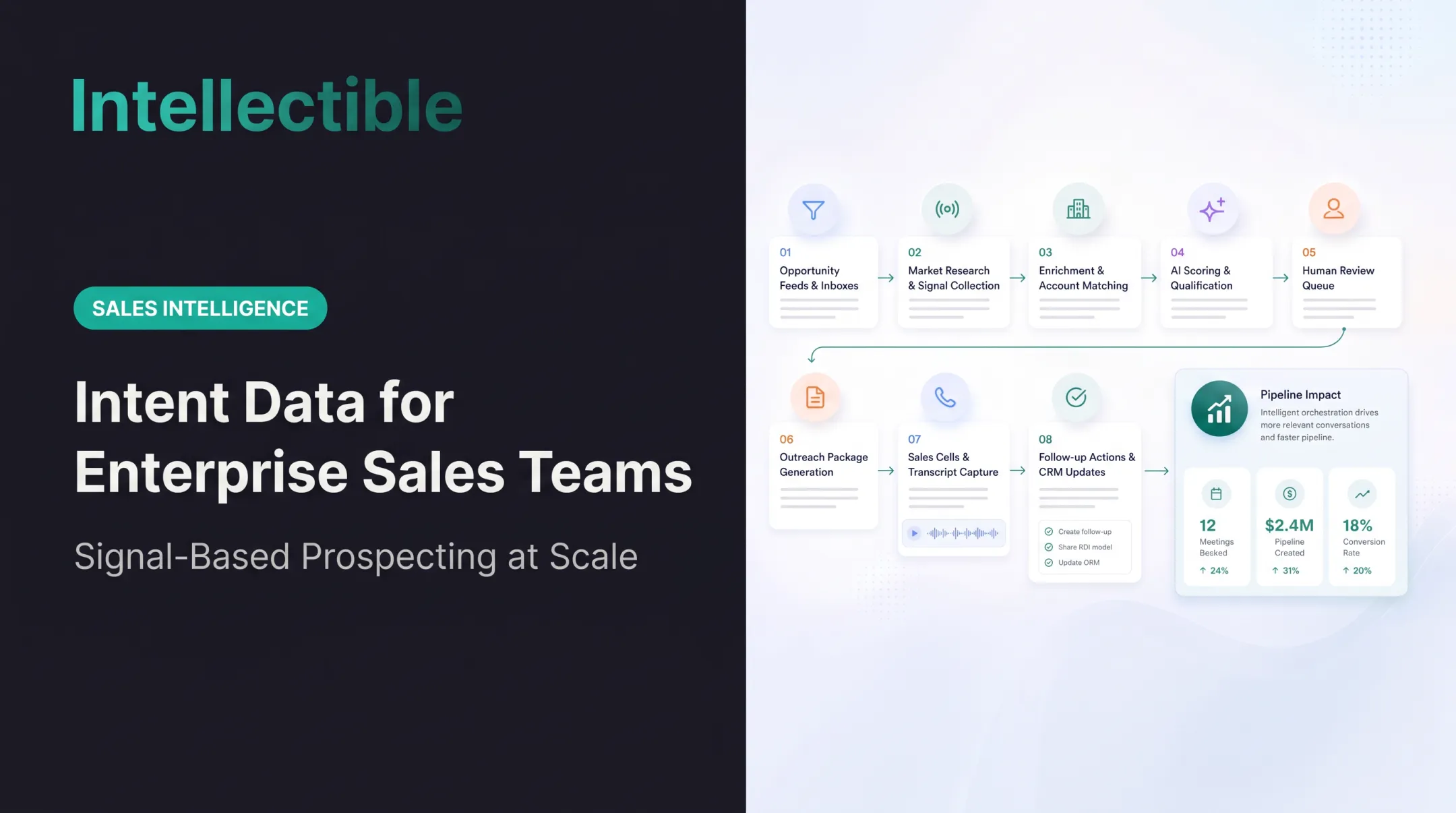
Intellectible fits here as workflow infrastructure, not an intent-data source. Teams use it to build connected revenue workflows from data sources, APIs, AI, business logic, human review, and published interfaces.
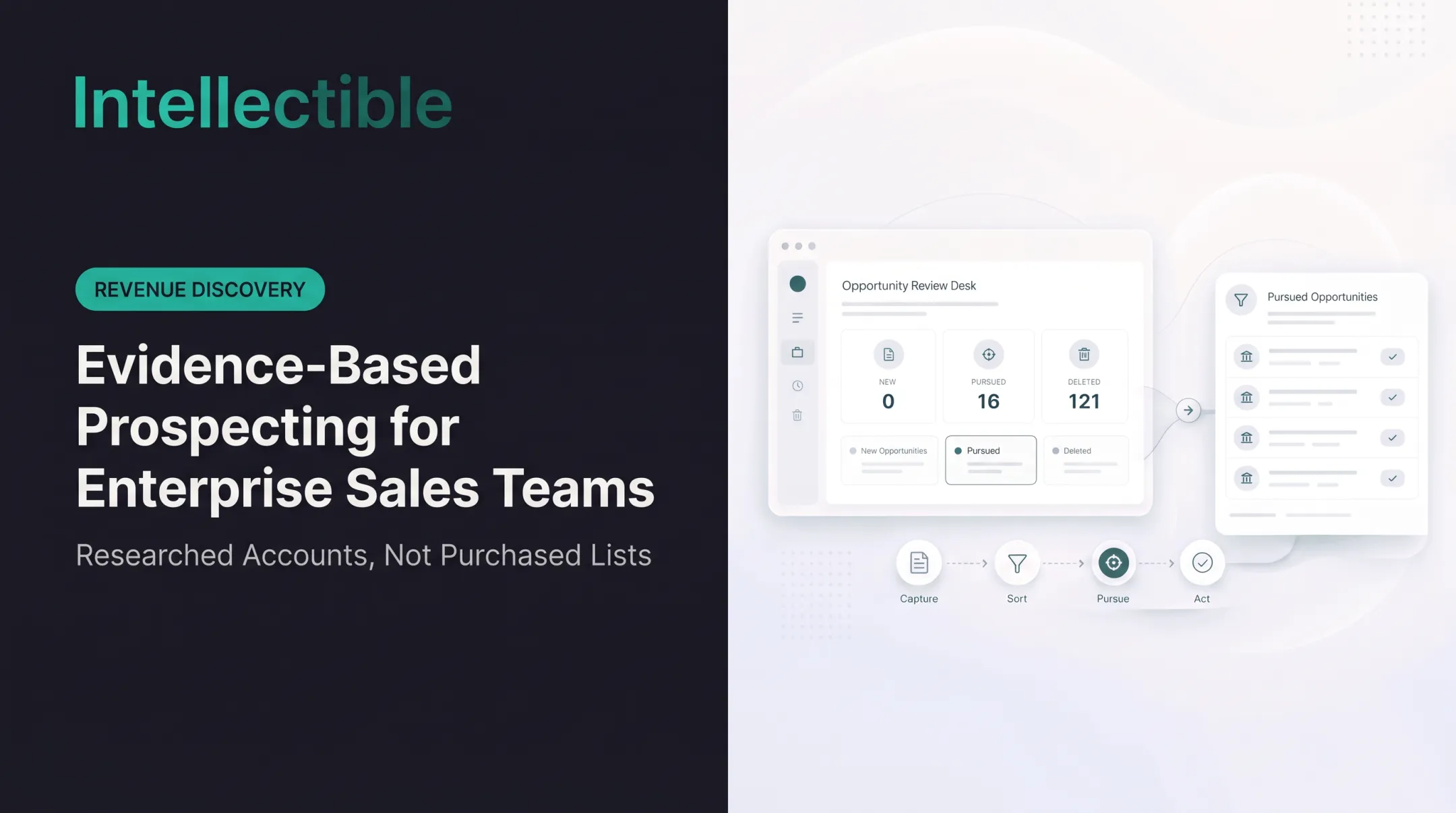
Its Revenue Discovery engine, for example, runs a gated sequence: Detect, Gate, Promote, Draft, Approve, Call, then Qualified. Approval gates sit before outreach or CRM updates.

Step 5: Personalize outreach and measure sales impact
Match the message to the researched topic and stage:
- Early research: educational guidance
- Consideration: problem-specific insight
- Active evaluation: comparisons, implementation detail, pricing, or proof
Track outcomes that show sales impact:
- Time from signal to action and response quality
- Meetings and qualified opportunities
- Stage progression, sales-cycle movement, and pipeline contribution
Be cautious with vendor claims. A commissioned Forrester TEI study modeled 454% ROI for 6sense, but it measures a whole platform, not intent data in isolation.
To test incrementality, compare intent-driven outreach against your existing prospecting motion, using holdout groups where you can. Review false positives, ignored alerts, and accounts that converted without any intervention.
When Should You Leverage Intent Data for Sales, and What Do You Need First?
Intent data pays off when you have more potential accounts than reps can research and need a consistent way to spot current buying activity.
When intent data is a strong fit
- Account prioritization and trigger-based prospecting
- Competitive plays
- Sales and marketing handoffs
- Reactivating stalled opportunities
- Expansion or churn-risk monitoring
It's especially useful for high-consideration purchases with multiple stakeholders, long research periods, or large account value.
Buyers also research on their own. Gartner found 67% of B2B buyers prefer a rep-free experience, yet a separate Gartner survey found 69% turn to reps to validate AI-generated insights. Those are different surveys, so don't compare them directly. Signals tell you when to show up; humans still close.
When to use caution
Intent may be inefficient when:
- Your addressable market is very small
- Sales are highly transactional
- Accounts show little digital activity
- Privacy rules limit usable data
No reliable public benchmark exists for intent coverage in U.S. healthcare or government contracting, so test coverage before committing.

A single anonymous page view, a generic topic spike, or an old third-party signal should never trigger a call on its own.
Minimum system requirements
You need a working stack (CRM, marketing automation, analytics, sales engagement, enrichment, alerting, and reporting) that passes signal context into the rep's existing workflow. Each record should carry:
- Account identity and ICP attributes
- Opportunity stage and owner
- Researched topic, source, and timestamp
- Score rationale and next action
Data, skills, and compliance readiness
Document a signal taxonomy and agree on what awareness, consideration, and decision-stage behavior look like. Train reps to talk about account-level research without implying they're watching someone's private activity.
On U.S. privacy, don't assume a blanket B2B exemption. California's employee and B2B exemptions expired January 1, 2023. Also:
- Honor opt-out signals such as Global Privacy Control where required
- Check whether your provider is a registered California data broker
- Document data sources, purposes, retention, and deletion handling
- Get legal review for your situation
Key Parameters That Affect Results When Leveraging Intent Data for Sales
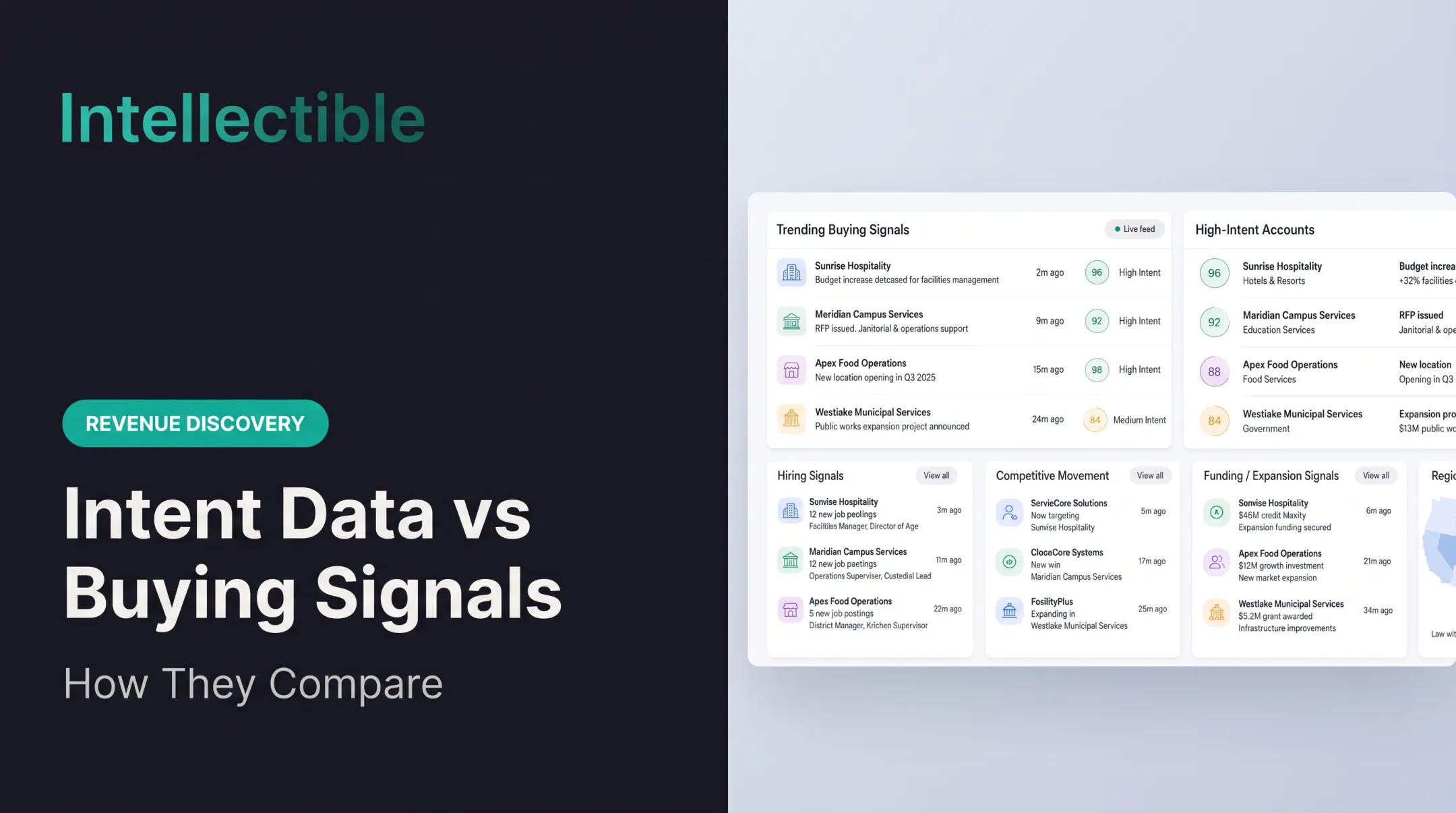
A buying signal in this comparison is an observable company event: a named employer hired a new operations leader, a facility received a permit, a business completed an acquisition, or a public contract reached a documented renewal point. Store the original source, event date, publication date, and company identity so a representative can inspect the fact.
Signal quality and context
A signal must relate to your actual problem and buying process, not a broad topic. Cut false positives by combining:
- Topic
- Source
- Behavior
- Account history
- Multiple stakeholders
No independent market-wide false-positive benchmark exists, so measure your own.
ICP fit and buying-stage interpretation
An account can research heavily and still lack budget, authority, or timing. The same activity should trigger different actions based on firmographic fit, CRM status, buyer role, and whether the account is learning, comparing, or preparing to buy.
Recency, frequency, and velocity
Recent, repeated activity beats an isolated or stale event, but decay depends on your sales cycle. Use timestamps, repeated topic activity, sudden increases, and declining engagement to judge urgency. Not every spike is a buying decision.
Routing speed and workflow adoption
Accurate data loses value in a dashboard nobody checks. These operational habits drive adoption:
- Automated routing
- Response SLAs
- CRM visibility
- Manager inspection
Forrester's 2026 research describes intent data as consistently underutilized, citing immature usage, measurement gaps, and integration difficulty.
Feedback loops and measurement
Models decay when outcomes don't feed back. On a regular cadence, review accounts that were accepted, rejected, converted, stalled, or disqualified. Then adjust topics, weights, routing, and messaging based on what you find.
Common Mistakes, Troubleshooting Issues, and Alternatives to Using Intent Data for Sales
Poor outcomes usually trace to weak setup, too much faith in scores, or signals with no executable process behind them.
Common mistakes
- Skipping ICP and use-case definition, then handing reps "high-intent" lists with no context
- Treating one signal as proof of purchase
- Sending generic outreach, or citing research activity in a way that feels intrusive
- Ignoring freshness, consent, account matching, negative signals, and rep feedback
Troubleshooting issues while using intent data
When results stall, fix the workflow before you blame the data.
Problem: Reps get too many alerts or stop trusting the data
- Likely cause: broad topics, low-quality sources, weak thresholds, duplicates, or no split between awareness and decision-stage behavior
- Fix: narrow topics, add ICP and CRM filters, group related activity, introduce tiers, and review sample alerts with managers
Problem: High-intent accounts don't respond
- Likely cause: research is for a different business unit, the contact isn't in the buying group, the signal is stale, or the message misses the researched issue
- Fix: confirm fit, identify relevant roles, review the full account journey, and lead with a useful educational or comparison asset
Problem: Intent data isn't changing pipeline
- Likely cause: signals miss the right owner, actions aren't completed, attribution is unclear, or you measure activity instead of qualified pipeline
- Fix: audit routing and task completion, set control comparisons, review stage progression, and focus on outcomes that sales leadership values
Alternatives to intent-data-led sales motions
If third-party intent is thin, noisy, or a poor fit for your market, these motions still move pipeline.
- Account research and trigger-based prospecting suit narrow markets, strong manual intelligence, or limited third-party coverage. Public procurement notices on SAM.gov are account-relevant triggers, though not buyer intent.
- Inbound qualification, referral selling, partner intelligence, and customer interviews work when the best context comes from conversations, not digital behavior.
- Broad nurture or territory-based outbound fits early markets with too little intent volume. You get wider coverage but lower prioritization precision.

Conclusion
Intent data works when signals connect to ICP fit, buying stage, clear ownership, and timely action. Most failures come from weak preparation, poor interpretation, disconnected workflows, and treating scores as guarantees instead of evidence.
Start with one sales use case, then:
- Build a measurable playbook
- Validate signals against real outcomes
- Expand only once results are reliable
Frequently Asked Questions
How is research intent different from a buying signal?
Topic-based intent data infers interest from patterns of online research and commonly reports it as an account-level score. It can suggest where to investigate, but it does not identify a confirmed purchase, a budget owner, or the reason an account must change suppliers. Keep that inference separate from the underlying observations.
What makes an observable signal verifiable?
A buying signal in this comparison is an observable company event: a named employer hired a new operations leader, a facility received a permit, a business completed an acquisition, or a public contract reached a documented renewal point. Store the original source, event date, publication date, and company identity so a representative can inspect the fact.
Does an expansion signal prove that an account will buy?
Consider a logistics business adding a warehouse. A permit or a dated job posting can establish that expansion activity occurred; the belief that it needs a new transport provider remains a sales hypothesis. Compare that evidence with a research-intent score, which can flag topic interest without establishing the operational change or identifying the decision-maker.
What should the account evidence record contain?
Make the distinction visible in the account record: observed event, source, date, matched legal entity, inferred commercial need, decision owner, and next verification step. Record observed versus inferred explicitly. A rep should be able to challenge the interpretation without losing the source evidence.
How should sales teams prioritize the resulting accounts?
Use fit criteria before timing signals. Route eligible accounts into contact-now, research-needed, nurture, or monitor queues according to evidence quality and whether the buying window is still open. Contact-now means there is a defensible reason for a conversation; it never means a purchase has been proved.
Can intent data and evidence-based signals work together?
The two approaches can complement each other. Research intent may help rank investigation, while evidence from public records, account activity, and CRM history supplies an explainable outreach reason. Measure accepted accounts and sales-accepted opportunities rather than treating a higher score or a larger alert count as success.