Introduction: How to Identify Buying Signals in B2B Sales
For an enterprise sales team, identifying buying signals starts with knowing which event to look for, where the evidence appears, and how long it takes to become visible. This guide organizes triggers into six families so RevOps and SDR managers can build a repeatable monitoring process across the market.
Interest turns into action somewhere in that mess, and teams miss it.
Buyers also move without you. 6sense's 2025 buyer study found that buyers first contacted sellers only after completing 61% of the buying journey, and 94% had already ranked a shortlist.
A buying signal is evidence of fit, intent, urgency, or a changing business condition. It is not proof of a purchase. This guide covers how to classify signals, interpret them in context, respond appropriately, and build a repeatable signal-to-action process.
Key Takeaways
- One page view or download rarely proves readiness; weigh fit, recency, urgency, and stakeholders.
- Converging signals, like a trigger plus active research plus decision-stage questions, mark the best opportunities.
- Match your response to the signal: educate, investigate, or remove friction.
- Log signal context and outcomes in the CRM so prioritization improves over time.
What Are B2B Buying Signals and Why Do They Matter?
A B2B buying signal is an observable action, statement, pattern, or business event suggesting an account may be evaluating a solution, developing a related need, or moving toward a decision.
It helps to separate three neighboring ideas:
- Fit data shows who could benefit (industry, size, technology).
- Intent data shows who is researching the category.
- Opportunity signals show that a business event may have created a new reason to buy.
Signals matter because they let teams prioritize accounts, personalize outreach, align sales and marketing, spot new members of a buying committee, and skip badly timed contact. That last point carries weight: Gartner reported that 73% of surveyed B2B buyers actively avoid suppliers that send irrelevant outreach.
Treat interpretation as probabilistic. A whitepaper download means little alone. Add strong fit, repeat visits, an urgent problem, or a decision-maker joining the thread, and the same download becomes meaningful.
Types of B2B Buying Signals: Categories and Examples
Fit and Account-Context Signals
Use six families to organize the trigger library: people; operations; technology; growth and capital; competitive and procurement; and relationship history. Each trigger needs a relevant commercial hypothesis, an eligible account, an original public or permitted internal source, and an owner. A generic alert without those fields is a research lead, not an action package.
- Target industry and company size
- Relevant or competing technology in use
- New departments or geographic expansion
- Roles that match your ideal customer profile
Fit tells you who deserves attention. It does not show active buying. A 500-person logistics firm that matches your ICP perfectly may have just signed a three-year contract with a competitor and have no reason to talk.
Intent and Engagement Signals
Strong intent signals include:
- Demo and quote requests
- Pricing-page and free-trial activity
- Competitor comparisons and implementation research
- Review-site activity
- Repeat visits to product or case-study pages
Not all activity is equal. Judge it by depth, frequency, recency, and commercial relevance. Three visits to a pricing page this week outweigh one blog read last quarter.
Conversation and Stakeholder Signals
Listen for commercial questions and disclosed constraints:
- Pricing, contracts, ROI, and procurement
- Integrations, security, and implementation
- Timelines and "what happens next"
- Pain points and internal deadlines
Stakeholder expansion matters just as much. Copied colleagues, finance or legal joining, executive participation, and multiple contacts from one account suggest a buying committee forming. Gartner's 2019 research reports a median buying group of 6-10 decision makers.
Trigger and Opportunity Signals
Common triggers include funding rounds, leadership changes, hiring surges, mergers, product launches, regulatory shifts, contract renewals, competitor dissatisfaction, and technology migrations. None proves budget on its own. Tie each to a plausible problem:
- New funding: pressure to scale quickly
- New revenue leader: process review within the first months
- Hiring surge: capacity strain
- Migration: integration gaps
A Scenario Showing Signal Convergence
An ideal-fit account hires a new head of revenue operations. Two weeks later, someone from that team reads your implementation guide and compares you with a competitor. Then a finance contact is copied on an email asking how onboarding works.
Each event alone is ambiguous. Together they show a new owner, active research, a widening committee, and a delivery concern. That pattern deserves a prompt, informed conversation.

How Can Revenue Teams Identify and Interpret Buying Signals?
Build a Signal Taxonomy Tied to Your ICP
For every family, capture event date, publication date, ingestion date, and last verification date. Define visibility lag as publication date minus event date and processing lag as ingestion date minus publication date. Unknown event dates stay unknown. Do not invent a universal number of days for sources whose timing differs by jurisdiction or publisher.
Start small. A handful of high-value signals sellers understand beats a catalog of every click.
Capture Signals Where They Appear
Pull signals from the channels your team already uses:
- CRM fields, notes, call transcripts, and emails
- Meeting outcomes, forms, and content engagement
- Web analytics, review platforms, and job postings
- Company announcements, technology data, and customer-success records
For each signal, record:
- Source and date
- Account and contact
- Related opportunity
- Observed behavior
- Suggested next action
That record keeps context intact when ownership changes. Data quality is the usual weak point. Salesforce's 2024 sales survey found only 35% of sales professionals completely trust their organization's data.
Evaluate Strength with Context, Not One Score
Assess each signal against:
- Account fit
- Intent strength
- Recency and urgency
- Stakeholder relevance
- Business impact
- Convergence with other signals
Calibrate any scoring weights against your own conversion history and review false positives regularly. Vendors do this too: Salesforce's lead scoring documentation describes models built from a company's own conversion history. No universal formula exists.
Validate Through Buyer-Centered Discovery
Test what the signal means with questions:
- What changed recently?
- Why does this matter now?
- Who is affected?
- Is there a deadline?
- How will you evaluate options?
Reference observable business context, such as a recent announcement. Don't recite tracking details. "I saw you're opening a second facility" works. "I saw you viewed our pricing page four times" feels invasive.
Read Signals at the Account and Committee Level
Roll actions from multiple contacts into one account view, but keep contact engagement distinct from company readiness. One enthusiastic user is not a buying committee.
Identify champions, economic buyers, technical evaluators, procurement, and legal. When finance or legal appears, the next best action changes: send ROI and contract materials, not another feature deck.
How to Act on Buying Signals and Operationalize the Process
Match the Response to Signal and Stage
- Early content engagement: educate or nurture. Send a relevant guide, not a sales pitch.
- Business trigger: insight-led outreach. "Congratulations on the Series B. Teams scaling that fast often hit pipeline-handoff gaps; here's how two peers handled it."
- Pricing or implementation question: a direct conversation. "Happy to walk through typical timelines. Would Thursday work, and should someone from IT join?"
- Competitor dissatisfaction: ask before assuming. "Many teams reevaluate at renewal. What would need to be different next time?"

Set Ownership and Response Rules
Define the operating rules up front:
- Who owns each signal
- Where it routes
- What information travels with it
- When it gets reviewed
Set response windows by urgency and business hours, then test them.
Be careful with speed claims. The often-cited MIT/InsideSales study found far higher contact odds at 5 minutes than at 30, but it dates to 2007 and measured contact and qualification, not closed deals.
Connect Signals to CRM Workflows
A workable flow runs:
- Detect the signal
- Enrich the record
- Assign the account
- Prioritize
- Send personalized outreach
- Follow up
- Log in the CRM
- Review the outcome
Capture these fields on every signal:
- Signal type, source, and date
- Account and contact
- Related opportunity
- Action taken, response, and outcome
Automate, but Keep Humans in Charge
Automation can monitor changes, enrich records, summarize unstructured text, set priority, create tasks, and route alerts. Sellers should validate relevance and choose the message.
Build in safeguards against:
- Alert overload and duplicate records
- Stale data and unsupported assumptions
- Outreach sent without context
An Example of a Connected Revenue Workflow
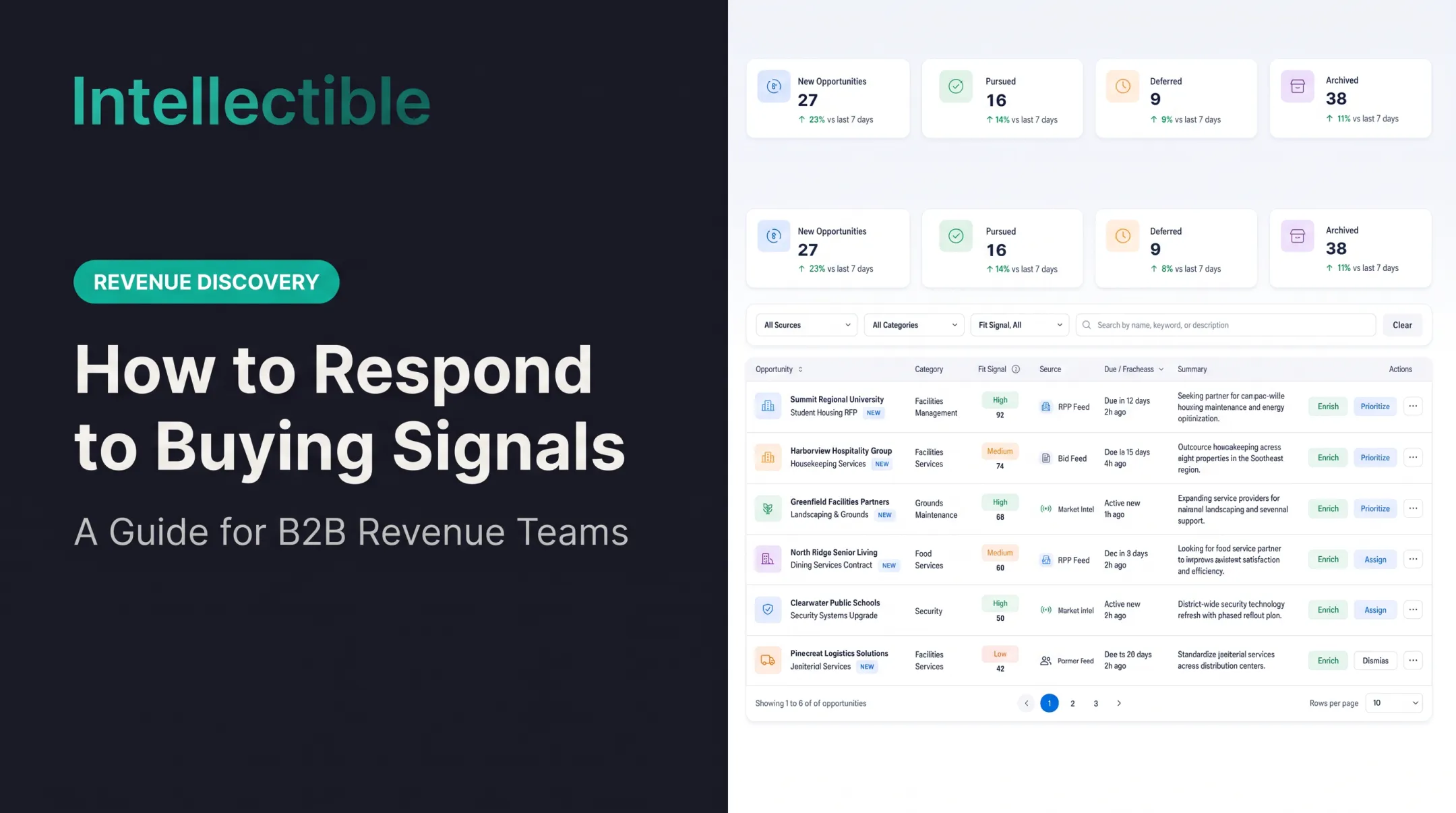
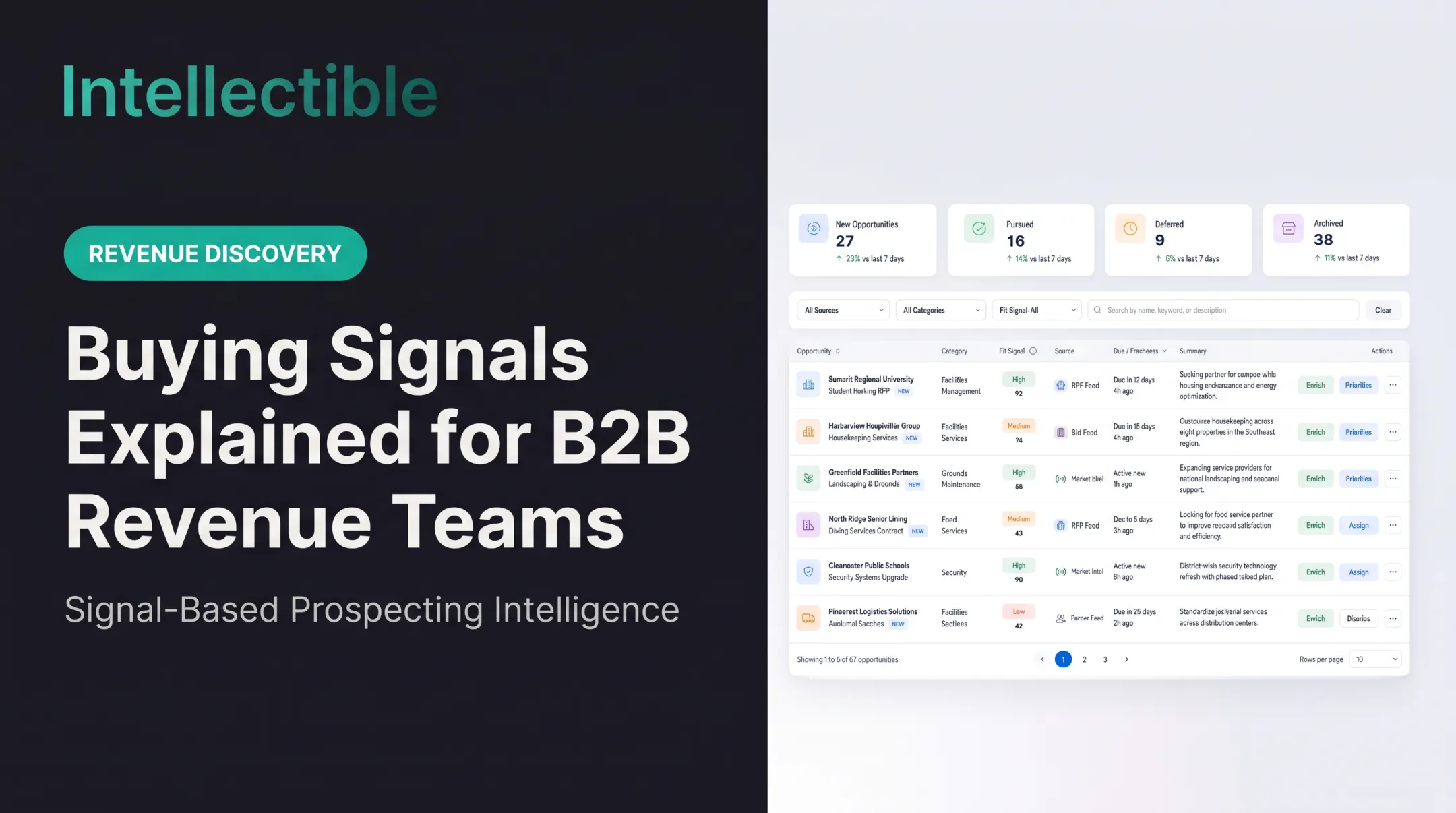
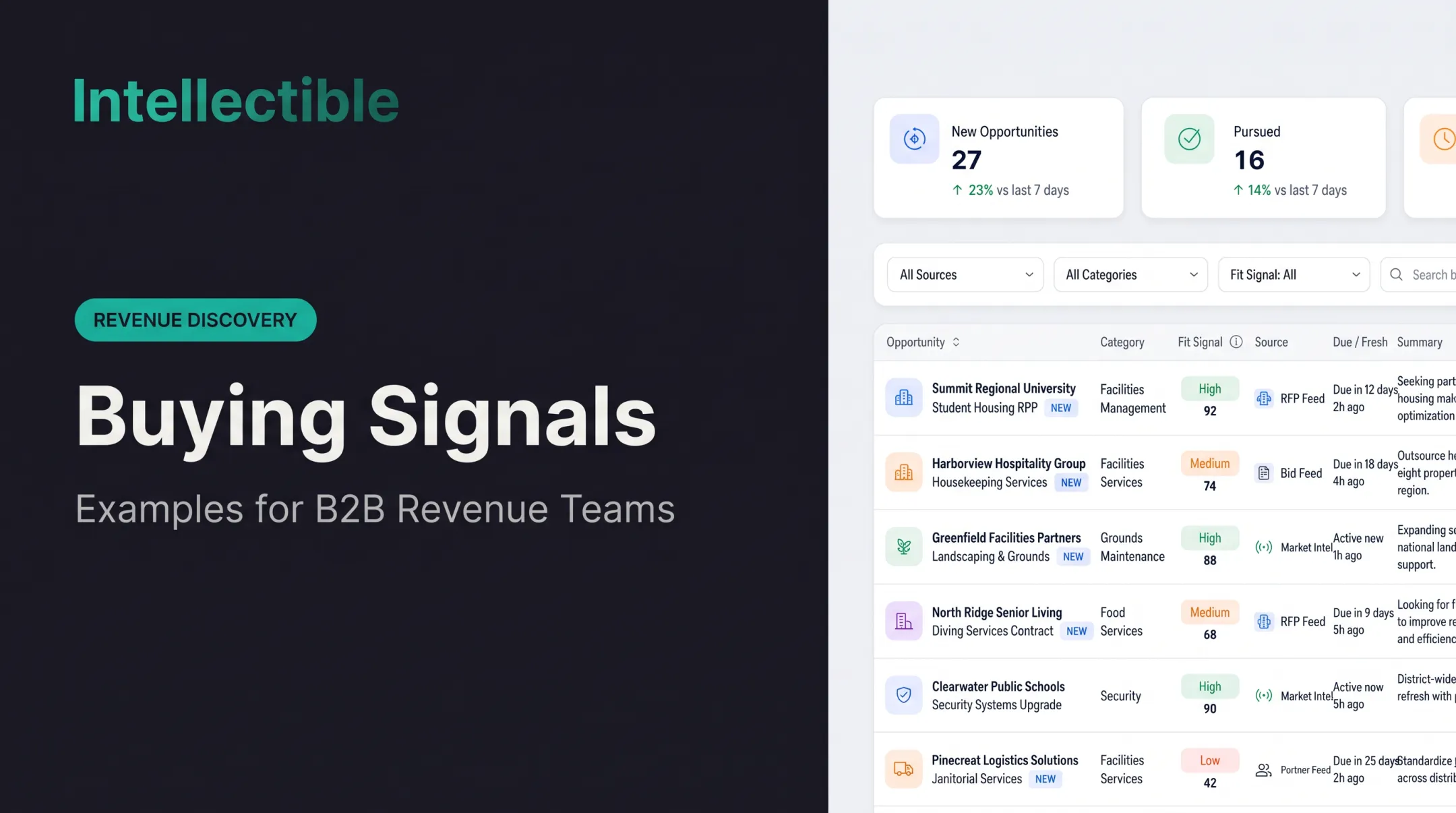
Intellectible's Revenue Discovery engine shows how this can work. It monitors standard feeds (funding, hiring surges, expansion, M&A, job changes) alongside team-defined signals such as review pain or inspection-score drops.
Its workflow runs Detect → Gate → Promote → Draft → Approve → Call → Qualified.
When a signal holds up, the account lands in a queue with evidence attached. Four approval gates are human, and the engine drafts outreach but sends nothing automatically. No bulk email, no LinkedIn automation, no automatic CRM writes.
For teams juggling signal data across disconnected systems, Intellectible connects data sources, workflow logic, interfaces, approvals, and human review in one place so you can run signal-to-action flows without adding operational overhead.
Common Buying-Signal Mistakes and How to Measure Signal Quality
Mistakes to Avoid
- Treating fit as intent
- Overvaluing isolated engagement
- Ignoring negative or risk signals
- Relying on stale records
- Contacting the wrong stakeholder
- Sending generic messages
- Not recording what happened after outreach
Metrics Worth Tracking
- Signal-to-action time
- Qualified meeting rate
- Opportunity creation and pipeline contribution
- Conversion and win rate by signal type
- False-positive rate
- Seller adoption

Build your own baselines. Published benchmarks for conversion by signal type, or for intent-data false-positive rates, are not available, so compare your results against your own history.
Govern Data Responsibly
Keep data accurate, restrict access, be transparent about use, and set retention limits. US rules still apply to B2B outreach:
- The FTC states CAN-SPAM has no business-to-business exception.
- Opt-outs must be honored within 10 business days.
- California's privacy agency says B2B exemptions expired at the end of 2022.
- Calling and texting rules under the TCPA may apply.
Check with counsel on your specific activities.
Frequently Asked Questions
What are the six buying-signal families?
Use six families to organize the trigger library: people; operations; technology; growth and capital; competitive and procurement; and relationship history. Each trigger needs a relevant commercial hypothesis, an eligible account, an original public or permitted internal source, and an owner. A generic alert without those fields is a research lead, not an action package.
Where do people and operations triggers appear?
People triggers include a new plant manager, CFO, or VP Operations, evidenced through company announcements and dated role information. Operations triggers include openings, expansions, inspections, and permits in local records. Their visibility lag varies: a job advertisement may precede a project, while a permit portal may publish after the recorded event.
How should technology and capital events be verified?
Technology triggers can appear in implementation announcements or job descriptions naming systems. Growth and capital triggers can appear in SEC filings, acquisition announcements, and investor releases. Record whether a deal is announced or completed; filing publication time and transaction completion time are different facts.
Where do procurement and relationship triggers come from?
Competitive and procurement triggers include an incumbent award, amendment, expiration, RFP, or documented vendor complaint in the relevant records. Relationship triggers come from CRM loss reasons, past champions, prior evaluations, and permitted customer conversations. Keep public evidence separate from confidential relationship history and confirm the right buying entity.
How should this process be put into practice and measured?
For every family, capture event date, publication date, ingestion date, and last verification date. Define visibility lag as publication date minus event date and processing lag as ingestion date minus publication date. Unknown event dates stay unknown. Do not invent a universal number of days for sources whose timing differs by jurisdiction or publisher. Prioritize fit, source reliability, freshness, and whether a decision is still open. Start by monitoring the families most predictive of your actual service purchase, then compare acceptance and opportunity rates by family. A faster alert only helps if the evidence is relevant and a representative has a useful next action.