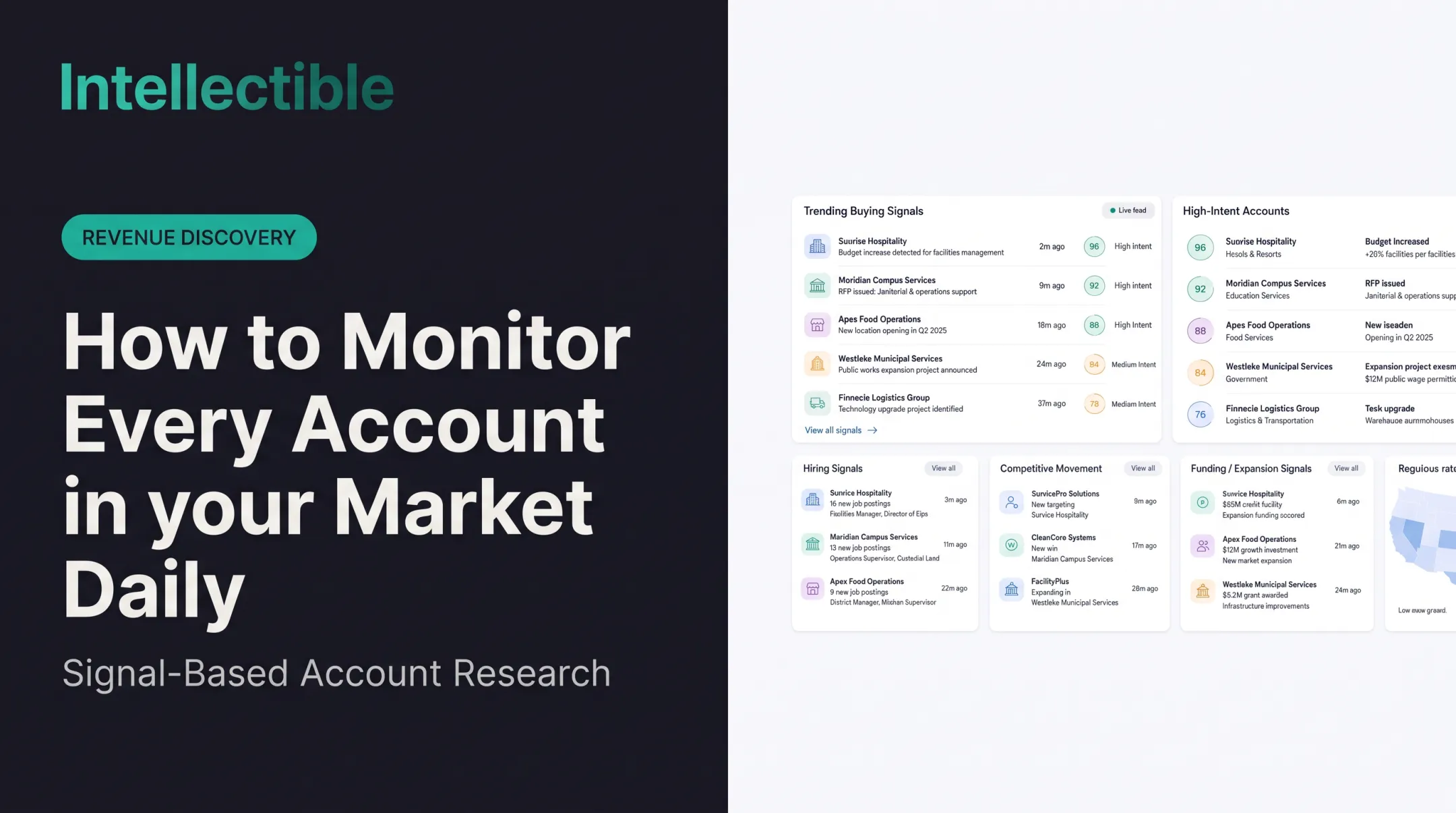
Customer expansion signals are observable changes that may point to more demand, new stakeholders, added use cases, greater capacity needs, or available budget inside an existing account. Expansion matters: Benchmarkit's 2025 report puts expansion at 40% of total new ARR, and over 50% for companies above $50M ARR.
This article covers the main signal categories, how to validate and prioritize them, how to route them into action, and how to measure the program.
Key Takeaways
- Signals are clues, not guarantees. Combine at least two types of evidence.
- The strongest signals show a change in scope: new executives, growing teams, rising usage.
- Every signal needs an owner, a likely outcome, a stakeholder, and a next action.
- Measure operational quality first, then pipeline and revenue.
What Are Customer Expansion Signals?
What counts as a signal?
Run expansion research across the full customer base, not only new-logo prospects or accounts near renewal. New facilities, locations, acquisitions, hiring surges, and permits may change a customer’s need for your service before the account manager hears about it. Link those events to the customer hierarchy and current contract scope.
Timing matters. A leading signal is early: a new department researching a use case. A lagging indicator arrives late: the customer formally asks for a bigger contract. Gainsight draws the same line, treating retention and upsell rates as outcomes and engagement measures as leading indicators.
Why signals matter to account managers
Signal-based management replaces calendar-driven upselling with conversations tied to something that actually changed. Your accounts already hold relationship history, outcome data, and proof of value. What you still need is a view of whitespace and the customer's current priorities.
Expansion and churn signals can appear together
A champion's departure, a new executive, falling engagement, or a competitive evaluation can signal opportunity and risk at once. A new executive might want to buy more, or might want to re-evaluate every vendor.
Resolve the risk and confirm the business need before you present any offer. Expansion pitched into an unhappy account usually backfires.
Customer Expansion Signals Account Managers Should Watch
Product usage, capacity, and adoption signals
- Rising usage, transaction volume, or project volume
- More seat or service requests
- Repeated capacity constraints
- New feature adoption
- Customer workarounds, such as spreadsheets bolted onto your product
Gainsight describes feature engagement and usage as health-score inputs for predicting renewal or expansion. That is vendor guidance, not an independent study, so treat it as a starting point.
Stakeholder and organizational signals
- Champion promotions
- New executives and decision-makers
- Department growth
- Reorganizations and acquisitions
These changes can shift budget ownership or open doors to adjacent teams. Gartner's 2025 survey found buying groups of 5 to 16 people across up to four functions. That is general B2B buying data, but it shows why one contact is rarely enough.
Intent and engagement signals
- Visits to product or pricing pages
- Downloads of relevant resources
- Attendance at educational sessions
- Support questions about capabilities the customer doesn't own
- Renewed activity from a previously quiet stakeholder
Business and account-change signals
- Funding, new markets, or new contracts
- Hiring and operational growth
- Strategic initiatives and procurement cycles
- Compliance changes
These can all create new requirements. Treat them as context, not proof: no authoritative research shows that any one of these alone predicts expansion.
Relationship and success signals
- Positive outcome discussions
- Executive participation in reviews
- Requests for roadmap or planning conversations
- Referrals and advocacy
- QBR questions about broader use
- Language such as "we wish this also handled..."
No single signal should trigger an upsell. The most reliable opportunities combine at least two relevant signals with a clear customer problem or goal.

How to Qualify and Prioritize Expansion Signals
Turn an observed event into an expansion hypothesis
Record five things for each signal:
- What changed
- When it changed
- Where the signal came from
- Which customer outcome it may affect
- What you still need to learn
Translate the event into a whitespace hypothesis: which current service could extend to the new site, business unit, or acquired company? Compare the need with the contract’s geographic and service scope. Record both the verified change and the assumption that still needs customer confirmation.
Use a consistent prioritization framework
Score each signal on:
- Timing
- Potential account value
- Urgency
- Available whitespace
- Stakeholder access
- Relationship strength
- Confidence in the data
Prioritize signals that are actionable and tied to a current customer objective, not accounts with the most engagement volume.
Intellectible's Revenue Discovery works this way: it scores accounts for fit and urgency, and every weight is editable in the admin settings.
Corroborate across data sources
These sources can each confirm or challenge your hypothesis:
- CRM activity
- Product usage
- Support history
- Billing
- Customer conversations
- Web behavior
- Org changes
Data quality matters. In Validity's 2025 survey, 76% of respondents said less than half their CRM data was accurate and complete. Stale contacts, duplicates, partial usage data, and intent data with no named stakeholder all produce false leads.
Map the opportunity to the buying group and outcome
Before reaching out, map the buying group:
- Champion
- Decision-maker
- Budget owner
- Users
- Influencers
- Blockers
Then tie the expansion to a specific outcome: supporting a growing team, cutting manual work, extending a workflow that already works, or meeting a new business requirement.
Avoid false positives and premature selling
- A usage spike may be a one-off project.
- A pricing-page visit may be research.
- A new executive may be auditing every vendor.
Use discovery questions to validate before creating a qualified opportunity. Respect privacy and consent too: the FTC notes CAN-SPAM has no exception for B2B email, so honor opt-outs.
How to Turn Signals Into Account Management Actions
Create a signal-to-action workflow
Define the path from detection to action:
- Capture the signal from CRM, usage, support, or external sources
- Verify the context against account history and current goals
- Assign the account owner responsible for follow-up
- Identify the relevant stakeholder to engage
- Select a play matched to the signal type
- Record the outcome for the next review cycle
Set an owner and response expectation per signal type. Decide upfront when the account manager, customer success manager, sales specialist, marketing, or an executive sponsor steps in.
Use relevant plays instead of generic outreach
- Congratulate a promoted champion, then propose a planning session
- Brief a new leader using documented customer outcomes
- Open a usage-threshold conversation before limits become a problem
- Request an introduction to an adjacent department
Keep outreach consultative: lead with the observed change or stated goal, ask a validation question, and only then discuss a broader solution.

Connect systems without removing human judgment
A good workflow pulls CRM, usage, support, billing, web, and external organization data together, then routes a prioritized alert with context to the right person.
Intellectible is one example of a horizontal AI build platform for this. It connects data sources, designs visual workflows, publishes custom interfaces, and launches automations, with human review nodes before action.
Its Revenue Discovery engine follows a Detect, Gate, Promote, Draft, Approve, Call, Qualified sequence with four human approval gates. It has no bulk email or auto-CRM writes.
NIST's generative AI profile advises human review and oversight for AI use where warranted. Automation should cut manual research and missed follow-ups, not send unverified, impersonal messages.
How to Measure an Expansion-Signal Program
Track leading indicators of operational quality
- Signal coverage and data freshness
- Percentage of signals verified
- Time from detection to owner assignment
- Time to first action
- Stakeholder coverage
- Play adoption and follow-up completion
These show whether your team can reliably detect and act before you judge revenue.
Measure qualified pipeline and commercial outcomes
- Signal-sourced expansion opportunities and qualification rate
- Win rate and average expansion size
- Expansion revenue and sales-cycle length
- Net revenue retention (NRR)
For context, SaaS Capital's 2025 benchmarks show median NRR of 101% and median GRR of 91%. Compare signal-driven opportunities with a defined baseline. Document the real customer interaction and decision path before crediting revenue to a signal.

Review by signal type and segment
Break results down by signal category, customer segment, account tier, and play. Then act on what you learn:
- Cut noisy signals
- Improve scoring and update routing
- Sharpen discovery questions
- Favor actions that create customer value, not just commercial activity
Frequently Asked Questions
Which customers should expansion monitoring cover?
Run expansion research across the full customer base, not only new-logo prospects or accounts near renewal. New facilities, locations, acquisitions, hiring surges, and permits may change a customer’s need for your service before the account manager hears about it. Link those events to the customer hierarchy and current contract scope.
What account baseline is required?
Maintain a baseline of each customer’s legal entities, parent company, operating locations, services bought, stakeholders, and account owner. Match new records to that baseline so a subsidiary opening is visible without creating a duplicate new-business account or contacting another owner’s customer.
Which sources reveal expansion?
Monitor public permits, facility announcements, ownership releases, relevant hiring, and permitted CRM history. A permit can indicate proposed work rather than an operating facility; confirm status, completion evidence, location, and buying responsibility before inferring additional demand.
Does a permit prove a new customer need?
Translate the event into a whitespace hypothesis: which current service could extend to the new site, business unit, or acquired company? Compare the need with the contract’s geographic and service scope. Record both the verified change and the assumption that still needs customer confirmation.
How should account managers act on a signal?
Give the account manager an evidence brief, current relationship context, potential decision owner, and a next conversation. Route uncertain matches to research and coordinate with service delivery before committing capacity. A signal should help a customer conversation rather than trigger an automatic upsell.
How should an expansion program be measured?
Measure monitored-customer coverage, rep acceptance, expansion meetings, sales-accepted expansion opportunities, and attributable pipeline. Review missed changes and duplicate outreach. Expansion is a repeatable monitoring process using the same evidence discipline as new-business research.