Introduction
Enterprise buyers do most of their homework before a rep ever hears from them. 6sense's 2025 buyer study found that first seller contact now happens at 61% of the buying journey, and 94% of buying groups rank a preferred vendor before that contact.
Add the 13 people Forrester says sit in a typical B2B decision, and sales teams are working half-blind.
Enterprise teams should evaluate intent data as an operating investment. Before signing or renewing a large contract, define what qualifies as an accepted account and a sales-accepted opportunity, who works the evidence, and how pipeline will be attributed. This guide applies that buyer’s scorecard to the data and workflow.
This guide covers what intent signals mean, how enterprise sales teams apply them, and where judgment still decides the call.
Key Takeaways
- Intent signals pay off when combined with ICP fit, CRM history, and buying-group context.
- First-, second-, and third-party data each show a different slice of the buyer journey.
- Account-level intent finds the company; person-level data is a starting point for mapping the committee.
- Value comes from tying signals to plays, owners, human review, and pipeline outcomes.
What Is Intent Data for Enterprise Sales Teams?
B2B intent data is behavioral information showing that a company or its stakeholders are researching a problem, category, vendor, competitor, or solution you sell. Bombora defines it as signals showing accounts and buying-group members researching topics across the internet.
Firmographics tell you whether an account fits. Intent suggests what it may be researching and whether interest is rising. You need both.
Types and sources of enterprise intent data
- First-party: signals from your website, email, events, forms, content, and product or trial usage.
- Second-party: another company's first-party data shared by a partner, such as G2 review-site activity on product profiles, competitor comparisons, and alternative pages.
- Third-party: licensed signals from outside your owned channels, including publisher data cooperatives, publisher-direct data, and bidstream data.
One page view means little. Repeated category research, competitor comparison activity, and engagement with your own content together tell a story. Treat the pattern as a reason to investigate, never as a purchase decision.
Intent data versus a B2B sales-lead database
A lead database supplies company and contact records. It answers "who could we contact?" Intent data adds behavioral context and answers "which eligible accounts may be researching this problem now?"
Enterprise teams typically need both: clean contact data and timely buying signals. A database is not a substitute for intent.
How Do Enterprise Sales Teams Collect B2B Intent Data?
Start with a data-source audit. List what you already capture:
- Website activity and content downloads
- Email engagement and event participation
- Product or trial usage
- CRM activity, support interactions, and sales conversations
First-party data collection
Define which events matter. A pricing-page revisit, demo request, or webinar attendance carries more weight than a blog skim. Set consent, retention, access, and data-quality rules before any signal reaches a sales workflow.
Where permitted, tie website visits, repeat sessions, and engagement to known accounts. Be careful with reverse-IP matching. Demandbase notes that a lookup can return an ISP instead of the company, and registry data can be incomplete. No reliable benchmark exists for the error rate with remote workers, so treat matches as probabilistic.
Second-party and third-party data collection
Review platforms, publisher partnerships, data cooperatives, and technographic sources can reveal research before an account contacts you. Use this checklist when evaluating providers:
- Data provenance and consent model
- Industry, account, and geographic coverage
- Topic taxonomy and how well it maps to your offer
- Refresh frequency (Bombora's Company Surge reports update weekly or monthly)
- Account matching and person resolution
- Integrations and transparency into the underlying signal
Forrester's guidance is to test relative accuracy on sample data or a proof of concept, and to check overlap with signals you already have.
Resolve signals to accounts and buying groups
Account-level resolution says a company is researching. Person-level resolution points to someone tied to the activity. In enterprise deals, that person may not be the decision-maker.
Combine intent with role, seniority, department, relationship history, open opportunities, past interactions, and technographic fit. The result is a draft buying group to validate, not a finished map.
Score and qualify the signal
A workable model weighs:
- Topic relevance and source quality
- Recency, frequency, and velocity
- Breadth of engagement across the account
- ICP fit and existing account status
Compare activity with the account's own baseline. Bombora's scale, for instance, treats 60+ as a statistically significant rise above baseline, though that is one vendor's methodology, not a universal score. Filter out broad or irrelevant research, and ask providers for their methodology before accepting any accuracy claim.
How to Turn Intent Data Into Enterprise Sales Plays
Intent should change what the team does next: which account gets attention, who owns it, what message goes out, and which channel fits.
Prioritize accounts using fit and intent together
Don't sort by intent score alone. Rank accounts by:
- ICP tier and commercial potential
- Territory ownership and relationship status
- Opportunity stage and intent strength
Picture two accounts. The first is a Tier 1 fit with no open deal and a recent surge on topics central to your offer. The second is a poor fit with one generic whitepaper download. The first gets a researched call this week; the second goes back to nurture.

Intellectible's Revenue Discovery scores each account for fit and urgency using team-defined priorities, then places qualified accounts in a "Contact Now" queue with evidence attached.
Research the account before contacting it
Validate the signal first:
- Public company news and current initiatives
- Leadership changes and technology environment
- CRM notes and open opportunities
- Likely business pain
Use the signal to guide your research, not your script. Never tell a prospect you saw their anonymous browsing. It feels like surveillance and kills trust.
Personalize outreach around the business problem
Let the researched topic shape the opening message, discovery questions, proof points, and content. Don't assume a purchase plan. Tailor by role:
- Executives: business outcomes and risk
- Technical evaluators: integration and architecture detail
- Finance and procurement: cost, terms, and process
- Users and champions: day-to-day workflow gains
Activate coordinated account-based plays
Marketing and sales can run one theme across:
- Account-specific ads and educational content
- Executive outreach and event invitations
- Sales sequences
Suppress accounts that have:
- Active opportunities or recent sales contact
- Customer escalations or legal restrictions
- A weak signal
Support expansion, renewal, and competitive-defense motions
Intent can surface cross-sell interest, new initiatives inside customers, or competitor research that deserves an account-management response. But a signal is a prompt, not a verdict. Check usage, support history, and contract status before declaring churn risk or an upsell.
How to Build an Intent-Driven Enterprise Sales Workflow
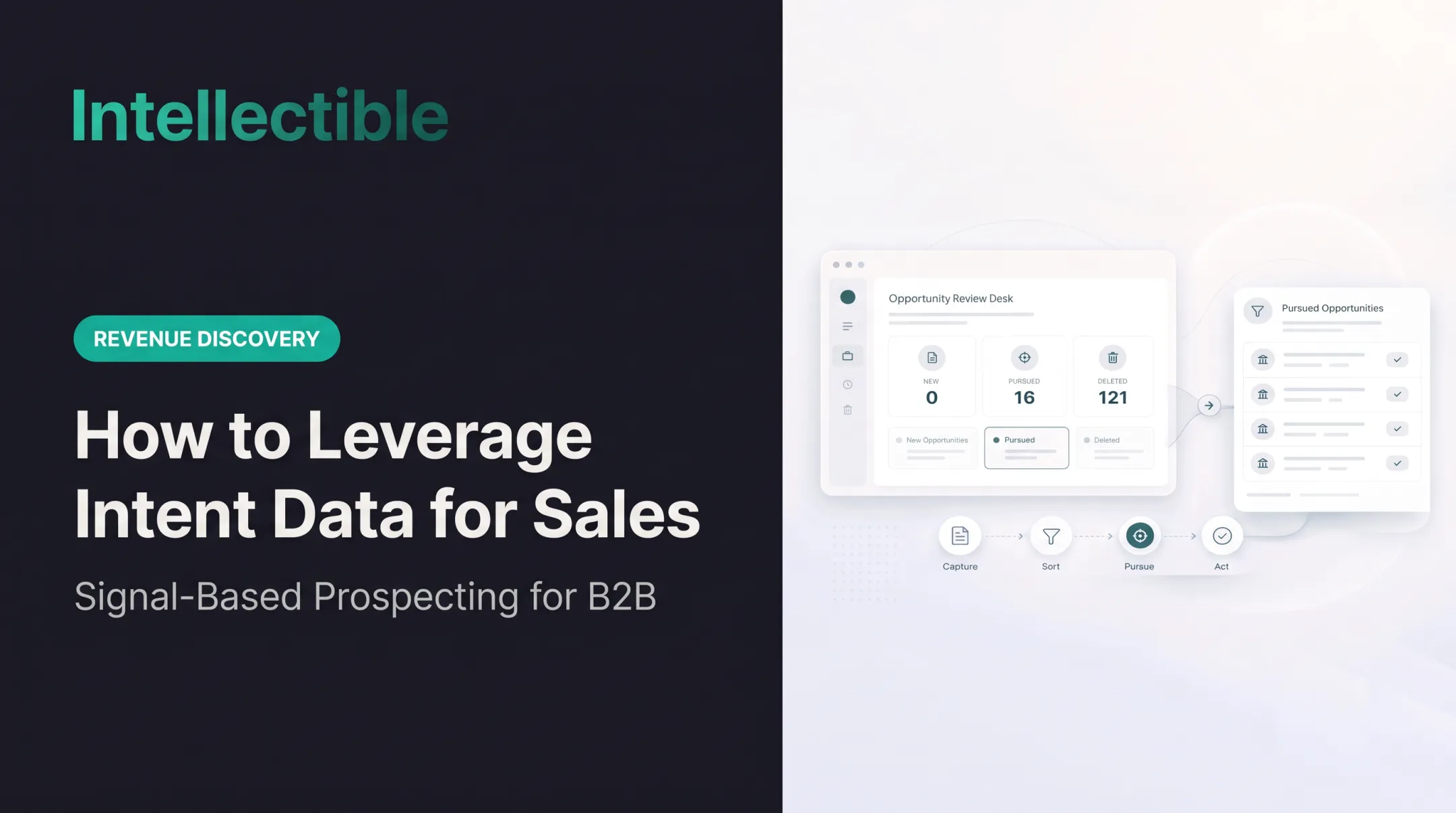
The full path runs in sequence:
- Signal capture and enrichment
- Scoring and account assignment
- Research and human review
- Outreach, CRM logging, and follow-up
- Outcome measurement

Define triggers, owners, and response rules
- Set routing thresholds and name the owner for each segment.
- Set response windows to fit the sales motion.
- Decide when a signal triggers an alert, a task, campaign enrollment, or a research brief.
- Add human checkpoints so reps approve messaging, suppress unsuitable contacts, and block automation on weak evidence.
Connect intent data to the existing revenue stack
Map intent into the CRM, sales-engagement tools, marketing automation, and dashboards. Know which integrations are live and which still rely on manual spreadsheet exports. For example, 6sense documents a nightly Salesforce change sync.
Get the basics right before you scale:
- Deduplication and account hierarchies
- Ownership fields and opportunity-stage awareness
- Consistent activity logging
Pick one source of truth for intent-driven actions.
Build an auditable operating layer
Connect each opportunity to the originating signal and source record. Distinguish sourced pipeline from influenced pipeline, remove duplicate opportunities, and compare like-for-like segments. Use a pilot cohort and a comparable baseline to understand whether the program improves results rather than merely attaching credit to deals already underway.
- Source, timestamp, and topic
- Score and the reasoning behind it
- Action taken and rep feedback
- Eventual outcome
That trail shows why an account entered or left a play.
Use configurable automation where the process is complex
Some enterprises have CRM structures, approval rules, and account hierarchies that off-the-shelf tools don't fit. Intellectible is one example of a configurable AI build platform. It includes:
- A visual workflow builder with code nodes and human review steps
- PostgreSQL databases plus API and webhook connections
- A Revenue Discovery engine that follows Detect, Gate, Promote, Draft, Approve, Call
Approval is required before outreach and CRM updates, so you can match the workflow to your methodology without rebuilding infrastructure each time.
Pilot, learn, and expand
Start with one segment, use case, or intent topic. Define the control group, workflow owner, qualification rules, and success criteria up front. Then feed accepted and rejected signals, meeting quality, pipeline progression, and closed outcomes back into scoring and play design before adding teams or regions.
Challenges, Governance, and Measurement
Common limitations and safeguards
Expect these problems:
- False positives from students, researchers, competitors, bots, and overly broad topics
- Stale signals (Forrester flags rapid decay)
- Incomplete account matching and distributed workforces
- Duplicate records and thin contact data
Mitigate these risks with:
- Multi-signal validation and ICP filters
- Recency limits and baseline comparisons
- Manual review and suppression rules
- Provider audits and steady CRM hygiene
Use an evaluation scorecard with eligible accounts surfaced, evidence completeness, rep acceptance rate, time to first touch, meetings per signal type, sales-accepted opportunities, and pipeline from accepted signals. Give each metric an owner, denominator, reporting period, and a definition that sales and RevOps both accept.
Privacy and responsible use
Avoid blanket compliance claims. US rules vary by state and channel:
- California's CCPA no longer has B2B or employee exemptions (they expired December 31, 2022).
- Colorado, Virginia, and Texas define "consumer" to exclude commercial or employment contexts.
- CAN-SPAM covers B2B commercial email, including opt-outs honored within 10 business days.
- TCPA consent rules apply to certain autodialed calls and texts.
Ask each provider how it collects data and handles consent, opt-outs, deletion, retention, and processing. Have counsel review your use case. In messaging, reference a business issue or public initiative, never an individual's observed behavior.
Measure business impact
Track:
- Signal coverage, match rate, and enrichment quality
- Time from signal to action and rep adoption
- Response rate and meeting quality
- Opportunity creation, pipeline progression, and win rate
- Sales-cycle movement, expansion, and revenue influence
Compare intent-led accounts against a control group. Treat vendor case studies cautiously. Reachdesk's reported 35% win rate with 6sense, for example, discloses no sample size or control group.

Conclusion
Intent data works as a prioritization and orchestration layer. It doesn't replace qualification, discovery, relationships, or accurate account data. Your action sequence:
- Audit the signals you already have.
- Define your ICP and scoring model.
- Connect data to workflows you own.
- Pilot one sales play.
- Protect privacy and keep humans in the loop.
- Measure outcomes through the CRM.
Frequently Asked Questions
What should a six-figure intent contract be judged on?
A six-figure contract buys access to capabilities and data, not a guaranteed pipeline outcome. Begin with the accounts and service purchases the team must find, then test whether the program supplies evidence that sellers can use. Define success before the renewal conversation or vendor demonstration.
What belongs in the evaluation scorecard?
Use an evaluation scorecard with eligible accounts surfaced, evidence completeness, rep acceptance rate, time to first touch, meetings per signal type, sales-accepted opportunities, and pipeline from accepted signals. Give each metric an owner, denominator, reporting period, and a definition that sales and RevOps both accept.
How is rep acceptance measured?
Rep acceptance rate is accepted accounts divided by accounts submitted for review. Track acceptance reasons and rejection reasons separately. A high acceptance rate still needs to translate into qualified conversations and sales-accepted opportunities; do not substitute account engagement or marketing-qualified volume for that handoff.
How should pipeline be attributed?
Connect each opportunity to the originating signal and source record. Distinguish sourced pipeline from influenced pipeline, remove duplicate opportunities, and compare like-for-like segments. Use a pilot cohort and a comparable baseline to understand whether the program improves results rather than merely attaching credit to deals already underway.
How should this process be put into practice and measured?
Include subscription, contact data, seats, integrations, implementation, source access, and operating time in the cost model. For an illustrative break-even calculation, divide annual program cost by contribution profit per incremental win; label assumptions clearly. An expected benefit is a model, not a promised customer result. Make the renewal decision from accepted-opportunity economics, seller use, coverage gaps, and the quality of the evidence-to-action process. Continue, change, or stop the program according to the agreed scorecard. More warm accounts on a dashboard are not sufficient proof of commercial value.