Why 5,000 Accounts Need a Prioritization System
No enterprise team can research, contact, and manage 5,000 accounts with equal depth. An undifferentiated list scatters effort and leaves the accounts that matter most under-covered.
The problem gets worse when sellers have little time to sell. Salesforce's 2026 State of Sales survey of 4,050 sales professionals found reps spend 40% of their time selling and 60% on other work.
The purpose of prioritizing 5,000 accounts is to select the few worth working this week. Apply fit gates first, then timing and change, evidence quality, and seller actionability. A worked example should explain how the team reaches a capacity-based queue instead of giving every account a score without a next step.
This guide covers a five-step framework:
- Clean the account universe
- Score fit and readiness
- Assign five capacity-based levels
- Tie each level to a sales play
- Keep updating the ranking
Key Takeaways
- Score accounts on ICP fit, commercial value, signals, relationships, engagement, and committee coverage.
- Set five priority levels by real seller capacity, not arbitrary percentages.
- Promote and demote accounts as signals and relationships change.
- Judge the model by pipeline progression, win rate, and deal economics by level.
Build the Account Prioritization Framework
Define what "priority" means
Start with the decisions the model must support:
- Which accounts get first research attention
- Which get executive outreach
- Which enter active pursuit
- Which stay in automated nurture
Start with fit gates that remove accounts your team cannot serve: unsuitable geography, service scope, account size, contractual exclusions, and an incorrect buying entity. Do not allow a high engagement score to rescue an ineligible account. Keep exclusions and unresolved data separate so the model can be reviewed.
Prepare and segment the universe
Clean before you score. Validity's 2024 CRM survey of 600+ administrators found that 24% said less than half their CRM data was accurate and complete. Scoring bad records just ranks bad data.
- Deduplicate records and normalize company names
- Link parents to subsidiaries
- Remove inactive or invalid records
- Assign an owner to every account
Then segment by market, industry, account type, territory, customer status, opportunity status, and sales motion. One model applied to everything hides real differences between groups.
Define ICP and commercial-fit criteria
Cover:
- Company size, industry, and business model
- Technology environment and use-case fit
- Procurement or regulatory complexity
- Serviceability and expected cost to win and serve
- Contract value and expansion potential
Derive these from your own closed-won, closed-lost, expansion, churn, and sales-cycle data. Don't rely on leadership assumptions or an attractive logo list. Accounts that bought and stayed are positive evidence. Churned customers are negative evidence.
Add relationship and strategic context
Layer in:
- Existing contacts and executive access
- Partner introductions and references
- Prior opportunities and competitors
- Open initiatives and known constraints
Reps must challenge machine rankings. Account politics, incumbent contracts, procurement timing, and recent conversations rarely live in the CRM.
Validate before full deployment
Test the criteria against historical accounts and a small representative sample first. Then apply them to all 5,000 records. Expect directional improvement, not guaranteed results.
Score 5,000 Accounts Without Losing Enterprise Context
Work Through a Fit-to-Capacity Example
Keep the model small enough that reps trust it. Useful categories:
- Fit
- Account value
- Buying readiness
- Relationship strength
- Engagement
- Strategic importance
- Execution risk
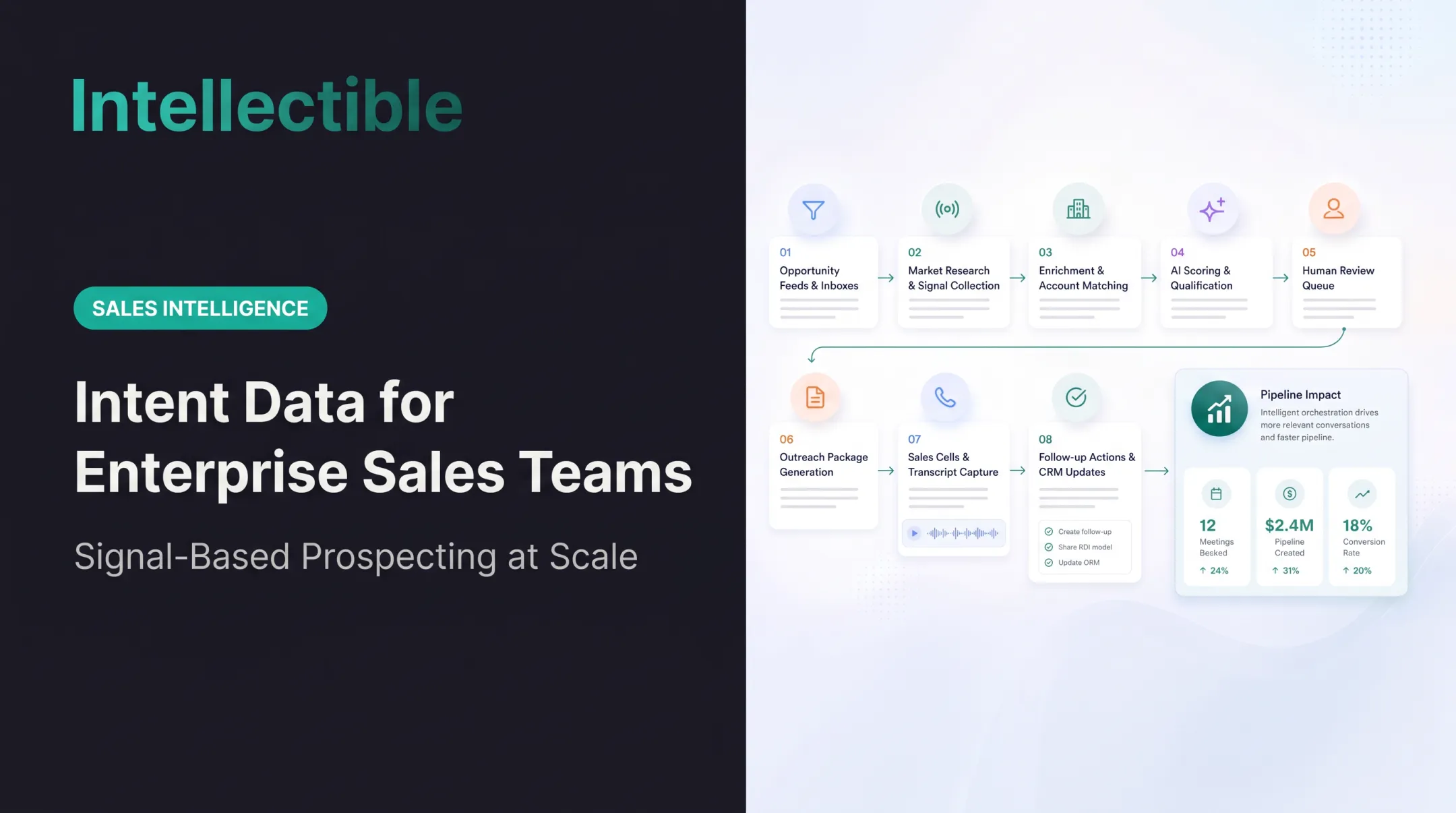
A worked example makes the sequence concrete: begin with 5,000 accounts, retain 1,800 that pass fit gates, identify 320 with relevant recent changes, verify evidence and an open buying window for 90, and assign the strongest 40 to this week’s available seller capacity. These are illustrative numbers, not an Intellectible case-study result.
Build a transparent rubric
Use observable rules, consistent rating bands, and explicit evidence requirements. "Strong fit" is not a rule. "Operates 10+ sites and runs a compatible CRM" is.
Here is a fictional example, not real company data. Northvale Logistics scores:
| Factor | Evidence | Score (0-10) |
|---|---|---|
| Fit | Right industry and size, compatible stack | 9 |
| Urgency | New COO and an active hiring surge | 8 |
| Relationship access | One mid-level contact | 4 |
| Engagement | Three people visited pricing pages | 7 |
| Risk | Incumbent contract renews in 14 months | 5 |

Fit and urgency are strong, but access and timing pull the account below the very top.
Handle missing, stale, or conflicting data
Distinguish a low score from an unknown score. Missing information should trigger enrichment or review, not an automatic "poor prospect" label.
Add a data-confidence field showing whether a score rests on verified current data, older CRM data, third-party estimates, or incomplete records.
Aggregate signals across the buying committee
6sense's account prioritization guide scores profile fit, intent, buying stage, engagement, and reach, with reach reflecting identified and active buying-group members. Useful signals include:
- First-party engagement and intent activity
- Leadership changes and hiring patterns
- Funding, M&A, and strategic initiatives
- Technology changes and procurement activity
Aggregate across contacts and functions. One hyperactive individual should not inflate an account score, and broad engagement should not collapse into a single lead score.
Score in batches, then route exceptions
Score the full universe automatically. Then send high-value, low-confidence, contradictory, or strategically sensitive accounts to sales or revenue operations. Preserve the reasons behind every score so sellers can correct bad inputs without rebuilding the model.
Test against outcomes
Compare historical scores with opportunity creation, stage progression, cycle length, win rate, deal value, expansion, and loss reasons. Keep the factors that predict progress. Recalibrate when the ICP changes, you launch a new offer, or a favored signal stops correlating with revenue.
Convert Scores Into Capacity-Based Priority Levels
Use five levels instead of making everything Tier 1
Five levels is a capacity design, not an industry standard. Set boundaries from seller capacity and historical performance. Published ABM motions (one-to-one, one-to-few, one-to-many) offer a useful parallel, though they don't prescribe account counts.
- Priority 1: Strategic accounts with exceptional value and a credible reason for immediate, coordinated pursuit.
- Priority 2: High-potential accounts needing active ownership and tailored outreach, possibly more signal development or access.
- Priority 3: Good-fit accounts with structured, semi-personalized engagement that move up on meaningful activity.
- Priority 4: Accounts monitored through scalable programs and trigger-based review.
- Priority 5: Weak-fit, low-potential, data-poor, or poor-economics accounts in automation, suppression, or future reassessment.
Set thresholds around capacity
Start with how many accounts each rep can realistically research, multi-thread, and advance. Fill the highest-touch levels with the top-ranked accounts.
Salesforce's territory guidance notes the trade-off: too many accounts and high-potential prospects get overlooked; too few and targets are hard to hit.
A level matters only if it changes ownership, research depth, outreach frequency, and marketing or executive support.
Match each level to a play
| Level | Play |
|---|---|
| Priority 1 | Custom account plan, stakeholder map, executive alignment, tailored value hypothesis, coordinated outreach, frequent signal review |
| Priority 2 | Account-specific research, multi-contact sequences, segment personalization, scheduled owner reviews |
| Priority 3 | Reusable messaging with account-specific evidence, scalable events and content, seller intervention on signals |
| Priority 4-5 | Automated nurture, broad education, enrichment, suppression rules, promotion on predefined signals |
Define promotion and demotion rules
Promote on:
- New executive or strategic initiative
- Active evaluation or repeated stakeholder engagement
- Partner introduction, new funding, or a meaningful buying-group response
Demote on:
- Stalled opportunities, departed champions, or lost access
- Budget changes, inactive engagement, or poor economics
- Duplicates or ICP mismatch
Build committee coverage into the decision
Priority 1 and 2 plans should name the economic buyer, champion, technical evaluator, end users, procurement, legal, security, and likely blockers. 6sense's buying group research describes a typical group of about 10 people.

An account with one enthusiastic contact and no wider coverage needs a relationship-building play before a top-level classification.
A practical decision example
Three fictional accounts share similar firmographic fit:
- Alder Health: a new CIO, an active vendor evaluation, and contacts across IT, finance, and security. Priority 1.
- Brightline Manufacturing: strong fit and a funding round, but one champion and no executive access. Priority 2, with a stakeholder-building plan.
- Corvid Freight: good fit, no signals, and a long incumbent contract. Priority 4, monitored for triggers.
Make Prioritization Operational With Signals, Workflows, and Team Alignment
Refresh priorities as conditions change
Separate scheduled model reviews from continuous signal monitoring. Define three event classes:
- Alert only, such as a news mention
- Automatic score change, such as a new funding round
- Human confirmation required, such as a departed champion on a Priority 1 account
Connect the model to seller workflows
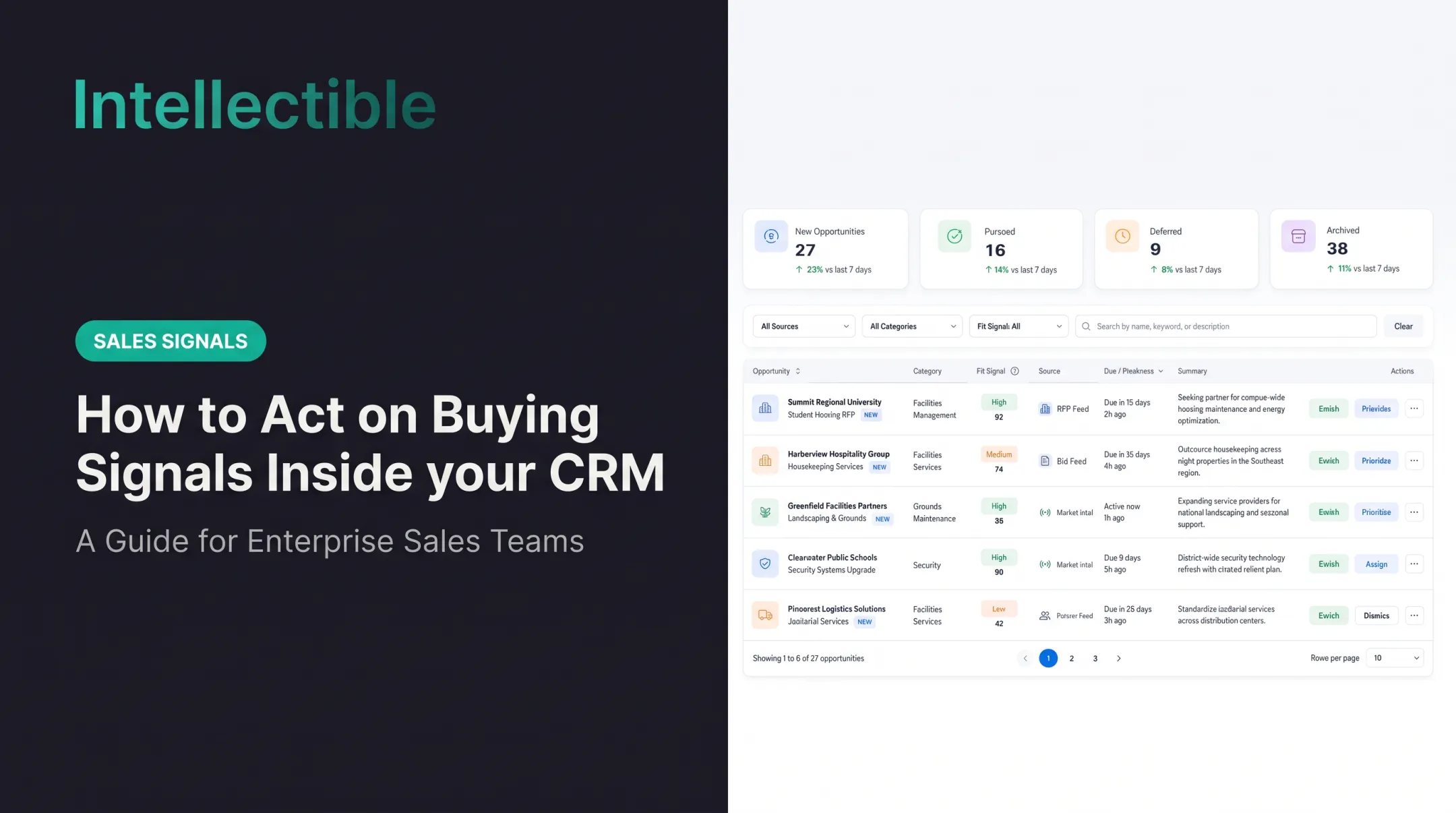
Surface rankings where sellers already work: the CRM, daily seller queue, research brief, opportunity review, and management dashboard. Every score should lead to a next action.
Assign clear owners:
- Sales operations: data quality and scoring logic
- Sellers: signal review and exceptions
- Sales leadership: reassignment decisions
- Marketing: support aligned to each level
Use automation without removing judgment
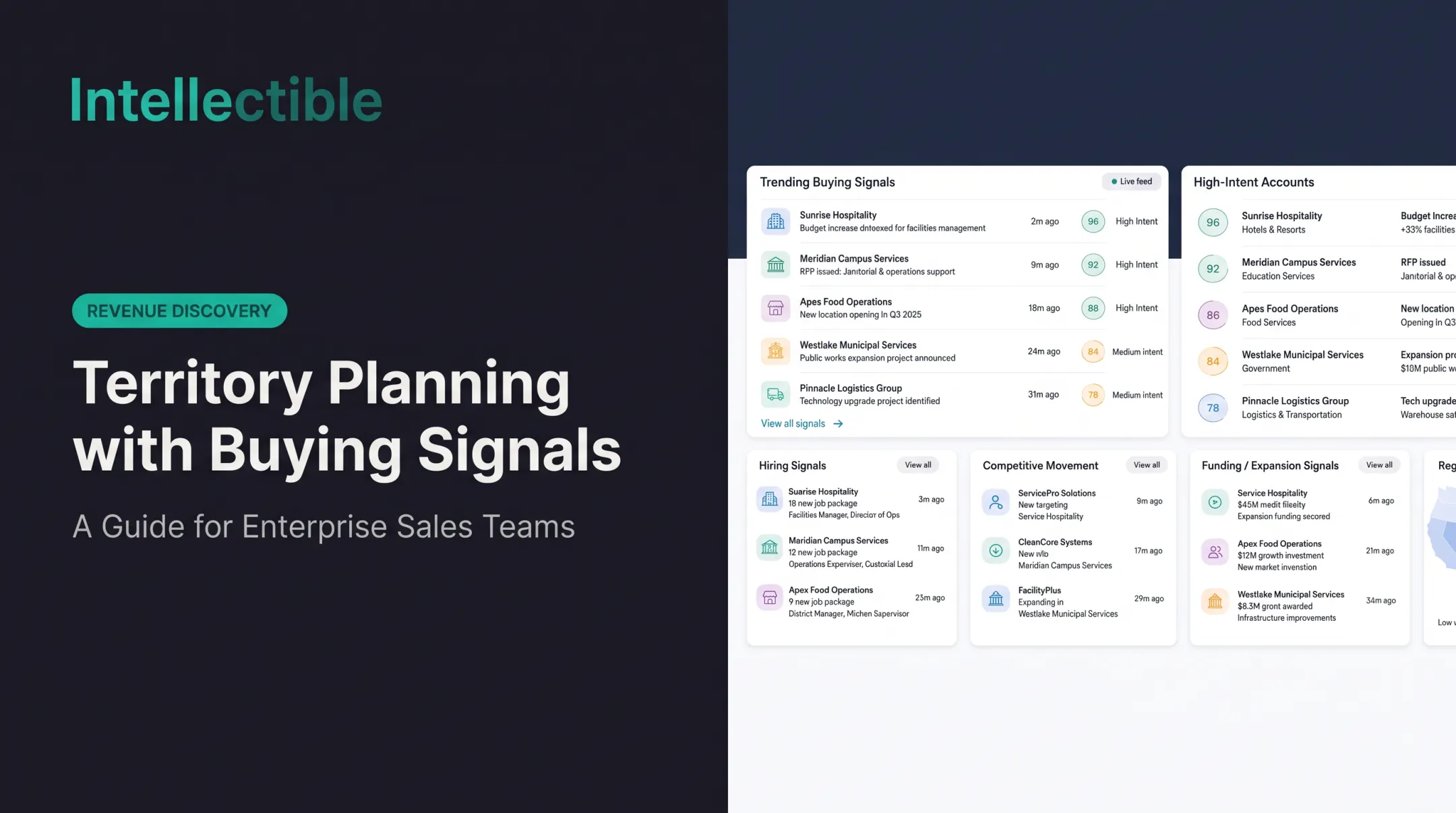
Intellectible's Revenue Discovery engine is one option for a connected workflow. It scores accounts on fit and urgency with editable signal weights and tracks signals on set schedules.
Accounts sort into queues such as Contact Now, Research Needed, Nurture, and Qualified. Approval gates require human sign-off before outreach or CRM updates, and each score carries its reasoning.
Automation should cut repetitive research and admin. Sellers keep relationship context, account politics, messaging, and final pursuit decisions.
Measure, Refresh, and Improve the Model
Track progression, not activity alone
Use three layers of measures, as 6sense's ABM metrics guide suggests:
- Leading: account coverage, stakeholder engagement, signal response, meeting quality
- Pipeline: opportunity creation, stage progression
- Outcomes: win rate, deal value, cycle length, expansion, retention
Compare by priority level and segment. If Priority 1 accounts don't outperform lighter-touch ones, the model or the plays need work.

Audit ranking quality and adoption
Review ranking quality on a regular cycle:
- False positives and false negatives
- Stale accounts and ignored alerts
- Wrong ownership
- Accounts sellers keep overriding
Check that sellers understand why accounts rank where they do, and that time allocation actually follows the levels.
Set a governance cadence
- Operational reviews for data quality and exceptions
- Periodic business reviews for scoring performance
- A deeper refresh when ICP, product strategy, territories, or economics change
No universal recalibration schedule exists, so judge drift against your own account outcomes. Every review should end in actions:
- Recalibrate a factor
- Enrich a segment
- Change a play
- Move accounts
- Retire a signal
- Reassign capacity
Frequently Asked Questions
Which account gates should come first?
Start with fit gates that remove accounts your team cannot serve: unsuitable geography, service scope, account size, contractual exclusions, and an incorrect buying entity. Do not allow a high engagement score to rescue an ineligible account. Keep exclusions and unresolved data separate so the model can be reviewed.
What does a 5,000-to-40 worked example look like?
A worked example makes the sequence concrete: begin with 5,000 accounts, retain 1,800 that pass fit gates, identify 320 with relevant recent changes, verify evidence and an open buying window for 90, and assign the strongest 40 to this week’s available seller capacity. These are illustrative numbers, not an Intellectible case-study result.
How should timing be evaluated?
Evaluate timing and change after fit. Relevant changes might include a new location, an operations leader, an approaching procurement date, or evidence of an incumbent problem. Record source date and event date separately, and check that the account still has a decision your team can influence.
What makes an account actionable?
Rank evidence quality before increasing outreach volume. A named account, source document, relevant buyer, clear date, and useful next step make an account actionable. Missing or contradictory facts move it to research-needed; weaker timing can go to nurture or monitor rather than to an overloaded rep.
How should sales capacity determine queue size?
Set weekly queue sizes from actual research and selling capacity. Compare territories by eligible account coverage and current signal density, not raw logo count. Reassign work transparently when capacity changes, retaining ownership history and the reason an account moved.
How should prioritization improve over time?
Review acceptance, disqualification reasons, first-touch time, sales-accepted opportunities, and pipeline by segment. Refresh source data and thresholds using seller feedback. The objective is a defensible list of accounts worth working now, not a precise-looking score attached to every company.