Opportunity scoring software fixes the guesswork problem. It ranks bids against your actual fit and past performance, so your team spends limited proposal hours on pursuits you can realistically win. This guide covers what opportunity scoring is, how it works, what data it needs, and how to pick the right platform.
Key Takeaways
- Track fit, readiness, and PWin as separate metrics—not one blended score
- Unscored pipelines waste capture hours and inflate forecasts with no-shot deals
- AI surfaces win/loss patterns; relationships and competitive nuance still need human judgment
- Bad input data creates false confidence: a wrong score is worse than no score
What Is Opportunity Scoring Software and Why It Matters
Opportunity scoring software evaluates each bid against defined criteria, such as fit, past performance, and delivery capacity, and produces a ranked, prioritized pipeline. Instead of one binary go/no-go call, you get a live-ranked list showing exactly where to spend proposal hours.
Unscored pipelines cost more than they appear to:
- Capture resources get spread across too many low-probability pursuits
- Proposal inputs arrive late because nobody flagged priority early
- Revenue forecasts inflate with deals that were never truly winnable
The stakes are real. CohnReznick and Unanet found that 40% of firms won more than half of their submitted proposals in 2024, up from just 25% in 2021—a gap driven largely by better qualification discipline, not more bidding.

Scoring shouldn't wait for the RFP to drop. The earliest signals (recompete windows, agency forecasts, sources-sought notices) let you qualify (or disqualify) an opportunity months before the solicitation posts. By the time a bid officially opens, the strongest scoring models have already been tracking it for weeks.
Core Criteria: How Bids Get Ranked by Fit and Past Performance
Effective scoring separates two distinct evaluation tracks: fit and past performance. Blending them into one number hides the real story.
Fit Scoring Dimensions
Fit measures whether an opportunity matches your business, regardless of whether you're likely to win it today.
- Strategic alignment — target agencies, NAICS/PSC codes, contract vehicles, and set-aside eligibility
- Solution fit — how clearly your capabilities map to the customer's stated outcomes and requirements
- Customer relationship — existing contacts, incumbent status, and prior engagement with the buyer
- Competitive position — incumbent strength, likely competitors, and your relative differentiators APMP's guidance on bid/no-bid data reinforces this: firms should use prior solicitations and project-performance data to make informed pursuit calls, not gut instinct.
Past Performance Scoring Dimensions
Past performance measures whether you can prove you've done this before, and recently.
- Relevance and recency — match solicitation requirements against a structured past performance library
- Contract access — whether you can bid directly or need a teaming/vehicle strategy
- Delivery capacity — staffing and certifications to perform if you win
Those two tracks often feed one prioritization scorecard. Keep them as separate weighted inputs so you can see which side is weak:
Dimension Weight Score Basis Strategic alignment 30% NAICS/PSC match, vehicle access, set-aside eligibility Customer relationship 20% Existing contact, incumbent status, past engagement Past performance 30% Relevant, recent, similarly scoped contracts Competitive position 20% Incumbent strength, differentiator clarity FAR 15.305 requires solicitations to spell out exactly how past performance will be evaluated, including how offerors with no relevant history are treated — which is exactly the kind of nuance a scoring engine needs to account for.

How AI-Powered Opportunity Scoring Software Works
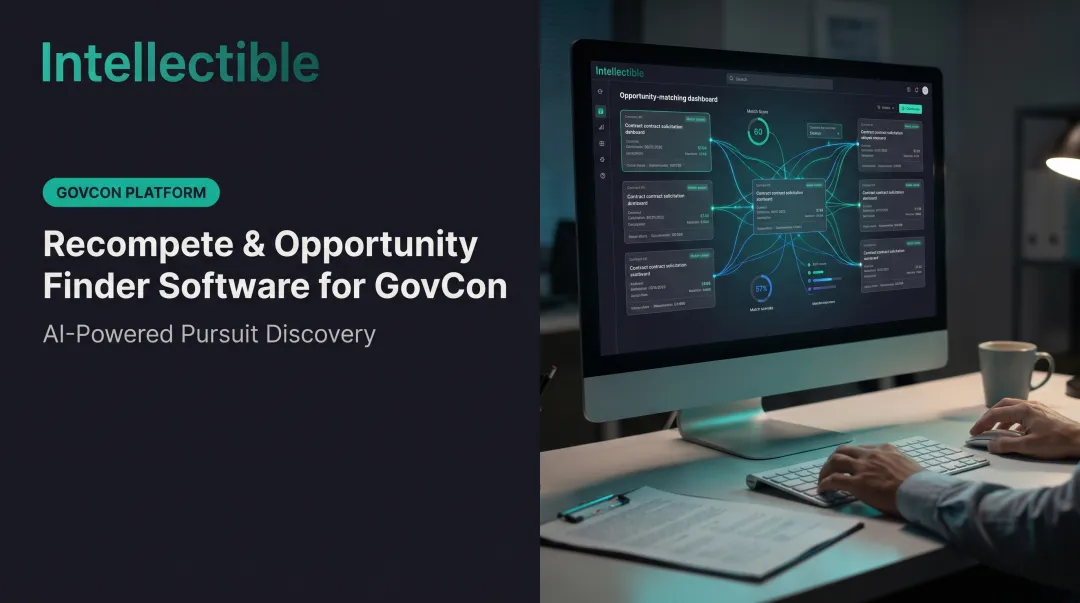
AI-driven scoring ingests solicitation data, your capability profile, and historical win/loss records to generate fit and PWin scores automatically, no spreadsheet required. What good AI scoring does:
- Flags missing qualification data before a human makes the final call, including stale competitive intel, incomplete past performance, and unverified staffing capacity
- Updates scores automatically as amendments land, instead of going stale between gate reviews
- Improves over time by comparing predicted scores against actual award outcomes Deltek's 2025 research found the top 10% of self-reported win-rate performers already lean on AI, proposal automation, and early lead identification. Intellectible's GovCon Engine applies that approach in practice. It scores opportunities against configurable fit criteria—target agencies, NAICS/PSC, deal-size thresholds, certifications—and market signals like award history, bidder density, and incumbent patterns. Each notice becomes a structured record with agency, office, NAICS, PSC, timing, scope, and a fit rationale attached. Those records feed directly into Go/No-Go workflows without manual re-entry. Oceus, one of Intellectible's clients, saw qualified opportunities per week more than double, with roughly seven to eight opportunities per month now clearing their qualification bar. HHS's business development team reported the platform removed the "tedious, monotonous hours" of early RFP triage. Across the platform, clients have seen 95%+ time saved on opportunity search and Go/No-Go decisions, plus 150%+ growth in actionable pipeline opportunities.

Why Manual Go/No-Go Processes Fall Short
Manual processes fail in predictable ways.
- Informal spreadsheets and gut calls leave decisions to whoever is loudest in the room, not documented evidence
- Self-reporting bias lets capture managers inflate relationship or competitive scores on pursuits they're already invested in
- Disconnected data across SAM.gov, CRM notes, and shared drives means scores go stale the moment new intel arrives

Washington Technology's bid/no-bid research recommends a scorecard built around the top seven leading indicators of whether a bid will be won — a structure most manual processes never formalize.
There's a deeper problem too: without tracking predicted scores against actual outcomes, teams have no feedback loop. They keep making the same qualification mistakes because nobody's measuring whether last quarter's "strong fit" calls actually won.
Choosing the Right Opportunity Scoring Software
Not all scoring tools are built the same. Before you commit, check for these:
- Data connectivity: Does it plug into your existing past performance library and CRM, or force you to rebuild a separate database from scratch?
- Downstream flow: Does the score feed directly into capture, proposal, and pricing workflows, or does someone have to re-enter data at each handoff?
- Customization: Can you set your own scoring weights, or are you stuck with a generic industry template that doesn't reflect your actual business rules?
Intellectible is a horizontal AI build platform, not a single-purpose scoring tool—so those three checks are configuration choices, not integration projects. Revenue and pursuit teams set their own scoring workflows and business logic (deal-size thresholds, certifications, geographic preferences, disqualifiers) on top of existing systems, then push scores into capture, proposal, and pricing work without re-keying data.
The process scales with your pipeline, not your headcount.
Frequently Asked Questions
How should past performance be weighted against fit?
Relevance and recency carry more weight than volume: a smaller, closely comparable contract usually scores better than a large unrelated one. FAR 42.1501 treats past performance as key source-selection information, so a scoring model that ignores recency will overstate your position on older work.
What data does a scoring model need to rank an opportunity?
At minimum: the solicitation's requirement and NAICS, your relevant contract history, incumbent and competitor position, and contract-vehicle access. Scoring quality tracks the completeness of that inventory, not the sophistication of the algorithm sitting on top of it.
Can opportunities be scored before the RFP drops?
Yes, and that is where scoring earns its keep. Agency forecasts and award records carry enough signal to rank a pursuit while there is still time to shape it. Scoring only at solicitation release means ranking work you can no longer influence.
How should contract-vehicle access weigh in a fit score?
Treat it as a gate before it is a score. If the work will be competed on a vehicle you do not hold, fit is capped no matter how strong the past performance match looks. Teams that score vehicle access late end up ranking pursuits they cannot actually bid.
How is fit different from probability of win (PWin)?
Fit measures strategic alignment: whether the opportunity matches your capabilities and target market. PWin reflects your current likelihood of winning based on available competitive evidence. Both matter, and both should be tracked as separate metrics.
Can opportunity scoring software replace human judgment in bid decisions?
No. AI improves consistency and flags missing data, but final pursuit decisions still require human knowledge of relationships and competitive dynamics that scoring models can't fully capture. The strongest workflows keep analysts in the loop, using automation to inform, not replace, the decision.