That moment — where an opportunity either becomes a real pursuit or gets archived — is where understanding RFPs stops being academic and starts mattering operationally.
This article covers what an RFP actually is, how it functions differently in software procurement versus government contracting, how the process runs from issuance to award, and what separates winning responses from disqualified ones.
Key Takeaways
- An RFP is a formal solicitation requesting a full solution proposal — more comprehensive than an RFI (information gathering) or RFQ (pricing only)
- Government RFPs are legally governed by the FAR; private-sector RFPs vary by buyer policy
- Federal opportunities are published on SAM.gov; missing registration requirements can disqualify you before evaluation begins
- Weighted scoring matrices drive most evaluations — respond in the buyer's stated order, addressing their exact criteria
- Win rates improve through selective bidding and disciplined go/no-go decisions, not by submitting more proposals
What Is an RFP? Core Definition and Purpose
A Request for Proposal (RFP) is a formal document issued by a buyer — a government agency, enterprise, nonprofit, or educational institution — that describes a specific need and invites qualified vendors to submit competitive proposals covering their proposed solution, approach, timeline, and pricing.
Three reasons organizations issue RFPs:
- Drive competition — structured comparison keeps pricing honest and surfaces better solutions
- Define scope — the RFP process forces the buyer to articulate requirements clearly before engaging vendors
- Ensure compliance — particularly in government, procurement regulations mandate competitive solicitation above certain thresholds
RFP vs. RFI vs. RFQ
These three instruments are frequently confused but serve distinct purposes:
| Instrument | Stage | What It Seeks |
|---|---|---|
| RFI (Request for Information) | Market research, pre-solicitation | Market intelligence; no award intended |
| RFQ (Request for Quotation) | Price comparison | Pricing only; a quotation is not a binding offer |
| RFP (Request for Proposal) | Competitive source selection | Full solution proposal against stated requirements |
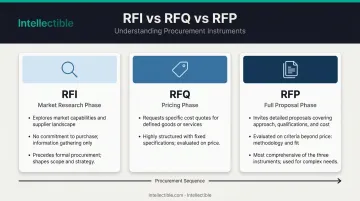
Per FAR 15.201 and FAR 13.004, an RFI does not commit the government to award, and a quotation is not a binding offer. The government's subsequent purchase order is. An RFP, governed by FAR 15.203, applies to negotiated acquisitions where the government evaluates full proposals against disclosed evaluation factors.
Who issues RFPs? Any organization with formal procurement requirements:
- Federal, state, and local agencies — often legally required to solicit competitively above set dollar thresholds
- Large enterprises managing complex technology purchases
- Nonprofits operating as federal award recipients
- Educational institutions subject to grant or institutional procurement rules
The issuing entity determines how formal and regulated the process will be.
RFP in Software Procurement: How It Works
A software RFP is issued when an organization needs to select a vendor for a specific technology need (custom development, a SaaS platform, an ERP implementation, IT services) and cannot make that decision responsibly without structured, comparable information from multiple vendors.
What a Software RFP Typically Contains
A well-structured software RFP covers:
- Company background and current environment
- Project goals and specific pain points
- Functional and technical requirements (scope of work)
- Architecture, integrations, security, and scalability requirements
- Implementation, training, and support expectations
- Budget range and commercial assumptions
- Submission timeline and format requirements
- Evaluation criteria with relative weighting
How Vendors Are Evaluated
Buyers typically use a weighted scoring matrix that assigns different weights to criteria such as functionality, cost, vendor experience, and scalability. Research from Responsive shows that one common model weights functionality at 40% — but these are illustrative, not universal. The key principle: weights should be set before proposals arrive and published where required.
Evaluation typically moves through:
- Initial scoring against the weighted matrix
- Shortlisting to 1–3 finalists (Forrester recommends keeping the reviewed list small)
- Reference checks, demos, or oral presentations
- Negotiation and award
The Vendor's Perspective
Understanding how buyers score proposals changes how vendors should respond. Each section of a strong submission addresses the buyer's pain points directly, demonstrates measurable value rather than feature lists, and gives evaluators confidence — while they're reading multiple competing submissions at the same time.
Consider a mid-sized organization issuing an RFP for a CRM or project management SaaS solution. Their RFP will likely include sections on current-state problems, required integrations, user adoption expectations, data security protocols, and support SLAs. A winning vendor response mirrors that structure, answers each criterion in the stated order, and gives concrete evidence for every capability claimed.
RFP in Government Contracting: Key Differences
Government RFPs differ from private-sector ones because they are legally governed by procurement regulations — primarily the Federal Acquisition Regulation (FAR). FAR compliance is a legal requirement, not a formatting preference. It mandates how solicitations are structured, publicized, and awarded to ensure fairness and prevent favoritism.
Where Government RFPs Are Published
Federal opportunities appear on SAM.gov. State and local opportunities are published on individual agency portals. Contractors must actively monitor these sources — opportunities don't come to you.
Structure of a Federal RFP
The Uniform Contract Format (FAR 15.204) creates a standardized structure that proposal teams must understand:
| Section | Content |
|---|---|
| Section C | Statement of Work (SOW) or Performance Work Statement (PWS) |
| Section L | Instructions to offerors — how to format and submit |
| Section M | Evaluation factors and their relative importance |
| Section K | Representations and certifications |
| Sections H–I | Special requirements and contract clauses |
The practical rule: build your response outline from Sections L and M, then trace every requirement back through C, H, I, and J.
Unique Challenges of Government RFPs
- Deadlines are firm — agencies reject late submissions without exception, regardless of technical issues on the submitter's end
- Registration requirements — offerors must be active in SAM.gov at submission and at award; a CAGE code is required per FAR 52.204-16
- Past performance documentation — must be verifiable, correctly formatted, and directly relevant to the requirement
- Set-aside eligibility — the SBA administers the 8(a) Business Development Program (socially and economically disadvantaged small businesses), HUBZone (historically underutilized business zones), and SDVOSB (service-disabled veteran-owned firms)
- Contract vehicles — GWACs and IDIQs create eligibility to compete for task orders, not guaranteed revenue
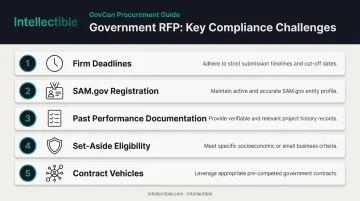
Missing a registration requirement or failing to address evaluation factors in the correct order can result in disqualification before evaluation begins.
The RFP Process: From Issuance to Award
Issuing Side (Buyer's Steps)
The buyer's process runs through four stages:
- Define goals, assemble an evaluation team, and set weighted criteria before any RFP is drafted
- Write clear requirements and set realistic timelines — then publish. Per FAR 5.203, synopsized actions require at least 15 days' notice before issuance and 30 days from issuance for proposal submissions on non-commercial acquisitions above the Simplified Acquisition Threshold
- Evaluate proposals against the weighted matrix — score independently before consensus discussions
- Shortlist, conduct reference checks or demos, negotiate, award, and issue required notifications
The quality of the RFP directly determines the quality of proposals received. Vague requirements produce vague responses — and vendors who recognize that vagueness early are the ones who make smarter go/no-go calls.
Responding Side (Vendor's Steps)
- Read the full solicitation — every section, attachment, and amendment before anything else
- Make a go/no-go decision before committing team resources
- Assemble a response team with relevant subject matter experts
- Tailor the proposal to the buyer's specific environment and stated priorities
- Submit on time with every required document, certification, and attachment
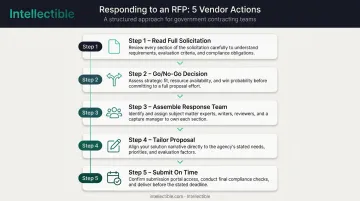
How to Respond to an RFP: Strategies for Contractors
Evaluators identify recycled templates immediately. A response that echoes the buyer's own language, addresses their stated pain points, and reflects knowledge of their operating environment signals genuine understanding — and that alone can set you apart from technically equivalent competitors.
Components of a Winning Response
- Executive summary that leads with the buyer's problem, not your company history
- Direct answer to every evaluation factor, in the stated order from Section M (government) or the evaluation criteria section (private)
- Specific differentiation — what you do that competitors don't, with concrete evidence
- Past performance tied to verifiable, similar-scope contracts
- Pricing structured precisely to the RFP's instructions, not a generic quote format
Getting the content right is only half the battle. Procedural mistakes can eliminate an otherwise strong proposal before evaluators read a single page.
Common Disqualifiers
- Missing required attachments, certifications, or representations
- Exceeding page limits
- Failing to address all evaluation factors
- Undefined jargon or undefined acronyms
- Submission errors — wrong format, wrong portal, wrong time zone
The Go/No-Go Decision: Pursuing the Right RFPs
Chasing every RFP is not a strategy. Each opportunity consumes real resources — Loopio's 2026 research reports that responding organizations spend an average of 33 hours per RFP response and submit 166 proposals annually. That workload compounds fast.
Evaluate each opportunity against these criteria before committing:
- Is this work within our demonstrated core capabilities?
- Do we have relevant, verifiable past performance?
- Is this a cold opportunity or an established buyer relationship?
- Can we credibly compete against the incumbent or likely bidders?
- Does the contract value justify the bid cost?
High-volume government contractors managing dozens of active solicitations simultaneously face the largest strain here. The decision to pursue or pass needs to be fast, defensible, and consistent. Manual processes rarely hold up at that pace.
Intellectible's Proposal & Pursuit Engine addresses this directly. The platform ingests federal notices from government portals and transforms each one into a structured capture record covering agency, NAICS/PSC codes, scope, fit rationale, and risk signals.
From there, it applies semantic fit analysis against a contractor's configurable capture profile. The output: an AI-generated go/no-go report scoring fit, urgency, risk, contract terms, and capability match — with the win thesis captured in the record. Hours of manual review become a structured, defensible document.
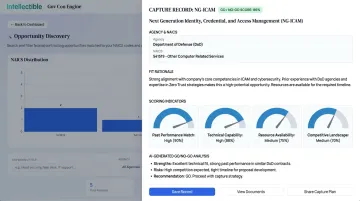
Oceus, a defense contractor, used Intellectible to double the qualified opportunities it surfaces and reviews each month. The platform delivers 95%+ time savings on opportunity search and go/no-go decisions, enabling teams to process more opportunities without adding headcount. For teams running at volume, that's what a proactive pipeline actually looks like in practice.
Frequently Asked Questions
What is an RFP in software?
A software RFP is a formal document issued by an organization to invite vendors to propose solutions for a specific technology need — such as a SaaS platform, ERP system, or custom development project. It includes requirements, evaluation criteria, submission guidelines, and timeline, enabling structured comparison across multiple vendors.
What is an example of an RFP for a software project?
A federal agency might issue an RFP for a cloud-based procurement management platform, covering data security protocols, FedRAMP authorization requirements, integration with existing financial systems, implementation timeline, and vendor support structure. Vendors respond to each section in the specified format and order.
What is the difference between an RFP, RFI, and RFQ?
Each document serves a different stage of procurement:
- RFI: Gathers market intelligence before a procurement decision is finalized
- RFQ: Focuses narrowly on pricing comparison among known vendors
- RFP: Requests a full solution proposal — approach, qualifications, timeline, and cost
In federal contracting, each carries different legal implications and competition requirements.
Are government agencies required to issue RFPs?
Federal agencies are generally required under the FAR to use competitive solicitations for procurements above the Simplified Acquisition Threshold — $250,000, with the micro-purchase threshold at $10,000. The requirement ensures fair competition and prevents favoritism, though the specific method (sealed bid vs. negotiated RFP) depends on the acquisition type.
How long does the government RFP process typically take?
Timelines vary considerably. GAO data shows a 32-day median for DOD transactions above $250,000 in FY2022, but 458 days for competed definitive contracts above $50M. Complexity, contract type, and agency all affect timing — there is no universal rule.
What makes a strong government contracting RFP response?
Strong responses directly address every evaluation factor in the stated order, include verifiable past performance in relevant scope areas, demonstrate compliance with all submission requirements, and articulate a clear, specific reason why this contractor is the right fit for this particular work — grounded in evidence, not broad claims.