Introduction
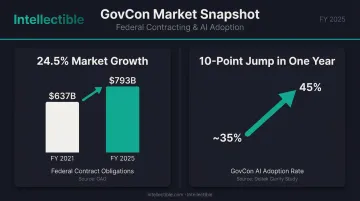
Federal contracting is a $793 billion market — and it grew roughly 24.5% between FY2021 and FY2025, according to GAO data. For BD teams already stretched thin, that growth means more solicitations to track, more Go/No-Go decisions to make, and more proposals to produce without any growth in headcount to absorb it.
The core problem isn't opportunity volume. It's the manual work buried inside every stage: scanning SAM.gov daily, scoring pursuits in spreadsheets, chasing approvals across email threads, and rebuilding pricing models from scratch every single bid.
Bid automation addresses this directly — but the tools available don't all cover the same ground. Some focus on discovery. Others on proposal drafting. A few attempt the full lifecycle. Choosing the wrong one means solving one bottleneck while ignoring the rest.
This guide evaluates the top bid automation tools for GovCon teams: what each one actually does, where it falls short, and how to match a tool to your pursuit operation's real needs.
Key Takeaways
- Most tools cover only one or two stages of the GovCon bid lifecycle — know your biggest bottleneck before selecting
- GovWin IQ leads on pre-solicitation intelligence; Unanet CRM on pipeline-to-project continuity
- Responsive and Privia (now Xait Privia) specialize in proposal production and response throughput
- Salesforce Government Cloud offers flexibility and FedRAMP authorization — but requires dedicated admin or SI resources to configure
- End-to-end automation — connecting opportunity discovery, Go/No-Go scoring, and pricing in one workflow — is where platforms like Intellectible separate from single-stage tools
What Is Bid Automation for GovCon Teams?
In commercial contexts, "bid automation" often refers to programmatic ad buying or e-commerce price optimization. For government contractors, the definition is different and far more complex.
GovCon bid automation refers to software and AI workflows that handle the pursuit lifecycle — from identifying relevant solicitations in federal databases (SAM.gov, GovWin, USASpending) through automated Go/No-Go scoring, proposal response generation, and pricing model execution.
The goal is to reduce manual labor at each stage so pursuit teams can focus on strategy and relationships rather than administrative processing.
Why GovCon Automation Is Distinct
Generic CRMs and RFP tools weren't built for federal contracting. Government solicitations involve:
- Compliance matrices tied to FAR Part 15 Section L (instructions) and Section M (evaluation factors)
- NAICS and PSC code filtering for opportunity relevance
- Set-aside requirements and contract vehicle eligibility
- DFARS clauses and, for defense contractors, CUI handling obligations
- Certified cost or pricing data requirements above $2.5M under FAR 15.403-4
Adapting a generic tool to handle these requirements adds configuration overhead that often negates the time savings. Purpose-built GovCon tools build these requirements in from the start — or at least reduce the configuration burden substantially.
The Market Case for Automation
The GAO's FY2025 snapshot puts federal contract obligations at approximately $793 billion — up from $637 billion in FY2021. For growth-focused contractors, that means the opportunity pool is expanding. But so is the competition.
Deltek's 2025 Clarity Study, covering nearly 900 contractors, found 45% AI adoption among GovCon firms, up 10 percentage points year over year. Teams not automating are increasingly competing against teams that are — and the gap is widening.
Top Bid Automation Tools for GovCon Teams
These tools were evaluated on four criteria: GovCon workflow relevance, automation depth, integration with federal data sources, and scalability without proportional headcount growth.
GovWin IQ by Deltek
GovWin IQ is the federal market's leading opportunity intelligence platform, aggregating data from SAM.gov, agency forecasts, and pre-solicitation signals into a searchable pipeline management system.
Its primary differentiator is pre-award intelligence depth. Deltek reports that approximately 75% of leads in GovWin are posted before they appear on SAM.gov, giving BD teams a head start on early capture planning. The platform tracks incumbents, agency spend histories, and competitor activity — functions that support opportunity identification and pipeline prioritization more than proposal production.
| Category | Details |
|---|---|
| Best For | BD and capture teams needing early market intelligence, incumbent tracking, and pipeline dashboards |
| Key Features | Federal opportunity database, pre-solicitation alerts, competitor tracking, pipeline reporting, SAM.gov integration |
| Pricing | Essentials, Professional, and Advanced tiers; quote required from Deltek |
| G2 Rating | 4.5/5 from 154 reviews |
Trade-off: GovWin's strength is discovery and intelligence, not proposal drafting or pricing automation. Teams treating it as an end-to-end solution will need additional tools.
Unanet CRM for GovCon
Unanet CRM is built specifically for government contractors, integrating BD pipeline management with proposal tracking, contact management, and win/loss analytics. Its tightest differentiator is the ERP connection, linking pursuit data directly to project execution and financials within the Unanet ecosystem.
For teams already using Unanet ERP, this continuity eliminates the re-entry of contract data when a bid is won. The platform also supports pWin scoring and teaming partner management — both native GovCon concepts that generic CRMs require extensive configuration to approximate.
| Category | Details |
|---|---|
| Best For | GovCon firms using or evaluating Unanet ERP who want pursuit-to-project data continuity |
| Key Features | Opportunity pipeline, pWin tracking, teaming management, proposal milestone tracking, ERP integration |
| Pricing | Typically sold as part of the broader Unanet platform suite; contact Unanet for pricing |
| Capterra Rating | 4.4/5 from 69 reviews |
Limitation: Unanet's value grows significantly when paired with its ERP. Firms on a different accounting system get less out of it.
Responsive (formerly RFPIO)
Rebranded to Responsive in July 2023, this platform focuses on proposal content management and RFP response automation. Its AI matches incoming solicitation questions against a curated content library, surfaces the most relevant past responses, and assigns SME review tasks. Proposal teams generate first-draft responses faster as a result.
Responsive offers an AWS GovCloud deployment option for Growth and Enterprise customers. Pricing starts at $5,000/year for five users on the Lite tier, with higher tiers requiring a quote.
| Category | Details |
|---|---|
| Best For | Proposal teams managing high volumes of simultaneous RFPs who need first-draft automation and content reuse |
| Key Features | AI-assisted RFP response generation, content library management, SME assignment workflows, compliance matrix automation, multi-format export |
| Pricing | Lite tier starts at $5,000/year for 5 users; Emerging, Growth, Enterprise require quotes |
Trade-off: Responsive excels at response throughput but doesn't handle upstream opportunity discovery or downstream pricing. Teams still need tools for those stages.
Xait Privia (formerly Privia)
Acquired by Xait in 2021, Privia is a cloud-based pursuit management platform built for GovCon teams. It covers structured capture planning, proposal collaboration, document version control, and deadline management, available in cloud, on-premise, and SCIF configurations.
Privia's strength is pursuit-stage governance: it enforces a disciplined capture-to-proposal workflow with built-in process structure, section assignment, and review gates. That structure reduces the coordination overhead teams typically manage across shared drives and email.
| Category | Details |
|---|---|
| Best For | Mid-to-large GovCon firms needing structured pursuit governance and proposal collaboration across concurrent bids |
| Key Features | Capture planning, proposal section assignment, document version control, compliance tracking, deadline management |
| Pricing | Per-user subscription with enterprise options; contact Xait for current pricing |
| Capterra Rating | 4.5/5 from 14 reviews |
Worth noting: Privia's SCIF deployment option and GovCon-specific design are genuine differentiators, but independent evidence on specific time savings is limited.
Salesforce Government Cloud
Salesforce Government Cloud Plus carries FedRAMP Certification at the High impact level (Class D), making it the most compliance-ready option for contractors handling sensitive federal data. The platform offers opportunity pipeline management, Einstein AI-assisted scoring, and highly configurable workflow automation through its no-code Flow Builder.
Salesforce isn't GovCon-native, so BD stage names, pWin tracking, compliance matrices, and FAR-aligned processes all require configuration. Pricing adds 15% of net spend for Government Cloud Plus (25% for the Defense tier), making total cost of ownership a significant consideration.
| Category | Details |
|---|---|
| Best For | Large GovCon enterprises needing a FedRAMP-authorized, highly customizable CRM across complex organizational structures |
| Key Features | FedRAMP High authorization, opportunity and account management, custom workflow automation (Flow Builder), Einstein scoring, reporting dashboards |
| Pricing | Government Cloud Plus adds 15% of net spend; Defense tier adds 25%; Government Cloud Premium requires quote |
Trade-off: Maximum flexibility and compliance posture, but not out-of-box GovCon-ready. Budget for significant configuration and administration.
How to Choose the Right Bid Automation Tool
Match the Tool to Your Bottleneck
The most common mistake: selecting a tool based on brand recognition or a single impressive feature without evaluating whether it connects to adjacent stages. A best-in-class proposal tool that doesn't receive pipeline data from your opportunity tracking system creates exactly the kind of manual handoff automation was supposed to eliminate.
Start with an honest bottleneck assessment:
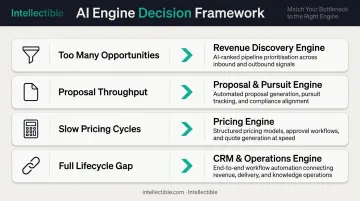
- Too many opportunities to evaluate? → Prioritize discovery and automated Go/No-Go scoring (GovWin IQ, or a connected platform)
- Proposal throughput is the constraint? → Focus on response automation and content management (Responsive, Privia)
- Pricing cycles are slow and error-prone? → Look for pricing workflow automation with audit trail controls
- Need the whole lifecycle connected? → Point solutions may create new silos; evaluate platforms that connect stages natively
Non-Negotiable Evaluation Criteria for GovCon
Regardless of which stage you're automating, these criteria should be on every evaluation checklist:
- SAM.gov and federal market data integration — does it pull from federal sources directly, or require middleware?
- Compliance audit trails — can it document Go/No-Go decisions and pricing approvals in a reviewable format?
- Set-aside and teaming workflow support — does it handle small business set-aside tracking and teaming partner management?
- CUI and data security posture — where does proposal data reside, and does the platform meet your organization's handling requirements?
The Case for Connected Platforms
Teams building a truly automated bid operation often find that managing multiple point solutions creates integration complexity that offsets time savings. When opportunity data, Go/No-Go scoring, proposal kick-off, and pricing all live in separate tools, the handoffs between them become the new bottleneck.
AI workflow platforms like Intellectible connect these stages within a single configurable operating system. Intellectible's GovCon Engine ingests federal market notices and generates structured capture records with Go/No-Go reports, compliance matrices, incumbent maps, bidder density assessments, and recommended next actions — routing high-fit pursuits directly to capture, BD, and leadership teams through daily match briefs before manual triage ever begins.
Clients like Oceus have used this connected approach to more than double the qualified opportunities reviewed each month.
One important caveat: the platform doesn't hold FedRAMP authorization and isn't tailored for FISMA-regulated workflows, which matters for teams processing CUI. For pre-award BD operations — discovery, scoring, proposal drafting, and pricing — the connected lifecycle eliminates the integration overhead that point solutions leave behind.
Frequently Asked Questions
What is the automated bidding process?
In GovCon, the automated bidding process covers each stage from opportunity identification on SAM.gov and GovWin through Go/No-Go scoring, proposal generation, and pricing. Software handles the repeatable tasks at each step, reducing manual labor so pursuit teams focus on strategy rather than administrative processing.
Is autobidding worth it for government contractors?
Yes, particularly for teams reviewing more opportunities than staff can evaluate manually. Automation cuts per-opportunity review time and expands the number of qualified bids a team can realistically pursue. It also reduces the risk of missing a high-probability win buried in a high-volume pipeline.
What is bid software?
Bid software in GovCon refers to platforms that manage the pursuit lifecycle or specific stages within it — opportunity discovery, pipeline tracking, proposal development, and pricing. Tools vary widely in scope: some cover a single function, others automate multiple stages within one platform.
How does bid automation help government contractors win more contracts?
Automation lets GovCon teams review more opportunities in less time, score Go/No-Go decisions with consistent criteria, produce proposals faster using content libraries, and reduce pricing errors. Each of these directly improves win rate and the volume of bids a team can pursue.
What features should GovCon teams prioritize in bid automation software?
The key criteria: SAM.gov and federal market data integration, Go/No-Go scoring automation, proposal content management with compliance tracking, pricing workflow automation with audit trails, and data security posture appropriate for your organization's handling requirements.
Can bid automation tools integrate with SAM.gov or other federal procurement databases?
GovCon-specific tools like GovWin IQ and Unanet CRM pull data directly from SAM.gov and agency forecast sources. General-purpose CRMs like Salesforce typically require middleware or custom API integrations to connect to federal data, which adds configuration overhead and ongoing maintenance cost.