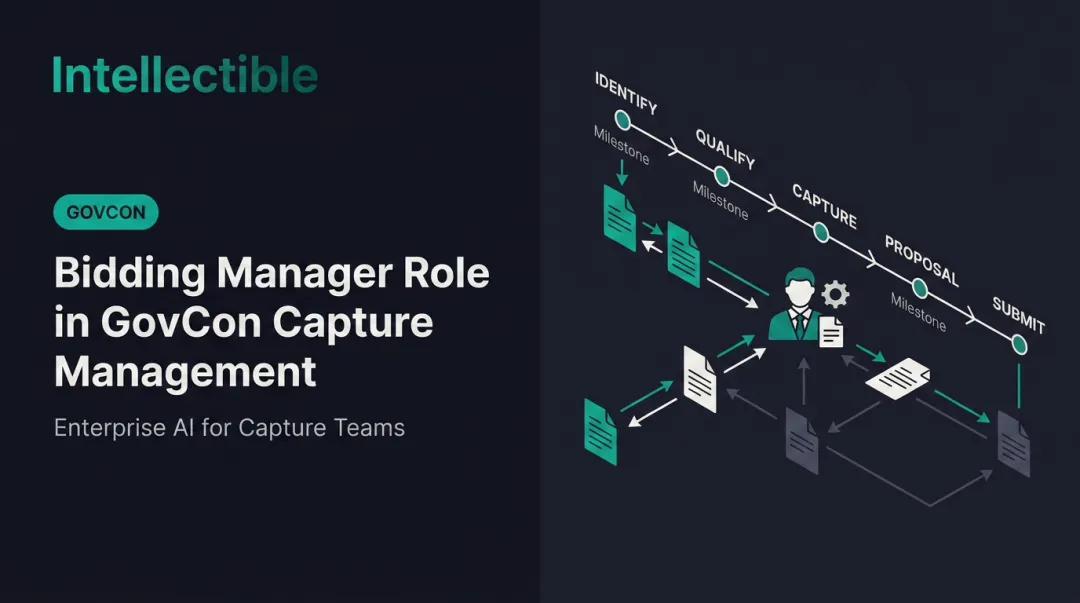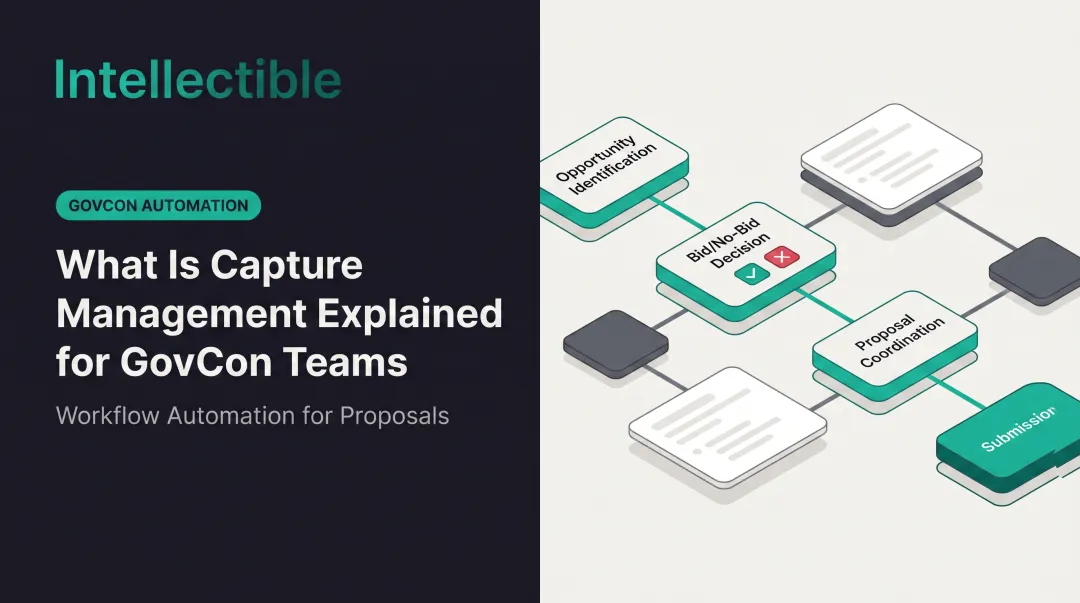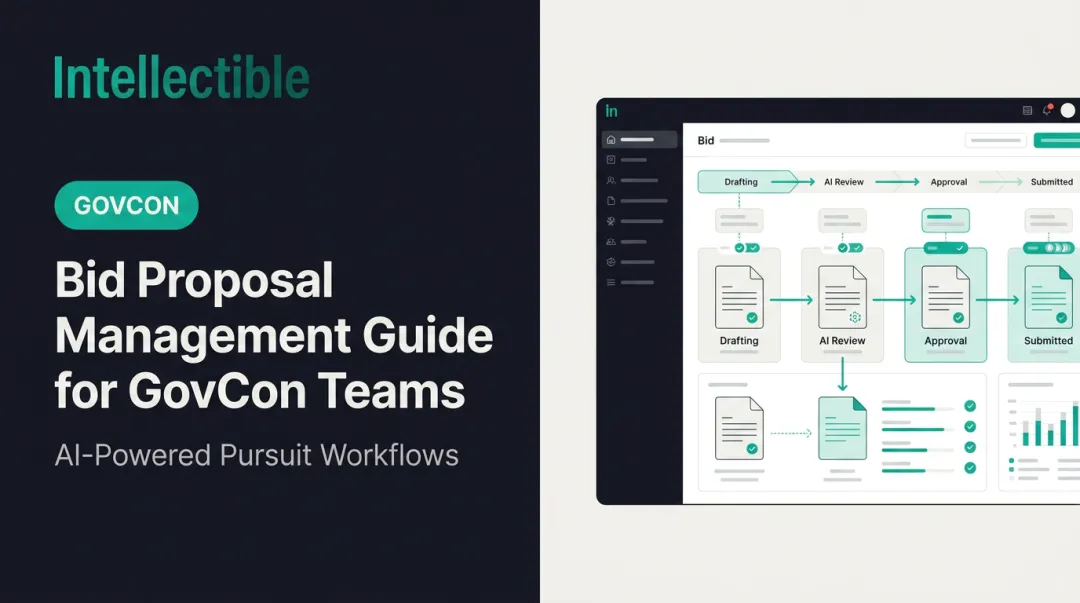
In GovCon, this role functions as the operational hub connecting opportunity intelligence, compliance management, and proposal execution. Without it, firms chase the wrong bids, submit non-compliant responses, and burn resources on proposals they were never positioned to win.
This article explains what the role actually entails across the full proposal lifecycle, how it differs from BD and capture management, where it most commonly breaks down, and how AI-powered workflow platforms are changing what a lean proposal team can realistically accomplish.
Key Takeaways
- The bid and proposal manager owns the full GovCon lifecycle — from go/no-go through submission and debrief
- FAR/DFARS compliance requirements make this role more structured and higher-stakes than commercial proposal work
- BD, capture, and proposal management are distinct functions — each owns a different phase of the pursuit lifecycle
- Most GovCon teams fail here by treating proposal management as administrative work, merging it with BD, or staffing it below bid volume demands
- Intellectible's GovCon AI system lets small proposal teams handle more bids — without adding headcount to do it
What Is a Bid and Proposal Manager in GovCon?
A bid and proposal manager in GovCon coordinates and oversees a company's response to government solicitations — RFPs, IFBs, RFIs, and task order requests — from initial identification through final submission. They ensure each response is compliant, coordinated, and strategically sound.
What separates GovCon bid management from commercial proposal work is the regulatory layer. Federal procurement is governed by the Federal Acquisition Regulation (FAR), with agency-specific supplements like DFARS and HHSAR on top. Three regulatory requirements define the compliance floor:
- FAR 15.204-5 — proposals must address instructions in Section L and evaluation factors in Section M
- FAR 15.208 — offerors bear full responsibility for timely, properly delivered submissions, no exceptions
- DFARS 252.215-7009 — covered offerors must complete a Proposal Adequacy Checklist identifying where required information appears or explaining any omissions
Compliance isn't a box to check at the end — it's structured into the solicitation itself.
The outcome this role is designed to produce: a compliant, competitive proposal submitted on time that maximizes probability of win (Pwin) and positions the firm for award or follow-on work.
Bid Manager vs. Proposal Manager in GovCon
These titles are often used interchangeably, but the functional distinction matters:
- Bid manager — process leadership: timelines, stakeholder coordination, go/no-go decisions, compliance oversight
- Proposal manager — content quality: writing, narrative development, technical volume coherence
APMP's institutional framework uses the combined title "Bid/Proposal Manager," reflecting how frequently both functions sit with one person. A 2022 article published on APMP's Winning the Business site articulates the relationship clearly: "all Proposal Managers must be good Bid Managers but not all Bid Managers can be Proposal Managers."
In practice, GovCon job postings use a range of titles for overlapping responsibilities. Capture manager, pursuit manager, proposal coordinator, RFP manager, and BD manager all appear in this space. Reading the job description carefully matters more than the title.
Why GovCon Demands a Dedicated Bid and Proposal Manager
The Compliance Stakes Are Real
Federal procurement is unforgiving about noncompliance. Two GAO decisions illustrate what that looks like in practice.
In N&S Property Services, B-423852.2, March 2026, ICE excluded page 26 of a technical submission because the solicitation imposed a 25-page limit including the cover page. GAO upheld the agency's action, finding the limit unambiguous and confirming that offerors bear the risk of exceeding it.
In Guidehouse, B-422115.2, January 2024, two emails containing a required volume reached an NGA security gateway but never made it to the designated contract specialist's inbox. The agency deemed the firm ineligible, and GAO denied the protest. Vendors own delivery to the right place.
These aren't edge cases. FAR 15.208 is consistent: the offeror owns the submission outcome, start to finish. A dedicated bid and proposal manager exists precisely to close these gaps before they become disqualifications.
The Go/No-Go Decision as a Strategic Filter
Unlike commercial sales — where pursuing more leads is often the default — GovCon bid and proposal managers must evaluate strategic fit before committing proposal resources. A well-executed no-go saves more than a poorly resourced yes.
The evaluation typically covers:
- NAICS code alignment and set-aside eligibility (8(a), SDVOSB, HUBZone)
- Past performance relevance to the requirement
- Incumbent strength and competitive positioning
- Teaming requirements and partner availability
- Internal resource capacity across concurrent bids
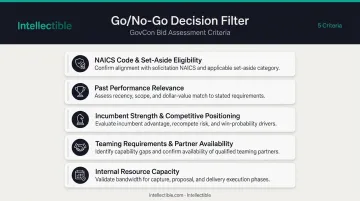
Shipley's bid decision framework identifies three gates: pursuit (strategic and capability fit), bid (positioned to win), and bid validation (no unresolved showstoppers before full production begins). Each gate is a deliberate filter, not a formality.
What Happens Without the Role
GovCon firms that lack dedicated bid and proposal management typically experience:
- Reactive pipeline management — only engaging after RFPs drop
- Non-compliant proposals eliminated at the administrative review stage
- Poor resource allocation across simultaneous bids
- No post-award debrief loop to improve future win rates
No regulation mandates the job title. But the structure of federal procurement — Section L/M compliance, color team reviews, DCAA-compliant pricing — creates enough moving parts that without one owner, critical steps fall through the cracks. The title is optional. The function is not.
How the Role Operates: The GovCon Proposal Lifecycle
The bid and proposal manager orchestrates a five-phase process, each requiring different skill sets and stakeholder coordination.
Phase 1: Opportunity Identification and Go/No-Go
The manager monitors federal procurement portals (SAM.gov, agency forecast tools, and commercial intelligence platforms) evaluating solicitations against strategic criteria before issuing a go/no-go recommendation. This happens before committing proposal resources.
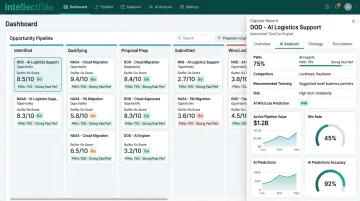
Platforms like Intellectible automate much of this triage. The platform analyzes thousands of opportunities daily, converting each federal notice into a structured capture record that includes agency details, NAICS/PSC codes, fit rationale, and risk signals. For Oceus, a defense contractor, this resulted in more than double the qualified opportunities surfaced each week — without adding headcount to the capture team.
Phase 2: Capture Planning and Pre-RFP Strategy
When the decision is go (ideally before the RFP drops), the bid and proposal manager works with the capture manager (or leads this function in smaller firms) to define win themes, identify teaming partners, assess incumbent strengths, and shape the solution narrative.
Competitive positioning gets locked in here, before a single proposal page is written. Intelligence gathered in this phase — incumbent vulnerability, bidder density, award history patterns — directly shapes how the proposal frames differentiators.
Phase 3: Proposal Development and Coordination
Once the RFP releases, the bid and proposal manager:
- Creates a compliance matrix mapping Section L requirements to proposal sections
- Assigns section owners (technical SMEs, pricing team, past performance leads)
- Sets internal deadlines with buffer for reviews
- Runs the kickoff meeting to align all contributors
- Consolidates inputs into a coherent, Section L-compliant response
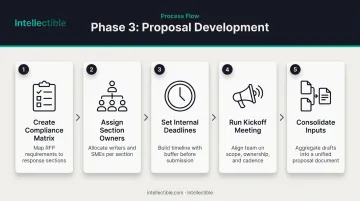
Coordination and compliance drive this phase. Writing is secondary.
Phase 4: Color Team Reviews and Compliance Checks
GovCon proposals undergo structured reviews at defined stages:
| Review | Purpose |
|---|---|
| Pink Team | Outline, storyboards, evaluation-factor coverage before drafting |
| Red Team | Near-final draft reviewed from the evaluator's perspective |
| Gold Team | Executive authorization and final version check before submission |
The bid and proposal manager coordinates reviewers, tracks feedback, resolves conflicts between contributors, and validates formatting, page limits, required certifications, and submission portal requirements before anything goes out the door.
Phase 5: Submission, Debrief, and Pipeline Improvement
After submission, the manager handles clarification requests and regardless of outcome, leads a lessons-learned debrief. Win/loss data, contracting officer feedback, and internal review notes feed back into the content library and go/no-go criteria for future bids.
Most firms underinvest here. Those that systematically capture and apply debrief intelligence raise their Pwin on every subsequent bid.
Key Factors That Shape Role Effectiveness
Team Structure and Bid Volume
A bid and proposal manager handling multiple simultaneous proposals across different agencies and contract vehicles faces compounding coordination demands. According to Deltek's 2026 GovCon pricing data, top-performing contractors achieve a 72% win rate versus a 48% industry average — a gap that reflects both selective bidding and disciplined proposal execution.
The role typically needs dedicated support — proposal coordinator, technical writer, pricing analyst — when bid volume outpaces what one person can manage with adequate quality control. Where that threshold falls depends on proposal complexity and the platform tools in place.
Regulatory Knowledge as a Non-Negotiable
Effectiveness depends on the manager's fluency with:
- FAR Part 15 (competitive negotiation structure)
- Agency-specific acquisition regulations (DFARS, HHSAR, etc.)
- Section L/M interpretation and compliance matrix development
- DCAA-compliant cost volume structuring
- Submission portal requirements and late-proposal rules
Gaps in any of these create compliance risk across every bid they touch. A manager who understands writing but not FAR 15.208 is a liability in a high-stakes solicitation environment.
AI-Powered Tools and What They Change
GovCon-specific platforms now let small teams process far more opportunities without proportional headcount growth — changing what's possible for lean proposal shops.
Intellectible's Proposal & Pursuit Engine runs a governed pursuit workflow rather than relying on a prompt box or static template. It generates go/no-go reports automatically from uploaded solicitation documents — scoring each opportunity across fit and capability match, urgency and timeline risk, win thesis strength, and compliance requirements — and then turns the solicitation into a response plan with mandatory versus strategic sections, owners, deadlines, and status tracking. Compliance matrices, requirement summaries, and risk lists surface before kickoff — not mid-proposal.
For HHS, Corporate Director of Business Development John Grady described the shift as removing "the tedious, monotonous hours of RFP efforts out of human hands," freeing the team to focus on analysis and strategy. Across clients, Intellectible users see 95%+ time savings on opportunity search and go/no-go decisions, and a 150%+ increase in actionable pipeline opportunities.
Common Misconceptions and When the Role Breaks Down
Misconception 1: BD and Bid Management Are the Same Function
BD generates pipeline and relationship intelligence. The bid and proposal manager converts qualified opportunities into compliant submissions. According to APMP's role framework, these functions have distinct horizons and compliance exposures. Conflating them means neither gets the focus it requires — pipeline quality suffers, and win rates follow.
Misconception 2: Proposal Writing Is the Same as Bid Management
Writing is one input. The bid and proposal manager's primary obligation is process integrity, compliance, and strategic coherence — not authorship. Treating it as a writing role leads to systematic underinvestment in go/no-go and capture planning, which is where Pwin is actually determined.
Misconceptions about the role are one problem. Structural failures are another — and they undermine even strong candidates:
- Activated reactively — only after an RFP drops, with no pre-RFP positioning
- No authority to issue a no-go decision
- No content library or knowledge management system between bids
- Expected to cover capture, writing, compliance, pricing, and coordination without tool support
- Proposal volume exceeds what the role can handle with adequate quality control
These are structural failures. Hiring a strong candidate into a broken process produces predictable results.
Frequently Asked Questions
What does a bid and proposal manager do?
They coordinate the full GovCon proposal lifecycle — from opportunity identification and go/no-go analysis through proposal development, color team reviews, and submission. Their core obligation is ensuring proposals are compliant, competitive, and delivered on time to the right place.
What is the difference between bid management and proposal management?
Bid management emphasizes process ownership, compliance, and coordination across all contributors. Proposal management emphasizes content quality and narrative development. In GovCon, smaller firms typically combine both in one role; larger firms may separate them as proposal volume and complexity grow.
How does this role differ in GovCon compared to commercial markets?
FAR/DFARS compliance requirements, mandatory Section L/M formatting, submission portal constraints, structured color team reviews, and the formal go/no-go process all distinguish GovCon bid management from commercial proposal work. Noncompliance in GovCon means disqualification, not just a weaker submission.
What qualifications does a GovCon bid and proposal manager typically need?
Common entry points include proposal writing, project management, or business development backgrounds, with APMP certification (Foundation through Professional levels) widely valued. Senior roles typically require hands-on experience with FAR, federal solicitation types, government procurement portals, and Shipley-process proposals.
What is a go/no-go decision and why is it critical?
A go/no-go is a formal evaluation of whether a solicitation is worth pursuing — based on strategic fit, competitive position, past performance relevance, resource availability, and probability of win. In GovCon, where proposals are resource-intensive, a disciplined no-go preserves capacity for winnable bids.
Can a small GovCon company manage bids effectively without a full-time hire?
AI-powered tools that automate opportunity filtering, go/no-go analysis, and compliance extraction let small teams scale proposal operations without adding headcount. Process ownership still needs a clear owner, though. The tools support execution; they don't replace accountability.