Introduction: Why Your Team Needs a Government Contract Pipeline
Picture this: your team gets an RFP with 30 days to respond. Nobody has met the contracting officer. Past performance is a weak match. No teaming partners are lined up. The scramble starts, and your win odds drop near zero.
This happens when teams react to RFPs instead of preparing for them. A government contract pipeline is a system for identifying, qualifying, tracking, and pursuing opportunities before the solicitation drops.
That gap between reactive bidding and disciplined pipeline management is often what separates competitive proposals from wasted pursuit spend.
This guide covers pipeline stages, opportunity qualification, team workflows, technology, metrics, and the pitfalls that stall GovCon teams.
Key Takeaways
- Focus resources on qualified, winnable opportunities rather than chasing every RFP to increase win rates
- Assign clear roles and run disciplined processes across business development, capture, proposal, and leadership
- Balance early identification (12-24 months out) with active pursuit management using stage-based workflows
- Use automation to cut manual tracking and prioritize pursuits with real pipeline data
What Is a Government Contract Pipeline?
Defining the pipeline
A government contract pipeline is a structured system for tracking opportunities from early identification through award. It organizes pursuits by stage and win probability so teams put time and resources where they matter most.
Unlike simple opportunity lists, pipelines include:
- Qualification criteria and go/no-go gates
- Stage-based workflows with clear ownership
- Resource allocation and capacity planning
- Strategic prioritization frameworks
- Regular review cadences and decision points
Why pipelines matter for team success
A disciplined pipeline delivers three practical advantages.
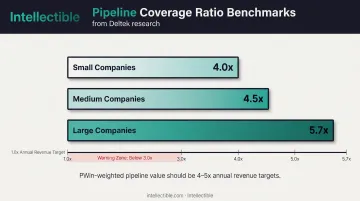
Revenue visibility and forecasting. Deltek's 2021 study found contractors maintain pipeline multiples of 4.0 to 5.7 times their revenue targets, depending on company size. Teams with insufficient coverage rarely hit revenue goals even with strong execution.
Proactive relationship-building. APMP guidance emphasizes that capture should start before RFP release. Pipelines give teams 12-24 months to build agency relationships, shape requirements, and position solutions—work you cannot do if the opportunity first appears at solicitation.
Resource optimization. 54% of contractors cite limited business development resources as a top challenge. Pipelines prevent capacity overload by forcing clear decisions about which opportunities deserve investment.
Building Your Pipeline: A Stage-by-Stage Framework
Effective pipelines move opportunities through six distinct stages:
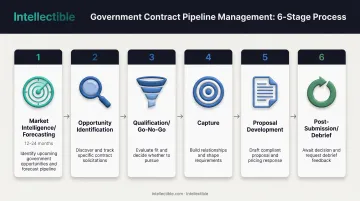
Stage 1: Market Intelligence/Forecasting
Monitor agency budgets, strategic plans, industry days, procurement forecasts, and incumbent contract expiration dates 12-24 months before RFP release. This stage identifies future opportunities while you still have time to position your company.
Key activities:
- Track agency spending patterns and budget cycles
- Review procurement forecast schedules quarterly
- Attend industry days and agency briefings
- Monitor incumbent contract end dates
- Analyze agency strategic plans for new initiatives
Stage 2: Opportunity Identification
Actively source qualified leads and log them with enough detail to prioritize pursuit.
Primary sources:
- SAM.gov solicitations and notices
- Agency forecast schedules
- Teaming partner intelligence
- Industry networks and events
Capture at minimum: agency, office, estimated value, timing, and scope.
Stage 3: Qualification/Go-No-Go
Apply structured criteria to filter opportunities. Drop poor fits early and advance only strong matches to active pursuit.
APMP's gate framework recommends testing:
- Strategic fit
- Customer understanding
- Solution strength
- Team availability
Clear gates before you commit capture resources.
Stage 4: Capture
This is where most pipeline investment happens before the RFP drops.
Key activities:
- Assign capture leads
- Build customer relationships
- Shape requirements where possible
- Form teaming arrangements
- Draft solution approaches
FAR 5.203 typically gives only 15-30 days' notice before solicitation. Work done here decides whether you can respond competitively.
Stage 5: Proposal Development
Execute the RFP response. Strong capture work lets the team write a compelling proposal instead of scrambling to learn the requirements.
Core steps:
- Compliance review
- Solution development
- Writing and pricing
- Color reviews
- Final production
Stage 6: Post-Submission/Debrief
Close the loop so every pursuit improves the next one.
Key activities:
- Track award decisions
- Request debriefs
- Document lessons learned
- Feed insights back into qualification and capture
Every pursuit—win or loss—produces intelligence that sharpens future go/no-go calls.
Qualifying and Prioritizing Opportunities
Establishing go/no-go criteria
Create a standardized qualification scorecard covering:
- Capability alignment and past performance relevance
- Competitive position and customer access
- Teaming options and partner strength
- Contract value versus pursuit cost
- Strategic fit with company growth goals
Use a two-gate process: initial rapid screening (5-10 minutes) eliminates obvious non-fits, then deeper evaluation (1-2 hours) for opportunities passing initial review.
Prioritization frameworks
Probability-of-win (PWin) assessment evaluates:
- Incumbent status and relationship strength
- Customer relationships and decision-maker access
- Technical differentiation and solution fit
- Pricing competitiveness
- Past performance strength and relevance
Balance your pipeline composition by mixing:
- Sure bets: Recompetes and strong incumbent positions
- Stretch opportunities: New customers and competitive displacements
- Strategic investments: New capability areas and important agency relationships
That mix only works if pursuit volume matches what your team can actually execute.
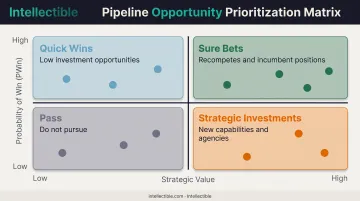
Resource-based prioritization
Match pipeline volume to available resources. Pursuit capacity constraints should drive prioritization decisions, not wishful thinking.
A typical small-to-mid-sized contractor can actively pursue 8-15 opportunities simultaneously, depending on team size, pursuit complexity, and proposal requirements. Deltek's research confirms that 54% of contractors struggle with limited BD resources.
Trying to pursue more than your team can handle guarantees poor proposals and burned-out staff.
Conduct quarterly pipeline reviews where leadership makes explicit keep/kill/park decisions based on updated intelligence and shifting priorities.
Managing Your Pipeline: Workflows and Team Collaboration
Roles and stage handoffs
Define pipeline accountability across five key roles:
| Role | Pipeline Responsibility |
|---|---|
| Business Development | Source and qualify opportunities; maintain agency relationships |
| Capture Managers | Build positioning strategies; shape requirements; develop teaming |
| Proposal Managers | Execute RFP responses; coordinate writing and review |
| Subject Matter Experts | Develop technical solutions; validate approaches |
| Executive Sponsors | Make strategic decisions; engage customers at senior levels |
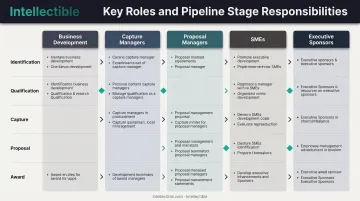
Each stage transition needs documented justification and an updated PWin assessment:
- BD → Capture: Qualified opportunity with initial customer intelligence
- Capture → Proposal: Developed strategy, teaming, and solution approach
- Proposal → BD: Completed submission plus lessons learned for future pursuits
Review cadence and governance
Establish a three-tier review rhythm so near-term pursuits and long-range bets get different scrutiny:
- Weekly quick-syncs: Active pursuits with RFPs expected in 30–60 days
- Monthly pipeline reviews: Mid-stage opportunities 2–12 months out
- Quarterly strategic reviews: Long-range forecasting and portfolio decisions
Pair that cadence with clear decision authority:
- Dollar thresholds that require executive review
- Bid/no-bid authority matrices by role and deal size
- Stage-gate checkpoints where opportunities advance only if they meet criteria—or get removed
Shared tracking and cross-functional coordination
Every team member should work from the same pipeline record, with real-time updates on:
- Ownership assignments
- Next actions and deadlines
- Current stage status
- Milestone dates and dependencies
Pipeline calls also drive work outside capture and proposals. Flag these early with operations:
- Hiring plans
- Subcontractor agreements
- Facility security clearances
- Accounting system compliance
Early coordination gives those teams the lead time they need and keeps late-stage pursuits from stalling on operational gaps.
Tools and Technology for Pipeline Automation
The pipeline technology spectrum
Spreadsheets work for teams with fewer than 20 active opportunities. Beyond that threshold, manual tracking becomes error-prone and time-consuming.
Specialized GovCon CRM platforms like GovWin and Deltek offer automated opportunity imports from SAM.gov, configurable workflows, collaboration features, and reporting dashboards tailored to government contracting.
Comprehensive business operating systems integrate pipeline management with proposal, contract, and project management, eliminating data silos and reducing handoff friction.
Key efficiency features
Whatever tier you choose, prioritize tools that support:
- Automated opportunity imports from SAM.gov
- Configurable stage-based workflows
- Task assignments and document sharing
- Collaboration features like comment threads
- Reporting dashboards with drill-down capability
- Integration with proposal and contract systems
AI-powered pipeline transformation
Platforms like Intellectible handle pipeline work through visual workflow builders that connect opportunity data sources to capture operations. Typical capabilities include:
- Automated qualification scoring
- Intelligent deadline alerts
- Integrated databases linking opportunities to past performance, teaming partners, and capability libraries
Teams using these systems report 150%+ increases in actionable pipeline opportunities and 95% less time spent on qualification decisions.
They also turn federal and state notices into structured capture records with agency details, timing, scope, fit rationale, and recommended actions. That cuts hours of manual research and lowers the chance of missing a qualified opportunity.
Metrics and KPIs for Pipeline Health
Healthy pipelines are measurable. Track a short set of value, velocity, and efficiency KPIs so you can spot coverage gaps early and coach pursuits with evidence—not gut feel.
Core pipeline metrics
Track these essential measures:
- Total pipeline value: Sum of all opportunity values
- Pipeline value by stage: Distribution across your workflow
- Number of opportunities by stage: Volume at each phase
- Average time-in-stage: Cycle time through your process
- Conversion rates between stages: Percentage advancing to next phase
- PWin-weighted pipeline value: Sum of opportunity values × respective PWin percentages
Coverage ratio
Your pipeline value should be 4-5x annual revenue targets when weighted by PWin. This benchmark comes from Deltek's survey of government contractors, which found multiples ranging from 4.0 for small companies to 5.7 for large firms.
Teams with insufficient coverage are unlikely to hit revenue goals even with strong execution. If your weighted pipeline sits at 2x your target, you need more qualified opportunities, not just better win rates.
Pursuit efficiency metrics
Watch these efficiency measures alongside coverage:
- Win rate: Awards divided by submissions
- Pursuit ROI: Contract value won divided by pursuit costs
- Average pursuit cycle time: Time from qualification to submission
- Bid/no-bid decision quality: Compare predicted PWin to actual outcomes
Deltek's 2021 research reported these win-rate benchmarks:
- 40% average overall
- 35% median
- 33% for small/medium contractors on competitive proposals
- 48% for large firms on competitive proposals
Use them as reference points, then segment your own data by agency, contract type, and competitive position for comparisons that actually guide decisions.
Common Pipeline Management Pitfalls and How to Avoid Them
Even disciplined capture teams fall into traps that inflate pipeline value and burn bid capacity. Spot these four patterns early and shut them down before they distort forecasts.
Pipeline stuffing
Adding every remotely relevant opportunity inflates pipeline value without rigorous qualification. That habit wastes time on low-probability pursuits and hides true pipeline health.
Apply go/no-go criteria ruthlessly. Drop anything that fails your minimum standards.
Zombie opportunities
These pursuits linger long after they are effectively dead: expired forecasts, indefinitely delayed procurements, or deals where competitors have already outmaneuvered you.
Run pipeline hygiene at least quarterly. Removing dead leads keeps the data honest and the team on live opportunities.
Capacity mismatch
Qualifying more opportunities than you can pursue leads to rushed proposals, missed deadlines, and demoralized staff. 54% of contractors already struggle with limited BD resources—don't make it worse by overcommitting.
Disciplined prioritization and realistic resource planning keep pursuit load matched to capacity.
Sunk-cost pursuit
APMP guidance is clear: prior effort should not override a no-bid when facts change. Weeks in capture do not justify a weak proposal.
Walk away when new intelligence weakens your position.
Frequently Asked Questions
What is a procurement pipeline?
A procurement pipeline (or government contract pipeline) is a structured system for identifying, tracking, qualifying, and pursuing government contracting opportunities through defined stages from early market intelligence to contract award. It differs from passive opportunity tracking by including active qualification, resource decisions, and strategic prioritization.
What opportunities should teams prioritize first in their pipeline?
New teams should prioritize opportunities where they have relevant past performance, existing agency relationships, and clear competitive advantages. Focus on "low-hanging fruit" that builds wins and credibility before pursuing highly competitive opportunities. Recompetes where you're the incumbent or opportunities with agencies you've served successfully offer the strongest starting point.
How does the Rule of 2 affect pipeline strategy?
The Rule of 2 requires set-asides when contracting officers expect offers from at least two responsible small businesses at fair market prices. Small business teams should track set-aside forecasts, build agency relationships and past performance, and watch competitors' size status and pricing to stay positioned as a viable option.
How many opportunities should be in a healthy pipeline?
Volume depends on company size, pursuit capacity, and win rate. A common starting frame: for every win you want, keep roughly 3-4 opportunities in proposal, 6-8 in capture, and 15-20 qualified earlier. Quality still beats quantity—APMP's gate framework stresses rigorous qualification over raw volume.
How often should teams review their pipeline?
Use a three-tier cadence: weekly tactical reviews for imminent opportunities (RFP expected within 60 days), monthly operational reviews for active capture (2-12 months out), and quarterly strategic reviews for long-range planning and portfolio health assessment. This rhythm balances immediate execution needs with strategic positioning.
What's the difference between pipeline management and opportunity tracking?
Opportunity tracking is passive: monitoring SAM.gov and agency forecasts. Pipeline management is active: qualifying opportunities, prioritizing by resources and win probability, assigning capture teams, making go/no-go decisions, and running workflows across the portfolio.