Most proposal, pricing, and BD teams already feel this. Weeks disappear into Go/No-Go research and compliance checks that should take hours. That's time not spent writing winning proposals or building agency relationships.
This article breaks down what contract intelligence solutions actually do, why GovCon companies need one now, how they differ from CLM and CMS platforms, what they typically cost, and how to evaluate the right fit for your team.
Key Takeaways
- Contract intelligence links opportunity, pricing, and compliance data in one system
- GovCon platforms track solicitations, awards, and FAR/DFARS obligations, not just spend
- Pricing defensibility is the top reason proposals lose, making cost data critical
- Lean BD teams can compete for larger contracts without adding headcount
What Is a Contract Intelligence Solution?
Contract intelligence uses AI and machine learning to extract, analyze, and connect contract data to actual business activity, rather than simply filing PDFs into a folder. The system reads the content, understands the context, and surfaces what matters.
For GovCon companies, that means intelligence layered across three data types:
- Solicitation data — RFPs, RFIs, and RFQs pulled from federal and state portals
- Award documents — historical contract outcomes, incumbents, and agency spending patterns
- Compliance clauses — FAR and DFARS requirements embedded in every solicitation
Grounded in Real GovCon Documents
A useful contract intelligence platform doesn't deal in abstract "contract data"; it works with the specific paperwork BD and pricing teams touch daily:
- SF-1449s — the standard solicitation/contract/order form for commercial products and services under FAR 12.204
- PWS/SOW documents — performance work statements describing required results in measurable terms
- CDRLs — Contract Data Requirements Lists (DD Form 1423) that create binding delivery obligations under Section J
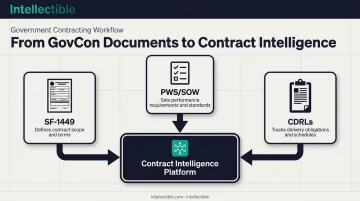
This distinguishes GovCon contract intelligence from generic commercial platforms, which focus mainly on internal spend and supplier compliance rather than external opportunity pursuit. GovCon platforms, by contrast, prioritize opportunity pursuit, pricing defensibility, and win probability, the metrics that actually decide whether a bid succeeds.
Delivering on that focus requires specific technology working beneath the surface, including:
- Natural language processing (NLP) to parse dense solicitation and contract language
- Machine learning models trained to recognize contract vehicles like GWACs, IDIQs, and BPAs
- Integrations linking opportunity data directly into CRM and pipeline systems
Those integrations matter because federal opportunity data changes constantly. SAM.gov's opportunity API updates active notices daily and archived notices weekly, per GSA's own API documentation. That pace alone makes manual monitoring a full-time job for even mid-sized BD teams.
Why GovCon Companies Need Contract Intelligence Now
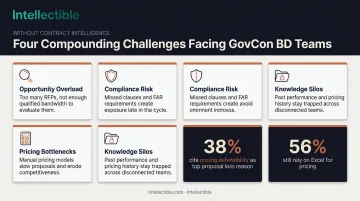
Four problems compound on each other inside most GovCon shops, and none of them get better with more spreadsheets.
Opportunity overload. Thousands of notices post across SAM.gov, USAspending.gov, FPDS, GSA eLibrary, and state portals every week. Small BD teams simply can't manually qualify fit against NAICS codes, set-aside eligibility, and past performance at that volume.
Compliance risk. Missing a CMMC requirement or set-aside eligibility issue carries real consequences. Under DFARS, contracting officers cannot award a contract if an offeror lacks the required CMMC status posted in SPRS. Size-status disqualifications can also trigger contract termination after award if unresolved.
Pricing bottlenecks. Proposal teams need to cross-reference historical contract data, labor categories, and wrap rates before submitting a price. This is slow work, and it shows in the results.
38% of GovCon companies identified pricing defensibility as the number-one reason their proposals weren't selected, according to Deltek's 2026 GovCon pricing study. The same study found 56% of contractors still lean on Excel somewhere in their pricing process.
Knowledge silos. Institutional knowledge from past proposals sits disconnected from current pursuits. Teams rewrite what they already know, and past-performance leverage gets lost between deals.
The impact of solving these problems is measurable. Intellectible clients report 95%+ time saved on opportunity search and Go/No-Go decisions, along with a 150%+ increase in actionable top-of-funnel opportunities.
Oceus, a defense contractor, saw this play out directly. CEO Jeff Harman noted the platform delivered "more than double the qualified opportunities per week — about seven to eight opportunities a month making it through our threshold," adding that a new pipeline relationship emerged from exposure that "didn't exist before."
Contract Intelligence vs. CLM vs. CMS: What's the Difference?
These three terms get used interchangeably, but they solve different problems.
CLM (Contract Lifecycle Management) tools focus on authoring, negotiation, e-signature, and approval workflows, managing a contract once it's already in play.
CMS (Contract Management System) tools focus on document storage, basic search, and manual tracking of key dates. Think digital filing cabinet with reminders.
Contract intelligence connects opportunity, pricing, and compliance data across the entire capture-to-close lifecycle. It surfaces insight and recommends action instead of just storing information, closing the gap between raw data and a decision.
Side by side, the differences in scope become clear:
| Category | Purpose | Primary Focus | GovCon Use Case |
|---|---|---|---|
| Contract Intelligence | Surface insight and action | Solicitations, awards, pricing, compliance data | Qualify opportunities, build defensible pricing, flag compliance risk before submission |
| CLM | Manage contract execution | Authoring, negotiation, e-signature, approvals | Finalize and execute the contract once awarded |
| CMS | Store and track documents | Document repository, basic search, key dates | Archive executed contracts and track renewal or option dates |
Most GovCon organizations eventually need elements of all three. But contract intelligence closes the gap that CLM and CMS were never built to address: the strategic distance between identifying a winnable contract and pricing it profitably.
Key Capabilities to Look for in a Platform
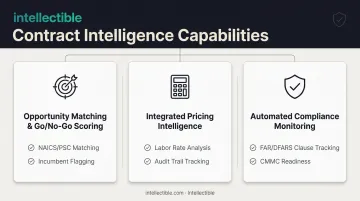
Not every "AI-powered" GovCon tool does the same thing. When evaluating a contract intelligence platform, prioritize three capability areas.
Opportunity Matching and Go/No-Go Scoring
Look for AI matching that goes beyond keyword search. The best platforms structure every notice into a capture record with NAICS and PSC codes, then compare it against your target agencies, past performance, set-aside status, and known incumbents.
Strong platforms also flag likely incumbents and expiring contracts by comparing new postings to award history and agency patterns. This gives your team a head start on capture strategy rather than a cold start on every pursuit.
Integrated Pricing Intelligence
Pricing intelligence should connect historical contract and labor data directly into proposal development, with:
- Configured labor categories, hourly rates, and fully loaded costs
- Confidence-scored data extraction from RFPs and scope documents
- A complete audit trail covering approvals, changes, and version history
- Rate build snapshots capturing wages, benefits, and burdened rates before anything goes customer-facing
Automated Compliance Monitoring
FAR and DFARS clause tracking, CMMC readiness, and task order deadlines shouldn't live in someone's memory. NCMA has documented AI and machine learning uses in contracting, according to NCMA's analysis of AI in contract management. These include flagging high-risk clauses, identifying missing or outdated language, and detecting price discrepancies before submission.
Data quality matters here too. A GAO review found only 36 of 70 agencies, or 51%, confirmed completion of their FY2023 procurement data-quality reports, according to GAO's 2025 findings on federal procurement data. Platforms that verify source data and flag entry inconsistencies protect you from inheriting those gaps.
How Much Does a Contract Intelligence Solution Cost?
Pricing across the market generally falls into three models:
- Per-seat SaaS subscriptions: priced by number of active users
- Tiered pricing: based on opportunity volume or feature depth
- Custom enterprise pricing: negotiated based on scale and integration complexity
GovCon-specific factors that drive cost include:
- Number of BD, pricing, and proposal users needing access
- Integration depth with SAM.gov, CRM, and ERP systems
- Level of customization required for capture rules and compliance workflows
Vendors rarely publish exact figures publicly, since most enterprise GovCon deployments get quoted based on organizational scale. That makes ROI framing more useful than a price comparison. Weigh the platform cost against the labor hours currently lost to manual Go/No-Go research and pricing prep, plus the revenue cost of opportunities your team never had time to review.
Platforms delivering 95%+ time savings and 150%+ pipeline growth, like Intellectible's GovCon Engine, quickly offset subscription costs.
How Intellectible Powers Contract Intelligence for GovCon Companies
Intellectible operates as a horizontal AI build platform, delivering AI-powered capture intelligence built for federal markets. That matters practically: your team doesn't rebuild infrastructure every time a new workflow need appears.
For GovCon pursuit and pricing specifically, the platform automates the two heaviest lifts in the capture cycle:
- Opportunity search and qualification — turning notices into structured capture records with fit rationale, risk signals, and recommended next actions
- Pricing workflow — When pricing connects to the capture workflow, teams have achieved 90%+ reduction in time to final pricing, with full audit trail control across labor rates, cost assumptions, and approval routing
Client outcomes back this up:
- Oceus more than doubled its qualified opportunities reviewed monthly, moving to seven or eight opportunities a month clearing threshold
- HHS's John Grady says: "Intellectible is taking the tedious, monotonous hours of RFP efforts out of human hands. This allows us to do what we should be doing, analyzing and selling."
That's the core proposition for GovCon teams: scale the process, not the headcount. Small businesses chasing a first prime contract and established contractors managing dozens of pursuits both benefit, covering more ground with the same team.
Frequently Asked Questions
What is a contract intelligence solution?
It's AI-powered software that extracts and connects contract and opportunity data to real business activity, such as pricing and compliance decisions. Unlike simple document storage, it surfaces actionable insight rather than just archiving files.
How much does a contract intelligence solution cost?
Pricing typically follows per-seat subscriptions, tiered plans based on opportunity volume, or custom enterprise quotes. GovCon-specific costs depend on user count, integration needs with SAM.gov and CRM/ERP systems, and customization depth.
How does a contract intelligence solution differ from CLM and CMS?
CLM manages contract authoring, negotiation, and approval workflows once a deal is in motion. CMS focuses on document storage and basic tracking. Contract intelligence connects opportunity, pricing, and compliance data to surface insight and action.
Can contract intelligence help small GovCon businesses compete for larger federal contracts?
Yes. Automated opportunity matching and pricing intelligence let lean teams review far more opportunities and build compliant pricing without adding staff. Oceus grew its qualified opportunity volume by more than 150% using exactly this approach.
What data sources does a GovCon contract intelligence platform typically connect to?
Most platforms pull from federal and state solicitation portals, then integrate with CRM systems like Salesforce and internal pricing or ERP tools. Exact integrations vary by vendor, so confirm specifics during evaluation.
Does contract intelligence replace a proposal or pricing team?
No. It automates repetitive research, scoring, and pricing prep so staff can focus on strategy, analysis, and writing. As HHS's John Grady put it, it removes "tedious, monotonous hours" so teams can focus on selling.