Introduction
An ideal customer profile tells you who could buy. It says nothing about who is ready to buy now. Forrester describes an ICP as a way to focus effort on best-fit accounts with a strong propensity to buy. Propensity isn't timing.
A new operations leader, CFO, or plant manager may change how an account evaluates service providers. Sales teams need to verify the role and mandate, identify the purchase it could affect, and investigate while the change is relevant. A leadership announcement alone is not a commitment to switch vendors.
This article walks through how to spot hiring and leadership signals, validate the evidence, match each signal to the right contact, combine signals, and turn the result into outreach worth reading.
Key Takeaways
- People signals reveal changes in decision-makers, ownership, or priorities, not static fit.
- Hiring means most when you can separate growth, backfills, and new functions.
- A leadership change opens a research window; a confirming signal makes it a lead.
- Verify source and date, then contact the person who owns the problem.
What Are People Buying Signals?
People buying signals are dated, observable changes in the individuals or roles that shape priorities, budgets, workflows, and purchasing decisions. Think of an appointment, a departure, a new job posting, a board addition, or a former champion landing at a new company.
How they differ from other data
- Firmographics describe fit: size, industry, location.
- Intent data suggests research activity. Forrester cautions that vendors use the term broadly and that the data types aren't interchangeable.
- People signals show a change in who decides, who owns a problem, or where the organization is heading.
The evidence standard
Every signal should carry four things:
- A reliable source
- A clear date
- A relevant role or remit
- Enough context to support a reasonable buying hypothesis
If one is missing, you have a rumor, not a signal.
Hiring Changes as Buying Signals
Verify leadership changes through company announcements, official filings where available, professional role updates, and relevant registrations. Match the person to the correct company, business unit, and geography. Keep announced start date, actual start date if known, source publication date, and last verification separate.
The Bureau of Labor Statistics separates openings from hires: an opening is a position for which work exists, not a completed hire, net headcount growth, or a budget.
No public benchmark ties hiring to technology spend at the account level. Treat hiring as a hypothesis generator.
Hiring patterns to monitor
- Hiring surges across a function
- Repeated openings for the same role
- Senior or specialist roles
- Newly created positions
- Job descriptions naming specific systems, processes, compliance needs, or growth initiatives
Function matters too. Revenue operations, proposal and pursuit, pricing, sales development, data, and operations teams each generate different needs, and not every opening in them means the same thing. A pricing analyst backfill is routine. A first pricing lead at a growing contractor is not.

Expansion or replacement?
Check the job description, team structure, reporting line, and role history. Look for related announcements.
Signs of expansion:
- New reporting lines
- "Build" language in the posting
- Several openings at once
Backfills often mirror an old posting. Seasonal hiring repeats on a calendar.
Mapping signals to needs
| Hiring signal | Possible need | Likely buyer |
|---|---|---|
| New RevOps team | Process and systems work | Head of RevOps or Sales |
| Growing proposal team | Knowledge management, opportunity qualification, pricing workflows | Proposal or capture lead |
| First data hire | Data integration, reporting | Operations or finance leader |
Timing
Reach out while the team is being built or the mandate is being implemented. Once the function is staffed and standardized, tools and vendors are usually chosen.
Forrester notes that intent data is time-sensitive with a limited action window, but publishes no universal interval, and none exists for people signals. Set your own window by role and source date, then test it against your results.
Leadership Changes as Buying Signals
New executives and functional leaders
A new VP Operations, CFO, or plant manager can reopen a vendor discussion when their remit includes the service you sell. The relevant change is the role, scope, and operating mandate, not simply a senior title. New leaders may retain incumbents, so treat the event as a reason to investigate rather than proof of a planned replacement.
McKinsey frames the first six to 12 months of a CEO transition as an opportunity for organizational renewal. That is not a vendor-switching statistic, so treat it as context.
Not all appointments are equal:
- External hires and newly created roles imply more change.
- Internal promotions suggest continuity unless other evidence points to a reset.
- Interim appointments usually signal a holding pattern.
External hiring is common. Spencer Stuart found roughly 40% of 2025 S&P 1500 CEO appointments were external, and the share was higher in small-cap and mid-cap companies than in large caps.
First-time leaders and new roles
A first-time function leader or a brand-new role is a strong buying signal. That person has to set up processes, pick systems, define metrics, and show early progress.
Related people signals
- Departures can leave decision ownership unclear and reopen vendor discussions.
- Board appointments can shift strategic direction.
- Former champions who change companies offer a warm path into a new account.
Research before you reach out
Look at the leader's previous remit, stated priorities, prior tools or operating model, and public announcements. Form a hypothesis, but don't assume they'll bring their old vendor along.
Who to contact
The new leader sets the mandate. A direct report, operations owner, or functional evaluator often runs research and implementation.
Gartner's survey of 632 buyers found buying groups of 5 to 16 people across as many as four functions. So multithread: reach the mandate-setter and the person who will do the work.
How to Interpret, Combine, and Prioritize People Signals
A practical validation framework
Ask five questions of every signal:
- Does the account fit the ICP?
- What changed?
- Which business problem could the change create?
- Who owns that problem?
- Why might the timing matter now?

Keep verified facts apart from interpretation. Write "may indicate," "suggests," or "worth investigating" unless the evidence shows active purchase intent.
Corroborate with combinations
Single signals are weak on their own. Stack them before you treat the account as active:
- A new revenue leader plus relevant hiring
- A first operations hire plus a technology initiative
- A former champion's move plus an open role in the same function
A simple tiering model
Rank by recency, source quality, role relevance, business impact, and corroboration. No public benchmark offers validated weights, so start simple and adjust with your own outcomes.
| Tier | What it looks like | Action |
|---|---|---|
| Research | Single signal, fit confirmed, little corroboration | Gather facts, map contacts |
| Monitor | Relevant signal, unclear ownership or timing | Watch for a second signal |
| Personalized outreach | Recent, verified, role-relevant, corroborated | Contact the owner |
Turning a signal into a message
- Reference the verified change.
- Connect it to a plausible, role-specific challenge.
- Offer a useful insight or resource.
- Present your view as a hypothesis, not fact.
Skip the generic congratulations. A specific opener works harder:
"Saw you joined as VP of Sales. Teams stepping into that seat often inherit a messy qualification process. Here's how two peers handled it."
That beats "Congrats on the new role!"
When not to act
Hold off when you see:
- Stale announcements
- Unclear role ownership
- Routine backfills
- Unverifiable profile changes
- Signals unrelated to your solution
Keep those in monitoring or drop them.
How to Operationalize People Signals at Scale
What to monitor
- Company newsrooms and press releases
- Career pages and job boards
- Professional profiles
- Trade publications
- US public-company filings
- Your own customer and champion records
For SEC registrants, Form 8-K Item 5.02 covers certain officer and director appointments and departures, generally due within four business days. Filings can be delayed if a separate public announcement is planned.
Record the source URL, event date, role, account, and confidence level for every signal.
A repeatable workflow
- Detect the change from newsrooms, filings, job boards, or internal records.
- Enrich the account and person with role, timing, and related context.
- Validate the event against a second source before acting.
- Identify the likely buying committee tied to the new mandate.
- Assign a priority based on fit, urgency, and open opportunities.
- Draft a signal-specific action for the right stakeholder.
- Record the outcome so future scoring improves.

Bake compliance into every step. The FTC says CAN-SPAM covers all commercial email, with no carve-out for B2B. This is a scope note, not legal advice.
Where Intellectible fits
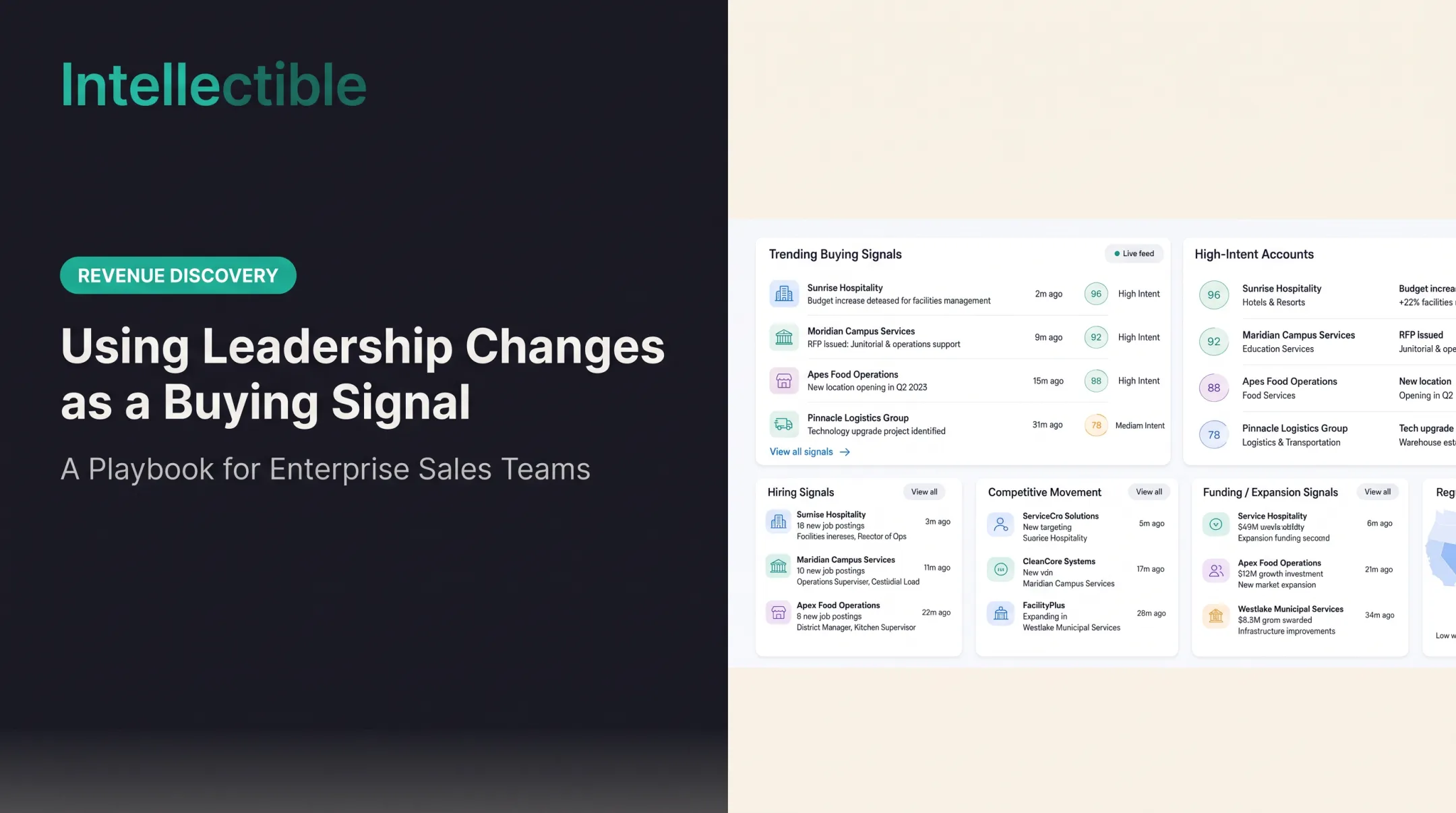
Intellectible's Revenue Discovery engine connects these steps in practice. Its Signal Monitor lists live signals, including hiring pressure and leadership change, with account, title, detection date, and status. Job-posting monitoring runs daily, and Salesforce refresh runs nightly.
Accounts receive fit and urgency scores with reasoning attached. Human approval gates sit before outreach, Salesforce updates, and qualification. The system drafts and sends nothing on its own:
- No bulk email
- No LinkedIn automation
- No automatic CRM writes
Intellectible's CRM & Operations layer can route qualified signals alongside Salesforce records, Gmail threads, and call notes.
Frequently Asked Questions
Which leadership changes are commercially relevant?
A new VP Operations, CFO, or plant manager can reopen a vendor discussion when their remit includes the service you sell. The relevant change is the role, scope, and operating mandate, not simply a senior title. New leaders may retain incumbents, so treat the event as a reason to investigate rather than proof of a planned replacement.
Where should teams verify new leaders?
Verify leadership changes through company announcements, official filings where available, professional role updates, and relevant registrations. Match the person to the correct company, business unit, and geography. Keep announced start date, actual start date if known, source publication date, and last verification separate.
How should roles be matched to service purchases?
Map roles to purchases: a plant manager may influence maintenance or industrial services, an operations leader may own facilities or logistics, and a CFO may sponsor finance or billing changes. Confirm authority, budget ownership, procurement participation, and existing agreements before proposing a vendor review.
Is the first 90 days a guaranteed buying window?
Use the first 90 days as a planning lens for researching a new leader’s priorities, not a universal buying deadline or a guarantee they will switch vendors. Look for a stated mandate, new facility, changed hiring pattern, or documented incumbent problem that supports a relevant conversation.
What should the outreach brief contain?
Prepare an account-specific brief with the source, date, role, likely responsibility, evidence of a relevant change, and a low-assumption discovery question. Monitor all eligible accounts rather than asking individual reps to search for leaders one company at a time.
How should leadership-change plays be measured?
Track verification accuracy, seller acceptance, first-touch time, meetings, and accepted opportunities by role and segment. Retain monitoring and nurture queues when a leadership change has no confirmed commercial implication. The useful output is an evidence-backed reason to investigate, not a mass congratulations campaign.