Static-list outreach skips that thinking. Reps contact accounts because they match a firmographic filter, with no current reason to talk. Buyers notice. Gartner found that 73% of buyers actively avoid suppliers who send irrelevant outreach.
This guide walks through the process: define fit, validate and prioritize signals, write a concise message, follow up across channels, and measure qualified meetings instead of activity.
Key Takeaways
- Judge every signal against ICP fit, role relevance, recency, and a problem you can solve.
- Good outreach says what changed, why it may matter, and what useful step you can offer.
- Stacking signals helps prioritization, but one strong recent event beats three weak ones.
- Reference public events openly. Never hint at private tracking.
- Measure from signal to qualified meeting, opportunity, and pipeline.
How to Turn Buying Signals into Outreach That Books Meetings
Step 1: Define the account, buyer, and signal-fit criteria
Prepare an action package for every promoted account: evidence links, event date, fit rationale, likely decision-maker, what remains unknown, a suggested outreach angle, and a next step. Draft the email or call brief around the account change, then require human review rather than treating an automated draft as permission to send.
Then map roles to signals:
- New revenue leader: sales process, tooling, inherited pipeline
- Proposal hiring: proposal executive or capture lead
- Pricing changes: pricing owner
- CRM or data issues: RevOps manager
- Capacity strain: operations leader
Finally, review recent closed-won deals. Which events preceded evaluation? Which signals produced real meetings rather than polite, unqualified replies? Your own history beats any generic list.
Step 2: Identify, validate, and prioritize buying signals
Group signals by category, and know what each can and can't prove:
- Company events (funding, M&A, expansion): priorities or budgets may have changed
- People changes (new executives, hiring): new mandates, but not necessarily purchases
- Technology changes: migration or integration risk
- First-party engagement: your own site and CRM activity
- Third-party intent: research activity around a category, not proof of a purchase
- Public content, competitive changes, and renewal timing: context that needs confirming
6sense's glossary frames these as indicators of possible interest, not proof. Treat them that way.
Before outreach, check the source, date, business significance, and confidence. An explicit hand-raise is different from broad hiring or social engagement.
Next, tier accounts using ICP fit, signal strength, freshness, buyer relevance, and a second supporting signal. No verified universal scoring threshold exists, so test your model against CRM outcomes with a holdout group.
Intellectible's Revenue Discovery works this way, scoring each account for fit and urgency (one sample account sits at fit 91, urgency 94) with team-editable weights and reasoning attached.
Step 3: Turn the signal into a useful outreach message
Build every message from four parts:
- A credible, public observation
- The likely operational implication
- A relevant insight or outcome
- A low-friction question
Match the angle to the signal:
- Leadership change: onboarding and inherited systems
- Hiring: process capacity
- Funding: execution pressure
- Technology change: integration or migration risk
- Renewal or competitive displacement: evaluation criteria
Keep it short. Gong's analysis of executive sales cycles found 50-100 words performs best, and replies drop past 100. That is observational vendor data, so test it on your own audience.
Email sample:
Saw you're hiring three proposal managers for the new federal vertical. Teams scaling that fast often hit a bottleneck in pricing and review cycles. Is that on your radar, or is it handled? Happy to share how a few teams approached it.
LinkedIn sample:
Congrats on the expansion into Texas. Curious how you're handling quoting across the new sites. Worth a short exchange?
Call opener:
I'm calling because I saw the open pricing analyst role. Do you have two minutes to tell me if quote turnaround is a priority this quarter?
Use the prospect's role and public language, and don't assume what you can't support. Gong recommends a value-offer CTA over leading with a meeting request, so a resource or diagnostic question often beats a calendar link.
Step 4: Launch, follow up, and learn from the response
Set response rules by urgency. Explicit hand-raises and active evaluations get fast action. Slower company events get a defined review window.
Chili Piper reports that 66.7% of qualified forms book a meeting with instant scheduling, but that covers inbound form fills only. Don't apply it to outbound. Set timing from your own data.
Make each follow-up add something:
- New context, such as a fresh public development
- An answer to a likely objection
- A useful resource or short benchmark
- A channel switch, such as a call after two emails
Never send "just following up."
Close the loop. Route replies, outcomes, disqualifications, and new signals back into your CRM, and cut the signals that don't produce qualified conversations.
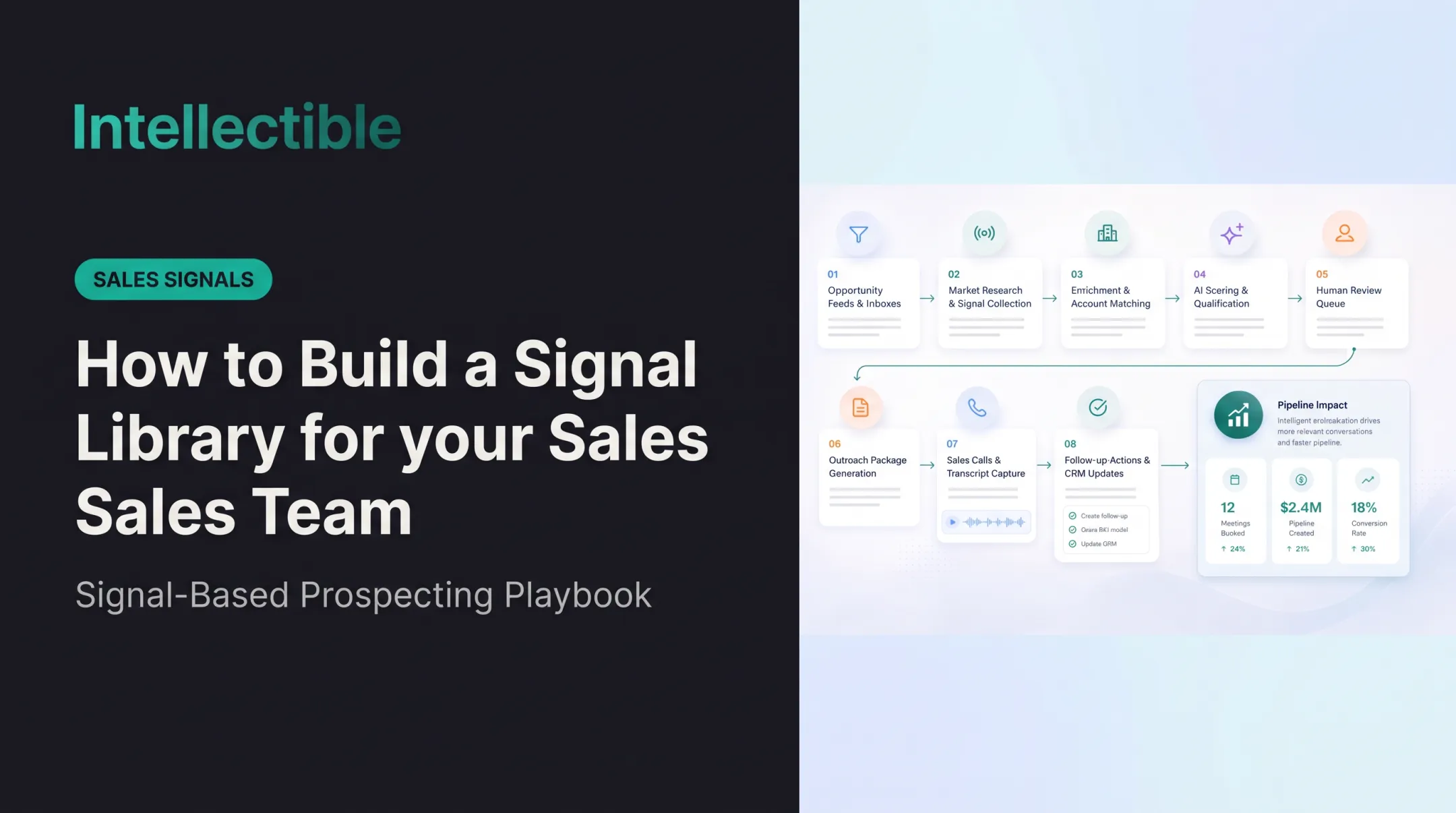
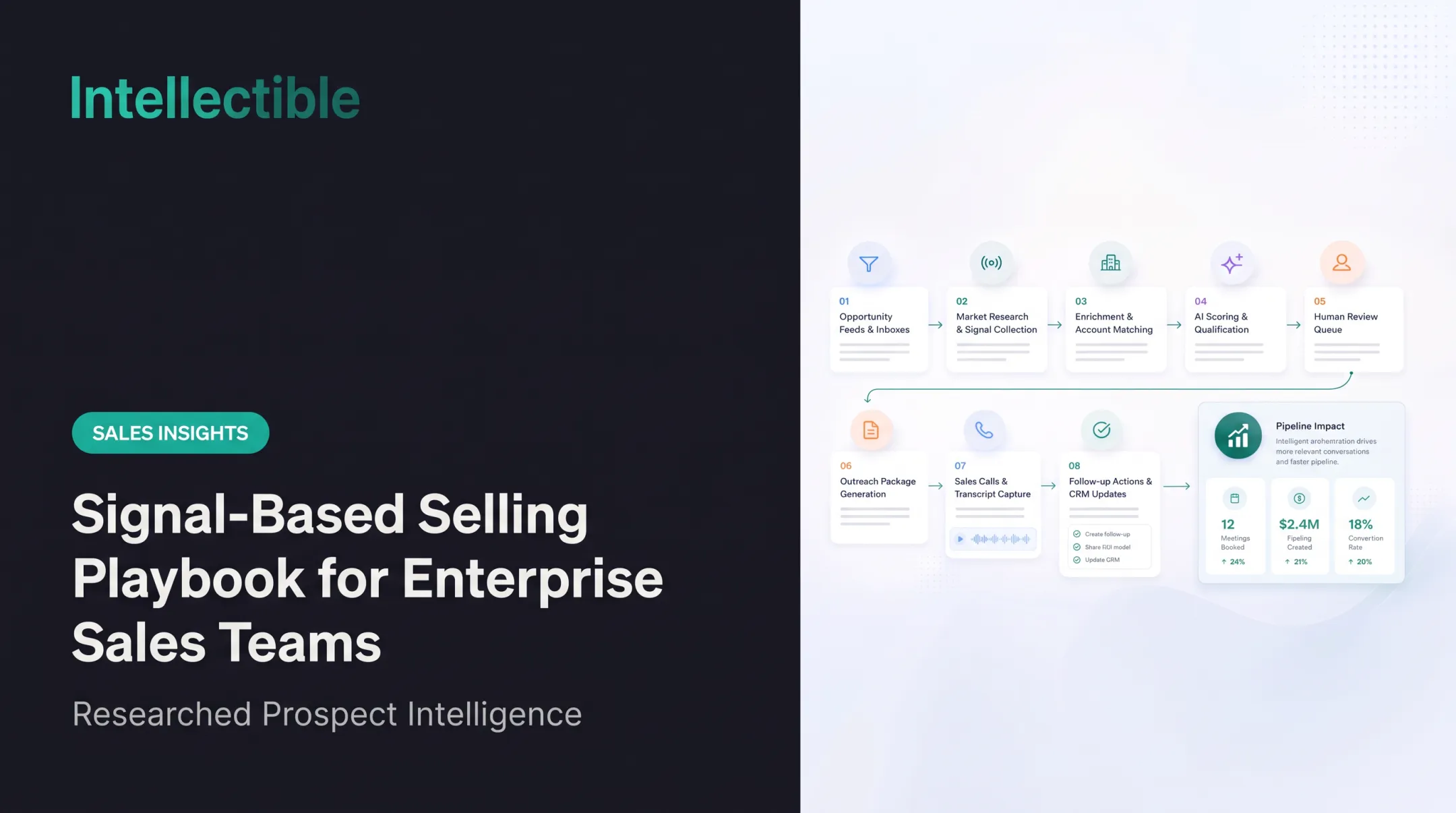
Operational bottlenecks tend to appear around monitoring, enrichment, scoring, review, and routing. Intellectible, a horizontal AI build platform, handles this with Revenue Discovery.
Its sequence runs Detect, Gate, Promote, Draft, Approve, Call, Qualified, with four human approval gates. It drafts everything and sends nothing, with no bulk email, LinkedIn automation, or automatic CRM writes.

When Should You Use Buying-Signal Outreach?
Apply eligibility gates before priority: serviceable geography, correct entity, relevant need, delivery fit, account ownership, and an open decision window. Distinguish observed facts from inferred needs. A company announcement can establish a new site; whether that site needs your service remains a hypothesis for qualification.
Good use cases:
- New decision-makers
- Hiring tied to a specific initiative
- Funding or expansion
- Technology migrations
- Competitor dissatisfaction
- Public statements about a pain point
- Proposal or pricing activity
- First-party evaluation behavior
Industry-specific tells work too. Examples include review pain across several locations, an inspection score drop, or permits filed.
Pause when:
- The signal is weak and standalone
- The event is outdated
- ICP fit is poor
- Ownership is unclear
- The data is sensitive or personal
- Procurement or customer restrictions apply
- Your team can't respond quickly or support the conversation you're promising
What You Need Before Outreach and Which Variables Affect Results
System Requirements
At minimum, you need:
- A reliable CRM or account system
- Verified contact and role data
- Signal sources with timestamps and provenance
- A place to capture the signal summary
- A workflow that routes qualified alerts to an owner
Inputs and Conditions
Before anything goes out, confirm:
- Account fit
- Business change, affected function, and likely consequence
- Source URL
- Contact history and open opportunity status
- Intended meeting outcome
Compliance and Human Review
Human review matters. So does compliance:
- CAN-SPAM applies to B2B email, per the FTC guide. It requires accurate headers, honest subject lines, a postal address, and a clear opt-out honored within 10 business days.
- TCPA consent rules vary by technology and destination for calls and texts. Check the rule against your actual campaign.
- California privacy law no longer exempts B2B contact data automatically.
- LinkedIn prohibits scraping and unauthorized automation.
Never expose private behavioral data in a message. Confirm the details with counsel.
Signal freshness and decay
Intent value can decay rapidly, but no authoritative universal interval exists. Avoid canned 7-, 30-, or 90-day rules. Instead, pull your own history, measure how long each signal type stays predictive, and set windows from that.
Suppress signals that are stale, resolved, duplicated, or contradicted before they trigger outreach.
Signal strength, ICP fit, and stacking
A strong signal is a direct event with clear business relevance, such as a new pricing lead at a fit account. A weak one is general hiring or a social like.
Stack only independent evidence. A funding press release and a news article about the same round count once. A funding round plus a relevant job posting is a real stack.

Stacking should raise priority, not license claims like "I know you're evaluating vendors."
Personalization depth and meeting ask
Personalize around business context, role, and likely outcome, and stay short enough to be read in seconds.
Compare the asks:
- Premature pitch or generic calendar link: high friction, little reason to answer
- Diagnostic question: easy to answer, reveals fit
- Resource offer: works when the prospect is early
- Referral request: works when ownership is unclear
Use a resource or question first. Ask for the meeting once there's engagement.
Common Mistakes, Troubleshooting, and Alternatives
Common Mistakes
Four patterns sink most programs:
- Acting on a weak signal without checking fit
- Sending after the signal has gone stale
- Using the same copy for every signal type
- Automating without human review or suppression rules
Trust erodes when you reveal private website behavior, overclaim what a signal means, or mention a competitor with no public evidence. Replies get thinner and less honest.
Track qualified meetings and downstream pipeline. Opens are unreliable: Apple Mail Privacy Protection can load tracking pixels automatically.

Troubleshooting Issues While Turning Signals into Meetings
Problem 1: The team detects signals but few prospects respond
Likely causes: weak signal-to-role alignment, generic messaging, bad contact data, poor timing, or a CTA that asks too much.
What to adjust:
- Compare performance by signal type and buyer role
- Review actual message examples
- Verify evidence freshness
- Test a more relevant business question
- Randomize at the account level against a static-list holdout
Problem 2: The team receives replies but meetings are poorly qualified
Likely causes: broad ICP rules, inflated scoring, outreach to non-owners, or curiosity-driven copy disconnected from a real problem.
What to adjust:
- Tighten qualification criteria and add disqualifiers
- Route to the correct stakeholder
- State the meeting purpose plainly
- Track show rate, qualification rate, and opportunity creation
Alternatives to Signal-Based Outreach
- Manual research and founder-led outreach: best for small lists, high deal values, or signals that are hard to automate. The trade-off is rep time and poor repeatability.
- Broad firmographic sequences: workable when signal coverage is thin or the market is large and mature. Expect weaker relevance, timing, and deliverability, plus more wasted activity.
- Inbound, event-led, partner, or account-based programs: better when buyers need education or trust before a meeting. They develop slower but can carry stronger relationship context. Gartner found 61% of buyers prefer a rep-free experience, so self-serve content supports all of these routes.
Conclusion
A buying signal creates an opportunity for relevance. It isn't permission to send an unverified pitch. The best results combine signal evidence with account fit, buyer ownership, timing, and a useful reason to talk.
The operating loop is simple: detect, validate, prioritize, personalize, contact, follow up, measure, refine.
Get the balance right between speed, accuracy, privacy, human judgment, and meeting quality, and the signals start turning into conversations worth having.
Frequently Asked Questions
What belongs in a signal-based selling process?
Signal-based selling is a team process. For a $20M–$500M company with a sales organization, begin with the market, service offer, buying roles, and six signal families. Give each signal a definition, source, evidence standard, freshness rule, disqualifier, and owner. A tool cannot compensate for unclear eligibility or an unowned follow-up process.
Which eligibility gates come before outreach?
Apply eligibility gates before priority: serviceable geography, correct entity, relevant need, delivery fit, account ownership, and an open decision window. Distinguish observed facts from inferred needs. A company announcement can establish a new site; whether that site needs your service remains a hypothesis for qualification.
How should account queues work?
Separate the work into contact-now, research-needed, nurture, and monitor queues. Define what moves an account between queues and who approves the decision. Uncertain entity matches, missing dates, and unclear commercial relevance belong in research, not automatically in a sales sequence.
What should a seller action package include?
Prepare an action package for every promoted account: evidence links, event date, fit rationale, likely decision-maker, what remains unknown, a suggested outreach angle, and a next step. Draft the email or call brief around the account change, then require human review rather than treating an automated draft as permission to send.
How should signals connect to CRM work?
Use CRM ownership, duplicate checks, task deadlines, and feedback to coordinate the team. A signal record should retain its source and decision history when promoted to an account, meeting, or opportunity. Rejected and deferred accounts also need reasons, so the research process learns from seller decisions.
How should the program be measured?
Measure the full chain: signals reviewed, eligible accounts, rep acceptance, time to first touch, meetings, sales-accepted opportunities, and sourced pipeline. Compare by signal family and segment. This operating loop is the playbook; alert volume, automated emails, and a new platform licence are inputs rather than business outcomes.